Sunday, March 8, 2009

Teylers Museum (Est. 1784); Haarlem, The Netherlands


While in The Netherlands for a recent conference, I made a special trip with my friend Eric to Teylers Museum in Haarlem, a small town on the outskirts of Amsterdam.

Virtually unchanged since it was opened to the public in 1784, Teylers Museum is a remarkable, nearly untouched early collection both in content and in its archaic Wunderkammer-esque display. The museum presents, with palpable joie de vivre, a series of wonders ancient and modern as seen through the eyes of the 18th century--naturalia and artificialia, fossils and telescopes, optical toys and comparative telegraph cables, automata and minerals, models and bird eggs, paintings and scientific glassware--all housed beneath lofty sculpted and glass-vaulted ceilings, and presented in handsome wood-and-glass cases or ancient bell jars. Later 19th century additions, such as The Kaiser Panorama--an enormous, automated stereoscopic viewer with multiple viewers and rotating slides (which still works!)--and the potted-palm dotted and salon-hung picture gallery only heighten the feeling of stepping back in time. The museum also boasts an excellent shop, featuring an assortment of well-illustrated museum publications, some produced in conjunction with the wonderful Museum Dr. Guislain (with whom they seem to have a sort of partnership).

Here is some historical information about the museum, edited down from its Wikipedia entry:

The museum was once the home and collection of Pieter Teyler van der Hulst (1702–1778), a wealthy cloth merchant and Amsterdam banker of Scottish descent, who bequeathed his fortune for the advancement of art and science. Teylers Museum displays an eclectic collection of fossils (among which the first ever discovered, if not recognised, of Archaeopteryx), minerals, scientific instruments, medals, coins, and paintings. It is most famous for its extensive collection of old master's prints and drawings, including several works by Michelangelo and Rembrandt. The various objects reflect the interests of 18th century wealthy men like Pieter Teyler who kept 'rariteiten kabinetten' or curiosity cabinets...

The history of the Teyler's collection is almost as interesting as the collection itself. As curiosity cabinets fell out of fashion, the museum was granted objects from former summer estates in the Haarlem area. For example, many of the fossils come from a collection of one of the former owners of Groenendaal. Many of the medals and coins come from the former Johan Enschede mint, which was just around the corner.

In the 19th century, the museum was expanded with two Painting Galleries. The Teyler Museum contains of a collection of more than 10,000 master drawings and some 25,000 prints.
If you are ever in the Amsterdam area, I highly recommend making a special trip to this often-overlooked gem. You can visit the museum website here. To visit the online museum shop, click here. To visit the full set of images (and to read more about them!) click here. And to view the Wikipedia entry for the museum, click here.

Thursday, March 5, 2009

Tea in the Morbid Anatomy Library, Friday, March 6, 4-6


If any of you readers out there are planning to be in the Brooklyn, New York vicinity tomorrow (Friday, March 6) and have a bit of time to spare, why not pop into the Morbid Anatomy Library for a leisurely perusal of the stacks and a fine cup of tea?

Morbid Anatomy Library Friday Tea
March 6th, 2009
4-6 PM
543 Union Street (at Nevins), Brooklyn, New York (Gowanus District)
Buzzer 1E or enter through Proteus Gowanus Interdisciplinary Gallery and Reading Room

Directions:
R or M train to Union Street in Brooklyn:
Walk two long blocks on Union (towards the Gowanus Canal) to Nevins Street. 543 Union Street is the large red brick building on right. Buzz 1E or follow signs to Proteus Gowanus.

F or G train to Carroll Street: Walk one block to Union. Turn right, walk two long blocks on Union towards the Gowanus Canal, cross the bridge. 543 Union will be on your left. Buzz 1E or follow signs to Proteus Gowanus.

Hope to make this more of a regular thing as my schedule solidifies... and hope to see you there! Email me at morbidanatomy@gmail.com with any questions.

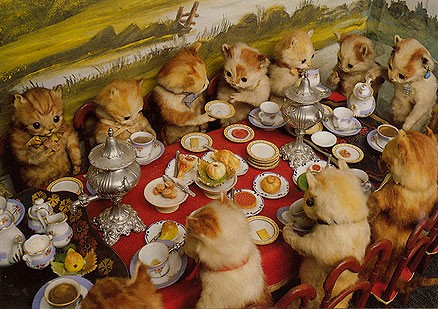
Image: Kitten's Tea Party by Walter Potter. Dates from around 1871.Victorian Mount. More info here.

"Marked," Pathological Portraiture, Late 19th/Early 20th C


Wonderful pathological illustrations (with no citations) from an entry entitled "Marked" on The Mouth and the Knife blog.

Wednesday, March 4, 2009

Seeking Holders of Private Cabinets/Call For Artworks!


As some of you already know, I am working on a project wherein I will be photographing "private cabinets" (see above)--idiosyncratic museum-like collections owned and displayed by individuals rather than institutions and housed in apartments, homes, and studies around the United States and England. It is my conviction that many of the best artifacts and collections now reside, as in the days of the Wunderkammer, in the private rather than the public realm; it is my goal with this project to document and make visible these fantastic collections as a sort of virtual Grand Tour. The resulting photographs will form the basis of an upcoming exhibition at Barrister's Gallery in New Orleans.

I am presently seeking to finalize a list of collectors in the greater New York, Washington D.C., and Los Angeles areas to visit and photograph. If anyone in these areas has any collections that might fit the bill (see this previous post for more information), or knows of any other collections that might, I would love to hear from you; you can email me at morbidanatomy@gmail.com.

For the same exhibition, I am also seeking a variety of artworks to accompany the photographs in a sort of private-cabinet installation of its own; see below for a full description:

The Morbid Anatomy Cabinet Call for Works
Barrister's Gallery
May 9th-June 6th
Opening Reception Saturday May 9th from 6-9
Curated by Joanna Ebenstein

Andy Barrister and I are putting together a "Morbid Anatomy Cabinet" at Barrister's Gallery in New Orleans. The "Cabinet" will consist of a clutter of objects and flatworks to supplement a collection of my photographs (see above) of privately held "personal cabinets"--idiosyncratic museum-like collections owned by individuals rather than institutions and housed in apartments, homes, and studies around the United States and England. Objects, artifacts, installation, and other 3-D works are especially of interest, though flat works are also acceptable.

To get a sense of the kind of work we are seeking to fill our cabinet with, just poke around this blog for a few minutes. If you need further clarification, here are some adjectives: anatomical, 19th Century, hysteria, specimens, natural history, unnatural history, teratology, art/science, reliquaries, old science, phrenology, taxidermy, taxonomy, the encyclopedic impulse, waxworks, antiquated forms of seeing and showing, magic lanterns, panorama, diorama, curious objects, bones, bell jars, the melancholy, things in jars, the "pathological sublime," antiquated photographic methods, Wunderkammer, devices of wonder, exotica, the sacred/profane, ephemera, memento mori... You get the idea.

All work must be ready for exhibition purposes—sculptural work may require a pedestal, and smaller works should have glass enclosures when practical.

You may submit jpegs of work to both of us and we will exercise a certain amount of curatorial judgment on the execution and appropriateness of the works. Conceptual projects should be detailed out. No work will be accepted after Saturday, April 25th.

If you are interested in submitting work, or have any suggestions or questions, please email me at morbidanatomy@gmail.com. The same goes if you are a collector or know of a collector I might want to contact.

Thanks so much!

“Anatomy in the Gallery,” International Museum of Surgical Science in Chicago, Call for Submissions


I just received a most exciting email from Lindsey Thieman, Manager of Exhibits & Programs at the International Museum of Surgical Science in Chicago. Seems they are putting out a call for proposals for their ongoing “Anatomy in the Gallery" exhibition program, which seeks to showcase contemporary art dealing with medicine. Here are the details:
“Anatomy in the Gallery,” a rotating exhibition program at the International Museum of Surgical Science in Chicago, showcases medically themed contemporary art within the unique context of the Museum’s historical collections and exhibits. The program was begun in 1998 to help fulfill the Museum’s mission of enriching its visitors’ lives by enhancing their knowledge and understanding of surgery and related sciences. “Anatomy in the Gallery” is will be accepting proposals for its 2010 exhibition calendar until April 17, 2009. The medical theme is open to interpretation, but figure studies without additional medical content do not qualify. For complete submission and exhibition details, click here. Contact Lindsey@imss.org with questions.
For more about the program and how to apply, click here; For information about previous “Anatomy in the Gallery" exhibitions, click here; To find out more about the International Museum of Surgical Sciences, click here.

Thanks, Lindsey, for sending this along!

Tuesday, March 3, 2009

More Behind the Scenes of "Brought To Life"


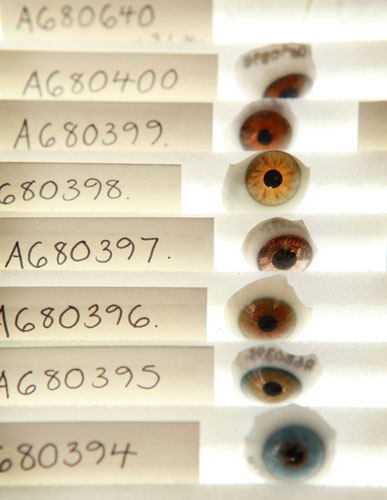
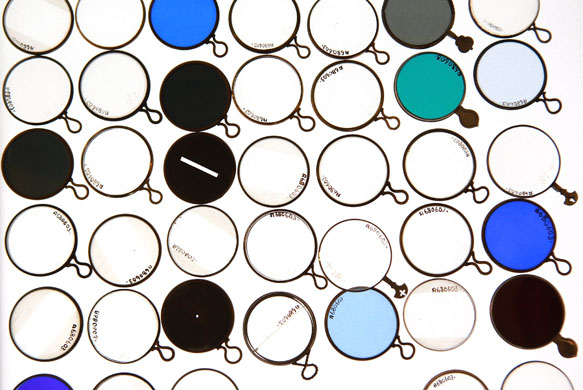
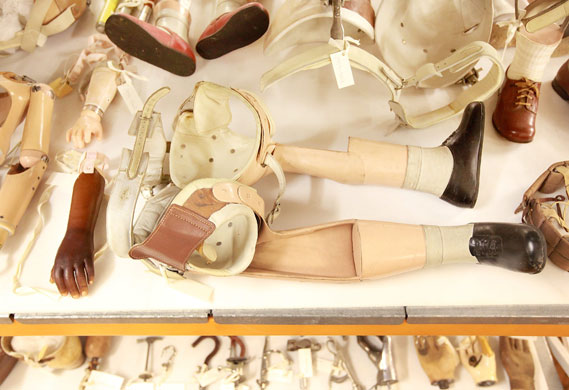
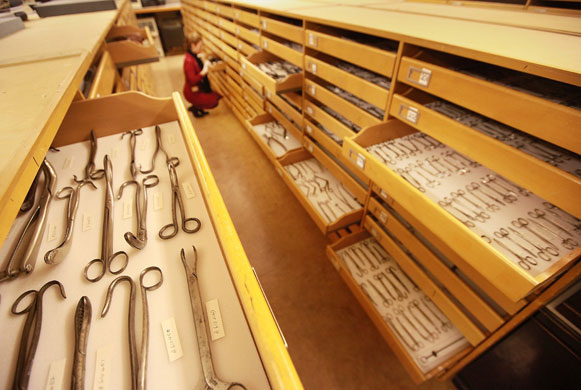
More (see recent post) behind the scenes photos of the archives where many of the wonderful objects featured in the Science Museum of London's "Brought to Life: Exploring the History of Medicine" spend most of their time.

All photos from The Telegraph's "Science Museum Object Store: Brought to Life: Exploring the History of Medicine" on-line slide show--click here to see full collection; Click here to visit the "Brought to Life" online exhibition. For more on this topic, see these (1, 2, 3, 4) recent posts.

Thanks, Lisa (see bottom photo!) for sending this along.

"Anatomically Correct: Medical Illustrations, 1543–2008" Exhibition


My friend Marie Dauenheimer just brought the upcoming exhibition "Anatomically Correct," a survey of medical illustration from 1543 to the present, to my attention. The show will be on view at "The Benton" (aka The William Benton Museum of Art) at The University of Connecticut from March 17 until May 1oth. It is really wonderful to see the explosion of interest in medical illustration and artworks over the past few years as exemplified by shows such as this one.

Full details:
March 17 – May 10
Anatomically Correct: Medical Illustrations, 1543–2008

The Benton’s contribution to the University-wide “Year of Science 2009” celebration is an exhibition that chronicles the history of medical illustration through a selection of prints, drawings, computer graphics and animation from the 16th century to the present. Each piece articulates a unique union of art, anatomy and medicine, the works together reflecting the ways that union has evolved over the centuries and continues to thrive in an era of digital photography and 3-D imaging.

The works in Anatomically Correct come out of a pictorial tradition that was set in motion by the Belgian anatomist Andreas Vesalius (1514–1564). He conducted his dissections firsthand, breaking away from the longstanding authority of classical texts by relying on direct observation. He similarly reformed scientific illustration by insisting upon anatomical accuracy and precision for the plates in his pivotal work, De Humani Corporis Fabrica (On the Fabric of the Human Body) of 1543. These illustrations by the artist John Van Calcar divided the field of scientific illustration into “pre-Vesalian” and “post-Vesalian” periods. With Vesalius’s brilliant integration of image and text, illustration began to serve a crucial function in the communication of scientific information, initiating the role of scientific illustration as a record of the progress of science in general.

Along with Vesalius’s contributions, Anatomically Correct highlights significant post-Vesalian developments that carried his vision into the present. Illustrations from William Hunter’s The Anatomy of the Human Gravid Uterus (1774) played a vital role in establishing obstetrics as a field of medicine rather than a practice of midwives. A major advancement in print technology is represented by color lithography in Jean Marc Bourgery’s Atlas of Anatomy (1831–1854). A shift in the role of illustration from works of art in themselves to didactic tools can be seen in Henry Gray’s Anatomy: Descriptive and Surgical (1858), and the increased role of the computer in contemporary illustration is evidenced in the 3-D animation of the Connecticut-based XVIVO studio.

In a discipline we associate with objectivity and empiricism, the works in the exhibition consistently reveal themselves to be products of their respective social climates. Ideological and social conventions inevitably come through in the illustrations as anatomists and artist catered to their audience’s desire to see the body represented morally, socially, theologically.

Anatomically Correct commemorates the 200th anniversary of Charles Darwin’s birth. The exhibition is particularly relevant to this moment of celebration as a reflection on the advancement in the field of anatomy as a basis for the theory of evolution and as an acknowledgement of the role of art as critical to the way these advancements were visualized.

Exhibition curated by Eve Perry, M.A. candidate, Art History, 2009.
For more information, visit "The Benton" exhibition website by clicking here.

Thanks so much, Marie, for sending this along!

Images: Top: Andreas Vesalius (1514–1564), Skeleton Contemplating a Skull from De Humani Corporis Fabrica, 1543. Lent by the Hartford Medical Society. Bottom: The Form of the Thorax..., color lithograph from Joseph Maclise, Surgical Anatomy, Philadelphia, 1851. Hartford Medical Library.

Behind The Scenes of The Science Museum's Medical History Collection


Rare and unseen items from the Science Museum's object store, from the Gaurdian.co.uk slideshow. Copy reads: "Many objects in the Wellcome Trust collection, held by the Science Museum, will be on view for the first time in the museum's new multimedia resource "Brought to Life: Exploring the History of Medicine."

Click here to see full slide-show and find out more about the images. For more on "Brought to Life: Exploring the History of Medicine," see these recent posts: 1, 2, 3. To visit the "Brought to Life" web exhibition, click here. For more visual exploration of the back room of the Wellcome Trust, see the Brothers Quay's "Phantom Museum."

Thanks to Lisa O'Sullivan, Senior Curator of Medicine at the Science Museum, for the tip! And congratulations on the fantastic website.

Monday, March 2, 2009

"Confronting Mortality with Art And Science" Book Release Party and Film Screening, TONIGHT!


Snow or no, hope you can make it tonight! More details here.

Perhaps this is a good moment, also, to announce the launch of the new space in which tonight's event will take place. "Observatory" (as we are calling it) is a collaborative lecture/gallery/classroom/event space sandwiched between Proteus Gowanus Interdisciplinary Gallery and Reading Room, Cabinet Magazine, and the Morbid Anatomy library, all housed in a re-purposed turn-of-the-century box factory located at Union and Nevins in the Gowanus district of Brooklyn, New York. The collaborators include myself, animator/illustrator/musician G. F. Newland, Michelle Enemark and Dylan Thuras of the Curious Expeditions blog, Pam Grossman of Phantasmaphile, Herbert Pfostl of Blind Pony Books and Paper Graveyard, and video and book artist James Walsh. More on Observatory, and its many upcoming workshop, symposia, events and spectacles to come!

"Brought to Life" Project Brought to Life!


There are so many arresting wonders to be found on the Science Museum of London's newly launched (as of today!) web exhibit "Brought to Life: Exploring the History of Medicine" that I hardly know where to begin (and don't want to tear myself away for too long to write this post.) Suffice it to say, this easy-to-navigate, attractive, crammed-with-amazing-images website could easily occupy you for hours, if not weeks. Each of the 2,500 objects is interpreted with thorough-yet-concise text entries, and a handy feature suggests like-spirited images. You can peruse by material or technology, chronology, people, or theme or use the search function if you are seeking a particular kind of object.

Above are just a very few of my hasty-first-perusal favorites. Many more to come (I have just barely begun to explore), but I HIGHLY suggest you visit the website yourself and do some perusing of your own! But maybe not if you have anything else you need to accomplish today....

Click here to visit the "Brought to Life" website. Click here (1, 2) for recent posts on the same topic. For more on the fascinating Henry Wellcome and his collection (which is featured in "Brought to Life"), see this recent post.

All images © The Science Museum; Click on images to see larger versions.

Wednesday, February 25, 2009

More from The Science Museum of London's "Brought to Life" Website


More (see recent post!) artifacts to be featured on the Science Museum of London's "Brought to Life: Exploring the History of Medicine" website, due to launch in just days! (March 2nd, to be exact).

So, what do we have here? From the item description:
Set of nine wax plaques showing foetal development and dissection views of a female figure, Europe, 1801-1830

This series of nine wax plaques shows both the development of a foetus during pregnancy and anatomical details from the dissection of a young female figure who is pregnant in a number of the images.

Top to bottom: Female figure, deep dissection to show kidneys, uterus, etc.; Female figure, part of skin and wall of uterus removed showing foetus in utero; Foetus in placenta in utero.
For more on the "Brought to Life" project--with pictures!--click here. For more on the Science Museum's astounding history of medicine collection, click here. To count down the days until the website launches, visit the official website here.

All images © The Science Museum

Pedagogical Posters, 19th C, Maison Deyrolle, Paris


A really nice gif animation of a variety of pedagogical posters from the recently fire-damaged (see recent post) Maison Deyrolle, via Mapping the Marvelous.

Monday, February 23, 2009

"Fantasie Macabres," Paolo Vincenzo Bonomini (1757-1839)


One wonderful artist I discovered in the recently gushed about book Death and Resurrection in Art (Guide to Imagery) is Paolo Vincenzo Bonomini, also known by the last name of Borromini. I have found precious little about the artist in English; the "translate" function applied to the Italian Wikipedia entry reveals (to the best of my deciphering...) that he was an Italian artist who decorated many civic and religious buildings and is best known for his "Fantasie Macabres," a series of scenes depicting living skeletons (see above), which was commissioned by a parish in Bergamo, his hometown. He produced 6 paintings as part of the series, many of them featuring recognizable caricatures of well-known townsfolk; another (guess which?) serves as a skeletal self-portrait. They are housed in the church of Santa Grata Inter Vites di Borgo Canale.

Top two photos found here. Bottom image found here.

Images, from top to bottom: Il pittore; Il tamburino della Cisalpina; Il carpentiere.

Evanion Collection, 19th C Ephemera Collection by Conjuror and Ventriloquist Henry Evans (1832?-1905)


Check out these wonderful posters, found on the livejournal Dark Victoria (found via Apuntes Críticos).

Here is what they have to tell us about the collection:
Evanion collection
Evanion collection: In 1895 the British Museum purchased a rich and fascinating collection of 19th century ephemera formed by Henry Evans (1832?-1905), a conjuror and ventriloquist, who performed under the stage name "Evanion". During the course of a long career, he took every opportunity to amass a large collection of material relating to Victorian entertainment and everyday life. Harry Houdini, who described the collection as "full of priceless treasures", later acquired many of the items relating to magic. These are now in the possession of the Harry Ransom Humanities Research Center at the University of Texas at Austin.
The British Library owns approximately 5,000 items from Evanion's collection. These fall into two main categories – popular entertainment, and everyday life - and include posters, advertisements, trade cards and catalogues.
This is just a selection of my favorite posters; visit Dark Victoria to see the entire collection. Really wonderful images of early spectacle! (Click on images to see larger versions!)