Wednesday, November 2, 2011

"Deadly Medicine: Creating the Master Race" Exhibition and Symposium, Museum of Jewish Heritage, NYC, Through January 16


I have long been enthralled with the chilling Deadly Medicine: Creating the Master Race, a catalog for a touring exhibition of the same name organized by the United States Holocaust Memorial Museum. I have just found out that this exhibition is now on view right here in New York City, at the Museum of Jewish Heritage, through January 16th. If the catalog is any indication, this exhibit is simply not to be missed.

As a further lure, this Sunday, November 6th, the museum is hosting a fascinating looking symposium entitled "Medicine and Medical Ethics in Nazi Germany" preceded by a guided tour of the exhibition.

Full info follows for both exhibition and symposium; hope very much to see you there!
Deadly Medicine: Creating the Master Race
On view through January 16, 2012
Museum of Jewish Heritage
36 Battery Place, New York City

“Nazism is applied biology.”
— Rudolf Hess, Deputy to Adolf Hitler

WASHINGTON, D.C. — The United States Holocaust Memorial Museum’s traveling exhibition, Deadly Medicine: Creating the Master Race, examines how the Nazi leadership, in collaboration with individuals in professions traditionally charged with healing and the public good, used science to help legitimize persecution, murder and, ultimately, genocide...

Eugenics theory sprang from turn-of-the-century scientific beliefs asserting that Charles Darwin’s theories of “survival of the fittest” could be applied to humans. Supporters, spanning the globe and political spectrum, believed that through careful controls on marriage and reproduction, a nation’s genetic health could be improved.

The Nazi regime was founded upon the conviction that “inferior” races and individuals had to be eliminated from German society so that the fittest “Aryans” could thrive. The Nazi state fully committed itself to implementing a uniquely racist and antisemitic variation of eugenics to “scientifically” build what it considered to be a “superior race.” By the end of World War II, six million Jews had been murdered. Millions of others also became victims of persecution and murder through Nazi “racial hygiene” programs designed to cleanse Germany of “biological threats” to the nation’s “health,” including “foreign-blooded” Roma and Sinti (Gypsies), persons diagnosed as “hereditarily ill,” and homosexuals. In German-occupied territories, Poles and others belonging to ethnic groups deemed “inferior” were also murdered...
And the symposium:
Medicine and Medical Ethics in Nazi Germany
Sunday, November 6, 1 P.M.
Prof. Sander Gilman, Emory University; and Prof. Arthur Caplan, University of Pennsylvania; moderated by Museum Director Dr. David G. Marwell

Lectures by Prof. Gilman, a cultural historian who has written on Nazi science, and Prof. Caplan, a leading scholar in the field of medical ethics, will be followed by a conversation about the origins and legacies of Nazi medical practices.

$10, $7 students/seniors, $5 members

Co-presented by FASPE (Fellowships at Auschwitz for the Study of Professional Ethics). mjhnyc.org/faspe

This program has been made possible by a generous grant from the Conference on Jewish Material Claims Against Germany: Rabbi Israel Miller Fund for Shoah Research, Documentation and Education.

Presented in conjunction with Deadly Medicine: Creating the Master Race. Tour the exhibition at 12 P.M. Space is limited and pre-registration is required. Call 646.437.4202.
You can find out more about the exhibition by clicking here and more about the symposium by clicking here. You can watch an exhibition overview video by clicking here. You can order a copy of the fantastic catalog by clicking here, or peruse it anytime in The Morbid Anatomy Library.

Images top to bottom:
  1. International Hygiene Exhibition, 1911 promotional poster: The eugenics movement pre-dated Nazi Germany. A 1911 exhibition at the German Hygiene Museum in Dresden included a display on human heredity and ideas to improve it. The exhibition poster features the Enlightenment’s all-seeing eye of God, adapted from the ancient Egyptian “Eye of Ra,” symbolizing fitness or health. Credit: Deutsches Historisches Museum, Berlin
  2. Students at the Berlin School for the Blind examine racial head models circa 1935. Students were taught Gregor Mendel’s principles of inheritance and the purported application of those laws to human heredity and principles of race. During the Third Reich, German born deaf or blind, like those born with mental illnesses or disabilities, were urged to submit to compulsory sterilization as a civic duty. Credit: Blinden-Museum an der Johann-August-Zeune-Schule fur Blinde, Berlin
  3. Head shots showing various racial types. Most western anthropologists classified people into “races” based on physical traits such as head size and eye, hair and skin color. This classification was developed by Eugen Fischer and published in the 1921 and 1923 editions of Foundations of Human Genetics and Racial Hygiene. Credit: United States Holocaust Memorial Museum
  4. Nazi officials at the “The Miracle of Life” exhibition, German Hygiene Museum, Dresden, 1935. The new Nazi museum leadership asserted that societies resembled organisms that followed the lead of their brains. The most logical social structure was one that saw society as a collective unit, literally a body guided by a strong leader. Credit: National Archives and Records Administration
  5. The head of a Jewish youth was sculpted from wood by the Jewish artist M. Winiarski for German officials in the occupied Polish city of Lodz. Credit: Zydowski Instytut Historyczny, Instytut Naukowo-Badawyczy, Warsaw

Anthropomorphic Mouse Taxidermy Class with Susan Jeiven: Back by Popular Demand, November 15th and 29th


I have some very exciting news! Observatory's perennially sold out Anthropomorphic Mouse Taxidermy Class with Susan Jeiven is back for 2 newly announced classes this November, one on Tuesday the 15th and the other on Tuesday the 29th. For those as-of-yet unfamiliar with Sue's work or the history of anthropomorphic taxidermy, check out the video profile of Sue above, compliments of the always amazing Midnight Archive.

Full details follow for the classes follow; if interested, please RSVP to morbidanatomy [at] gmail.com making sure to specify which date you would like to attend. And these classes are VERY popular and tend to sell out fast, so please RSVP as quickly as possible to secure a slot!
Anthropomorphic Mouse Taxidermy Class with Susan Jeiven: Back by Popular Demand
Date: Tuesdays November 15th and November 29th
Time: 7 PM-11 PM
Admission: $60
Presented by Morbid Anatomy
***MUST RSVP to
morbidanatomy [at] gmail.com; Class size limited to 15

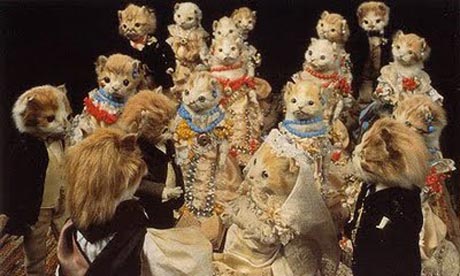
Anthropomorphic taxidermy--the practice of mounting and displaying taxidermied animals as if they were humans or engaged in human activities--was a popular art form during the Victorian and Edwardian eras. The best known practitioner of the art form is British taxidermist Walter Potter who displayed his pieces--which included such elaborate tableaux as The Death of Cock Robin, The Kitten Wedding, and The Kitten Tea Party--in his own museum of curiosities.

On Tuesdays November 15th and 29th, please join Morbid Anatomy and taxidermist, tattoo artist and educator Susan Jeiven for a beginners class in anthropomorphic taxidermy. All materials--including a mouse for each student--will be provided, and each class member will leave at the end of the day with their own anthropomorphic taxidermied mouse. Students are invited to bring any miniature items with which they might like to dress or decorate their new friend; some props and miniature clothing will also be provided by the teacher. A wide variety of sizes and colors of mice will be available.

No former taxidermy experience is required.

Also, some technical notes:

  • We use NO harsh or dangerous chemicals.
  • Everyone will be provided with gloves.
  • All animals are disease free.
  • Although there will not be a lot of blood or gore, a strong constitution is necessary; taxidermy is not for everyone.
  • All animals were already dead, nothing was killed for this class. All mice used are feeder animals for snakes and lizards and would literally be discarded if not sold.
  • Please do not bring any dead animals with you to the clas

You can contact Sue with any more questions by clicking here.

You can find out more about both classes by clicking here. You can find out more about The Midnight Archive by clicking here. And again, if interested, please RSVP to morbidanatomy [at] gmail.com making sure to specify which date you would like to attend. Also, please click on image to see much larger version.

Tuesday, November 1, 2011

Grand Guignol Spectacular: Call for Pieces, Volunteering Opportunities, Save the Date and More!


The Grand Guignol--posters from which you see above--was a Parisian theatre infamous in the late nineteenth and early twentieth centuries for theatrical productions merging horror and elegance, sex and death, fear and humor. To celebrate my 40th birthday, my very talented friend John Del Gaudio and I are putting together a Grand Guignol-inspired variety show and masquerade after-party on December 10th of this year that will be co-presented by Atlas Obscura and The Coney Island Museum and will take place at the latter.

We have just launched an IndieGoGo campaign to raise money for the production, with which we hope to pay participants a modest honorarium for their materials and labor. If you are interested in helping support this laudable endeavor, you can visit our campaign online (and contribute!) by clicking here.

To get inspired, check out our image- and video-rich Grand Guignol mood board (be sure to scroll down and click on thumbnails to see larger images) by clicking here. To learn more about The Grand Guignol, make sure to attend Mel Gordon's absinthe-sponsored lecture on the topic at Observatory next Friday, November 11th! More on that can be found here.

Also, if anyone is interested in pitching a short piece for inclusion, or volunteering their time for costumes, props, acting, etc, please email me at morbidanatomy [at] gmail.com.

Thanks! And whether you can contribute or not, mark your calendars! I promise this will be a great party; more on that as it develops.

Full text for the call-for-funds follows:
Join our band of curios and support the Grand Guignol Variety Hour at Coney Island Museum on Saturday, December 10th.

THE INSPIRATION
From its beginnings in turn-of-the-century Paris and through its decline in the 1960s, the Theatre of the Grand Guignol gleefully celebrated horror, sex, and fear. Its infamous productions featured innocent victims, mangled beauty, insanity, mutilation, humour, sex, and monstrous depravity in a heady mix that attracted throngs of thrill-seekers from all echelons of society. By dissecting primal taboos in an unprecedentedly graphic manner, the Grand Guignol became the progenitor of all the blood-spilling, eye-gouging, and limb-hacking “splatter” movies of today.

THE PROJECT
Presented by Atlas Obscura, Coney Island Museum, and Morbid Anatomy, our event will be a one-night-only ode to The Grand Guignol and its legacy. Our evening of variety theatre will be dedicated to such Guignol-esque and fin de siècle pleasures as the uncanny; spectacular illusions; sex and death, elegance and horror; tableau vivants; occult tinged magic shows; phantasmagoria; hysteria; contortionists; toy theatre; puppets; optical tricks and much more!

Participating artists include Lord Whimsy, Jonny Clockworks, Ronni Thomas, Doll Parts, GF Newland, Sarah Shoerman, Angela Di Carlo and Kathleen Kennedy Tobin, with a special set to be designed by NYU’s Chris Muller. Projects include a toy theater version of Bryusov’s “The Sisters,” a harmonious and creepy rendition of “Dry Bones,” an installation of classic Grand Guignol posters, magic lanterns, horrific film montages, and stagings of classic French and London Grand Guignol plays, all followed by an after-party with records on the victrola and cocktails courtesy of Hendrick’s Gin.

THE NEED
Your donation will go directly to the artists involved, providing them with a small honorarium and production budget for their piece. All donors will receive advance word about buying tickets to the event. There’s a limited capacity so to guarantee yourself a ticket, consider giving at least $100.

PERKS
$20 Contribution
Listing in program with your fellow horror afficionados, advance word on ticket sales to the event.

$100 Contribution
One ticket to the event on December 10th, listing in program

$500 Contribution
Two tickets to the event on December 10th with reserved seats, an old-timey shout out during the show and listing in program
Pledge your support now and get ready to geek out with us.

Joanna Ebenstein & John Del Gaudio
Co-Curators
To find out more and to contribute (thank you!), please click here.

Monday, October 31, 2011

Morbid Anatomy Mummification Class on Time Magazine's Website!


More video documentation of our extremely popular mummification class at Observatory, this time from Time Magazine's website. And, of course, just in time for Halloween!

Please note: our next mummification class taking place this Sunday, November 6th, has a few open slots. You can find out details by clicking here; you can RSVP for the class by emailing me at morbidanatomy [at] gmail.com. You can find out more about Observatory and the classes and lectures we offer by clicking here.

Happy Halloween From Morbid Anatomy!


All images drawn from Rip The Skull's Halloween Poscard Flickr set; you can see the entire fantastic set by clicking here.

Friday, October 28, 2011

Morbid Anatomy Library Open Hours This Saturday, October 29


This Saturday October 29th, the Morbid Anatomy Library--pictured above--will have open hours from 1 until 6 PM. So feel free to drop in for a perusal of the stacks and to meet our newest addition.

For more about the Morbid Anatomy Library and for directions and other such information, click here.

Photo of The Library by Shannon Taggart

“Metaphor as Illness,” Lecture by Mark Dery, Embodied Fantasies Conference, Sunday October 30


Mark Dery, one of my favorite all time thinkers and lecturers, will be giving a new presentation this Sunday as part of the amazing looking Embodied Fantasies Conference. Full details, drawn for his Shovelware blog, below; hope to see you there!
Live, from the Cancer Ward!
I’ll be lecturing on “Metaphor as Illness” at the School of Visual Arts this Sunday, at 1:30 P.M., in a double-header with media theorist McKenzie Wark.

Executive Summary: A personal essay—live, from the cancer ward!—that is simultaneously a philosophical investigation into the ways in which disease widens the Cartesian chasm, untethering our thought balloons from the Body in Pain.

Directions, program, list of speakers, HERE.

Teaser: During my recent hospitalization for a medical emergency—an unexpected vacation in hell, during which I had boundless hours to muse about Illness as Metaphor and The Body in Pain—I conceived the essay in question, an essay that simply had to be written, as a meditation on language, embodiment, language as embodiment, and the ontologically dislocating experience of being a patient. Drawing on my five-year tour of duty through ER’s, OR’s, and hospital wards as a cancer patient, the lecture in question combines a cultural criticism reminiscent of Sontag’s Illness as Metaphor with the mordant humor of Christopher Hitchens’s recent reports on his battle with the Big C. It’s a philosophical inquiry into the existential black comedy of being a patient—Burton’s Melancholy of Anatomy , reimagined as an episode of the cynical medical drama House.

It’s also one of the best things I’ve ever written—a closely observed, unsparingly honest, emotionally raw self-anatomization that manages, even so, to be philosophically probing, I think.
You can find out more about the conference and its schedule by clicking here.

Image: The Anatomy lesson of Dr Frederik Ruysch, Jan van Neck (lifted from Wikimedia Commons).

Morbid Anatomy Library on Fox News. Yes, Really.


A few weeks ago, Fox News (yes, THAT Fox News) sent over Red Eye host Bill Schulz and former medical examiner of New York Dr. Michael M. Baden for a little filmed visit to the Morbid Anatomy Library. In the course of our time together, we talked about phrenology, body snatching, and mummification. In addition, the very knowledgeable Dr. Baden conducted a thorough and pretty fascinating forensic examination of the newest addition to the library: an early 20th century human skeleton medical preparation, seen in the screen shot above.
You learn all about the skeleton--and watch the segment in its entirety--by clicking here.

Thursday, October 27, 2011

Exhibition: "Mechanical Wonders: The Sandoz Collection," Through November 26, 2011


This exhibit looks truly amazing! Many of the objects, I am told, come only very rarely to The United States, so make sure to take advantage of this opportunity while you can! I will absolutely be making a personal pilgrimage.
"Mechanical Wonders: The Sandoz Collection"
Presented by A La Vieille Russie and Parmigiani
October 26 – November 26, 2011

Visit ALVR this Fall to see a very special loan exhibition of intricate marvels that jump, sing and act as you never believed jeweled creations could.

Featuring early 19th century Swiss gold and enamel automaton snuff boxes, watches, magicians, and animals, the Imperial Swan Egg of 1906 and the Imperial Peacock Egg of 1908 by Fabergé, as well as contemporary interpretations by Parmigiani Fleurier of watches in the Sandoz Collection. In addition, the catalogue raisonné of the collection will be presented for the first time.

EXHIBITION HOURS (beginning October 26):
Monday through Friday 11am-6pm
Thursday 11am-7pm
Saturday 12pm-5pm
Closed for Thanksgiving Day.

Address: 781 Fifth Avenue at 59th Street
New York, NY 10022
212-752-1727
www.alvr.com
You can find out more and purchase tickets by clicking here. Thanks so much to the inspiring Jere Ryder for alerting me to this exhibition!

Amazing Auction Alert: Bonhams "Objects of the Wunderkammer including an Exceptional Private Collection of European Ivories," London


Wow. Via Artdaily.org:
LONDON.- On Wednesday 2 November, to coincide with Halloween, Bonhams will hold its first sale dedicated to the Wunderkammer, also known as the ’Kunstkammer’ or ‘cabinet of curiosities’, a collection of fine objects created from the rarest and most exquisite materials and designed to induce excitement and wonder in the viewer.

Comprising works of art ranging from ivory figures and reliefs, early and rare bronzes, fine enamels, chalices and caskets, the Wunderkammer brought together objects produced from the most expensive and highly prized materials of the day, including ivory, tortoiseshell, rhino horn, enamel and gilt bronze.

This unique, one-off sale features one hundred and thirty ivory carvings, including a very spooky South German skull (estimate £10,000 – 15,000); an eerie 17th century anatomical model of an eye (estimate £4,000 – 6,000); and a gruesome relief depicting the martyrdom of Saint Erasmus (estimate £10,000 – 15,000). The top lot is a rare collection of forty four mid 18th century ivory intaglios of Roman Emperors, which has attracted a pre-sale estimate of £20,000 – 30,000. ...
You can read the full article on Artdaily.org by clicking here. You can find out more about the auction by clicking here.

Images of lots, top to bottom:
1) Lot No: 225
An 18th / 19th century North European carved and painted wood skull
possibly from a large crucifixion group, 14cm high

Estimate: £500 - 700, € 580 - 810

2) A rare South German anatomical model of an eye
probably late 17th century
composed of ten individual sections including an iris, pupil, and a section painted with veins, with a turned handle to the reverse and on a turned ivory spiralling stem and foot, together with a small 17th century circular carved wood and painted box which the eye fits into when disassembled, glass lense repaired, the ivory 8.5cm high, the box 8cm diameter (2)

Estimate: £6,000 - 8,000, € 6,900 - 9,200

Footnote:
The exquisite workmanship combined with the use of a rare and prized material in this miniature model of a human eye are typical of the objects that were collected and displayed in the Wunderkammer. Detailed models of eyes, as well as skulls and skeletons that are now associated with the Wunderkammer, were produced from the 17th century onwards and originally conceived as anatomical teaching tools. Ivory carvers such as Stephan Zick (1639-1715) and Johann Martin Teuber were influenced by the anatomical drawings of Andrea Vesalius in the mid 16th century and later George Bartisch who produced a manuscript relating to the eye in 1583. For a similar anatomical model of an eye, see Christies, London, December 4 2008, lot 75.

3) Lot No: 174Y
An 18th century South German ivory skull
carved with an entwined crown of thorns, with a snake above, later mounted on a perspex rectangular plinth, the ivory 10.5cm high

Estimate: £10,000 - 15,000, € 11,000 - 17,000

Footnote:
For a comparable ivory skull see the Robert and Angelique Noortman Collection: Paintings and Works of Art from Chateau De Groote Mot, sold at Sotheby's, Amsterdam, December 17, 2007, lot 557.
A similar skull monogrammed by Josef Konrad Wiser (1693-1760) but lacking the snake was sold at Sotheby's, London, July 9, 2008, lot 92, £37,250.

Friday, October 21, 2011

Voodoo Medicinal Panels, Wellcome Collection


6 paintings : acrylic on wood ; wood of each painting ca. 122 x 66 cm.
Contents 1. "Gono"
2. "Male genital organ", "Female genital organ"
3. "Breast cancer"
4. "Syphilis"
5. "Eye", "Fistula", "Sore"
6. "Pregnant woman"

Credits On verso of no. 5, painted name: "Anan Antoine"

Summary Salvaged in August 2010, the six panels formed the walls of the shack of a vodoo (voodoo, vodou, vodun) practitioner in the town of Adjarra. The town is about one hour's drive from Porto Novo, the capital city of Benin, on a mud road towards the Nigerian border. The population attends a flourishing vodoo market where medical practitioners have dried animal parts, carved statuettes and other fetishistic items available for medicinal purposes. The paintings advertise the diseases and parts of the body which the practitioner offers to cure through sorcery and animal sacrifices that call upon the spirit world
Read more about these remarkable panels voodoo panels in the amazing Wellcome Collection by clicking here.

Thursday, October 20, 2011

"From the Magnificent to the Macabre: Send-Offs for the Dead," Tonight at Observatory!


Tonight at Observatory! Hope very much to see you there.

From the Magnificent to the Macabre: Send-Offs for the Dead
Illustrated talk and book signing with Sarah Murray, author of Making an Exit
Date: Tonight, Thursday, October 20th
Time: 8:00 PM
Admission: $5 Presented by Morbid Anatomy
*** Thematic DJed after-party will follow the lecture; Books will be also available for sale and signing

Sending off the dead is something mankind does spectacularly well. There’s perhaps no human condition to which more attention has been devoted—faced with death, we create elaborate ceremonies and build great architectural edifices. We bury our loved ones in the ground or burn them in fire. We leave corpses as carrion for the birds, hang them in trees, or stow them in caves. We arrange for riderless horses to accompany the cortege to the cemetery or toss the remains of our fellows into sacred rivers amid the sound of bells and the swirl of incense.

In researching her latest book, Making an Exit (St Martin’s Press), Sarah Murray traveled the world in search of the best send offs. She will describe her encounters with everything from a spectacular Balinese royal cremation and a chandelier in the Czech Republic made entirely from human bones to the American death care industry’s biggest road show and a ghoulish Sicilian crypt where mummified corpses line the walls. Join Sarah for an engaging and highly personal discussion in which she will also present some of the unusual objects and artifacts she collected on her travels (she might even tell you about the plans for her own eventual send off).

Sarah Murray’s new book is Making an Exit: From the Magnificent to the Macabre—How We Dignify the Dead (St Martin’s Press, October 2011). She is also author of Moveable Feasts: From Ancient Rome to the 21st Century, the Incredible Journeys of the Food We Eat (St Martin’s Press 2007, Picador 2008). A longtime Financial Times contributor and freelance writer, she lives in New York City.

To be alerted to future events, "like" Morbid Anatomy on Facebook by clicking here or sign up for the Observatory mailer by clicking here. You can find directions to Observatory here and more on all events here. You can find out more about these events by clicking here.

Wednesday, October 19, 2011

Skull Fracture with Hematoma, ca 1700


Citation (unconfirmed) reads: skull fracture with hematoma, ca. 1700

Found here.

Tuesday, October 18, 2011

19th Century Horror Theatre! An Ode to Absinthe and her Kin! COMPLEMENTARY ABSINTHE!!! Decadent Paris Weekend at Observatory, November 11-12


I am super excited to announce the newly announced Decadent Paris Weekend at Observatory. Night one will feature author and scholar Mel Gordon, one of the best speakers we have ever had at Observatory, presenting a heavily-illustrated and highly-engaging lecture on the largely forgotten history of The Parisian Grand Guignol Theatre (1897-1962). Night two will feature Observatory favorite--and Midnight Archive director--Ronni Thomas for an alcohol-drenched and image-heavy ode to absinthe and her kin. Both events will be supplied with free absinthe (!!!) compliments of La Fée Absinthe, the first traditional absinthe distilled in France since the 1915 ban and is the only absinthe endorsed by the Musée de l'Absinthe, Auvers-sur-Oise.

These are both going to be events not to miss. Hope very much to see you there!

gg-poster

The Grand Guignol: Parisian Theatre of Fear and Terror 1897-1962
Illustrated lecture/booksigning with author and scholar Mel Gordon
Date: Friday, November 11th
Time: 8:00 PM
Admission: $8
Presented by Morbid Anatomy
***Complimentary absinthe provided by our sponsor La Fée Absinthe, the first traditional absinthe distilled in France since the 1915 ban and is the only absinthe endorsed by the Musée de l'Absinthe, Auvers-sur-Oise
***Signed copies of Gordon's long out-of-print Grand Guiginol will be available for sale at $30 (copies generally go for $60-150)

Hidden among the decadence and sleaze of Pigalle with its roughnecks and whores, in the shadows of a quiet, cobbled alleyway, stands a little theatre... --"Grand Guignol: The French Theatre or Horror," Hand and Wilson

From its beginnings in turn-of-the-century Paris and through its decline in the 1960s, the Theatre of the Grand Guignol--literally "grand puppet show"--gleefully celebrated horror, sex, and fear. Its infamous productions featured innocent victims, mangled beauty, insanity, mutilation, humour, sex, and monstrous depravity in a heady mix that attracted throngs of thrill-seekers from all echelons of society. By dissecting primal taboos in an unprecedentedly graphic manner, the Grand Guignol became the progenitor of all the blood-spilling, eye-gouging, and limb-hacking "splatter" movies of today.

Tonight, join Professor Mel Gordon--author of Grand Guiginol: Theatre of Fear and Terror--to learn about the largely forgotten history of the Le Théâtre du Grand-Guignol in this heavily-illustrated and highly engaging lecture.

Mel Gordon is the author of Grand Guiginol: Theatre of Fear and Terror, Voluptious Panic: The Erotic World of Weimar Berlin, and many other books. Voluptuous Panic was the first in-depth and illustrated book on the topic of erotic Weimar; The lavish tome was praised by academics and inspired the establishment of eight neo-Weimar nightclubs as well as the Dresden Dolls and a Marilyn Manson album. Now, Mel Gordon is completing a companion volume for Feral House Press, entitled Horizontal Collaboration: The Erotic World of Paris, 1920-1946. He also teaches directing, acting, and history of theater at University of California at Berkeley.


albert_maignan_-_la_muse_verte

Absinthe and Other Liquors of Fin de Siècle Paris: Lecture and Tasting
Illustrated lecture and liquor tasting with film maker Ronni Thomas
Date: Saturday, November 12th
Time: 8:00 PM
Admission: $10
Presented by Morbid Anatomy
***Complimentary absinthe provided by our sponsor La Fée Absinthe, the first traditional absinthe distilled in France since the 1915 ban and is the only absinthe endorsed by the Musée de l'Absinthe, Auvers-sur-Oise

On Saturday November 12th, join Ronni Thomas and Observatory for an exploration of the exotic and often diabolic liquids of France's antiquity featuring absinthe, a liquor known in fin de siècle Paris as "the green fairy" for its bewitching allure and poetically transporting nature. Among history's most infamous and romanticized liquors, absinthe became a symbol of decadence and was drink of choice of such bohemian luminaries as Oscar Wilde, Charles Baudelaire, Vincent van Gogh, Alfred Jarry, Édouard Manet, Henri Toulouse-Lautrec, and Pablo Picasso. By 1915, it was widely banned after having been publicly tied to sensational stories of madness, murder and degeneracy; recently re-legalized, it has developed a passionate contemporary fan base.

Tonight, absinthe devotee Ronni Thomas will deliver an illustrated lecture on the history of absinthe and other great elixirs of fin de siècle Paris--such as green chartreuse, armagnac, and ricard--complete with artwork and video excerpts; he will also screen his own contribution to the absinthe mythos: a promotional video he produced for contemporary absinthe maker Le Tourment Vert. Liquor samples for tasting will also be available throughout the evening, including complimentary absinthe from our sponsor La Fée. There will also a Francophile music-filled after party. It will be a night straight out of Brassaï's Paris right in the heart of Brooklyn.

Ronni Thomas filmmaker and creator of The Midnight Archive web series is an avid drinker who appreciates both the history of antique spirits and the effects they have on his self esteem. Incidentally, his favorite absinthe is tonight's sponsor La Fée.

Image: "La Muse Verte" (The Green Muse), Albert Maignan, 1895

To be alerted to future events, "like" Morbid Anatomy on Facebook by clicking here or sign up for the Observatory mailer by clicking here. More on all events here. You can find out more about these events by clicking here.

Sunday, October 16, 2011

Comparative Death Rituals; Halloween and Day of the Dead Costume Party; A "Dead Animal Man: This week at Observatory!

This week and beyond at Observatory; hope very much to see you there!

adam_card

"A Dead Animal Man": Screening and Q & A with Film Maker Lily Henderson
Date: Monday, October 17th
Time: 8:00 PM
Admission: $5

Presented by Morbid Anatomy

"A Dead Animal Man" is a new documentary film which profiles Nate Hill, public attention seeker and self-proclaimed rogue taxidermist, as he sets out to make A.D.A.M--A Dead Animal Man--from various animal parts gathered from NYC's Chinatown dumpsters. This film details Hill's quest from conception to completion, and contains vignettes ranging from the humourous to the bizarre to the extremely grotesque. At the end, Hill's desire for stardom is realized, but for what? The film saves us from extreme nausea but still pushes us far enough to the point where we ask ourselves--how far is too far?

Tonight, join us for a 25 minute sneak peak version of the film. Filmmakers will be in attendance to answer questions. Barf bags not included.

Lily Henderson is a filmmaker living in Brooklyn. She is an active member of the the Brooklyn Filmmakers Collective and recently released Lessons for the Living - a film about why certain people choose to spend their free time with dying strangers. More information can be found here. Henderson and her co-producer, Lila Dobbs, found Nate Hill's story intriguing but not because of the spectacle he was creating. Their goal was to find the deeper meaning in his public persona and the decaying Frankenstein body next to him.


VID00072.AVI

From the Magnificent to the Macabre: Send-Offs for the Dead
Illustrated talk and book signing with Sarah Murray, author of Making an Exit
Date: Thursday, October 20th
Time: 8:00 PM
Admission: $5
Presented by Morbid Anatomy
*** Thematic DJed after-party will follow the lecture; Books will be also available for sale and signing

Sending off the dead is something mankind does spectacularly well. There’s perhaps no human condition to which more attention has been devoted—faced with death, we create elaborate ceremonies and build great architectural edifices. We bury our loved ones in the ground or burn them in fire. We leave corpses as carrion for the birds, hang them in trees, or stow them in caves. We arrange for riderless horses to accompany the cortege to the cemetery or toss the remains of our fellows into sacred rivers amid the sound of bells and the swirl of incense.

In researching her latest book, Making an Exit (St Martin’s Press), Sarah Murray traveled the world in search of the best send offs. She will describe her encounters with everything from a spectacular Balinese royal cremation and a chandelier in the Czech Republic made entirely from human bones to the American death care industry’s biggest road show and a ghoulish Sicilian crypt where mummified corpses line the walls. Join Sarah for an engaging and highly personal discussion in which she will also present some of the unusual objects and artifacts she collected on her travels (she might even tell you about the plans for her own eventual send off).

Sarah Murray’s new book is Making an Exit: From the Magnificent to the Macabre—How We Dignify the Dead (St Martin’s Press, October 2011). She is also author of Moveable Feasts: From Ancient Rome to the 21st Century, the Incredible Journeys of the Food We Eat (St Martin’s Press 2007, Picador 2008). A longtime Financial Times contributor and freelance writer, she lives in New York City.

Image: Capuchin Catacombs in Sicily, photo by the author


Jose Posada: El Jarabe en Ultratumba (The Folk Dance Beyond the Grave)

Halloween and Day of the Dead Party with New Episodes of Ghoul A Go-Go and The Midnight Archive, Costume Contest, Music, and More!
Date: Saturday, October 22
Time: 8:00 PM
Admission: $12
Presented by Morbid Anatomy and Borderline Projects

Please join us on Saturday, October 22 for a Halloween/Day of the Dead costume party featuring brand new episodes of Ghoul A Go-Go and The Midnight Archive, as well as burlesque, music, piñata, food, beverages, sugar skulls, a costume contest, and more! Please, please (!!!) come in costume! All costumes welcomed!

The night's amusements will include:

ENTERTAINMENT!

  • Ghoul a Go Go: Premiere of a brand new episode
  • The Midnight Archive: Two new episodes of The Midnight Archive, Ronni Thomas' new web series based on Observatory
  • Music: Wavy gravy Halloween music for the all night dance party
  • Burlesque: A creepy Burlesque performance by Lil' Miss Lixx

FOOD AND DRINK!

  • Traditional Food and Drink Specials throughout the evening

COSTUME CONTEST!

  • Prizes for costumes inspired by either Vlad, Creighton, The Invisible Man, or any of the clips featured on Ghoul a Go Go

TRADITIONAL DAY OF THE DEAD ATTRACTIONS!

  • Day of the Dead Altar: Altar de Muertos, an installation by Rebeca and Salvador Olguin celebrating Mexico and its past, history and culture
  • Face painting: Have the Kiss of Death painted on your face by La Catrina
  • Pan de Muerto: Indulge in this traditional dessert called Bread of Death
  • Piñata: Dash death to smithereens with our annual death piñata!
  • Sugar skulls: Decorate and eat or bring home your own Day of the Dead sugar skull
  • Offerings to the Departed: In some places in Mexico, people leave small, coffin-like figures out for the souls of the departed. Guests are invited to leave their own offering; they will be available at the installation

Image: El Jarabe en Ultratumba (The Folk Dance Beyond the Grave), Jose Guadalupe Posada

October 24: Freaks and Pornography: Victorian Popular Anatomy Museums, Sex and the Unusual Body: Illustrated talk with author Sarah Kathryn York

November 6: Class: Mummification: Learn the art and ritual of animal mummification with instructor Sorceress Cagliastro *** Limited Class Size; Please RSVP to morbidanatomy [at] gmail.com


To be alerted to future events, "like" Morbid Anatomy on Facebook by clicking here or sign up for the Observatory mailer by clicking here. More on all events here. You can find out more about these events by clicking here.

Thursday, October 13, 2011

Postcards of the Taxidermic Tableaux of Walter Potter


3 postcards of the taxidermic tableaux of Herr Walter Potter, found on the Wunderkammer Tumblr.

On a related note, Morbid Anatomy now has in stock several more copies of Pat Morris' definitive illustrated books on Walter Potter and the history of taxidermy. More on those books here; you can order copies of them by clicking here.

"The Wellcome at 75," Financial Times Magazine, Article and Slide Shows


...you can’t grasp the Wellcome collection unless you can see the poetry in it. But until quite recently, the irrepressible curiosities and juxtapositions that make the collection captivating were regarded as an irrelevance, an embarrassment and a confounded nuisance to the people charged with putting it in order. When Henry Wellcome displayed his collection for the first time, he decreed that the museum should be “strictly professional and scientific in character”. His collection has resisted successfully ever since...
From the article "The Wellcome at 75" by Marek Kohn in the Financial Times magazine. You can read the full article--from which the above was excerpted--by clicking here. You can view the complete slideshows--from which the above images are drawn--by clicking here and here. Click on images to see much larger images.

Thanks to the afore mentioned Ross Macfarlane for bringing this article to my attention!

Image captions top to bottom:
  1. Models of human skulls in ivory, silver and wood
  2. A pair of phrenological busts, 1821
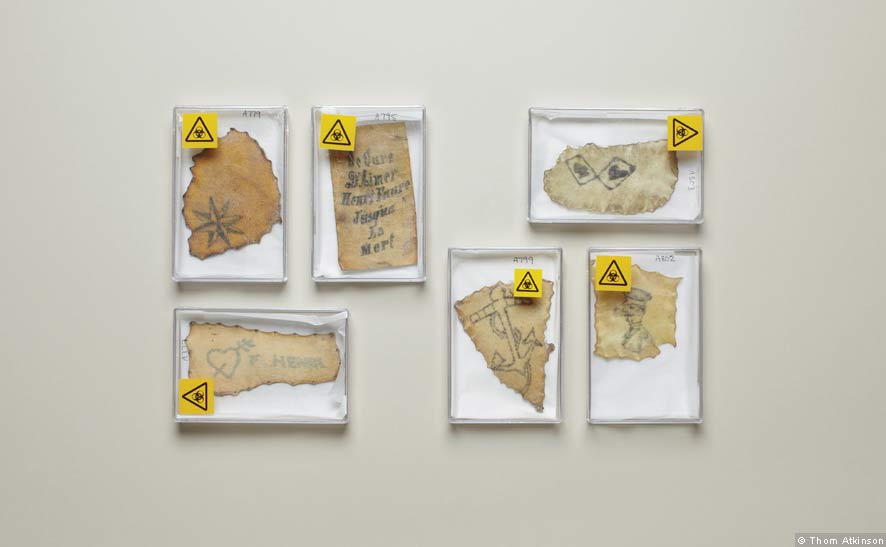
  3. Tattoos. Wellcome acquired 300 tattoos collected by a Paris surgeon who was active in the late 19th century. They are kept in boxes for fear that they were treated with toxic chemicals
  4. Ivory anatomical figures, 17th-18th century
  5. Roman votives. Romans would offer models of afflicted body parts to a god to beg or give thanks for cures. The model on the left is also Roman but was not one of these votive offerings. It came from Pompeii, where it may have adorned a shop front
  6. Wax model of decomposing body in coffin, Italian, late 1700s
  7. Plaster death mask of Victorian murderer James Bloomfield Rush
  8. Stuffed coiled snake, 1897
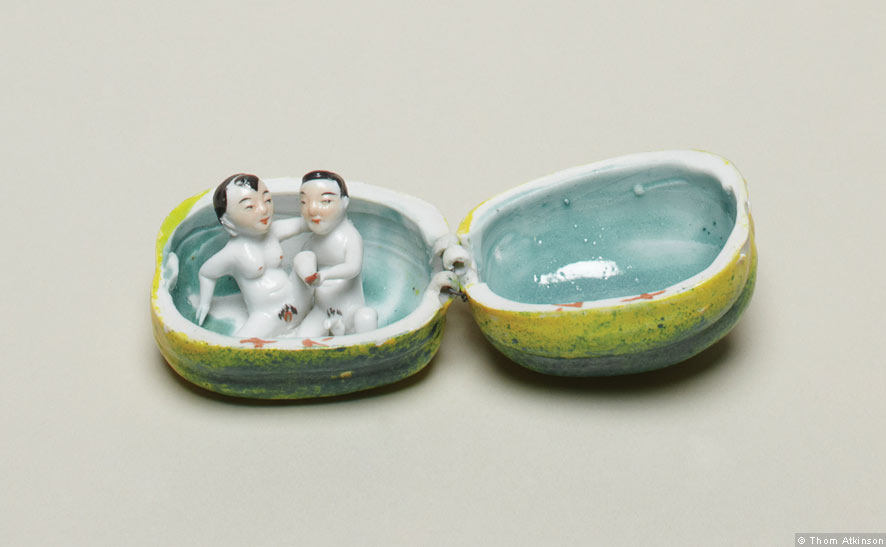
  9. Chinese porcelain fruit containing couple in sexual foreplay

Wednesday, October 12, 2011

"From Blue Beads to Hair Sandwiches: Edward Lovett's Folklore Collection," Lecture by Ross MacFarlane, The Wellcome Collection, November 10


Oh, if only I lived in London... November 10th at The Wellcome Collection:
From Blue Beads to Hair Sandwiches: Edward Lovett's Folklore Collection
Speaker: Ross MacFarlane, Research Officer, Wellcome Library.
Date: 10 November 2011, 15.00 - 16.00
Cost: This event is FREE. Reserve 90 minutes prior to start.

Explore the world of Edward Lovett, whose collection of amulets and curious objects lies at the heart of the 'Charmed Life' exhibition, through the Wellcome Library's archives.

You can pick up your free ticket for this event from the Information Point from 13.30 on the day. Tickets are issued on a first-come, first-served basis.

Please put coats and bags in the cloakroom to the rear of the foyer before meeting your guide, on the third floor, ten minutes before the event begins.
You can find out more by clicking here.

The Midnight Archive Episode 4: The Automata


The Midnight Archive--the new web-based video documentary series "centered around the esoteric and always exotic personalities that spring from Observatory"--has just launched a fantastic new episode, this one based the amazing Guinness Collection of Automata at the Morris Museum; you can view it above by clicking play.

Here is what Ronni Thomas, the film maker behind the series, has to say about this particular episode:
Tucked away, in a quiet and pleasant suberb of New Jersey, there exists one of the most fascinating collections of artistic engineering ever collected. The collection belonged to Murtogh Guinness, of the Guinness brewing company. Its contents are, what I can only describe as the early days of robotics, engineered for our ancestor’s entertainment. Dolls that perform incredible tasks, full orchestras in the middle of your parlor, and my favorite of course, a banjo that plays itself. The collection is maintained and managed by Jere Ryder who began his interest at a very early age. He is now entrusted to the collection at the Morris Museum located in Morristown New Jersey. Keep your eyes on the Brooklyn Observatory as they occasionally take a field trip out. The museum is located at 6 Normandy Heights Road Morristown, NJ and well worth the trip if you are nearby - Jere is not only very knowledgeable on the subject but also a fantastic tour guide... Thanks a ton, Mr. Ryder, we’ll see you soon no doubt!
For more on the series, to see former episodes, or to sign up for the mailing list so as to be alerted to future uploads, visit The Midnight Archive website by clicking here. You can also "like" it on Facebook--and thus be alerted--by clicking here. To find out more about Observatory, click here. To find out more about the Guinness collection at the Morris Museum, click here. There is also a wonderful, highly illustrated catalog for this exhibition, which Morbid Anatomy distributes. More on that here.

PS. To see brand new episodes of The Midnight Archive on the big screen and to meet the filmmaker, please come to the Observatory Halloween/Day of the Dead/Screening party! Click here for more on that.

Tuesday, October 11, 2011

Morbid Anatomy Library and Observatory, Open Studios, This Weekend 12-6!


This weekend, October 15th and 16th, please join the Morbid Anatomy Library and Observatory as we join dozens of other Gowanus-based galleries and artist studios in opening our spaces to the public for the Gowanus Artists Studio Tour, or "A.G.A.S.T."

Following are the full details: Hope to see you there!
Gowanus Artists Studio Tour (A.G.A.S.T.)
Saturday October 15th and Sunday October 16th 12-6
543 Union Street at Nevins, Brooklyn
Free and Open to the Public

Directions: Enter the Morbid Anatomy Library and Observatory via Proteus Gowanus Gallery

R or M train to Union Street in Brooklyn: Walk two long blocks on Union (towards the Gowanus Canal) to Nevins Street. 543 Union Street is the large red brick building on right. Go right on Nevins and left down alley through large black gates. Gallery is the second door on the left.

F or G train to Carroll Street: Walk one block to Union. Turn right, walk two long blocks on Union towards the Gowanus Canal, cross the bridge, take left on Nevins, go down the alley to the second door on the left.
You can find out more information about A.G.A.S.T., and get a full list of participants, by clicking here. You can find out more about Observatory and the exhibition now on view by clicking here.

Photo of The Morbid Anatomy Library by Shannon Taggart.