Showing posts with label anatomical model. Show all posts

Friday, May 16, 2014

Call for Papers: Bodies Beyond Borders: The Circulation of Anatomical Knowledge, 1750-1950, January 7-9 2015

This call for papers just in from my new friend Pieter Huistra, one of the many international attendees I had the pleasure to meet at last weekend's phenomenal Amsterdam Anatomy Weekend at the Museum Vrolik.

The conference will take place in Leuven, Belgium from January 7-9, 2015 with confirmed speakers including Sam Alberti, Sven Dupré, Rina Knoeff, Helen MacDonald, Anna Maerker, Chloé Pirson, Natasha Ruiz-Gómez and Michael Sappol.

The call for papers follow; abstracts of 300 words must be submitted by June 1, 2014 to pieter.huistra [at] arts.kuleuven.be. You can find out more here.

Bodies Beyond Borders. The Circulation of Anatomical Knowledge, 1750-1950
Leuven, 7-9 January 2015

Bodies Beyond Borders is a scholarly conference on the circulation of anatomical knowledge that indicates the heighted interest in the history of anatomy in Leuven. This conference fits in with two current projects on the history of anatomy in Leuven. The first is a research project on Anatomy, scientific authority and the visualized body in medicine and culture (Belgium, 1780-1930), that is conducted in our research group, Cultural History since 1750. The project is supervised by Kaat Wils, and co-supervised by Raf de Bont, Jo Tollebeek and Geert Vanpaemel, and has two PhD fellows, Tinne Claes and Veronique Deblon and one postdoctoral fellow, Pieter Huistra. This research project takes as its object the history of anatomy in Belgium in the ‘long nineteenth century’.

Secondly, Leuven will celebrate a Vesalius year in 2014-2015, to commemorate the 500th birthday of Andreas Vesalius. The mainstay of the programme will be the exhibition Unravelling the body. The theatre of anatomy, of which Geert Vanpaemel will serve as curator. This exhibition studies Vesalius himself, but also his work influenced representations of the human body and the tradition of anatomical research. These themes will also be included in Bodies Beyond Borders, our conference that takes up the question: how does anatomical knowledge move from site to another? Whereas our research project focuses specifically on Belgium, the conference will have a broad geographical scope in its topics as well as its speakers.

Call for Papers

How does anatomical knowledge move from one site to another? Between 1750 and 1950 the study of anatomy underwent great changes, as a part of the development of scientific medicine, through public anatomies, as well as in the interplay between the two. How did these changes spread geographically? How did knowledge about newly discovered lesions travel from one hospital to another? What was the role of anatomical models in the spread of the public consciousness of syphilis, for example? Was the spread of this knowledge hindered by national borders, or did anatomical knowledge cross those borders easily? These questions are concerned with what James Secord terms ‘knowledge in transit’. To seek an answer to these questions, a conference focusing on the circulation of anatomical knowledge between 1750 and 1950 will be organized in Leuven from 7-9 January 2015. Confirmed speakers are Sam Alberti, Sven Dupré, Rina Knoeff, Helen MacDonald, Anna Maerker, Chloé Pirson, Natasha Ruiz-Gómez and Michael Sappol.

Knowledge does not move by itself – it has to be carried. To better understand how anatomical knowledge moves from place to place, we will seek to trace the trajectories of its bearers. Some of those bearers were tied very specifically to the discipline of anatomy: wax models, preserved bodies (or parts of them) or anatomical atlases, for example. These objects are polysemic in nature, tending to have different meanings in different contexts and for different audiences. It makes the question of how anatomical knowledge travelled all the more pertinent if, for example, wax models that went from a Florentine museum to a Viennese medical training institution underwent a shift in meaning en route. But bearers of knowledge less specifically tied to anatomy were equally important: articles, books and individual persons to name but a few examples.

For our conference we welcome contributions regarding the geographical movement of anatomical knowledge between 1750 and 1950. We are equally interested in ‘scientific’ and ‘public’ anatomy – as well as in exchanges between the two domains. Therefore, we encourage contributions about bearers of anatomical knowledge as wide-ranging as persons (scientists, students, freaks), objects (models, preparations, bodies or body parts), visual representations (films, atlases, wall maps) and practices (dissections, travelling exhibitions), as well as their (transnational and intranational) trajectories.

Paper proposals must be submitted by 1 June 2014.

Please send a 300-word abstract to pieter.huistra[at]arts.kuleuven.be.

Notification of acceptance: early July, 2014.
Image: Enrique Simonet, "Anatomía del corazón; ¡Y tenía corazón!; La autopsia," 19th Century

Sunday, March 24, 2013

Finally! A Novel Based on 17th-century Sicilian Wax Modeler Gaetano Giulio Zumbo: "Secrecy," by Rupert Thomson


I seriously cannot wait to read Rupert Thomson's new novel Secrecy, which takes as muse the enigmatic work and mysterious life of one of my all time favorite artists, the 17th-century Sicilian abbot Gaetano Giulio Zummo aka Zumbo (1656 – 1701). It also seems to be a good book, or so at least asserts the review in The Guardian, which describes it as "a visionary tale of waxworks and court intrigue set in a sinister and baroque Florence" and mentions its author in same breath as JG Ballard, Dickens and Buñuel.

Zumbo--whom regular readers might remember from from these recent posts [1, 2]--was a fascinating character; before grandfathering the practice of anatomical waxes (see bottom image), he was already renowned for his obsessive, miniature wax memento mori-themed dioramas he called “Theatres of Death.” These tiny dioramas--featuring meticulously rendered representations of dead, decomposing and tortured human bodies and bearing titles such as “The Plague” (top image), “The Triumph of Time” (second image) “The Transience of Human Glory” (third image) and “Syphilis” (fourth image)--attracted the notice of such luminaries as the Marquis de Sade, Lord Byron and the Grand Duke of Tuscany Cosimo III. They also brought the attention of French surgeon Guillaume Desnoues, who commissioned Zumbo to create a wax simulacrum of a decaying medical preparation in what was to become the first wax anatomical teaching model.

The Financial Times has just run a really fascinating piece by the author in which he muses on his initiation into the wonders of anatomical waxes, details his discovery of Zumbo's work, and describes how he managed to research such an under-documented character and develop this research into a novel. 

Following is a short excerpt from this article; you can read it in its entirety--which I highly recommend!--by clicking here:
Fugitive pieces
By Rupert Thomson
How the macabre works of Gaetano Giulio Zumbo, a mysterious 17th-century Sicilian wax modeller, inspired Rupert Thomson’s new novel ‘Secrecy’
 
...Driving back to England two months later, I stopped in Florence. Opened in 1775, La Specola is the oldest scientific museum in Europe, and the first 24 rooms are filled with extraordinary zoological specimens. There is a 17th-century hippopotamus that the Grand Duke used to keep in the Boboli Gardens. For some reason, the taxidermist had given the hippopotamus what appeared to be the feet of a dog. There is also a manatee, and a basilisk in a jar. In the two months since the birth of my daughter I’d had little sleep, and I was so deeply tired that I felt at times as if I were hallucinating. I hurried on, eager to see the waxes Jan had spoken of. All I remember from that day is walking into a room that was dominated by three hip-high glass cases. Each case contained a life-size woman made of wax. They were naked except for delicate pearl necklaces, and their heads rested on satin pillows. They had real human hair, and eyes of coloured Venetian glass. Their skin, a sallow golden-yellow, gleamed as if they had just broken out in a light sweat. Though I knew nothing of their provenance or their purpose, they seemed distinctly ambiguous, walking a fine line between the medical and the erotic. I came away from La Specola fascinated by wax as a medium; the way it mimicked human flesh – in his Natural History, Pliny calls it “extreme resemblance” – was uncanny, disquieting.
Towards the end of that year, I went to the Spectacular Bodies exhibition at the Hayward Gallery in London. I still have the page of scribbled notes I made that day. Though I recorded the names of several wax artists – among them Joseph Towne, Anna Morandi, Petrus Koning and Clemente Susini (who had made the three women in La Specola) – almost a quarter of my notes related to Gaetano Giulio Zumbo, whose “Dissection of a Head” was on display, and who was described in the catalogue as an “eccentric Sicilian wax-modeller”. I learnt that several of Zumbo’s most important works were kept in La Specola, and felt stupid for not having noticed them in March. As I left the Hayward, I resolved to learn more.
I quickly discovered that Zumbo is perhaps most celebrated for his plague pieces, which are wooden cabinets – or teatrini – that are filled with the macabre yet oddly tactile bodies of the dead and dying. When I first saw them, as photographs, I was reminded of nativities – though their subject is obviously human not divine, death not birth. Zumbo’s figures sprawl on a rubble of broken tombs and scattered bones, and their flesh is green, yellow, brown or black, depending on the degree of decomposition. The detail is intricate, obsessive – rats tug at entrails, eyeballs are festooned with maggots – so much so that art historians suspect Zumbo of using a magnifying glass when he was modelling; there is a secret, hidden element to the work, just as there was in society, knowledge being the prerogative of the few in those pre-Enlightenment days. Each tableau Zumbo made contrives to be both rich and desolate, and each has a painted backdrop – one of his innovations – which affords the dying a “view” of the landscape beyond the grotto, a last glimpse of the world they are about to leave. Though most of the figures would fit on the palm of your hand, they look more like individuals than specimens, and have an unnerving flamboyance or sensuality that borders on exhibitionism.

Jorge Luis Borges once said that great art always has a certain ambiguity about it. Here, in that case, was great art. Here, also, was a conundrum. And, as a writer, that is precisely where a novel begins for me. Something seems to open out in front of me, something I feel driven to explore, and the only tools I have are sentence...
... By the late 17th century, the glories of the Renaissance were long gone. Florence had entered a profound economic slump – it was an age of austerity, not unlike our own – and the mood was neurotic, disapproving and suspicious. In order to survive, you had to dissimulate, cultivating a gap between your thoughts and actions. During his travels Zumbo may have come to see himself as an outsider but in Florence he was definitely a foreigner as well, and the graphic, gruesome nature of his plague pieces, which teetered on the brink of horror, would also have marked him out as an oddity. To Cosimo III, famously morbid, Zumbo’s work spoke of the transience of life – it was cautionary, meditative – but in centuries to come, opinions would differ wildly. Predictably, perhaps, it appealed to both Lord Byron and the Marquis de Sade. De Sade’s description of the plague pieces – their “fearful truth”, as he put it – was used in Juliette, or Vice Amply Rewarded, a context that mingled desire, cruelty and death. “So powerful is the impression produced by this masterpiece,” de Sade wrote, “that even as you gaze at it your other senses are played upon; moans audible, you wrinkle your nose as if you could detect the evil odours of mortality.” But Herman Melville, who mentioned Zumbo’s work in Journal up the Straits some 50 years later, took a different view: “A moralist, this Sicilian,” was his measured response. To this day, however, a sense of unease remains.
And what of Zumbo’s private life? The devil doesn’t appear in Zumbo’s work, and he makes no reference to salvation or paradise. His focus is specifically terrestrial. For Zumbo, the threat is not sin, but time. His anatomical pieces were forensic but they were also, quite clearly, sensual – or, as the art historian Roberta Panzanelli puts it, “love-letters to life itself”...
Excerpt and images from The Financial Times article "Fugitive Pieces;" You can read the entire piece by clicking here. The top four photos are drawn from the piece, and were taken by Nick Ballon, while the bottom image was sourced on the from Musesplorando website; Full captions follow, top to bottom. You can read The Guardian's review of the novel by clicking here. You can find out more--and order a copy of the book--by clicking here,.

Thanks so much to George Loudon and James Kennaway for bringing this amazing looking new book to my attention.
  1. Gaetano Giulio Zumbo’s miniature wax tableau ‘The Plague’
  2. ‘The Triumph of Time’
  3. ‘The Transience of Human Glory’
  4. ‘Syphilis’
  5. Anatomical head by Gaetano Giulio Zumbo; found here.

Monday, March 18, 2013

"History And Cultural Representations Of Human Remains," Symposia Series, London and Paris, 2013

I just learned of two wonderful looking symposiums taking place this year as part of a three-part series called "History And Cultural Representations Of Human Remains," organised by the CAS research centre (EA 801) in collaboration with the Toulouse Natural History Museum and in partnership with the Academy of Medicine (Paris), the Hunterian Museum (Museums and Archives, Royal College of Surgeons, London), the Center Alexandre Koyré and FRAMESPA (UMR 5136). The second one, entitled "Anatomical Models," will take place April 4 at the Academy of Medicine in Paris; the third one, entitled "Exhibiting Human Remains," will take place at London's Hunterian Museum on June 4th. They both look excellent! Sadly, we missed the first of the series, which took place in Toulouse on Feb. 4th and was called "Medical Museums and Anatomical Collections."

Full details on both remaining symposia follow; hope to see you at one or both!
Anatomical Models
Academy of Medicine - Paris
April 4, 2013
  • 9.00-9.15 : Welcome speech
  • 9.15-10.00 : Rafael Mandressi (CNRS, Centre Alexandre Koyré), Artificialisations du corps dans la première modernité européenne
  • 10.00-10.30 : Jack Hartnell (Courtauld Institute of Art, London), Anatomical Image as Anatomical Model: Evoking Skin and Surgery in a Tactile Anatomical Scroll
  • 10.30-11.00 : Marieke Hendriksen (University of Groningen), The Fabric of the Body: Textile in Anatomical Models and Preparations
  • 11.00-11.30 : Coffee break
  • 11.30-12.00 : Jean-Louis Fischer (CNRS), Les cires de foetus humains du Musée de la Specola : Une modélisation unique du dogme de la préexistence des germes
  • 12.00-12.30 : Margaret Carlyle (MacGill University, Canada), Manikins, Midwives, Medical Men: Obstetrical Hardware in the Paris Medical Marketplace, c. 1750-c.1789
  • 12.30-14.00 : Lunch Break 
  • 14.00-14.30 : Victoria Diehl (Spanish National Research Council), The Iconographic Catholic Legacy of Clemente Susini’s Anatomical Venus
  • 14.30-15.00 : Nike Fakiner (Spanish National Research Council), Impressions in wax: Alexander von Humboldt and Gustav Zeiller’s Anatomical Wax Models
  • 15.00-15.30 : Mechthild Fend (University College London), Contagious Contacts: The Dermatological Moulage as Indexical Image
  • 15.30-16.00 : Coffee break
  • 16.00-16.30 : Anna Maerker (King’s College London), Models and Performance in Leicester Square and the Strand, 1831-32
  • 16.30-17.00 : Birgit Nemec (University of Vienna, Department for the History of Medicine), Modelling the Human – Modelling Society. Anatomical Models in late 19th- and early 20th-Century Vienna and the Politics of Visual Cultures
Exhibiting Human Remains
Hunterian Museum - London
June 4, 2013
  • 10.00-10.45 : Sam Alberti (Hunterian Museum), Collecting the Dead
  • 10.45-11.15 : Nausica Zaballos (EHESS, Paris), Fear of death and body snatchers on the reservation: the corpse as a mediating figure between settlers and Navajo people
  • 11.15-11.45 : Coffee break 
  • 11.45- 12.15 : David Mazierski (University of Toronto), Vanitas Mundi: The Anatomical Legacy of Frederik Ruysch
  • 12.15-12.45 : Adrian Young (Princeton University, USA), Man Ape or Ape Man? Raymond Dart, the Taung Child, and the Rhetorics of Display at the 1925 British Empire Exhibition 12.45-14.00 : Lunch break
  • 14.00-14.30 : David Punter (University of Bristol), The Abhuman Remains of the Gothic
    14.30-15.00 : Laurence Talairach-Vielmas (University of Toulouse II-Le Mirail/Centre Alexandre Koyré), Bottled Specimens in Victorian Literature 
  • 15.00-15.30 : Peter M. McIsaac (German and Museum Studies, University of Michigan - Ann Arbor, USA), More than Shock Value: Gestures of Exposure in Gottfried Benn’s Morgue Cycle
  • 15.30-16.00 : Coffee break
  • 16.00-16.30 : Fiona Pettit (University of Exeter), Monstrous Specimens: The Conflation of Medical and Popular Exhibitions of Rare Anatomies
  • 16.30-17.00 : Gemma Angel (University College London), Displaying the Self: The Tattoo from Living Body to Museum Collection
For registration and information: email talairac [at] univ-tlse2.fr and rafael.mandressi [at] damesme.cnrs.fr.

Special thanks to Mechthild Fend--who will participate in the April event--for letting me know about this!

Image: "Royal College of Surgeons, Court of Examiners," Henry Jamyn Brooks, 1894

Friday, October 19, 2012

Ode to Anatomical Waxworks at I09

The website I09 just published a very nice ode to all things Anatomical Wax, drawing heavily from the Morbid Anatomy Archives; Highly recommended! Check it out by clicking here; all images drawn from that post.

Thursday, October 18, 2012

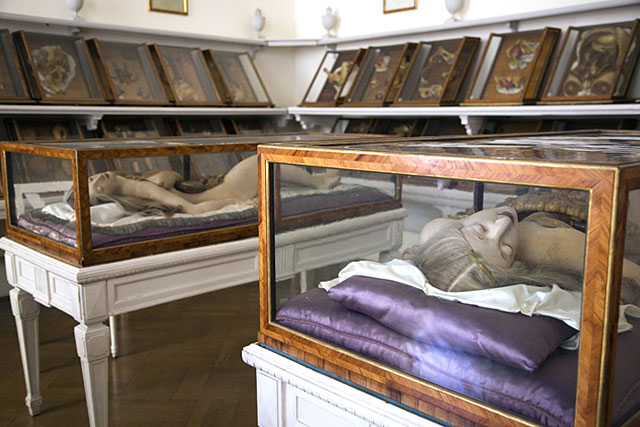
Care and Conservation of Early 19th Century Wax Anatomical Models


If you are interested in knowing more about anatomical waxes, you could do worse than to check out today's entry, "Waxing Lyrical," on The Science Museum's "Stories from the Stores" blog to read conservator Emily Yates' account of cleaning this circa 1818 Italian wax by by Francesco Calenzuoli for the wonderful looking exhibition Doctors, Dissection and Resurrection Men at the Museum of London, running until 14 April 2013. 

You can find out more about this particular piece by clicking here; click on images to see much larger, finer versions. Caption reads: This anatomical wax model shows the internal organs, the heart is entirely removable, made by Francesco Calenzuoli (1796-1821) ( Science Museum, London )

Tuesday, February 21, 2012

"Surgery" Worrydoll, Mixed Media, Renée Laferriere Cinderhouse, 2011


"Surgery," Stoneware, Mixed Media, 2011. From the series Worryldoll by Renée Laferriere Cinderhouse. You can see more of her work and find out more here.

Found here.

Tuesday, February 7, 2012

"Anatomical Venuses, The Slashed Beauty, and Fetuses Dancing a Jig," Morbid Anatomy Lecture, The Velaslavasay Panorama, LA, The Day After Tomorrow!


Just a reminder; for those of you in the greater Los Angeles area,I would love to see you the night after tomorrow at The Velaslavasay Panorama, where I will be giving a lecture entitled "Anatomical Venuses, The Slashed Beauty, and Fetuses Dancing a Jig: A Journey into the Curious World of the Medical Museum." The images above--drawn from my recent photo exhibitions The Secret Museum and Anatomical Theatre--constitute a tiny sampling of the many images I will be showing in the presentation.

Full details follow; very much hope very much to see you there.
Anatomical Venuses, The Slashed Beauty, and Fetuses Dancing a Jig:
A Journey into the Curious World of the Medical Museum
An Illustrated Lecture by Joanna Ebenstein
_______

The Velaslavasay Panorama
1122 West 24th Street, Los Angeles, CA
Thursday, February 9th, 2012 (The day after tomorrow!)
8 o’clock PM
Tickets $10 {$8 VPES Members, Students, Seniors}
Advance Tickets Available here:
http://www.brownpapertickets.com/event/221012

The Velaslavasay Panorama welcomes photographer and researcher Joanna Ebenstein, who will be here Thursday, February 9th at 8 pm to present an illustrated lecture entitled Anatomical Venuses, The Slashed Beauty, and Fetuses Dancing a Jig: A Journey into the Curious World of the Medical Museum. Abounding with images and insight, Ms. Ebenstein’s lecture will introduce you to the Medical Museum and its curious denizens, from the Anatomical Venus to the Slashed Beauty, the allegorical fetal skeleton tableau to the taxidermied bearded lady, the flayed horseman of the apocalypse to the three fetuses dancing a jig. Ebenstein will discuss the history of medical modeling, survey the great artists of the genre, and examine the other death-related arts and amusements which made up the cultural landscape at the time that these objects were originally created, collected, and exhibited.

Joanna Ebenstein is a New York-based artist and independent researcher. She runs the popular Morbid Anatomy Blog and the related Morbid Anatomy Library, where her privately held cabinet of curiosities and research library are made available by appointment. Her work has been shown and published internationally, and she has lectured at museums and conferences around the world. For more information, visit http://morbidanatomy.blogspot.com
Tickets available here. You can find out more about the lecture on Flavorpill and in The LA Weekly. You can find out more about the panorama (one of my favorite spots in LA! highly recommended!) by clicking here.

Images top to bottom, as drawn from my recent photo exhibitions The Secret Museum and Anatomical Theatre:
  1. "Anatomical Venus" Wax wodel with human hair and pearls in rosewood and Venetian glass case, "La Specola" (Museo di Storia Naturale), Florence, Italy, Probably modeled by Clemente Susini (around 1790)
  2. "Slashed Beauty" Wax wodel with human hair and pearls in rosewood and Venetian glass case, "La Specola" (Museo di Storia Naturale), Florence, Italy, Probably modeled by Clemente Susini (around 1790)
  3. "Anatomical Venuses," Wax Models with human hair in rosewood and Venetian glass cases,The Josephinum, Workshop of Clemente Susini of Florence circa 1780s, Vienna, Austria
  4. The Mütter Museum : Philadelphia, Pennsylvania, Pathological model; 19th Century?
  5. Wax Model of Eye Surgery, Musée Orfila, Paris. Courtesy Université Paris Descartes
  6. Wax Anatomical Models in Rosewood and Venetian Glass Boxes, The Josephinum, Workshop of Clemente Susini of Florence circa 1780s, Vienna, Austria
  7. Wax moulages; Probably by Carl Henning (1860-1917) or Theodor Henning (1897-1946); Early 20th Century; Federal Pathologic-Anatomical Museum (Pathologisch-anatomisches Bundesmuseum): Vienna, Austria, Austria
  8. Plaster Models in Pathological Cabinet, The Museum of the Faculty of Medicine at the Jagiellonian University, Krakow
  9. Skeleton and hand models for "la médecine opératoire" Musée Orfila, Paris. Courtesy Université Paris Descartes

Friday, January 13, 2012

"Anatomical Venuses, The Slashed Beauty, and Fetuses Dancing a Jig," Morbid Anatomy Lecture, The Velaslavasay Panorama, Los Angeles, Feb. 9


For those of you in the greater Los Angeles area: I would love to see you next month at at one of my very favorite Los Angeles attractions--The Velaslavasay Panorama--where I will be giving a lecture entitled "Anatomical Venuses, The Slashed Beauty, and Fetuses Dancing a Jig: A Journey into the Curious World of the Medical Museum." The images above--drawn from my recent photo exhibitions The Secret Museum and Anatomical Theatre--constitute a tiny sampling of the many images I will be showing in the presentation.

Full details follow; very much hope very much to see you there.
Anatomical Venuses, The Slashed Beauty, and Fetuses Dancing a Jig:
A Journey into the Curious World of the Medical Museum
An Illustrated Lecture by Joanna Ebenstein
_______

The Velaslavasay Panorama
1122 West 24th Street, Los Angeles, CA
Thursday, February 9th, 2012
8 o’clock PM
Tickets $10 {$8 VPES Members, Students, Seniors}
Advance Tickets Available here:
http://www.brownpapertickets.com/event/221012

The Velaslavasay Panorama welcomes photographer and researcher Joanna Ebenstein, who will be here Thursday, February 9th at 8 pm to present an illustrated lecture entitled Anatomical Venuses, The Slashed Beauty, and Fetuses Dancing a Jig: A Journey into the Curious World of the Medical Museum. Abounding with images and insight, Ms. Ebenstein’s lecture will introduce you to the Medical Museum and its curious denizens, from the Anatomical Venus to the Slashed Beauty, the allegorical fetal skeleton tableau to the taxidermied bearded lady, the flayed horseman of the apocalypse to the three fetuses dancing a jig. Ebenstein will discuss the history of medical modeling, survey the great artists of the genre, and examine the other death-related arts and amusements which made up the cultural landscape at the time that these objects were originally created, collected, and exhibited.

Joanna Ebenstein is a New York-based artist and independent researcher. She runs the popular Morbid Anatomy Blog and the related Morbid Anatomy Library, where her privately held cabinet of curiosities and research library are made available by appointment. Her work has been shown and published internationally, and she has lectured at museums and conferences around the world. For more information, visit http://morbidanatomy.blogspot.com

Tickets available here. You can find out more about the panorama (one of my favorite spots in LA! highly recommended!) by clicking here.

Images top to bottom, as drawn from my recent photo exhibitions The Secret Museum and Anatomical Theatre:
  1. "Anatomical Venus" Wax wodel with human hair and pearls in rosewood and Venetian glass case, "La Specola" (Museo di Storia Naturale), Florence, Italy, Probably modeled by Clemente Susini (around 1790)
  2. "Slashed Beauty" Wax wodel with human hair and pearls in rosewood and Venetian glass case, "La Specola" (Museo di Storia Naturale), Florence, Italy, Probably modeled by Clemente Susini (around 1790)
  3. "Anatomical Venuses," Wax Models with human hair in rosewood and Venetian glass cases,The Josephinum, Workshop of Clemente Susini of Florence circa 1780s, Vienna, Austria
  4. The Mütter Museum : Philadelphia, Pennsylvania, Pathological model; 19th Century?
  5. Wax Model of Eye Surgery, Musée Orfila, Paris. Courtesy Université Paris Descartes
  6. Wax Anatomical Models in Rosewood and Venetian Glass Boxes, The Josephinum, Workshop of Clemente Susini of Florence circa 1780s, Vienna, Austria
  7. Wax moulages; Probably by Carl Henning (1860-1917) or Theodor Henning (1897-1946); Early 20th Century; Federal Pathologic-Anatomical Museum (Pathologisch-anatomisches Bundesmuseum): Vienna, Austria, Austria
  8. Plaster Models in Pathological Cabinet, The Museum of the Faculty of Medicine at the Jagiellonian University, Krakow
  9. Skeleton and hand models for "la médecine opératoire" Musée Orfila, Paris. Courtesy Université Paris Descartes

Sunday, January 8, 2012

“The Lady Anatomist: The Life and Work of Anna Morandi Manzolini," Lecture by Rebecca Messbarger, New York Academy of Medicine, Jan. 19


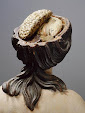
Next Thursday, Rebecca Messbarger--author of the lovely and fascinating The Lady Anatomist: The Life and Work of Anna Morandi Manzolini--will be speaking at The New York Academy of Medicine about the life and work of this rare 18th century female anatomist and master wax modeller, whose wax self portrait--where she depicts herself in the act of dissecting a brain!--you see above.

Full details below; very much hope to see you there!
“The Lady Anatomist: The Life and Work of Anna Morandi Manzolini”
The 2012 Malloch Circle Lecture and Reception
Date: January 19, 2012
Time: 6:00 PM - 8:00 PM

Speaker(s): Rebecca Messbarger, PhD, Associate Professor of Italian, Washington University
Location: The New York Academy of Medicine
1216 Fifth Avenue at 103rd Street, New York, NY 10029

The Malloch Circle, a special group of friends who are interested in the history of medicine and support the historical programs at NYAM, is hosting a lecture about Anna Morandi Manzolini, an illustrious 18th century anatomical modeler. This is a special introduction to the Malloch Circle, whose members are invited to dinner events featuring presentations of historical and bibliographic interest, exhibitions of relevant notable rare books, and private behind the scenes tour of the Rare Book Room.

Anna Morandi Manzolini was an illustrious 18th century anatomical modeler who, with her husband, Giovanni Manzolini, held anatomy lessons in their Bologna home. The artistry and accuracy of her wax models made her widely known as a leader in the field, and brought powerful supporters, including the Royal Society of London, Doge Moccenigo of Venice, and Holy Roman Emperor Joseph II. Long forgotten, her story has been disinterred and developed through the research of Dr. Rebecca Messbarger. Professor Messbarger earned her PhD from the University of Chicago. She has been the recipient of fellowships from the Andrew W. Mellon Foundation, the National Endowment for the Humanities, and the American Philosophical Society. She is director of undergraduate studies in Italian, founder and co-convener of the 18th Century Interdisciplinary Salon, and an executive board member of the Society for 18th Century Studies. Her most recent book The Lady Anatomist: The Life and Work of Anna Morandi Manzolini, examines the details of Morandi’s remarkable life, tracing her intellectual trajectory from provincial artist to internationally renowned anatomical wax modeler for the University of Bologna’s famous medical school.

The Friends of the Rare Book Room is a special group of contributors who for sixty years have supported public programs in the history of medicine, the acquisition and cataloging of historical scholarly material, and activities that make the Malloch Rare Book Room a center for scholarship in the history of medicine and public health and for the study of books and printing. The Malloch Circle is composed of special Friends of the Rare Book Room who support this work at a level of $1,000 annually. The Malloch Circle is named for Archibald Malloch, a protege of William Osler, who served as the Academy's Librarian from 1926 to 1949. The continuing support of the Malloch Circle will dramatically improve the library's efforts to enhance its collections through full cataloguing and archival processing, digitization, and conservation treatment. The Malloch Circle meets several times a year for dinner and conversation, with special presentations of bibliographical and historical interest, and for private tours of notable rare book collections.

Registration Information
Cost: $35
You can find out more--and order tickets!--by clicking here. To find out more about Rebecca Messbarger's book The Lady Anatomist: The Life and Work of Anna Morandi Manzolini, click here.

Image: Wax self-portrait of 18th-century wax modeler and anatomist Anna Morandi Manzolini dissecting a human brain; Palazzo Poggi, Bologna; found here.

Monday, May 23, 2011

New Book (In English!!!) About Honoré Fragonard's Incredible 18th Century Anatomical Ecorchés!


If the Founding Fathers wanted to visit Body Worlds they could have. Or pretty darn close, at least - they just needed to visit one of the many European cabinets of anatomical curiosities, to see the work of anatomists like Honore Fragonard.

Fragonard's eighteenth-century ecorches were the clear precursors to Gunther von Hagens' "Body Worlds" exhibits: preserved, injected, partially dissected bodies in lifelike, dramatic poses, with ragged strips of muscle draped like primitive clothing over exposed vessels and nerves. The effect is eerie - like a Vesalius illustration sprung to (half-)life... --Bioephemera, "If the Founding Fathers wanted to visit Body Worlds..."
Much has been said--and rightfully!--about the "uncanny similarity" (as one might charitably say) between the anatomical works of Body Worlds' impresario Gunther von Hagens and the 18th Century allegorical anatomical ecorchés of Honoré Fragonard, cousin of well-known rococo painter Jean-Honoré Fragonard. Bioephemera says it very very well today--as quoted above--and follows with a really nice, extensive review of the new, wonderful, lavishly illustrated Blast Books publication Fragonard Museum: The Ecorches.

To read the entire post on the Bioephemera website--very much recommended!--click here. To order a copy of the book for your very own--also highly recommended!--click here.

The specimens you see above -- and more! -- are housed in the amazing Le Musée de l’Ecole Nationale Vétérinaire d’Alfort (née Musée Fragonard) right outside of Paris; to find out more about that museum, click here. Images as credited; to see more images from the Musée, click here. To visit the museum website, click here.

Image credits and captions:
  • Top image: Fragonard's Horseman, found here.
  • Second image: Fragonard's man with the mandible, inspired by Samson smiting the Philistines with an ass's jaw, found here.
All other images from the Bioephemera post. Captions, top to bottom:
  • Nilgai/Doe of the Indies
  • Human Bust
  • Human Bust
  • Installation view of The Musee Fragonard

Wednesday, December 22, 2010

Anatomical Wax, Gallery Comparative Anatomy, Circa 1880


Cote cliché: 09-575178
Inventory Number: P4460
Fund: Photographs
Title: Anatomical wax
Description: Gallery comparative anatomy, circa 1880
Author: Petit Pierre Lanith (1831-1909)
Photo credit: Contact us in advance for monographs, exhibition panels, commercial editions, advertising and communication. An additional proof be sent to the museum. (C) National Museum of Natural History, Dist. RMN / image MNHN, Central Library
Period: 19th century
Date: 1880
Location: Paris, National Museum of Natural History, Central Library
Click on image to see much larger, more interesting image. Via RMN found via Bits and Bites Tumblr.

Wednesday, October 13, 2010

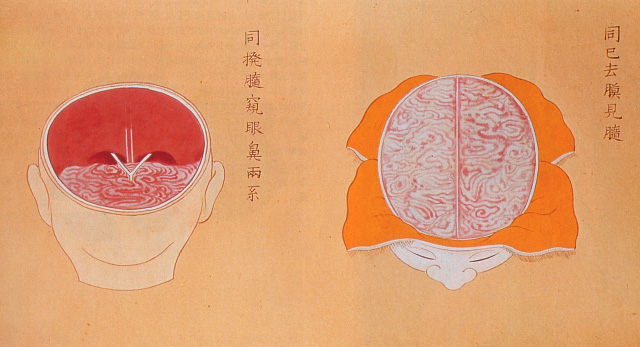
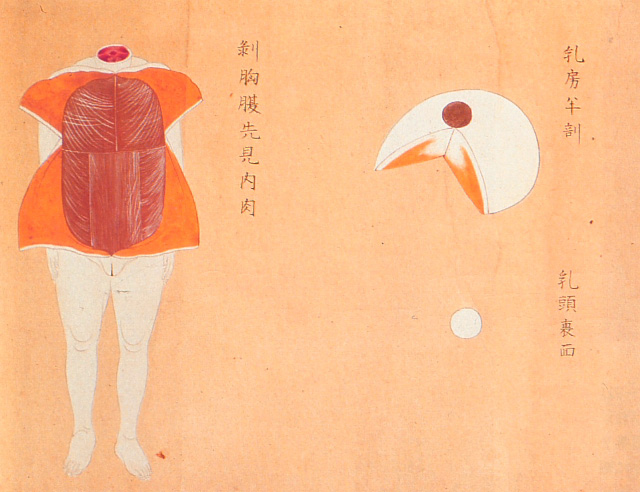
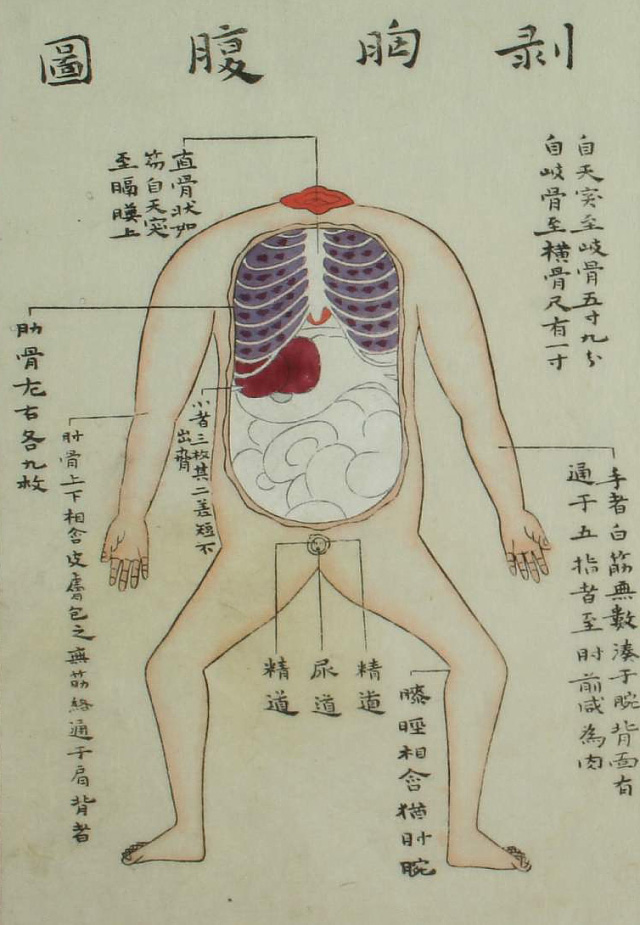
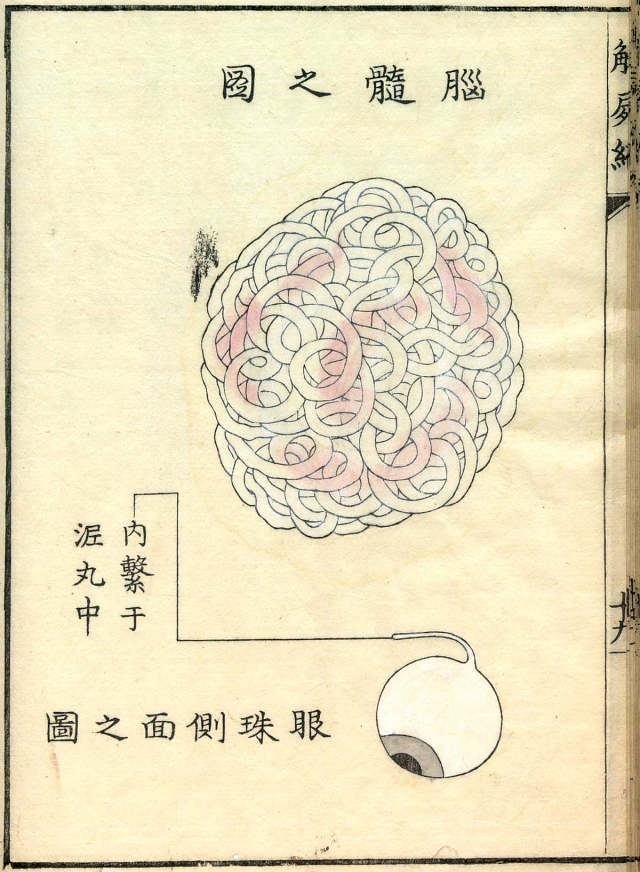
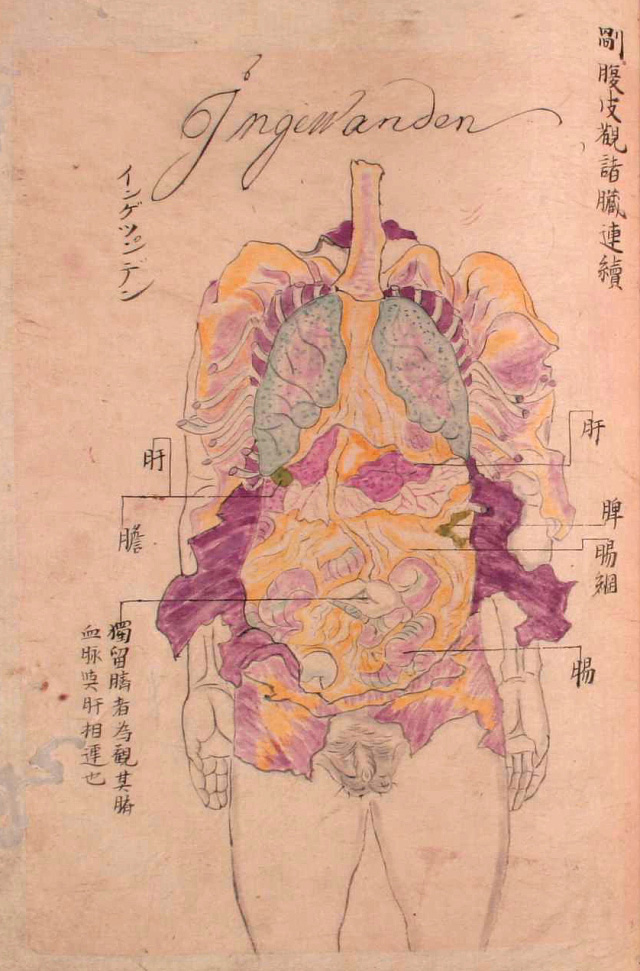
Anatomical illustrations from Edo-period Japan, 1603-1868


All of the images you see above are drawn from a simply marvelous collection of anatomical illustrations tracing the evolution of medical knowledge in Japan during the Edo period (1603-1868) as found on the Pink Tentacle website.

To see the complete set of images (well worth it, I promise!) and read more about them, check out the original piece by clicking here.

Brief captions, top to bottom:
  1. Pregnancy illustrations, circa 1860
  2. Anatomical illustrations (artist/date unknown)
  3. Kaishihen (Dissection Notes), 1772
  4. Breast cancer treatment, 1809
  5. Zoku Yōka Hiroku (Sequel to Confidential Notes on the Treatment of Skin Growths), 1859
  6. Zoku Yōka Hiroku (Sequel to Confidential Notes on the Treatment of Skin Growths), 1859
  7. Zoku Yōka Hiroku (Sequel to Confidential Notes on the Treatment of Skin Growths), 1859
  8. Female dissection, 1774
  9. Female dissection, 1774
  10. Illustration from 1759 edition of Zōzu
  11. Kaishihen (Dissection Notes), 1772
  12. Seyakuin Kainan Taizōzu (circa 1798)