Showing posts with label wellcome. Show all posts

Wednesday, November 26, 2014

Henry Wellcome's Anatomical Venus: A Missing Link? Guest Post by Joanna Ebenstein for the Wellcome Collection Blog

I was recently invited to select a single object from Blythe House--the storehouse containing the remains of early 20th century pharmaceutical magnate Henry Wellcome's once million strong collection--for an episode of the Wellcome Collection's “The Thing Is…" From the over 100,000 amazing objects in the collection--including ivory anatomical mannequins, wax vanitas busts, antique sexual aids, Greek anatomical otives, torture devices, statues of saints and even a Peruvian mummy--I chose, it will not surprise regular readers to discover, Henry Wellcome's Wax Anatomical Venus (see above).

I had been curious about this enigmatic creature ever since Kate Forde and I featured her in the Wellcome’s 2009 Exquisite Bodies exhibition. Although diminutive--she is only three feet in length while most others are life-sized--she is still an extraordinarily uncanny and charismatic object. She was also a very mysterious object, with very little I could discover, despite my best efforts, about her provenance.

To prepare for this talk--hosted by journalist and historian Frances Stonor Saunders--I delved, with the help of my friend Ross MacFarlane, deeply into the Wellcome Library and its archives to see what I might be able learn about this mysterious artifact.

To read the full report I wrote for the Wellcome Collection blog detailing my findings--and to see many more images, including another animated GIF like the one above, compliments of Russell Dornan!--click here.

Image:
  1. Wellcome Collection’s Anatomical Venus in various stages of dissection as shown in an animated GIF. Courtesy of Wellcome Images.
  2. Catalog card for the Wellcome Anatomical Venus.

Wednesday, May 8, 2013

"The Devil Examining the Head of a Boy" Frontspiece to a Manual on Phrenology; 1847, The Wellcome Library


From the wonderful Wellcome Library where I am busy doing research at the next week or so:
The devil examining the head of a boy; three other boys lurk under the devil’s wings; frontispiece to a manual on phrenology. Steel engraving

1847 By: Hippolyte Bruyères after: Jean Denis Nargeot
Published: Aubert & c.ie,[Paris (Place de la Bourse, 29) : 1847

V0009469 Credit: Wellcome Library, London
Clink on image to see larger version. You can learn more on Wellcome Images.

Sunday, March 3, 2013

Collector of Rare Diseases, Wellcome Library Blog

[Frederick Parkes Weber (1863-1962)] was more generally a relentless collector of examples of rare diseases and conditions, in fact had been a committed collector since boyhood, when he took up the collection of coins and medals, later becoming a noted expert in numismatics, as well as stamps, butterflies and moths, mineralogical specimens and fossils. His papers reflect this tendency very strongly, revealing the accrual over the many years of his lengthy career of material on diseases either rare in themselves, or unusual manifestations of more common disorders...
You can read the whole article about this "collector of diseases"--from whence came the text and image above--on the Wellcome Library blog by clicking here.

Wednesday, November 21, 2012

From the Sacred Heart to the Profane: "Collector of Hearts," Morbid Anatomy Guest Post on The Newly Launched Wellcome Library Website


The kind of research that I am drawn to tends to focus on things that reside at tricky intersections, or have fallen though the historical cracks. The incredibly broad and multi-disciplinary collection of the Wellcome Library — one that gives equal primacy to the highbrow contemporary academia, forgotten ephemera, art, artifacts, outdated science, and outsider scholarship — makes this the perfect library for the sort of research I do, and allows for all manner of idiosyncratic research that would simply be impossible to conceive of at more conventional libraries.
--"Collector of Hearts" Guest Post, The The Wellcome Library Website
Today, that spectacular and unrivaled resource The Wellcome Library launched a brand new, image-intensive website; as part of the relaunch, I was asked to write a guest post about my "user experiences" in the library over a series of visits on my recent trip to London.

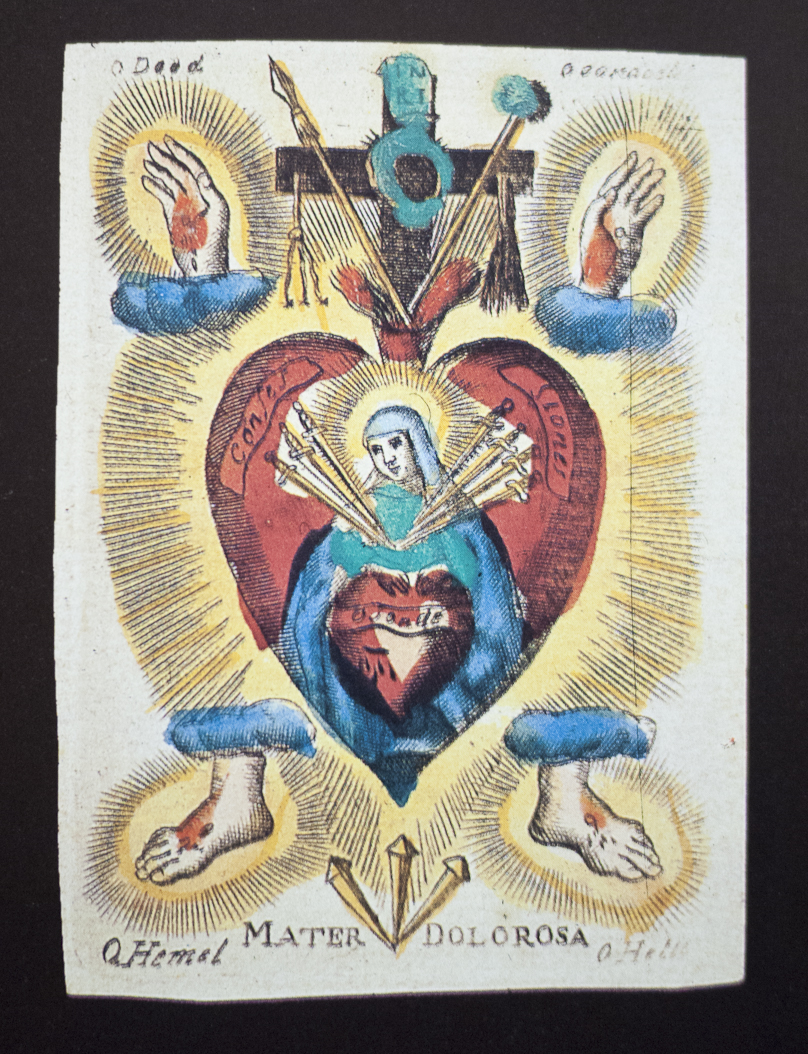
In the post--excerpted above, full post here--I use as a point of departure the randomly stumbled upon and utterly amazing book From Holy Pictures to the Healing Saints: Faith and the Heart. In it, author, doctor and collector N. Boyadjian’s showcases and muses on his wonderful and vast assortment of ‘holy pictures,’ also known as ‘prayer cards,’ or small popular pictures used in “individual intimate devotion” (see top 5 images). Using that book and its chapter on "The Sacred Heart" as a departure point, I then delved into all aspects of the Wellcome Library and Image Collection--digital and print, rare and every day--to ferret out the variety of ways in which the human heart has been approached from the sacred and secular, the symbolic to the medical.

In this fashion, I discovered a dizzying array of curiosities showcasing the depth a breadth of The  Wellcome Library and Collection; just a very few of my favorites: an illustration of "A most true and certaine relation of a strange monster or serpent found in the left ventricle of the heart of John Pennant, gentleman, of the age of 21 yeares" (7th down);  a Carmelite scapular; a theatrical-framed illustration of the "Heart, illustrated as a pumping machine" from 1733; "The vivisector asked to choose between head and heart" from 1886; a dried and preserved human tattoo depicting a sacred heart (9th down); a print of of an anatomist examining the heart of suspiciously beautiful female cadaver ("She Had a Heart," 1890) (6th down); and, perhaps my favorite, a painting of souls in purgatory looking at the wounds of christ (8th down).

You can read the post in its entirety--and see all the amazing images I located, a few of which are even zoom-able in the post!--by clicking here.

Images Captions:
  1. From the book From Holy Pictures…to the Healing Saints: Faith and the Heart,
    N. Boyadjian, 1986
  2. From the book From Holy Pictures…to the Healing Saints: Faith and the Heart,
    N. Boyadjian, 1986
  3. From the book From Holy Pictures…to the Healing Saints: Faith and the Heart,
    N. Boyadjian, 1986
  4. From the book From Holy Pictures…to the Healing Saints: Faith and the Heart,
    N. Boyadjian, 1986
  5. From the book From Holy Pictures…to the Healing Saints: Faith and the Heart,
    N. Boyadjian, 1986
  6. From Wellcome Images: a print of of an anatomist examining the heart of suspiciously beautiful female cadaver ("She Had a Heart," 1890)
  7. From Wellcome Images: "A most true and certaine relation of a strange monster or serpent found in the left ventricle of the heart of John Pennant, gentleman, of the age of 21 yeares"
  8. From Wellcome Images: a painting of souls in purgatory looking at the wounds of Christ
  9. From Wellcome Images :a dried and preserved human tattoo depicting a sacred heart

Thursday, November 15, 2012

"Death: A Self Portrait," The Wellcome Collection, Through February 24, 2013


In some way death in our culture happens offstage in private, but this show looks at the ways in which people have explored death much more face on. --Kate Forde, Curator of "Death: A Self Portrait," The Wellcome Collection, BBC Magazine
My last night in London, I had the honor and delight to attend the preview of "Death: A Self Portrait," the Wellcome Collection's spectacularly amazing new exhibition which officially opens today.

Beautifully and thought-provokingly curated by Kate Forde (who also curated the Wellcome's 2009 Exquisite Bodies), the exhibition uses as its base and its muse the extensive, broad, and rather profound death-themed collection of Chicago-based Richard Harris. Harris' collection is comprised of all things death, ranging from valuable artistic masterworks to the lowest-brow of popular culture, bringing to mind the collection of none other than Henry Wellcome, the man behind the Wellcome Collection. To its merit, "Death: A Self Portrait" draws deftly from both extremes as well as all that is located in between; the result is an exhibition that is at a lovely, provocative, fascinating, witty, and thoughtful investigation into the human obsession with imagining and coming to terms with that greatest and most unknown of absolutes: DEATH.

"Death: A Self Portrait" is divided up into five sections: The first, "Contemplating Death," is a collection of memento mori themed work; The second, "The Dance of Death," gathers works responding to notions of the danse macabre or death as the great equalizer; "Violent Death" features a variety of artistic responses to war, including Goya's Disasters of War series; "Commemoration" concerns itself with burial, morning, and our responses the particular dead; My personal favorite, "Eros and Thanatos," is an unusual addition to a public discussion of death, and showcases "works expressing our strange fascination with 'things at the outer limits of life and death, sexuality and pain."

Above are just a very few images from this wonderful exhibition; there are many, many more excellent artworks, objects and artifacts to be seen; I simply cannot more highly recommend checking out this jaw-dropper before its closing date on February 24th!

You can find out more about the show on the Wellcome Collection website by clicking here; To hear the lovely illustrated interview with curator Kate Forde from which the above quote was drawn, click here.

Also, for the interested among you: both collector-of-death Richard Harris and curator Kate Forde will be contributors to the Morbid Anatomy Anthology, a new lavish book immortalizing in words and images the best of Morbid Anatomy Presents; you can secure your own copy--and find out more--by clicking here. For more on the Richard Harris collection, click here to learn about a recent exhibition using his collection as its base at The Chicago Cultural Center.

All images ©  Wellcome Images, Courtesy The Richard Harris Collection; captions, top to bottom:
  1. Metamorphic Postcard, c.1900 
  2. Skeleton puppet. Wood and cotton
  3. Bathel Bruyn the elder, 'A Skull in a Niche', c.1535-55 Oil on panel
  4. When Shall we Meet Again?Gelatin silver print Size, c.1900
  5. Louis Crusius, Antikamnia, 1900 Paper: calendar series of 6, 1900
  6. Marcos Raya, Untitled (family portrait: woman in yellow dress), 2005 Collage: vintage photo with mixed media
  7. Dana Salvo, From the series 'The Day, the Night and the Dead': 'Home altar atop table commemorating ancestors', 1990-2004 Photograph
  8. Alfred Rethel, 'Death the Enemy', 1851 Wood engraving
  9. Memento Mori, unknown artist, late 18th-century Engraving
  10. Mors Ultima Linea Rerum (Death the Final Boundary of Things), c.1570 Engraving, 
  11. Ivo Saliger 'Der Artz (The Doctor), c.1921 Colour etching on brown paper
  12. Marcos Raya, Untitled (family portrait: grandma), 2005

Friday, November 2, 2012

"Death and What it Can Teach us About Improving Life," BBC Radio "Today," November 2

I just got back from the BBC studios, where I engaged in a (very brief) live discussion about death and "what it can teach us about improving life" with Ben Haggarty of the Crick Crack Club as part of the promotion for tonight's "Seize the Day" event at The Wellcome Collection. If you are interested in giving it a listen, click here; the piece begins at about two Hours and fifty five minutes in.

Segment description, from the BBC website:
The Wellcome Trust in London is going to hold an evening of talks about death and what it can teach us about improving life. Joanna Ebenstein, who runs a blog called Morbid Anatomy, and Ben Haggarty, who runs the Crick Crack Club which is a story telling workshop, ask why we find it hard in modern western society to talk about death.
Hope to see you at the event tonight!

Tonight: Morbid Anatomy Speaking at "Seize the Day," A Special Day of the Dead Inspired Program at The Wellcome Collection, London

Tonight! Hope to see you at "Seize the Day," a special Day of the Dead inspired program taking place at my all-time favorite institution, The Wellcome Collection. I will be giving an illustrated talk as part of the wonderful-looking evenings line-up that will also include drinking, dancing, and general death-related merriment.

Full details follow; hope very much to raise a glass with you there!
Seize the Day
02 November 2012, 19.00 - 23.00
The Wellcome Collection
183 Euston Road, London NW1 2BE
Experience a brush with death at our special Friday-night late, and explore what death has to tell us about life. If you knew you were going to die tomorrow, what would you choose to do today? How would you like to be remembered after you die? And what would you like to achieve before you go? Ponder these questions while enjoying stimulating talks, enchanting stories from around the world and activities throughout the galleries. Enjoy a drink while listening to a Dixieland jazz band. Decorate a coffin, pick up some dance steps in our special ‘Last Dance’ class and design your ideal fantasy funeral. Join us to embrace the inevitability of death and celebrate while we still can!

Featuring:

•  Joanna Ebenstein, founder of the Morbid Anatomy blog and library, on facing up to death through art

•  David Spiegelhalter, Winton Professor for the Public Understanding of Risk, University of Cambridge, on the statistics of death

•  Frank Swain, author of ‘Zombology: The new science of zombies, reanimation and mind control’ on science’s investigations into the final frontier

•  Activities in the galleries from The Natural Death Centre
•  New Orleans jazz funeral tunes from the Silk Street Jazz band
•  Stories of God, the Devil and Death from the Crick Crack Club
•  Tea dance classes from former dancer and teacher Glen Snowden
•  ‘Immortal Dream’ from Contemporary Vintage.

This event is free, so drop in any time. Talks are ticketed and tickets will be available on the night. 
You can find out more about this event here.

Image: Memento Mori, Andrea Previtali, 1502; Museo Poldi Pezzoli, Milan ; sourced here.

Monday, October 29, 2012

More Saint Florian, Patron Saint Invoked Against Flooding, From The Wellcome Library

Thanks to Ross MacFarlane from The Wellcome Library--one of our esteemed contributers to the Morbid Anatomy Anthology Volume 1--for sending along an even better image than that last of St. Florian, patron saint invoked against fire, floods and drowning. As the winds rage and the water beats against my flimsy 6th-floor window, fingers crossed that this magical thinking helps!

Image info: Saint Florian. Coloured engraving by F. Nowohradsky, The Wellcome Library. More here.

Friday, October 19, 2012

Morbid Anatomy Speaking at "Seize the Day," A Special Day of the Dead Inspired Program at The Wellcome Collection, London, November 2, 7 PM

For those in London and environs: I would love to see you next month at "Seize the Day," a special Day of the Dead inspired program taking place at my all-time favorite institution, The Wellcome Collection, on the evening of Friday, November 2. I will be giving an illustrated talk as part of the wonderful-looking evenings line-up that will also include drinking, dancing, and general death-related merriment.

Full details follow; hope very much to raise a glass with you there!
Seize the Day
02 November 2012, 19.00 - 23.00
The Wellcome Collection
183 Euston Road, London NW1 2BE
Experience a brush with death at our special Friday-night late, and explore what death has to tell us about life. If you knew you were going to die tomorrow, what would you choose to do today? How would you like to be remembered after you die? And what would you like to achieve before you go? Ponder these questions while enjoying stimulating talks, enchanting stories from around the world and activities throughout the galleries. Enjoy a drink while listening to a Dixieland jazz band. Decorate a coffin, pick up some dance steps in our special ‘Last Dance’ class and design your ideal fantasy funeral. Join us to embrace the inevitability of death and celebrate while we still can!

Featuring:

•  Joanna Ebenstein, founder of the Morbid Anatomy blog and library, on facing up to death through art

•  David Spiegelhalter, Winton Professor for the Public Understanding of Risk, University of Cambridge, on the statistics of death

•  Frank Swain, author of ‘Zombology: The new science of zombies, reanimation and mind control’ on science’s investigations into the final frontier

•  Activities in the galleries from The Natural Death Centre
•  New Orleans jazz funeral tunes from the Silk Street Jazz band
•  Stories of God, the Devil and Death from the Crick Crack Club
•  Tea dance classes from former dancer and teacher Glen Snowden
•  ‘Immortal Dream’ from Contemporary Vintage.

This event is free, so drop in any time. Talks are ticketed and tickets will be available on the night. 
You can find out more about this event here.

Image: Memento Mori, Andrea Previtali, 1502; Museo Poldi Pezzoli, Milan ; sourced here.

Saturday, October 6, 2012

"Wellcome's Collectors," Ross MacFarlane, The Royal Society, London. November 2nd

Oh, if only I were still in London... The inimitable Ross MacFarlane, genius moderator of last month's Congress for Curious Peoples, London edition on Henry Wellcome's collectors, at The Royal Society, London, on November 2:
Wellcome's Collectors 1:00 pm – 2:00 pm on Friday 02 November 2012
at The Royal Society, London
History of science lecture by Ross MacFarlane.
Event details
Ross MacFarlane is Academic Engagement Officer at the Wellcome Library, London.
Pharmacist, philanthropist – and Fellow of the Royal Society – Sir Henry Wellcome is now widely recognised as one of the most acquisitive of collectors during the late nineteenth and early twentieth centuries. But Wellcome’s collection of historical objects was not the work of one man acting alone. This talk will aim to bring forth from the shadows of his store rooms the men and women who bid, bought, and collected in Wellcome’s name. 
Attending this event
This event is free to attend and open to all. No tickets are required. Doors open at 12:30pm and seats will be allocated on a first-come-first-served basis.
Recorded audio will be available on this page a few days afterwards.
Enquiries: Contact the events team.
This event is free and open to the public. To find out more, click here.

Image: Photograph of Wellcome Museum staff with artefacts (Wellcome Library, London)

Thursday, April 5, 2012

"O Death Where Is Thy Sting?" or Happy Easter Everyone!


Easter week celebrates the moment when, in Christian metaphysics, mortality is overcome by everlasting life. The crucifixion of Jesus Christ redeems mankind from the sinful state into which mankind fell through Adam's disobedience to the will of God in the garden of Eden. His resurrection liberates us from eternal perdition: in Saint Paul's famous words (I Corinthians, XV.54-55) "So when this corruptible shall have put on incorruption, and this mortal shall have put on immortality, then shall be brought to pass the saying that is written, 'Death is swallowed up in victory'. O death where is thy sting? O grave where is thy victory?".

These concepts were articulated with fresh force in the later sixteenth century through the Counter-Reformation, in media such as altarpieces, sermons, the educational work of the Jesuit Order, and through devotional prints which were widely disseminated. Here we present four such prints from the holdings of the Wellcome Library...
Read the entire article from which this excerpt is drawn--and see more images!--on the excellent Wellcome Library blog by clicking here; click on image to see a much larger, more detailed view.

Image: Engraving after Maerten de Vos, late 16th century. Wellcome Library no. 23283i.

As described on the blog:
Finally in this sequence, we have the powerful figure of Christ triumphing over death. The upper part combines two scenes: Christ is simultaneously resurrected from the tomb and ascends into heaven. In the lower left corner, Death itself is about to be swallowed up by a monster, while in the centre the snake that led Adam and Eve astray, and who is entwined around the secular world, is about to be trampled down by the wounded foot of Christ. On the right a tablet engraved with the Ten Commandments faces upwards, indicating that Christ is triumphing over righteousness of the law, replacing it with righteousness of faith...

Wednesday, March 21, 2012

"A Verger's Dream: Saints Cosmas and Damian Performing a Miraculous Cure by Transplantation of a Leg," Attr. to the Master of Los Balbases, ca. 1495


L0064585 Credit: Wellcome Library, London
A verger's dream: Saints Cosmas and Damian performing a miraculous cure by transplantation of a leg. Oil painting attributed to the Master of Los Balbases, ca. 1495.
1495 By: Masterof Los Balbases, after: Alonso de. Sedano
Published: [ca. 1495?]
Size: wood ca. 169 x 133 cm.
Collection: Iconographic Collections
Library reference no.: Iconographic Collection 46009i
Full Bibliographic Record Link to Wellcome Library Catalogue
From the incredible Wellcome Image Collection, via today's Wellcome Images news bulletin. Click on image to see larger, more detailed version.

Tuesday, January 31, 2012

Head Composed of Writhing Écorché Figures Composed in the Manner of Giuseppe Arcimboldo, Wellcome Collection


"Recently conserved painting of a head composed of writhing écorché figures, composed in the manner of Giuseppe Arcimboldo (right: Wellcome Library no. 44576i)." Click on image to see much larger, more detailed version.

Via The Wellcome Library blog.

Monday, November 21, 2011

William Cheselden Giving an Anatomical Demonstration to Six Spectators in the Anatomy-theatre of the Barber-Surgeons' Company, London, Circa 1730/1740


In Cheselden’s time, surgeons trained through an apprenticeship during which, they would attend private anatomy lessons. Before the Anatomy Act of 1832, the only legal supply of bodies for anatomical purposes where those of criminals condemned by the courts. The Barber-Surgeons’ Company kept scrupulous control over the use of bodies dissected in their hall, with the macabre ritual of often later displaying the dissected bodies of executed criminals in niches around the walls. Cheselden himself was fined by the Company in 1714 for carrying out dissections without permission, which drew away audience members from regular lectures at the Company. With students having little opportunity to take part in dissections themselves, teachers would rely on models or anatomical preparations for class...
Image and text from The Wellcome Collection blog; you can learn more about this fabulous painting--and read the text in its entirety--by clicking here.

Full image credit: William Cheselden giving an anatomical demonstration to six spectators in the anatomy-theatre of the Barber-Surgeons' Company, London. Oil painting, ca. 1730/1740. Wellcome Images.

Friday, October 21, 2011

Voodoo Medicinal Panels, Wellcome Collection


6 paintings : acrylic on wood ; wood of each painting ca. 122 x 66 cm.
Contents 1. "Gono"
2. "Male genital organ", "Female genital organ"
3. "Breast cancer"
4. "Syphilis"
5. "Eye", "Fistula", "Sore"
6. "Pregnant woman"

Credits On verso of no. 5, painted name: "Anan Antoine"

Summary Salvaged in August 2010, the six panels formed the walls of the shack of a vodoo (voodoo, vodou, vodun) practitioner in the town of Adjarra. The town is about one hour's drive from Porto Novo, the capital city of Benin, on a mud road towards the Nigerian border. The population attends a flourishing vodoo market where medical practitioners have dried animal parts, carved statuettes and other fetishistic items available for medicinal purposes. The paintings advertise the diseases and parts of the body which the practitioner offers to cure through sorcery and animal sacrifices that call upon the spirit world
Read more about these remarkable panels voodoo panels in the amazing Wellcome Collection by clicking here.

Thursday, October 13, 2011

"The Wellcome at 75," Financial Times Magazine, Article and Slide Shows


...you can’t grasp the Wellcome collection unless you can see the poetry in it. But until quite recently, the irrepressible curiosities and juxtapositions that make the collection captivating were regarded as an irrelevance, an embarrassment and a confounded nuisance to the people charged with putting it in order. When Henry Wellcome displayed his collection for the first time, he decreed that the museum should be “strictly professional and scientific in character”. His collection has resisted successfully ever since...
From the article "The Wellcome at 75" by Marek Kohn in the Financial Times magazine. You can read the full article--from which the above was excerpted--by clicking here. You can view the complete slideshows--from which the above images are drawn--by clicking here and here. Click on images to see much larger images.

Thanks to the afore mentioned Ross Macfarlane for bringing this article to my attention!

Image captions top to bottom:
  1. Models of human skulls in ivory, silver and wood
  2. A pair of phrenological busts, 1821
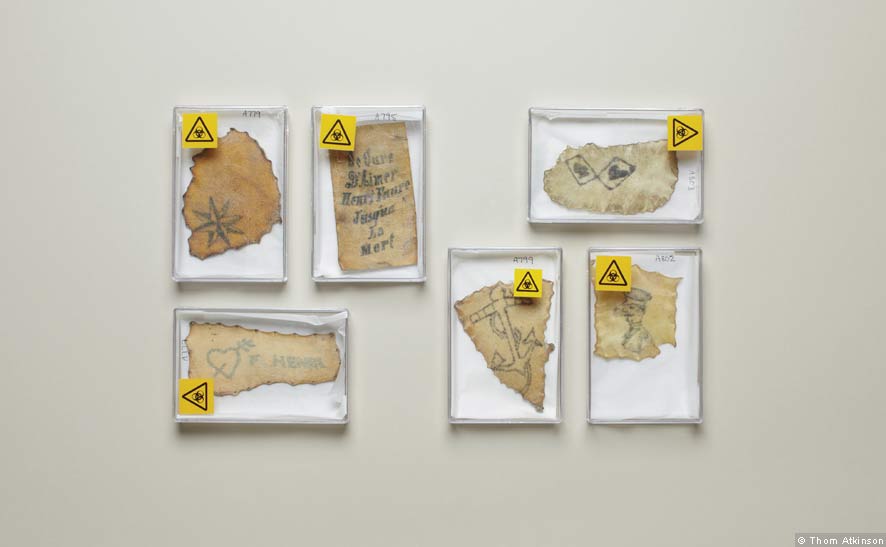
  3. Tattoos. Wellcome acquired 300 tattoos collected by a Paris surgeon who was active in the late 19th century. They are kept in boxes for fear that they were treated with toxic chemicals
  4. Ivory anatomical figures, 17th-18th century
  5. Roman votives. Romans would offer models of afflicted body parts to a god to beg or give thanks for cures. The model on the left is also Roman but was not one of these votive offerings. It came from Pompeii, where it may have adorned a shop front
  6. Wax model of decomposing body in coffin, Italian, late 1700s
  7. Plaster death mask of Victorian murderer James Bloomfield Rush
  8. Stuffed coiled snake, 1897
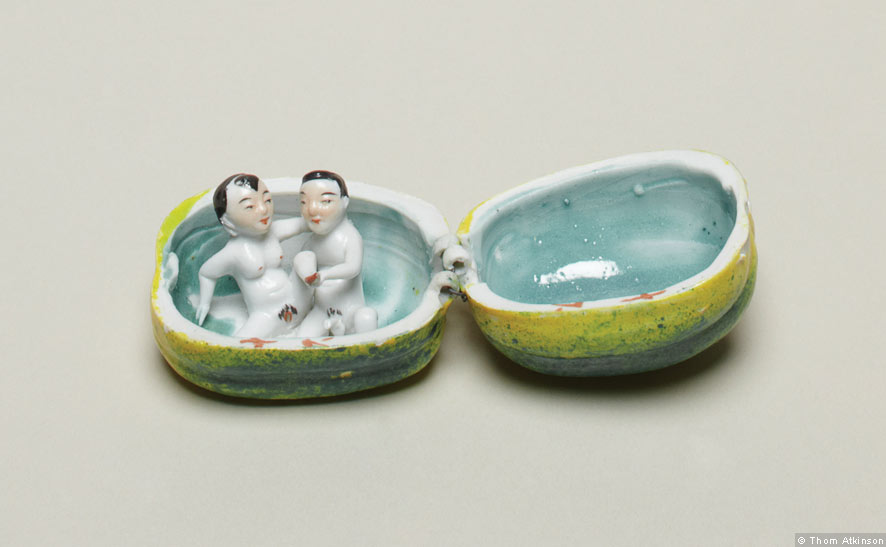
  9. Chinese porcelain fruit containing couple in sexual foreplay

Wednesday, October 12, 2011

"From Blue Beads to Hair Sandwiches: Edward Lovett's Folklore Collection," Lecture by Ross MacFarlane, The Wellcome Collection, November 10


Oh, if only I lived in London... November 10th at The Wellcome Collection:
From Blue Beads to Hair Sandwiches: Edward Lovett's Folklore Collection
Speaker: Ross MacFarlane, Research Officer, Wellcome Library.
Date: 10 November 2011, 15.00 - 16.00
Cost: This event is FREE. Reserve 90 minutes prior to start.

Explore the world of Edward Lovett, whose collection of amulets and curious objects lies at the heart of the 'Charmed Life' exhibition, through the Wellcome Library's archives.

You can pick up your free ticket for this event from the Information Point from 13.30 on the day. Tickets are issued on a first-come, first-served basis.

Please put coats and bags in the cloakroom to the rear of the foyer before meeting your guide, on the third floor, ten minutes before the event begins.
You can find out more by clicking here.

Tuesday, October 11, 2011

Wellcome Object of the Month: Hair Mourning Jewelry


It is easy to miss these four little brooches, tucked away as they are in the far corner of Medicine Man alongside Egyptian canopic jars, mortuary crosses and even a shrunken head. But these examples of European mourning jewellery demonstrate an ambiguity at the heart of Henry Wellcome’s collection – the potential for the human subject to become material object after death.

Medicine Man is full of curios serving as literal or metaphorical extensions of the human body, and, like most medical collections, also features artefacts formerly part of the body itself. These brooches are no exception, each containing samples of human hair, neatly arranged and set behind glass.

Hair is certainly a material that occupies the narrow ground between person and thing – in life as much as death. Although it is ‘dead’ matter (as only the follicle contains living cells), once separated from the body, our hair is capable of outlasting us. These qualities of durability, alongside the fact that it is easily removed from the body and can be manipulated into almost any shape, led to the widespread use of hair in the 18th and 19th centuries as a tangible way to remember an absent loved one. Encased in a locket, ring or brooch, a lock of hair stood in for the recently departed, whose memory, it was hoped, would endure for as long as the jewellery itself.

But detached hair, alienated from its natural location on the body, can also provoke disgust – a reaction any of us who have found a stray hair in our food can identify with. The anthropologist Mary Douglas proposed that any ‘matter out of place’, including hair, becomes dirt, posing the threat of chaos and disorder unless carefully gathered and contained (1966)...
Read the full story from which the above image and text are excerpted on the Wellcome Collection blog by clicking here.

Image: Mourning brooches containing the hair of a deceased relative. Wellcome Images

Friday, September 30, 2011

"Miracles & Charms," Exhibition, The Wellcome Collection


I am very very excited about the new exhibition "Miracles & Charms" opening next Thursday at the always amazing Wellcome Collection in London. The exhibition will feature Mexican votive paintings borrowed from Mexican museums and sanctuaries as well as votives, amulets and charms drawn from the Pitt Rivers-housed collection of "obsessive folklorist Edward Lovett [1852-1933], who scoured the city by night, buying curious objects from London's mudlarks, barrow men and sailors, which he sold on to Wellcome." There will also be original artworks.
Full details follow, and above are images of just a few of the pieces you will find in the exhibition (credits at end of post). If you are based in the London area, be sure to check it out! I know I would if I could....
Miracles & Charms at Wellcome Collection
Wellcome Collection | 6 October 2011 – 26 February 2012

Miracles & Charms, Wellcome Collection's autumn exhibition programme, explores the extraordinary in the everyday with two shows: Infinitas Gracias: Mexican miracle paintings, the first major display of Mexican votive paintings outside Mexico; and Felicity Powell: Charmed life, an exhibition of unseen London amulets from Henry Wellcome's collection, curated by the artist Felicity Powell. Drawing lines between faith, mortality and healing, Miracles & Charms will offer a poignant insight into the tribulations of daily life and human responses to chance and suffering.

Infinitas Gracias: Mexican miracle paintings
Mexican votives are small paintings, usually executed on tin roof tiles or small plaques, depicting the moment of personal humility when an individual asks a saint for help and is delivered from disaster and sometimes death. Infinitas Gracias will feature over 100 votive paintings drawn from five collections held by museums in and around Mexico City and two sanctuaries located in mining communities in the Bajío region to the North: the city of Guanajuato and the distant mountain town of Real de Catorce. Together with images, news reports, photographs, devotional artefacts, film and interviews, the exhibition will illustrate the depth of the votive tradition in Mexico.

Usually commissioned from local artists by the petitioner, votive paintings tell immediate and intensely personal stories, from domestic dramas to revolutionary violence, through which a markedly human history of communities and their culture can be read. Votives to be displayed in Infinitas Gracias date from the 18th century to the present day. Over this period, thousands of small paintings came to line the walls of Mexican churches as gestures of thanksgiving, replacing powerful doctrine-driven images of the saints with personal and direct pleas for help. The votives are intimate records of the tumultuous dramas of everyday life: lightning strikes, gun fights, motor accidents, ill health and false imprisonment; in which saintly intervention was believed to have led to survival and reprieve.

Infinitas Gracias will explore the reaction of individuals at the moment of crisis in which their strength of faith comes into play. The profound influence of these vernacular paintings, and the artists and individuals who painted them, can be seen in the work of such figures as Diego Rivera and Frida Kahlo, who were avid collectors. The contemporary legacy of the votive ritual will be present in the exhibition through a wall covered with modern day offerings from one church in Guanajuato: a paper shower of letters, certificates, photographs, clothing and flowers, through which the tradition of votive offering continues today. The sanctuaries at Guanajuato and Real de Catorce remain centres of annual pilgrimage, attracting thousands of people to thank and celebrate their chosen saints.

Felicity Powell: Charmed life
A please to the votives' thank you, Charmed life, curated by Felicity Powell, features some four hundred amulets from Henry Wellcome's vast collection, which will be exhibited encircled with works, including new pieces and videos, by the artist. The amulets, ranging from simple coins to meticulously carved shells, dead animals to elaborately fashioned notes, are from a collection within a collection, amassed by the banker and obsessive folklorist Edward Lovett, who scoured the city by night, buying curious objects from London's mudlarks, barrow men and sailors, which he sold on to Wellcome.

The amulets are objects of solace. Intended to be held, touched, and kept close to the body, they are by turns designed and found, peculiar and familiar. The potency of the charms is invested through rituals of hope and habit. Each amulet on display has long been separated from its wearer, but collectively they form a repository for the anxieties, reassurances and superstitions of the city and its occupants. Lovett's amulets are held at the Pitt-Rivers Museum where they have remained archived and largely unseen. The amulets selected by Powell are uncanny: they are secrets brought to light.

Powell's own works address the strange allure of objects which are a source of comfort and compensation. Intricate miniatures, with white wax reliefs on black mirror slate, they carry the same intimacy of size as the amulets, and are meticulously crafted. Her portraits, which appear as inverted silhouettes, white on black, are all in a process of change, metamorphosing into other selves and creatures. Like Lovett's amulets, they seem to be more than themselves, hinting at a hidden magic at work, as they dip between real and imagined worlds. Using the reverse side of a mirror, Powell hides away literal reflection but leaves the viewer wondering at their playful and compelling strangeness.

Film works projected in the gallery see the wax reliefs in animation, featuring the hands of the artist as she works, alongside medical scans of her body overlaid with drawn images of amulets from the Lovett collection. These films, with music by William Basinski, create imagery and forms that relate directly to the objects on display and to the artist’s own desire for wellbeing.

Ken Arnold, Head of Public Programmes at Wellcome Collection, says: "These two exhibitions explore rich traditions of everyday faith and health, presenting us with objects from across cultures, all invested with extraordinary personal potency. Sometimes comforting, other times strange, both simply made and exquisitely wrought: these exhibits give us insight into centuries of charmed lives and miraculous events."

A full programme of events will accompany the exhibition.

Miracles & Charms runs from 6 October 2011 to 26 February 2012.
You can find out more about this exhibition--which runs from October 6th 2011 to February 26 2012--by clicking here.

Image credits:
  1. Amulet from the Lovett Collection Credit: Pitt Rivers Museum, University of Oxford. (L0069108)
  2. Amulet from the Lovett Collection Credit: Pitt Rivers Museum, University of Oxford. (L0069107)
  3. Amulet from the Lovett Collection Credit: Pitt Rivers Museum, University of Oxford. (L0069255)
  4. Amulet from the Lovett Collection Credit: Pitt Rivers Museum, University of Oxford (L0069216)
  5. Votive on tin, 1840 Credit: Museo Nacional de las Intervenciones / INAH (L0069314)
  6. Votive on tin, 1856 Credit: Museo Nacional de Historia - INAH (L0069326)
  7. Votive on tin, 1861 Credit: Museo Nacional de Historia - INAH (L0069334)
  8. Votive on tin, 1940 Credit: Santuario de San Francisco de Asis de la Diócesis de Matehuala / INAH (L0069348)
  9. Extruding coral Credit: Felicity Powell (L0069400)