Showing posts with label history. Show all posts

Wednesday, May 16, 2012

JOB OPENING: Information Services Librarian, New York Academy of Medicine, New York City

The Malloch Rare Book Room at the New York Academy of Medicine.
For all you wonderful librarians out there who also happen to be interested in the history of medicine, I have an exciting announcement to make: The New York Academy of Medicine is advertising for a new opening for Information Services Librarian!

Full details follow; Hope one of you ends up in this role!
Information Services Librarian
Center for the History of Medicine and Public Health
The New York Academy of Medicine
Mission
The New York Academy of Medicine advances the health of people in cities. An independent organization since 1847, NYAM addresses the health challenges facing the world's urban populations through interdisciplinary approaches to policy leadership, education, community engagement and innovative research.

Drawing on the expertise of diverse partners worldwide and more than 2,000 elected Fellows from across the professions, our current priorities are
  • To create environments in cities that support healthy aging
  • To strengthen systems that prevent disease and promote the public's health
  • To implement interventions that eliminate health disparities
  • Summary and Description
Summary and Description
The Center for the History of Medicine and Public Health is NYAM’s newest center and provides access to and enhances awareness of NYAM important research collections in medicine, public health and their history. The aim of the new Center is to build bridges among an interdisciplinary community of scholars, educators, clinicians, curatorial and conservation professionals and the general public.

The NYAM Research Library
The NYAM collections, which opened its to the general public in 1878, include over 500,000 volumes, 275,000 portraits and illustrations and around 400,000 pamphlets in its Research and Rare Books and Historical sections. NYAM is the only specialized research library in NYC offering access to medical and health information for members of the general public, a mission the Information Services Librarian will be critical in fulfilling.

The Research Library collection comprises monographs in medicine, public health and health policy, an extensive journal collection, grey literature, the various databases, and primary and secondary materials in the history of medicine, public health, science and other health-related disciplines. The Research Library collection is supported by an extensive reference collection of medical bibliography, biography, biographical dictionaries, dictionaries and library catalogues, as well as books on the history of books and printing.

The Research Library forms part of NYAM’s Center for the History of Medicine and Public Health. The Center is made up of the Research Library, Rare Book and Historical Collections and Conservation Laboratory. The Information Services librarian will function as the main contact person for users of the Research Library.
The Center for the History of Medicine and Public Health

In addition to the Research Library, the Center for the History of Medicine and Public Health’s  Rare Book and Historical Collections include a rare book collection of approximately 35,000 volumes, with manuscripts and archives dating from the 17th century B.C.E. to the present.  Books from the 17th and 18th centuries are another particular area of strength, as are materials related to the history of medicine in the City of New York.  Currently, the Rare Book and Historical Collections support a variety of programs, including two residential fellowships and an annual lecture series.

The Gladys Brooks Book and Paper Conservation Laboratory was established in 1982 for the express purpose of caring for the NYAM collections.  In addition to its preservation mandate, the Lab plays an important role in the training of future generations of conservators through its internship and volunteer programs and offers professional educational opportunities through a robust calendar of workshops and lectures.

Summary and Description
The NYAM Research Library is looking for a dedicated and enthusiastic librarian to provide information and reference services to NYAM Fellows and staff, members of the general public, and middle and high school students. The Information Services Librarian will be responsible for reference hours in the main reading room of the Research Library and play a central role providing users with research support. We are looking for an individual with a high level of communication and research skills, who will be proactive in helping to build the profile and activities of the Research Library.

Duties and Responsibilities
The Information Services Librarian will:

• Facilitate the use of databases and resources available in the Library, especially PubMed
• Support the research needs of staff, Fellows and corporate clients
• Assist the general public in their use of the library collections
• Provide in-depth reference searches, including searching grey literature
• Play a central role in NYAM’s Junior Fellows Program, helping middle and high school students develop and successfully complete research projects in the library
• Provide teaching and instructional sessions to Junior Fellows and participants in other NYAM programs such as EBEM (evidence-based emergency medicine) workshops
• Maintain and update Library CMS information
• Use social media to communicate Library activities and research results
• Take part in other special projects as required.

This role offers an exciting opportunity to help develop the activities and profile of a new Center dedicated to creating links between recent medicine and public health material and the history of medicine and public health. The Information Services Librarian will work closely with colleagues in the Center, and other NYAM sections. In particular s/he will collaborate with colleagues in the delivery of public services, introducing students from a variety of disciplines to the Center’s collections, and teaching research skills.

Qualifications
• MLS from an ALA-accredited institution (required)
• AHIP credentials (preferred)

Experience and/or Education
Required:

• Reference experience in an academic or research library with a focus on health sciences
• Familiarity with the databases and other reference tools necessary to answer a wide variety of questions related to public health, health policy, and medicine
• A sophisticated understanding of PubMed and an ability to teach it to a variety of different user groups
• Experience engaging with a diverse audiences, from school children, especially secondary school students, to professional
• Strong oral, written and interpersonal communication skills, with an ability to communicate complex ideas in an accessible manner
• Demonstrated commitment to public service
• Excellent computer and web skills
• Physical ability to undertake collection management duties such as movement of books and materials weighing up to 40 lbs., and work in sometimes dusty environments.

Preferred:
• At least 3-5 years reference experience in a large health sciences library
• Teaching experience, particularly with middle and high school students
• Familiarity with medical language and terminology
• Experience using social media.

To Apply
Please email a resume and cover letter to hr@nyam.org. Please include "Information Services Librarian" in subject line.

The New York Academy of Medicine is an Affirmative Action/Equal Opportunity Employer.

For more information, visit our website: www.nyam.org. 
The New York Academy of Medicine is an Affirmative Action/Equal Opportunity Employer.
You can find out more by clicking here. Click on image to see larger, finer version; image above was sourced here.

Wednesday, April 18, 2012

Hidden Stories: What do Medical Objects Tell and How Can We Make them Speak? 16th Biennial EAMHMS Conference Berlin, September 13-15 2012


I am very excited to announce the final lineup for this year's EAMHMS--aka European Association of Museums of the History of Medical Sciences-- conference taking place September 13-15 in Berlin, Germany at the fantastic Museum of Medical History at the Charité, pictured above!

Full details below. Hope to see you there.
Hidden Stories: What do medical objects tell and how can we make them speak? 16th Biennial EAMHMS Conference
Berlin Museum of Medical History at the Charité, Charitéplatz 1, D-10117 Berlin,
13 – 15 September 2012
The XVI EAMHMS Conference
European Association of Museums of the History of Medical Sciences
Berlin, September 13 - 15, 2012

PROGRAMME

Thursday, 13 September 2012: Beginning in the ‘Hörsaalruine’ of the Berlin Museum of Medical History

10.00 - 13.30 Arrival of Participants, Registration and Refreshments
11.00 + 12.30 Guided tours through the museum (a look behind the scenes)
14.00 - 14.30 Opening speeches

14.30 - 15.30 Session 1: Introduction, getting started …
  • Robert Jütte, Stuttgart (Germany): Exhibiting Intentions. Some Reflections on the Visual Display of a Culturally Purposeful Object
  • Thomas Söderqvist, Copenhagen (Denmark): Is the ‘things talk’ metaphor really useful? Or does it conceal a deeper understanding of our material interaction with things?
15.30 - 16.00 Coffee and Tea

16.00 - 16.15 Walk to the Institute of Anatomy (Oskar Hertwig-Lecture Hall)

16.15 - 18.15 Session 2: Object biographies (I)
  • Sophie Seemann, Berlin (Germany) A friend’s skull – gazing in a patient’s room in 1757
  • Christa Habrich, Ingolstadt (Germany): A Mystery of a Platinum-made Cystoscope
  • Lisa Mouwitz, Gothenburg (Sweden): Looking through the nail
  • Jim Edmonson, Cleveland (USA): The art of extrapolation: following the trail from patent number to a revolution in surgical instrument design and manufacture
18.15- 19.15 Guided tours through the Anatomical Teaching Collection or the nearby
Zootomical Theatre

19.30 - 23.00 Conference Dinner in the ‘Hörsaalruine’

9.00 - 10.30 Session 3: Object biographies (II ) – waxes
  • Marion Maria Ruisinger, Ingolstadt (Germany) Christus anatomicus
  • Sara Doll, Heidelberg (Germany) Models of Human Embryogenesis. The search for the meaning of wax reconstructions
  • Michael Geiges, Zürich (Switzerland) Wax Moulage Nr. 189. From teaching aid to the patients‘ story by an unusual research document
10.30 - 11.00 Coffee and Tea

11.00 - 12.30 Session 4: Teaching
  • Shelley McKellar, London (Canada) Challenging Students with Toothkeys and Scarificators: Experiences with Object-Based Teaching in History
  • Alfons Zarzoso, Barcelona (Spain) Teaching medical history through the material culture of medicine
  • Stefan Schulz, Bochum; Karin Bastian, Leipzig (Germany) Object-based, Research-oriented Teaching in Seminars and Exhibition Projects
12.30 - 14.00 Lunch, Coffee and Tea

14.00 Walk to the nearby ‘Museum für Naturkunde’

14.30 - 15.30 Guided tours in smaller groups through the ‘Museum für Naturkunde’

15.30 - 17.40 Session 5: Research
  • Thomas Schnalke, Berlin (Germany) Divas on the Catwalk. Some thoughts on research with objects in medical history
  • Claire Jones, Worcester (Great Britain) Identifying Medical Portraiture: The case of Andrew Know Blackall
  • Julia Bellmann, Heiner Fangerau, Ulm (Germany) Evolution of Therapeutic Technology: Industrial archives and collections as sources for historians of medicine
  • Benôit Majerus, Luxembourg (Luxembourg) The Material Culture of Asylums Supported by Verein der Freunde und Förderer der Berliner Charité e.V.
  • Nurin Veis, Melbourne (Australia) Stories from Asylums – Discovering the Hidden Worlds of the Psychiatric Services Collection
17.40 - 18.30 Transfer to the boat pier ‘Märkisches Ufer’

19.00 - 22.15 Spree Cruise (Berlin from the waterside) and dinner on board

Saturday, 15 September 2012: Final meeting in the ‘Hörsaalruine’

9.00 - 11.00 Session 6: Presenting
  • Hsiang Ching Chuang, Eindhoven (Netherlands) Contextualizing Museum Experiences Through Metaphors
  • Mienekete Hennepe, Leiden (Netherlands) Scary Things: Horrifying objects between disgust and desire
  • Bart Grob, Leiden (Netherlands) Medicine at the Movies
  • Tim Huisman, Leiden (Netherlands) Anatomical Illustration and Beyond: Looking at Bidloo and De Lairesse’s Anatomia humani corporis
11.00 - 11.30 Coffee and Tea

11.30 - 12.30 Final session
You can find a registration form here; Image sourced here. Hope to see you there!

Tuesday, February 21, 2012

Lost Libraries and Fake Catalogs: A Renaissance Trope Explained


Musaeum Clausum (the hidden library) is a fake catalogue of a collection that contained books, pictures, and artefacts. Such collections (and their elaborate indices) were a common phenomenon from about 1500 to 1700 and after. Gentlemen and the nobility collected as a matter of polite engagement with knowledge and as a way of displaying wealth and learning; savants made arrays of plants, animals, and minerals as museums or ‘thesauruses’ of the natural world to record and organise their findings; imperial and monarchical collections were princely in their glamour, rarity, and sheer expenditure: these might contain natural-historical specimens but also trinkets and souvenirs from far-flung places, curiosities of nature and art, and historically significant items. For example, taxidermically preserved basilisks shared room with a thorn from Christ’s crown and feathered headdresses and weapons belonging to native American tribes. Browne takes these traditions of assemblage and makes a catalogue of marvellous things that have disappeared...
Read the whole fascinating article about fake catalogues of fictional collections--a common trope, as the article explains, from around 1500 to 1700--on the Public Domain Review website by clicking here.

Image: Engraving from the Dell'Historia Naturale (1599) showing Naples apothecary Ferrante Imperato's cabinet of curiosities, the first pictorial representation of such a collection.

Wednesday, November 30, 2011

"Human Zoos: The Invention of the Savage," Exhibition, Musée du Quai Branly, Paris, Through June 2012


Half-naked Africans made to gnaw bones and presented as "cannibals" as they shivered in a mock tribal village in northern France; Native American children displayed at fairgrounds; families from Asia and the South Pacific behind railings in European zoos and dancing Zulus on the London stage.

Paris's most talked-about exhibition of the winter opened on Tuesday with shock and soul-searching over the history of colonial subjects used in human zoos, circuses and stage shows, which flourished until as late as 1958...

--Paris show unveils life in human zoo, The Guardian, Tuesday 29 November 2011
Wow. Finally. The exhibition I have long been waiting to see (and which just might inspire a pilgrimage!)

"Human Zoos: The Invention of the Savage," now on view at the Musée du Quai Branly in Paris through June 2012, "brings together hundreds of bizarre and shocking artefacts, ranging from posters for 'Male and Female Australian Cannibals' in London... to documentation for mock villages of 'Arabs' and 'Sengalese'" in the recounting of the under-discussed history of "exotic" humans on display from the 19th through the mid 20th Century. These kinds of display were prevalent not only abroad but also here in the United States, where they could be seen at sites ranging from World's Fairs to museums to Coney Island, as explored in the exhibit The Great Coney Island Spectacularium (on view through this summer).

More about the exhibit, from the museum website:
HUMAN ZOOS, The invention of the savage unveils the history of women, men and children brought from Africa, Asia, Oceania and America to be exhibited in the Western world in circus numbers, theatre or cabaret performances, fairs, zoos, parades, reconstructed villages or international and colonial fairs. The practice started in the 16th Century royal courts and continued to increase until the mid-20th Century in Europe, America and Japan.

A wide array of paintings, sculptures, posters, postcards, movies, photographs, mouldings, dioramas, miniatures and costumes provide insight on the scope of the phenomenon and on the success of the exotic performance industry, which captivated over a billion spectators who, between 1800 and 1958, marvelled at more than 35,000 individuals throughout the world.

Through 600 items and the screening of many film archives, the exhibition shows how this type of performance, when used as propaganda and entertainment, has fashioned the Western perspective and deeply influenced a certain perception of the Other for nearly five centuries.

The exhibition explores the sometimes fine lines between exotic individuals and freaks, science and voyeurism, exhibitionism and spectacle. It also questions visitors on their own contemporary biases.

While the exhibitions gradually disappear in the 30s, they have by then already had their effect, of setting a boundary between the exhibited and the spectators. Which begs the question: does that line still remain today?

Exhibition Path
Human zoos, The invention of the savage aims at giving back their name to women, men and children used as extras, circus freaks, actors and dancers, by telling their diverse and forgotten stories.

Based on research started over ten years ago (Pascal Blanchard, Human zoos: Science and Spectacle in the Age of Empire, Liverpool University Press, 2008), a corpus of several thousand documents from over 200 international museums and private collections (including the Prado Museum, the Paris Musée des Arts Décoratifs, the British Library, the Victoria & Albert Museum, the National Portrait Gallery, the Muséum d'Histoire Naturelle, the Frankfurt historical museum, the musée du quai Branly and the private collection gathered by the Achac research group), and cross cooperation with over thirty countries, this is the first major exhibition to internationally approach what has been called the ‘human zoos’.

In a scenography inspired by the world of theatre, the exhibition historically and thematically approaches the staging of so-called ‘exotics’ or ‘freaks’, as well as the reactions to these popular scientific or avant-garde shows throughout the world. In an audio guide, Lilian Thuram provides his comments to visitors as they walk through the exhibition to view posters, photographs, sculptures and other items, putting them in their specific context.

ACT 1 - DISCOVERING THE OTHER: REPORT, COLLECT, PRESENT

The first Act features the 15th and 18th Century arrival of exotic people in Europe, and their consideration as ‘strange foreigners’, categorized in four archetypes throughout the exhibition: the savage, the artist, the freak and the exotic ambassador.

Various media reported on the parade of Brazil’s Tupinamba ‘savages’ for the royal entrance of King Henri II in 1550 in Rouen, on the arrival of Siamese ambassadors at the Court of Versailles in 1686, on the 1654 presentation of Inuits to King Frederik II in Copenhagen and on the return of Captain James Cook to England with Tahitian ‘Noble Savage’ Omai in 1774. The latter inspired a play that was presented in Paris and London for many years…

The exhibition also features a famous portrait of Antonietta Gonsalvus painted by Lavinia Fontana (1585), depicting one of the Gonsalvus children, a family of the Canary Islands known in the 16th Century for its legendary hairiness.

ACT 2 – FREAKS & EXOTICS: OBSERVE, CLASSIFY, CATEGORIZE

The early 19th Century brings the emergence of a new genre: ethnic shows. They first develop in theater cafés before spreading to larger and larger venues and being included in exhibitions and circuses.

This process of staging the difference blurs the difference between the deformed and the foreign: physical, psychological and geographical abnormalities are first staged, and then become the focus of performances.

The first ethnic and freak shows add a new dimension to popular culture by more and more regularly bringing together exotic people alongside freaks. Case in point: Saartje Baartman, nicknamed the “Hottentot Venus”, exhibited in London and Paris in the early 19th Century. She represents a new phase of the exhibition process.

The first shows fashion and structure the Western view on otherness, specifically from regions such as the various regions Europe hopes to conquer or in the process of colonizing.

In the early stages of imperial colonization, theories arise on the classification and organization of humanity and on the concept of race: an academic way of thinking that marked humanities throughout the 19th century.

ACT 3 – THE SPECTACLE OF DIFFERENCE: RECRUIT, EXHIBIT, SHARE

Between 1870 and WWII, many venues start specializing in ethnic performance as the Crystal Palace, Barnum and Bailey in Madison Square, the Paris Folies Bergères or the famous Panoptikum in Berlin. It is the time of the professionalization of the activity, and exotic performance morphs into mass entertainment.

Visitors are introduced to “actors of savageness” who become true genre professionals: Aboriginals, ‘lip-plate women’, Amazons, snake charmers, Japanese tightrope walkers or oriental belly dancers, but also the first black clown in France called “Chocolat” and drawn by Toulouse-Lautrec and legendary Buffalo Bill, whose show revolves on the native American Indian archetype, which forever brands the Far West imagery.

Unbeknownst to them, audiences encounter made-up ‘savages’. Generally paid, the exhibited actively participate in building the imagery.

ACT 4 – STAGING: EXHIBIT, MEASURE, PROFILE

Reconstructed ethnic villages, zoos, colonial and international fairs, science and spectacle merge in multiple places. Exotic peoples and physical strangeness are brought together on stage as if they both equally represented the realm of abnormality.

Excess, grandeur and ephemeral reconstructions characterize this section of the exhibition with posters and painted dioramas, film ,screenings, photographs, automates and postcards.

The practice starts in public gardens, following the one in Paris which, in 1877, is the first in Europe to exhibit tribes and groups. Such exhibitions lead to the invention of travelling Villages, like Carl Hagenbeck’s. Major tours start in 1874, and in 1878 until the 30s, international and colonial fairs include an exotic dimension to their programs.

While this trend primarily hits Europe, it also reaches America, Japan and the colonies themselves (Australia, India and Indochina), and attracts hundreds of million visitors.
You can also read the entire article from which the introductory quote was drawn by clicking here. More can be found on the museum website by clicking here. For more on The Great Coney Island Spectacularium, click here.

Thanks so much to my buddy John Troyer for sending this along.

Bottom two images from News.com.au. Captions: Top: Nineteenth century models of heads of Botoduco men on display in Human Zoos: The invention of the savage. Picture: AFP; Bottom: Busts of an English man, a Chinese man, an Algerian man and a Brazilian man as part of Human zoos, The invention of the savage. Picture: AFP

Wednesday, November 2, 2011

"Deadly Medicine: Creating the Master Race" Exhibition and Symposium, Museum of Jewish Heritage, NYC, Through January 16


I have long been enthralled with the chilling Deadly Medicine: Creating the Master Race, a catalog for a touring exhibition of the same name organized by the United States Holocaust Memorial Museum. I have just found out that this exhibition is now on view right here in New York City, at the Museum of Jewish Heritage, through January 16th. If the catalog is any indication, this exhibit is simply not to be missed.

As a further lure, this Sunday, November 6th, the museum is hosting a fascinating looking symposium entitled "Medicine and Medical Ethics in Nazi Germany" preceded by a guided tour of the exhibition.

Full info follows for both exhibition and symposium; hope very much to see you there!
Deadly Medicine: Creating the Master Race
On view through January 16, 2012
Museum of Jewish Heritage
36 Battery Place, New York City

“Nazism is applied biology.”
— Rudolf Hess, Deputy to Adolf Hitler

WASHINGTON, D.C. — The United States Holocaust Memorial Museum’s traveling exhibition, Deadly Medicine: Creating the Master Race, examines how the Nazi leadership, in collaboration with individuals in professions traditionally charged with healing and the public good, used science to help legitimize persecution, murder and, ultimately, genocide...

Eugenics theory sprang from turn-of-the-century scientific beliefs asserting that Charles Darwin’s theories of “survival of the fittest” could be applied to humans. Supporters, spanning the globe and political spectrum, believed that through careful controls on marriage and reproduction, a nation’s genetic health could be improved.

The Nazi regime was founded upon the conviction that “inferior” races and individuals had to be eliminated from German society so that the fittest “Aryans” could thrive. The Nazi state fully committed itself to implementing a uniquely racist and antisemitic variation of eugenics to “scientifically” build what it considered to be a “superior race.” By the end of World War II, six million Jews had been murdered. Millions of others also became victims of persecution and murder through Nazi “racial hygiene” programs designed to cleanse Germany of “biological threats” to the nation’s “health,” including “foreign-blooded” Roma and Sinti (Gypsies), persons diagnosed as “hereditarily ill,” and homosexuals. In German-occupied territories, Poles and others belonging to ethnic groups deemed “inferior” were also murdered...
And the symposium:
Medicine and Medical Ethics in Nazi Germany
Sunday, November 6, 1 P.M.
Prof. Sander Gilman, Emory University; and Prof. Arthur Caplan, University of Pennsylvania; moderated by Museum Director Dr. David G. Marwell

Lectures by Prof. Gilman, a cultural historian who has written on Nazi science, and Prof. Caplan, a leading scholar in the field of medical ethics, will be followed by a conversation about the origins and legacies of Nazi medical practices.

$10, $7 students/seniors, $5 members

Co-presented by FASPE (Fellowships at Auschwitz for the Study of Professional Ethics). mjhnyc.org/faspe

This program has been made possible by a generous grant from the Conference on Jewish Material Claims Against Germany: Rabbi Israel Miller Fund for Shoah Research, Documentation and Education.

Presented in conjunction with Deadly Medicine: Creating the Master Race. Tour the exhibition at 12 P.M. Space is limited and pre-registration is required. Call 646.437.4202.
You can find out more about the exhibition by clicking here and more about the symposium by clicking here. You can watch an exhibition overview video by clicking here. You can order a copy of the fantastic catalog by clicking here, or peruse it anytime in The Morbid Anatomy Library.

Images top to bottom:
  1. International Hygiene Exhibition, 1911 promotional poster: The eugenics movement pre-dated Nazi Germany. A 1911 exhibition at the German Hygiene Museum in Dresden included a display on human heredity and ideas to improve it. The exhibition poster features the Enlightenment’s all-seeing eye of God, adapted from the ancient Egyptian “Eye of Ra,” symbolizing fitness or health. Credit: Deutsches Historisches Museum, Berlin
  2. Students at the Berlin School for the Blind examine racial head models circa 1935. Students were taught Gregor Mendel’s principles of inheritance and the purported application of those laws to human heredity and principles of race. During the Third Reich, German born deaf or blind, like those born with mental illnesses or disabilities, were urged to submit to compulsory sterilization as a civic duty. Credit: Blinden-Museum an der Johann-August-Zeune-Schule fur Blinde, Berlin
  3. Head shots showing various racial types. Most western anthropologists classified people into “races” based on physical traits such as head size and eye, hair and skin color. This classification was developed by Eugen Fischer and published in the 1921 and 1923 editions of Foundations of Human Genetics and Racial Hygiene. Credit: United States Holocaust Memorial Museum
  4. Nazi officials at the “The Miracle of Life” exhibition, German Hygiene Museum, Dresden, 1935. The new Nazi museum leadership asserted that societies resembled organisms that followed the lead of their brains. The most logical social structure was one that saw society as a collective unit, literally a body guided by a strong leader. Credit: National Archives and Records Administration
  5. The head of a Jewish youth was sculpted from wood by the Jewish artist M. Winiarski for German officials in the occupied Polish city of Lodz. Credit: Zydowski Instytut Historyczny, Instytut Naukowo-Badawyczy, Warsaw

Thursday, September 8, 2011

Prints and the Pursuit of Knowledge in Early Modern Europe, Exhibition, Through December 10th


I have just been alerted to a pretty great looking exhibition on through December 10th at the Arthur M. Sackler Museum at Harvard. Entitled "Prints and the Pursuit of Knowledge in Early Modern Europe," the exhibition features not only prints but also flap anatomies (!!!), books, maps, and scientific instruments, all intended to explore "the role of celebrated artists in the scientific inquiries of the 16th century."

Full information follows, from the exhibition website:
Prints and the Pursuit of Knowledge in Early Modern Europe
Sep 6 2011 — Dec 10 2011
Arthur M. Sackler Museum

Prints and the Pursuit of Knowledge examines how celebrated Northern Renaissance artists contributed to the scientific investigations of the 16th century. The exhibition and its accompanying catalogue challenge the perception of artists as illustrators in the service of scientists. Artists’ printed images served as both instruments for research and agents in the dissemination of knowledge. The exhibition, displaying prints, books, maps, and such instruments as sundials, globes, astrolabes, and armillary spheres, looks at relationships between their producers and their production, as well as among the objects themselves. The story of 16th-century technology is enhanced by technology of the 21st, with interactive computers in the galleries, an interactive module on the website, and an iPhone/iPad application in iTunes (check back here soon for an update on availability).

Curated by Susan Dackerman, Carl A. Weyerhaeuser Curator of Prints, Division of European and American Art, Harvard Art Museums. Organized in collaboration with the Mary and Leigh Block Museum of Art, Northwestern University, Evanston, IL.

Opening Panel Discussion and Reception: September 6, 2011, 5–8pm.
Symposium: December 2, 2011, 5–8pm (evening program), and December 3, 2011, 8:30am–6:30pm (day program).

For more special programming related to the exhibition, such as tours, talks, concerts, and Family Days, see the Prints and the Pursuit of Knowledge section of our calendar.

Admission note: During Prints and the Pursuit of Knowledge, admission to the Sackler Museum galleries will be free on Tuesday, Wednesday, and Thursday, 3–5pm.

Travel dates:
– September 6–December 10, 2011
Harvard Art Museums
Arthur M. Sackler Museum, Cambridge, MA
– January 17–April 8, 2012
Mary and Leigh Block Museum of Art
Northwestern University, Evanston, IL

The exhibition and its accompanying catalogue are made possible by funding from the National Endowment for the Humanities, Mrs. Arthur K. Solomon, Lionel and Vivian Spiro, Walter and Virgilia Klein, Julian and Hope Edison, Novartis on behalf of Dr. Steven E. Hyman, the Samuel H. Kress Foundation, Barbara and the late Robert Wheaton, the Goldman Sachs Foundation, and an anonymous donor. Additional support is provided by the Harvard Art Museums’ endowment funds: the Alexander S., Robert L., and Bruce A. Beal Exhibition Fund; Anthony and Celeste Meier Exhibitions Fund; Charlotte F. and Irving W. Rabb Exhibition Fund; and Melvin R. Seiden and Janine Luke Fund for Publications and Exhibitions.
You can find out more by clicking here; you can find out about--an order a copy of!--the catalog by clicking here.

Thanks to Daniel Margocsy, who helped put it together, for passing this along!

Images all drawn the exhibition page; full info including captions can be found by clicking here.

Friday, May 13, 2011

"Animated Anatomies," Duke University, Durham, North Carolina, Until July 17, 2011


While at the AAHM meeting in Philadelphia a few weeks ago, I met a number of fascinating folks, among them Rachel Ingold, the curator of the History of Medicine Collections at the Duke Medical Center Library & Archives. She was telling me about a wonderful exhibition on flap anatomies (images above) that will be on view there until July of this year; here is what she had to say about it:
Animated Anatomies explores the visually stunning and technically complex genre of printed texts and illustrations known as anatomical flap books. This exhibit traces the flap book genre beginning with early examples from the sixteenth century, to the colorful “golden age” of complex flaps of the nineteenth century, and finally to the common children’s pop-up anatomy books of today. The display—which includes materials from the Rare Book Manuscript and Special Collection Library at Duke University, the Duke Medical Center Library & Archives’ History of Medicine Collections, and from the private collections of the curators of the exhibit—highlights the history of science, medical instruction, and the intricate art of bookmaking.

Through the hands-on process of exposing layer after layer of anatomical illustrations, flap books mimic the act of human dissection, inviting the viewer to participate in a virtual autopsy, so to speak. Whether it’s a sixteenth-century hand-colored treatise on the layers of the eye or a nineteenth-century obstetrical guide in 3-D for performing cesareans, these books draw the viewer in. Over time, as advances in both science and printing promoted more widespread medical knoLinkwledge, anatomical flap books began to appeal to more general audiences eager to learn about their own bodies’ inner workings. Technological developments in machine printing also allowed for more colorful and precise illustrations than the hand-colored treatises of the early modern period.

A symposium was held on April 18 and we hope to have videos posted from this event soon. To learn more about the symposium, exhibit, see photos of anatomical flap books, and watch videos of them in action, visit the exhibit website. For more information, contact Meg Brown at meg.brown@duke.edu or Rachel Ingold at rachel.ingold@duke.edu. The exhibit will be up through July 17, 2011, and is free and open to the public.
This fantastic looking exhibition will be on display in the Perkins Gallery, Perkins Library, at Duke University, Durham, North Carolina, until July 17, 2011, and in the History of Medicine Gallery in the Medical Center and Archives Library from April 13-July 17, 2011. To find out more--or to pay a virtual visit!--check out the exhibition website by clicking here.

Monday, April 25, 2011

2011 Annual American Association for the History of Medicine (AAHM) Meeting, Phildadelphia, April 28-May 1, 2011


If anyone has plans to be in the Philadelphia area this week, you might consider popping over to the 2011 Annual American Association for the History of Medicine (AAHM) Meeting, taking place this week at the Philadelphia Society Hill Sheraton Hotel from April 28-May 1, 2011.

There are about a dozen interesting looking panels, but the two panels that look the most unmissable to me are the following, both taking place on Friday April 29th: "Museum Practice and the Making of Medical Science: Specimen Collections, Networks, and Institutions in the Late 19th and Early 20th Centuries," which will include two of my favorite scholars, Eva Ahren and Lisa O'Sullivan; and "Digital Media and New Audiences for the History of Medicine," where I will be delivering a short paper, along with such esteemed luminaries as Michael Sappol and Lisa Rosner.

Details for these two panels follow; to view the full schedule, click here.

Very much hope to see you there!
FRIDAY, APRIL 29
10:15 - 11:45 AM
Museum Practice and the Making of Medical Science: Specimen Collections, Networks, and Institutions in the Late 19th and Early 20th Centuries
Ballroom E
MODERATOR: Susan Lawrence (UniversityofNebraska,Lincoln)
  • Eva Ahren (University of Uppsala) ―Making Space for Specimens‖: Medical Museums and Institution-Building at the Karolinska Institute, 1860-1910
  • Ross Jones (University of Sydney) ―No interest in human anatomy as such‖: Frederic Wood Jones Dissects Anatomical Investigation in the United States in the 1920s
  • Lisa O‘Sullivan (University of Sydney) Creating Medical Specimens and Meanings: Frederic Wood Jones and the Work of a ―Good‖ Anatomical Specimen
12:00 - 1:15 PM
Digital Media and New Audiences for the History of Medicine
Ballroom B
  • Joanna Ebenstein (Morbid Anatomy Library, New York City)
  • Susan Reverby (Wellesley College)
  • Lisa Rosner (Stockton College)
  • Michael Sappol (National Library of Medicine)
  • Karie Youngdahl (College of Physicians of Philadelphia)
  • Laura Zucconi (Stockton College)
Click here to download a PDF program containing the complete and very extensive schedule. More information about the conference can be found here.

Image source: Rhizome.org; no citation found. Click on image to see larger, more detailed version.

Monday, March 21, 2011

"Blood Work: Medicine and Murder in the Scientific Revolution," Illustrated Lecture and Book Signing with Holly Tucker, Tomorrow Night at Observatory!


Tomorrow night at Observatory! Very much hope to see you there.
Blood Work: Medicine and Murder in the Scientific Revolution
Lecture and Book Signing with Professor and Author Holly Tucker
Date: Tuesday, March 22
Time: 8 PM
Admission: $5
Presented by Morbid Anatomy

In 1667 physician Jean-Baptiste Denis transfused calf’s blood into the body of Antoine Mauroy, an infamous madman known to tear through the streets of Paris naked and screaming. With this, Denis--a brash physician with a taste for the limelight--enraged both the elite doctors who wanted to perform the first animal-to-human blood transfusion themselves and powerful conservatives who believed he was toying with forces of nature that he didn’t understand. It only got worse when just days after the experiment, Mauroy was dead, and Denis was framed for murder. A trial ensued and Denis became a kind of 17th century Dr. Kevorkian, a stubborn man of science who held the public spellbound and reveled in controversy.

Animal-to-human transfusion was then on the cutting-edge of medicine. In an era in which superstition sparred with science, transfusion was also a flashpoint for controversy. Conservative camps in Catholic France, including King Louis XIV’s Academy of Sciences, railed against transfusion and predicted that before long animal-human hybrids would walk among us. Ambitious scientists fumed at being held back by retrograde forces who would choke the progress of science. A confused public feared that they would be crushed by cosmic backlash or social upheaval.

Join us tonight as Dr. Tucker tells us this fascinating story of a notorious madman, a renegade physician, a murder that remained unsolved for over three centuries, and the true story one of the world’s first blood transfusions in 17th century France as detailed in her new book, Blood Work: Medicine and Murder in the Scientific Revolution (W.W. Norton, March 2011).

Copies of Blood Work will be also available for sale and signing.

Holly Tucker is an associate professor at Vanderbilt University’s Center for Medicine, Health & Society and the Department of French & Italian. Her research focuses on the history of medicine. She writes for publications including the Wall Street Journal, San Francisco Chronicle, New Scientist, and Christian Science Monitor. She lives in Nashville, Tennessee. You can find out more at her website, www.holly-tucker.com and her blog www.wondersandmarvels.com.

You can find out more about the book by clicking here, and more about this event on the Observatory website by clicking here; you can access this event on Facebook here. You can get directions to Observatory--which is next door to the Morbid Anatomy Library (more on that here)--by clicking here. You can find out more about Observatory here, join our mailing list by clicking here, and join us on Facebook by clicking here.
Sunday, October 17, 2010

"Hygiene, the Story of a Museum," Marres, Centre for Contemporary Culture, Maastricht, October 24-January 30


I have just been alerted by a number of friends and friends-of-the-blog about a really fascinating looking upcoming exhibition taking place later this year at an intriguing looking venue in Maastricht, The Netherlands.

The exhibition, entitled "Hygiene, the Story of a Museum,"explores, as the press release describes, "the both fascinating and dramatic background of the notion hygiene" via an investigation into the history of a particular storied institution, the Deutsche Hygiene-Museum of Dresden, founded in 1911 by a mouthwash magnate. The exhibition uses this particular and important history as a launching-off point to explore questions about how the notion of hygiene changed "from a scientific concept into a global movement" and how it was "subsequently used by the National Socialism in Nazi-Germany and the socialism of the former DDR as an essential part of both ideologies."

This exhibition will be on view from October 24th until January 30 at the Marres Centre for Contemporary Culture in Maastricht, The Netherlands, and was created in cooperation with the wonderful Dresden Hygiene Museum.

Following is the press release with the full details:
Hygiene, the story of a museum
24 October 2010 – 30 January 2011

Marres, Centre for Contemporary Culture
Capucijnenstraat 98
6211 RT Maastricht
The Netherlands
Open: Wednesday-Sunday 12-5 pm.

Marres, centre for contemporary culture presents its fifth exhibition in the context of the long-term program on the notion of the Avant-garde: Hygiene, the story of a museum.

The coming exhibition investigates the both fascinating and dramatic background of the notion hygiene. How did this word transform from a scientific concept into a global movement? How was it subsequently used by the National Socialism in Nazi-Germany and the socialism of the former DDR as an essential part of both ideologies?

Hygiene, the story of a museum approaches these questions through the history of the Hygiene Museum in Dresden. Founded in 1911 by the inventor of Odol mouthwash, this museum still represents a unique position. The museum does not necessarily collect art or design, but has actively contributed to the awareness of diseases such as TB and cancer. Primarily, this museum has a social function—from information to prevention and education—and it presents the physical results of that function in the form of casts of skin conditions, promotional films and educational material, which have been produced and presented by this museum until 'Die Wende'. The museum had the ambition to 'reveal that which had hitherto been invisible'. Developing new exhibition models to reach broader audiences has been a primary point of interest, and the use of new technologies such as film has been of big importance in that ambition.

The unique, social role of this a-historical museum and the specific attention for the exhibition as medium to make the invisible still visible makes the Hygiene Museum a fascinating subject. Especially for Marres, which has been investigating the role of the museum, the collection, the exhibition and the artist, and has attempted to address these questions through the development of new exhibition models for several years as well.

The project arose in cooperation with the Hygiene Museum, which made several unique loans available for the exhibition. An example is the so-called Glass Man (see above): admired as the symbol of the desire for a transparent body and reviled as the perverse outcome of rationalism gone too far. The exhibition consists of three so-called thoughtscapes, which through the use of several objects, films, printing material and texts approach the Hygiene Museum on three different levels:

Museum as Discourse focuses on 'making the invisible visible,' on striving towards transparency, which can be seen as a dominant ambition of the twentieth century. In Museum as Practice, the pedagogical strive for education on hygiene and the diffusion of scientific knowledge takes central place. Museum as Ideology offers insights into the meaning and the practical mission of hygiene in connection to the political and social-economical systems that characterize the Germany of the twentieth century.

Research and production: Claudia Banz, Guus Beumer, EventArchitectuur, Sandra Kassenaar and Maureen Mooren

For press information, please contact: Floor Krooi.

For more, visit the venue website by clicking here.

Image: "Glass Man in the Buffalo Museum of Science:" In 1935 the Buffalo Museum of Science purchased a “glass man” from the Deutsches Hygiene-Museum. In the late 1980s, officials at the Buffalo Museum returned it to Germany, regarding the object as tainted by its Nazi associations. German Historical Museum, Berlin; Via DMHD.

Wednesday, May 19, 2010

The Never-Realized Führermuseum, Linz, Austria


Starting in 1939, Nazi henchmen and art dealers bought and stole thousands of paintings, sculptures, tapestries and other objects from private collections across Europe, then stockpiled them. Hitler helped draw up architectural plans, which megomaniacally grew to include a theater and an opera house, a hotel, a library and parade grounds. Photographs show him, pencil in hand, pondering plans and gazing raptly on the model for the site...
Just in time for International Museum Day (which was yesterday, actually!), a fascinating story in the New York Times which details the ill-fated story of Adolf Hitler's never-realized Führermuseum, an art gallery he planned to establish in his hometown of Linz, Austria.

The article details the surprising importance that collecting artworks and planning the architecture and minutia of a museum held for Hitler even up until the eve of his demise; it also traces the history of a series of intruiguing artifacts related to his pursuit: meticulous scrapbooks containing black and white photos of the projected Führermuseum's collection, scrapbooks which now function as a sort of "museum without walls" for this ill-fated museum that never was. The article also provocatively examines in what ways Hitler's projects of collecting and empire might have been linked.

The article explains:
    It’s hard to overstate how seriously [Hitler] took the whole project. Art collecting obsessed him for years; his staff endured nightly soliloquies, Hitler droning on about art while Germany collapsed around him. He fussed even about how the rooms in the museum should be decorated.
    And goes on to comment:
    The jury is out over whether the 'disproportionate amount of time and energy,' as the head of the Allied art-looting investigation unit put it after the war, that Hitler demanded go to amassing art, diverted German resources from the war effort, hastening its end, or the reverse — whether Hitler’s obsession with Linz, and with collecting generally, in some measure motivated him to press on.
    Full story follows; really fascinating stuff, and well worth a read!
    Strange Trip for a Piece of Nazi Past
    By MICHAEL KIMMELMAN

    BERLIN — Robert Edsel, author of “The Monuments Men,” came to town the other day with a heavy album bound in green Moroccan leather. “Gemäldegalerie Linz XIII” was embossed on the spine. Inside were black-and-white photographs of mostly obscure 19th-century German paintings.
    The album was one of the long-missing volumes cataloging the never-built Führermuseum in Linz, Austria, which Hitler envisioned someday rivaling Dresden and Munich. Starting in 1939, Nazi henchmen and art dealers bought and stole thousands of paintings, sculptures, tapestries and other objects from private collections across Europe, then stockpiled them. Hitler helped draw up architectural plans, which megomaniacally grew to include a theater and an opera house, a hotel, a library and parade grounds. Photographs show him, pencil in hand, pondering plans and gazing raptly on the model for the site.

    “And so they are ever returning to us, the dead,” the German novelist W. G. Sebald wrote in “The Emigrants.” “At times they come back from the ice more than seven decades later and are found at the edge of the moraine, a few polished bones and a pair of hobnailed boots.” He was recalling a long-forgotten Alpine climber, whose remains a glacier in Switzerland suddenly released, 72 years after the man had gone missing.

    But really Sebald was describing the past, which everywhere turns up unexpectedly, jolting us from our historical amnesia. A German publisher, Berliner Verlag, just released a book of photographs of postwar Berlin that had somehow languished in its archives. I know a man in Spain who has been accumulating long-forgotten photographs and other private relics from the war: a mesmerizing and mysterious stash of soldiers’ snapshots and letters, and documents scrawled with Hitler’s notes. The missing Linz album surfaced not long ago outside Cleveland, of all places. An 88-year-old veteran, John Pistone, who fought with Patton’s army, picked it up in 1945 while rummaging through the Berghof, Hitler’s retreat in the Bavarian Alps. Like other soldiers, he wanted a souvenir to prove he’d been there. He didn’t know, or particularly care, what the album was, and only learned its significance when a contractor installing a washer-dryer in his house noticed the volume on a shelf, hunted for information via the Internet, then called Mr. Edsel.

    Mr. Edsel heads the Monuments Men Foundation for the Preservation of Art, an organization dedicated to preserving the legacy of the 350 or so Allied soldiers tasked with looking after cultural treasures in Europe. A 53-year-old, white-haired former oilman, Mr. Edsel isn’t the sort of person who takes no for an answer, and he persuaded Mr. Pistone to relinquish the volume to the German Historical Museum in Berlin , which has the other extant Linz albums. (This makes 20; 11 are still missing.)

    Hitler was presented with the albums every Christmas and on his birthday. They featured reproductions of the latest art to go into the museum. The books were a virtual museum-in-waiting, a museum without walls. You imagine him cradling the bulky volumes, ogling bucolic scenes of a bygone German countryside now in ruins, imagining himself the next Medici.

    It’s hard to overstate how seriously he took the whole project. Art collecting obsessed him for years; his staff endured nightly soliloquies, Hitler droning on about art while Germany collapsed around him. He fussed even about how the rooms in the museum should be decorated.

    “I never bought the paintings that are in the collections that I built up over the years for my own benefit,” he took pains to write in his brief will, just before putting a pistol to his head, “but only for the establishment of a gallery in my hometown of Linz.”

    A model of Linz had already been moved to the bunker in Berlin so it would be among the last things he saw.

    Volume XIII, Mr. Pistone’s album, contains reproductions of 19th-century German and Austrian pictures, the art Hitler admired most. He may have bought some of these works with royalties from “Mein Kampf.” They’re mawkish idylls by painters largely obscure even to Germans and Austrians today. The best pictures are by Adolph von Menzel and Hans Makart, with whose early underappreciation Hitler perversely identified.

    Time whitewashes evil, or not. Mr. Edsel expressed his opinion this week that more and more curios like Mr. Pistone’s album would surface now that the last surviving veterans are dying.

    “Emotional value doesn’t transfer across generations,” is how he put it. “People don’t inherit passions.” One man’s private memento becomes another’s opportunity to sell something on eBay, notwithstanding that German and American authorities insist that artifacts like the Linz album are cultural property that shouldn’t be sold. Regardless, he meant that in the process of passing between generations, the object gains new life.

    In a ceremony on Tuesday, Volume XIII was delivered to the German Historical Museum here, joining other Linz albums on display behind glass, like contaminated evidence. The jury is out over whether the “disproportionate amount of time and energy,” as the head of the Allied art-looting investigation unit put it after the war, that Hitler demanded go to amassing art, diverted German resources from the war effort, hastening its end, or the reverse — whether Hitler’s obsession with Linz, and with collecting generally, in some measure motivated him to press on.

    Historians can thrash that out. Meanwhile, there are the 11 unaccounted-for albums. Presumably they’re still out there, like Sebald’s polished bones.
    You can view the full article by clicking here, and see the related slide-show--from which the above image, captioned "Hitler at work on plans for his museum in Linz, Austria," was drawn-- by clicking here.

    Thursday, May 13, 2010

    The Pennsylvania Medical Humanities Consortium, May 19-20, College of Physicians, Philadelphia PA


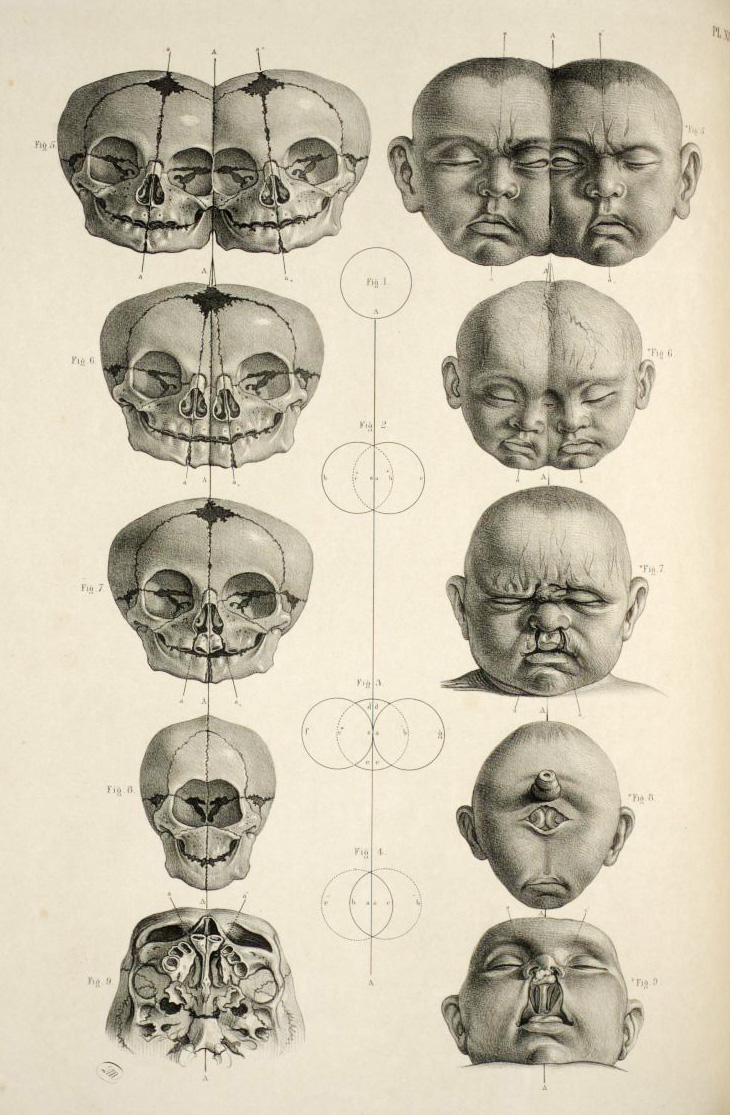
    Friend of Morbid Anatomy Todd Vladyka has just let me know about a rather exciting looking consortium taking place next week at the College of Surgeons (home of the Mütter Museum); highlights include an entire panel devoted to "The 'Art' of Anatomy and Other Collections," which will consist of a presentation devoted to the art of Joseph Maclise (as seen above), and two other presentations entitled "The Exquisite Cadaver and the Evolution of the Anatomic Theater"and "Constituting the Syphilitic Collector."

    The opening lecture--"What Mark Twain Might Tell Us (And Ask Us) If He Could Join Us Tonight"--is free and open to the public; $25 for students or $50 for non-students will gain you admission to all the other events.

    Full details follow; very much hope to see you there!
    The Pennsylvania Medical Humanities Consortium
    Through the Lens of Time: Perspectives on Medicine and Health Care
    May 19 – 20, 2010

    Events on Wednesday, May 19, 2010

    2 – 4 p.m. Visit the Ars Medica Collection at the Philadelphia Museum of Art’s new Perelman Building (across from the Museum’s main building, corner of Pennsylvania and Fairmount Avenues); Hosted by Peter Barberie, PhD, The Brodsky Curator of Photographs [Note: This tour is now full!]

    6:30 – 8:30 p.m. What Mark Twain Might Tell Us (And Ask Us) If He Could Join Us Tonight, K. Patrick Ober, MD, Professor of Internal Medicine and Associate Dean for Education, Wake Forest University School of Medicine, Winston-Salem, NC; author of Mark Twain and Medicine: Any Mummery Will Cure.

    At the College of Physicians of Philadelphia, 19 South Twenty-Second Street (between Chestnut and Market Streets).

    Wine-and-cheese reception to follow. This program is open to the public.


    Events on Thursday, May 20, 2010

    At The College of Physicians of Philadelphia, 19 South Twenty-Second Street

    8 a.m. Breakfast – Mitchell Hall

    8:30 a.m. Welcome
    Rhonda L. Soricelli, MD – Chair, Program Committee
    Paul C. Brucker, MD – President, College of Physicians of Philadelphia
    Mary Ellen Glasgow, PhD, RN – Associate Dean, Drexel University College of Nursing & Health Professions

    8:45–9:45 a.m. Opening Session – Mitchell Hall
    The Medical/Healthcare Humanities: Where We Are; Where We’ve Been; Where We’re Going
    Moderator: David H. Flood, PhD
    • Humanism Versus Humanities in Medicine: An Historical Perspective, Jack Coulehan, MD, MPH
    • Medical Humanism/Professionalism Teaching in a Community Hospital Since WWII, Victor Bressler, MD
    • Disability, Medicine, and Representation: Integrating Disability Studies into Medical, Education and Practice, Rebecca Garden, PhD
    • American Missionary Health Care Projects in the late Ottoman Empire: Civilization, Hygiene, and Salvation, Sylvia Önder, PhD
    9:45–10:15 a.m. Discussion: Flood, Coulehan, Bressler, Garden and Önder

    10:15 – 10:30 a.m. Morning break – Mitchell Hall

    10:30 – 11:30 a.m. Concurrent sessions

    1. Cholera and Its Representations – Mitchell Hall
    Moderator: Steven J. Peitzman, MD
    • Cholera, Commerce, and Contagion: Rediscovering Dr. Beck’s Report, Ashleigh R.Tuite, MHSc(c) and David N. Fisman, MD
    • The Epidemic Behind the Veil: Cholera in Fiction, Film and History, Agnes A. Cardoni, PhD; Molly Bridger; Angel Fuller; and Casey Kelly
    2. Impact of Illness and Disabilty – Gross Library
    Moderator: Jennifer Patterson, DO(c)
    • Home Sweet Home: The Impact of Poliomyelitis on the American Family, Richard J. Altenbaugh, PhD
    • Casualties of the Spirit: The Transatlantic Origins of Post Traumatic Neuroses, Susan Epting, PhD(c)
    • Turning a Blind Eye to the Rehabilitation Act: Meaningful Access and the Dollar Bill, Kenji Saito, MD/JD 2010(c)
    3. The Medical Environment – Koop Room
    Moderator: Todd Vladyka, DO
    • The Anemic Narrative: Will the electronic health record reduce the patient narrative to a footnote?, Valerie Satkoske, MSW, PhD
    • Gender Roles and the Changing Face of Medicine, Nina Singh, MD and Gabrielle Jones, PhD
    • The Changing Public Image of the American Catholic Hospital, 1925 – Present, Barbra Mann Wall, PhD
    11:45 a.m. – Concurrent sessions

    12:45 p.m.

    4. Exploring the Text – Koop Room
    Moderator: Jack Truten, PhD
    • Was Sherlock Holmes a Quack? Or, Why Arthur Conan Doyle’s Medical Stories Matter, Sylvia A. Pamboukian, PhD
    • Reaching Back Through Time: Constructing Genealogies of the Not-Neurotypical in Illness, Narratives, Elizabeth A. Dolan, PhD
    • Pathographies: Teaching Illness, Creating Theory, Karol Weaver, PhD and
    • A Recovery Narrative, Jenny Traig’s Devils in the Details: Scenes from an Obsessive Girlhood, Sara Kern
    5. Alternative Dimensions in Health Care – Gross Library
    Moderator: Steven Rosenzweig, MD
    • Cacao: From Ethnobotany to Translational Medicine, William J. Hurst, PhD
    • Just Language: The Key to Bridging the Gap Between Physicians and Patients, Kathryn M. Ross, MBE, DMH(c)
    • Historical Perspectives on Compensation in Human Subjects Research, Ilene Albala, JD/MBE(c)
    6. On Stage and Screen – Mitchell Hall
    Moderator: Joe Vander Veer, Jr., MD
    • Dramatizing the Local History of Medicine: An Early 21st Century Perspective on the Yellow Fever Epidemic of the Late 19th Century, Robert J. Bonk, PhD
    • Television’s Images of Health Practitioners and/or Health Care Institutions Through the Ages, Rosemary Mazanet, MD, PhD and Joseph Turow, PhD
    12:45 – 1:45 p.m. Lunch with Performance – Mitchell Hall
    My doc’s better than your doc: Medical advertising’s rinse and spin and the lost voice of Arthur Godfrey, Richard Donze, DO, MPH

    2:00 - 3:00 p.m. Concurrent sessions

    7. Narratives of Illness, Aging and Grief – Koop Room
    Moderator: Kimberly Myers, PhD
    • Listening to the Stories of Patients, David Biro, MD, PhD
    • MY FATHER’S HEART: A Son’s Reckoning With the Legacy of Heart Disease, Steve McKee
    • Imagining Death: Contemporary Grief Narratives, Kate Dean-Haidet, RN, MSN, MA, PhD(c)
    8. The “Art” of Anatomy and Other Collections – Mitchell Hall
    Moderator: Jan Goplerud, MD
    • Joseph Maclise and the Anatomical Arts Tradition, Rebecca E. May, PhD
    • The Exquisite Cadaver and the Evolution of the Anatomic Theater, Sherrilyn M. Sethi, MMH(c), DMH(c)
    • Constituting the Syphilitic Collector, Elizabeth Lee, PhD
    3:15 – 4:15 p.m. Closing Panel – Mitchell Hall
    Moderator: Rhonda L. Soricelli, MD
    The Virtual and the Real: Medical History at the 21st Century Mutter Museum, Robert Hicks, PhD; Anna Dhody, MA and Karie Youngdahl, BA

    4:20 – 5:00 p.m. Wrap-up; future plans for consortium

    Program Committee: Andrew Berns, PhD(c), David H. Flood, PhD, Jan Goplerud, MD, Steven J. Peitzman, MD, Rhonda L. Soricelli, MD (Chair), Joseph Vander Veer, Jr., MD and Todd Vladyka, DO.

    This meeting is made possible through the generous support of The College of Physicians of Philadelphia’s Francis C. Wood Institute for the History of Medicine and Sections on Medicine and the Arts and Medical History and Drexel University’s College of Nursing & Health Professions and College of Medicine with additional support from the Department of History and Sociology of Science, University of Pennsylvania
    To register, please send an email to RLSoricelli@comcast.net no later than MAY14th midnight. Registration is mandatory for the symposium.

    Image above, "Head and skull of malformed infants; conjoined twins, bilateral cleft lip and holoprosencephaly" from Joseph Maclise's book Surgical Anatomy, published in London in 1856. Click on image to see much larger version; Found on the N-66 Blog.

    Tuesday, December 8, 2009

    National Library of Medicine's History of Medicine Syllabus Archive


    I just discovered that in addition to their wonderful web exhibitions and online image collection, the National Library of Medicine also has an online archive of history of medicine syllabi, which it touts as "the world's largest." The collection can be browsed by professor, title, institution, or subject and looks, after a quick perusal, to be pretty rich. A great resource for anyone--like myself--interested in teaching themselves more about the history of medicine without going to grad school.

    Click here to explore the syllabi collection for yourself. Found via Somatosphere.

    Image: "The human body and the library as sources of knowledge", frontispiece of Tabulae Anatomicae, Early 18th cent., Johann Adam Kulmus; found via the National Library of Medicine's "Images from the History of Medicine;" Larger version found on Bibliodyssey's Flickr set.

    Monday, December 7, 2009

    My New Favorite Magazine : Lapham's Quarterly


    To the pain in the womb. O womb, womb, womb, womb. Boxy womb, red womb, white womb, fleshy womb, bloody womb, large womb, bloated womb--demonic womb.
    --From a prayer for curing hysteria, C. 950 , Europe. Lapham’s Quarterly Medicine Issue, p. 175
    At a recent open studio event, I met an editor for a magazine I had never heard of: Lapham's Quarterly. Interestingly, the current issue's theme was medicine, and the editor promised to send me a copy to check out. What I received has fast become my new favorite magazine.

    A kind of Cabinet Magazine for the history set, this digest-sized, beautifully illustrated tome is a delightful, intriguing and thought-provoking read. Each issue utilizes a sort of patchwork, magpie approach to the theme; contents include historical pieces (see epigraph above), artworks, quotations, and contemporary writings that approach the topic obliquely and with a restrained, urbane wit, resulting in an impressionistic, playful, suggestive portrait of the topic. Former issues of the magazine--described by founder Lewis H. Lapham (formerly of Harper’s Magazine) as a magazine for “people who wished they had paid more attention in school” (1)--have tackled themes such as Eros, Crimes and Punishment, and Book of Nature; the next issue will be Religion.

    The Medicine Issue will be on the newsstand until December 15th. I highly recommend you pick up a copy before it disappears. Truly not to be missed!

    You can find out more about the Lapham's Quarterly Medicine Issue--and read some of the pieces, including Lewis Lapham's brilliant introduction--by clicking here. You can find out more about the magazine in general by clicking here. Visit the magazine's blog by clicking here. Read more about the magazine in this recent New York Times story, from which the quotation above is drawn.

    Image: From the revelatory Wellcome Images. Credit: Position of the right hip. Figure showing child being turned in the womb. Engraving; From: Nouvelles demonstrations d'accouchemens, By: Jacques Pierre Maygrier; Published: BechetParis 1822; Credit: Wellcome Library, London

    Friday, July 10, 2009

    The Art and History of the Death Mask


    Death doesn’t lie, so death masks – a cast of the face in wax or plaster, taken just hours after breath has gone – promise truthful representations of the departed. In an era before photography, these masks give us each beauty and blemish, a living presence in unchanging material. But how were they made? And what is their uncanny allure?...
    So begins Obit Mag's article "Death Doesn't Lie," which offers a brief discussion of the art and history of that veritable institution, the death mask. You can read the whole story (and see more images) here. Image above, labeled "Making Death Mask, from the article; click in image to see much larger version.

    Tuesday, March 3, 2009

    More Behind the Scenes of "Brought To Life"


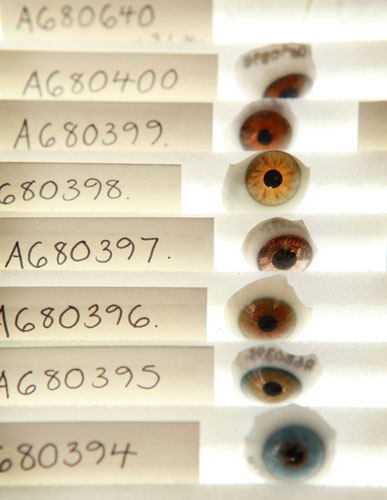
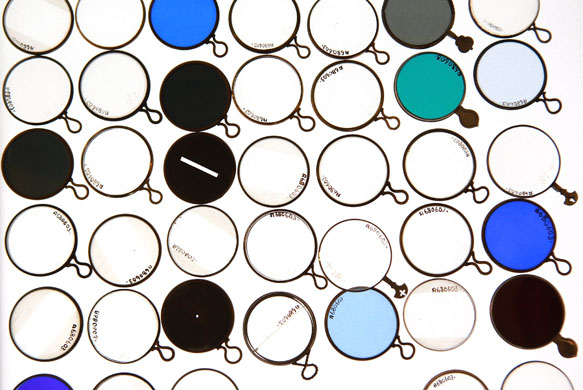
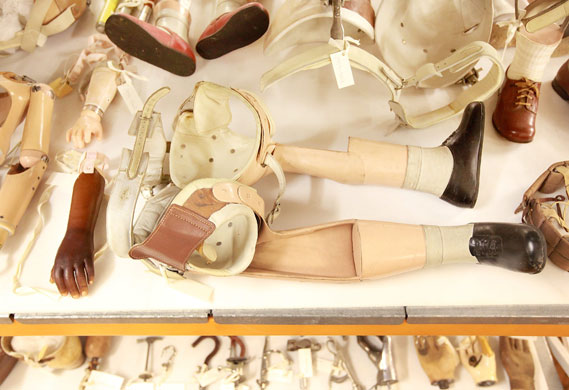
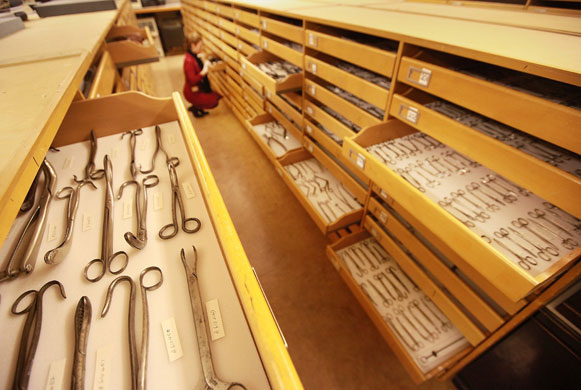
    More (see recent post) behind the scenes photos of the archives where many of the wonderful objects featured in the Science Museum of London's "Brought to Life: Exploring the History of Medicine" spend most of their time.

    All photos from The Telegraph's "Science Museum Object Store: Brought to Life: Exploring the History of Medicine" on-line slide show--click here to see full collection; Click here to visit the "Brought to Life" online exhibition. For more on this topic, see these (1, 2, 3, 4) recent posts.

    Thanks, Lisa (see bottom photo!) for sending this along.

    Behind The Scenes of The Science Museum's Medical History Collection


    Rare and unseen items from the Science Museum's object store, from the Gaurdian.co.uk slideshow. Copy reads: "Many objects in the Wellcome Trust collection, held by the Science Museum, will be on view for the first time in the museum's new multimedia resource "Brought to Life: Exploring the History of Medicine."

    Click here to see full slide-show and find out more about the images. For more on "Brought to Life: Exploring the History of Medicine," see these recent posts: 1, 2, 3. To visit the "Brought to Life" web exhibition, click here. For more visual exploration of the back room of the Wellcome Trust, see the Brothers Quay's "Phantom Museum."

    Thanks to Lisa O'Sullivan, Senior Curator of Medicine at the Science Museum, for the tip! And congratulations on the fantastic website.