Showing posts with label vanitas. Show all posts

Tuesday, May 20, 2014

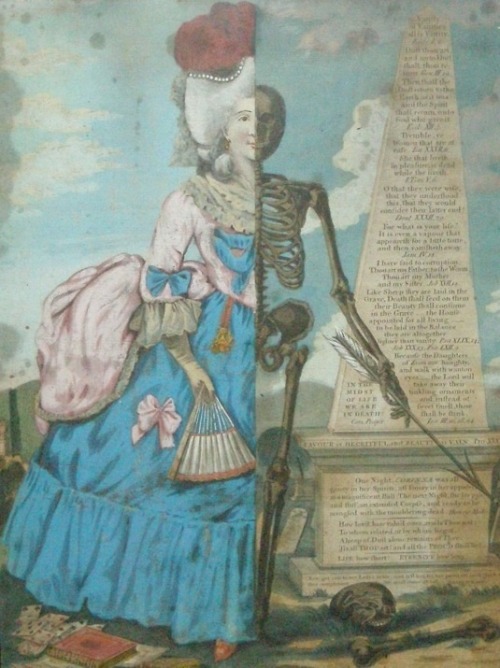
Life and Death Contrasted (ca.1770), The Public Domain Review

From one of my very favorite websites, The Public Domain Review via The Wellcome Library:
A striking image from the British engraver and publisher Valentine Green, illustrating the idea that life, with all its frivolity and distractions (symbolized by the romance novel, parlor games, and high society lady in all her finery) is in fact – echoing the sentiment of Ecclesiastes (quoted on the obelisk) – nothing but “vanity”, all lives as they do inevitably ending in death. The subtitle – “an essay on woman” – does, however, raise the question of whether Green is making a further comment on womanhood itself...
To read the full story--and see an additional image--click here.

Friday, January 4, 2013

Wonderful Italian Vanitas Bust from the Late 17th Century

An Italian vanitas bust from the late 17th century, from the exhibition “Marble Sculpture From 350 B.C. to Last Week” at Sperone Westwater as seen in a recent issue of The New York Times.

More about this exhibition, from the press release:
Marble Sculpture from 350 B.C. to last week Curated by Gian Enzo Sperone 22 December 2011New York, NY 
Sperone Westwater is pleased to present an exhibition of white marble sculptures dating from 350 B.C. to the present day. This survey includes Greek and Roman antiquities, Neoclassical sculptures, and works by modern and contemporary European and American artists. 
Marble is one of the oldest and most fundamental materials of sculpture with wide-ranging use in the fine arts, decorative arts, and architecture. Among the works from Greek and Roman antiquity in Marble Sculpture from 350 B.C. to Last Week is an Ionian Greek grave relief from the second half of the fourth century B.C. that depicts three figures presenting a narrative on a farewell to the deceased. A Vestal statue from the second century A.D. represents the virgin goddess of hearth, home, and family in Roman religion. Notable Roman sculptures from the first and second century A.D. are also presented including a vase and a bust of young man. Significant sculptures from the fifteenth to nineteenth centuries include Icarus, the mythological figure of a man with wings, by Tommaso Bonazza (Venice 1696 – Padua 1775), as well as Hercules by Giacomo Cassetti Marinali (Venice 1682 – Vicenza 1757), carved out of pietra di Vicenza, to name a couple.The modern and contemporary works in Marble Sculpture provide a different context for the ancient material. Pioneer of the Dada movement, Jean Arp created Mediterranean Sculpture I (Orphic Dream), 1941, a biomorphic sculpture that has rounded and angular edges, encompassing the artist’s desire to conflate nature’s different forms. Richard Long’s Heaven (Portrait of Carl Andre), 2011, consists of six rows of large marble blocks. Infinite, 2011, by Fabio Viale, depicts two interlocked tires carved out of marble. Not Vital’s 1/2 Man 1/2 Animal, 1996, is an eleven-foot tall anthropomorphic sculpture that resembles a mythical creature. An installation of five slabs, Ai Weiwei’s Marble Doors, 2007, depicts a barricade of white and grey doors. Bertozzi & Casoni’s Gorilbattista, 2011, is a vanitas sculpture of a gorilla head on a plate. Tom Sachs’s Brute, 2009/2010, transforms an ordinary lightweight object to the extraordinary through the medium of marble. In Purity, 2008-2011, Barry X Ball reinvigorates the age-old tradition of figurative marble sculpture through the use of unconventional stones and methods.
Click on image to see larger, finer version.

Wednesday, December 28, 2011

Vanitas Drawing Featuring Real Human Skeleton, With Classically Trained Artist Lado Pochkhua: Observatory, 6 Mondays Beginning Jan. 9


We have a new art class beginning on Monday, January 9th that I am very very excited about. Lado Pochkhua, an accomplished classically trained artist from Eastern Europe (see following bio) and artist in residence at our sister space Proteus Gowanus will, using a variety of artifacts drawn from The Morbid Anatomy Library, teach students to create and draw their own “vanitas”--or mortality-themed still life--compositions. The main star of said Vanitas composition will be the genuine human skeleton recently donated to the library, which you can see in the photograph above.

Full details follow; this is sure to be a awfully terrific class. Hope very much to see you there!

Vanitas Drawing Class with Classically Trained Artist Lado Pochkhua
Date: 6 Mondays, January 9th through February 13th
(Jan. 9, Jan. 16, Jan. 23, Jan. 30, Feb. 6 & Feb. 13)
Time: 7:30-10:00 PM
Admission: $110 (classes can also be taken individually on a drop-in basis for $20 per class)
*** This class has a 10 person size limit; Please RSVP for full course at morbidanatomy [at] gmail.com
This class is part of the Morbid Anatomy Art Academy

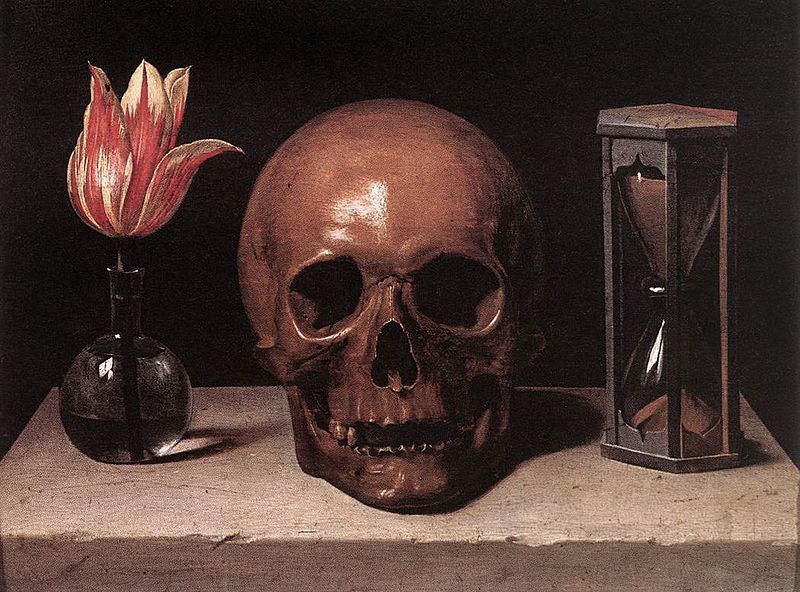
Vanitas is a genre of still-life painting that flourished in the Netherlands in the early 17th century. A vanitas painting contains collections of objects symbolic of the inevitability of death and the transience and vanity of earthly achievements and pleasures, exhorting the viewer to consider mortality and to repent.

This Vanitas course will comprise six drawing lessons in which, using artifacts drawn from The Morbid Anatomy Library, students will learn how to create and draw their own “vanitas” composition. The ultimate goal of the class will be not only the creation of this particular drawing, but also understanding of the principles of classical drawing. The instructor will also share historical images throughout the course.

No previous drawing experience necessary; all levels are welcome!

MATERIALS
Please bring with you to class:

  • One drawing pad at least 18" X 20" with a firm back; paper Fabriano or Arches, or Strathmore 400
  • Pencil: HB, 2B, 4B, simple graphite pencils, (no charcoal !!!)
  • Eraser

ABOUT THE INSTRUCTOR
Lado Pochkhua
was born in Sukhumi, Georgia in 1970. He received his MFA in Painting and Printmaking from Tbilisi State Art Academy in Georgia in 2001. He currently divides his time between New York and Tbilisi, Georgia.

Selected Exhibitions:

  • 2011 “Works from the Creamer Street Studio,” at the Literature Museum, Tbilisi Georgia (solo show)
  • 2010 “Paradise ” at Proteus Gowanus, New York
  • 2009 “Prague Biennale 4,” Georgian pavilion
  • 2009 “The Art of returning Home,” Arsi Gallery, Tbilisi Georgia (solo show)
  • 2008 Gardens, Ships, and Lessons, K. Petrys Ház Gallery, Budapest, Hungary (solo show) Exhibition of Georgian Artists, Festival OFF EUROPA ditorei Gallerie NBL, Leipzig, Germany
  • 2004 Artists of Georgia, Georgian Embassy, London, UK
  • 2003 Curriculum Vitae: a retrospective of 20th century Georgian art, Caravasla Tbilisi History Museum, Tbilisi, Georgia, Waiting for the Barbarians, Gallery Club 22, Tbilisi, Georgia (solo show)
  • 2001 21 Georgian Artists, UNESCO, Paris, France
  • 1998 Magical Geometry, TMS Gallery, Tbilisi, Georgia (solo show)
There is a 10 person limit for this class; you can sign up by sending an email to morbidanatomy [at] gmail.com. This class is one of the newest installments in the series newly termed The Morbid Anatomy Art Academy; to find out more about that--including a full class list thus far--click here.

Images: Top image: Still-Life with a Skull, "Vanitas" by Philippe de Champaigne (1602–1674) via Wikimedia; Bottom image: Skeleton from The Morbid Anatomy Library who will be featured in our Vanitas compositions

Monday, June 28, 2010

Vanitas, 18th Century


Via Wunderkammer.

Tuesday, September 23, 2008

Vanitas Figure, Wellcome Collection, London


While in the UK the last few weeks, I had the immense pleasure of visiting the Wellcome Collection. I could not recommend this museum more highly; it was the most exciting museum I have visited in a long while. More images and a more complete review to come, but for now, as I sort through my scores of photographs, please accept my offering of this beautiful wax, cloth, and hair vanitas figure, probably made in Europe in the 18th century, on display in the Medicine Man exhibit, and is on loan from the Science Museum. More to come soon--I promise!