
Liza Young--a museum studies student at St. John's University--recently chose a Neapolitan tin votive, or ex-voto, residing in the Morbid Anatomy Library as the subject for a school research project. Her task: to take an artifact of her choosing and research its provenance, situate it historically, and write for it a museum-quaility object record.
Below are her findings in truncated version; you can read a much more detailed report of her investigation by clicking here; you can find out more about Liza and her work by clicking here.
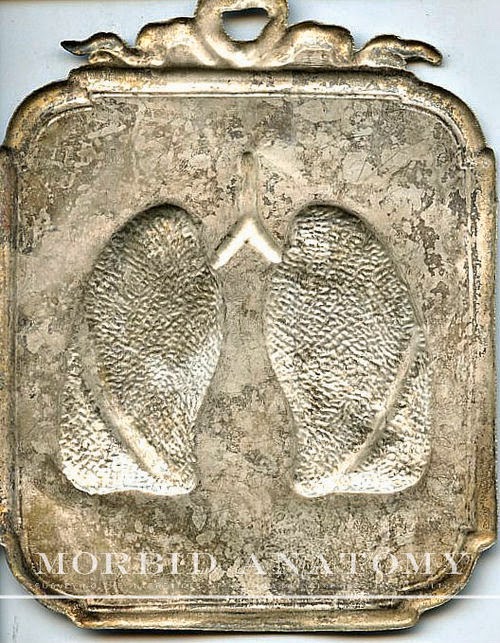
Anatomical Ex-Voto of Lungs from The Morbid Anatomy Library
Work Type: Italian Religious Visual Work
Title: Anatomical Votives of Lungs, or Ex-Voto
Creator: Unknown
Material: Tin
Dimensions: 3 ¾ x 4 ¼ inches
Work Type: Italian Religious Visual Work
Creation Date: 1890-1960
Subject: Religion
Style: Catholic
Culture: Italian
Materials and Technique: Tin plate stamped with image of lungs
The artifact I have chosen for this project was discovered at a flea market in Italy by Joanna Ebenstein, the Creative Director of the Morbid Anatomy Library and Museum. This anatomical ex-voto, or votive, bears a stamped image of the ailing lungs of an unknown Catholic Italian. Anatomical ex-votos function as representations of body parts that are either in need of a saint’s blessing, or as an homage of thanks to a saint for a blessing given. The external parts of the body may be used more metaphorically. A leg may represent an injury or a request for safe travel. Eyes may create a connection between the living and the dead (not unlike darshan). Internal organs, on the other hand, tend to relate directly to a literal illness. Today they are used primarily in Greek Orthodox and Catholic practices, where they are known as tama (Greek) and milagros, dijes, or promesas (Spanish). The exact date of this object is unknown, though it is likely that it was created in the early half of the 20th century. This dating is derived in part by the presence of two golden orbs on the left lung, which indicates a specific understanding of where the individual’s disease was located, implying the existence of advanced medical practice.
Thanks so much, Liza, for this excellent report, and we hope to work with you again in the future!
Image: © The Morbid Anatomy Library