Showing posts with label art. Show all posts

Monday, March 14, 2016

The Art and Anatomy of St. Bartholomew: Guest Post by Artist and Anatomist in Residence Emily Evans

Following is a guest post by Artist and Anatomist in Residence Emily Evans about flayed Saint Bartholomew and his curious afterlife in early anatomical illustration. You can find out more about Emily and her work here.
Tradition holds that the apostle Bartholomew was martyred by being flayed alive.
This brutal torture has been depicted in many different ways over the centuries. He is sometimes depicted holding the knife, which symbolizes his martyrdom. The artworks seem to evolve over time from showing him just before the blade strikes, to when flaying occurs and then in later works after the act, where he is draped in, or holding his own skin.

It can be difficult to view these artworks reflecting the act of being skinned alive without squirming thinking of the pain and blood. This is especially so in the early religious paintings of the saint.
Fine artists took the iconic portrayal of St. Bartholomew to use in their work. One of the most famous being Michelangelo who included Bartholomew holding a sheet of his own skin in his left hand and in his right hand is a knife in his famous Last judgment, in the Sistine chapel, The Vatican, Rome. The face on the skin is reputed to be a self-portrait of the artist.
For the anatomists among us, it’s possible to see past the grotesque barbaric act of flaying to reveal the beauty of the musculature beneath.

Medical illustrators took this concept and depicted a flayed anatomical man in a more anatomical context than religious one in the famous 16th century anatomical publications.

In 1543, Andreas Vesalius published De humani corporis fabrica (On the fabric of the human body). This groundbreaking anatomical tome consisted of engravings which many believe were created by Titian's pupil Jan Stephen van Calcar.

In 1560, Juan Valverde de Amusco published Historia de la composicion del cuerpo humano of which all but 4 of its 42 engravings were taken almost directly from Vesalius’s Fabrica. The original illustrations are thought to be drawn by Gaspar Becerra who was a contemporary of Michelangelo, and the copperplate engravings executed by Nicolas Beatrizet.

This movement from the religious to the more artistic and anatomical depictions of Bartholomew continued with the sculpture by Marco D’Agrate who was a pupil of Leonardo da Vinci. It begins to become clear how d’Agrate was interested more in the relationship between art and science than in the one between art and religion.
The American writer Mark Twain certainly did not see this beauty when he saw Marco d’Agrate’s statue of St. Bartholomew in Milan where the saint is shown wearing his skin like a stole. He wrote in 1867:
‘The figure was that of a man without a skin; with every vein, artery, muscle, every fiber and tendon and tissue of the human frame represented in minute detail. It looked natural, because somehow it looked as if it were in pain. A skinned man would be likely to look that way unless his attention was occupied with some other matter.

‘It was a hideous thing, and yet there was a fascination about it somehow. I am very sorry I saw it, because I shall always see it now. I shall dream of it sometimes. I shall dream that it is resting its corded arms on the bed’s head and looking down on me with its dead eyes; I shall dream that it is stretched between the sheets with me and touching me with its exposed muscles and its stringy cold legs. It is hard to forget repulsive things’
In 2002, Gunther Von Hagen’s Bodyworlds came to London, and I saw ‘The Skin Man’ for the first time. Hagen’s plastination process enabled the first and only depiction of Bartholomew in actual human tissues.

Not long after, I saw Hirst’s ‘Exsquisite Pain’ at Royal Academy of Arts Summer Exhibition 2009. This silver edition of the piece stands Bartholomew on a table covered in tools with a scalpel in one hand to reflect dissection traditions and in the other hand he is holding scissors (said to be inspired by Tim Burton’s film ‘Edward Scissorhands’ of 1990).

You can currently see an edition in gold at Great St Bartholomew church, London for the next few years.

Oddly, St. Bartholomew is also the patron saint of tanners!
Images top to bottom:
Fig.1. Saint Bartholomew, Church of San Laureano, Boyacá, Colombia (year not known)
Fig.2. Martyrdom of St. Bartholomew, (1355-1360) Prato, Museo di Palazzo
Fig.3. The Apostle St Bartholomew, (1480) Matteo di Giovanni Museum of Fine Arts, Budapest Hungary.
Fig.4. St. Bartholomew displaying his flayed skin in Michelangelo's The Last Judgment. (1536-1541)
Fig.5. Juan Valverde de Amusco's Historia de la composicion del cuerpo humano (Rome, 1560)
Fig.6. Statue of St. Bartholomew, with his own skin, by Marco d'Agrate, 1562 (Duomo di Milano)
Fig.7. Statue of St. Bartholomew at the Archbasilica of St. John Lateran by Pierre Le Gros the Younger. (1666-1719)
Fig.8. The Skin Man, Gunther von Hagens, Institute for Plastination, Heidelberg, Germany, (1993)
Fig.9. Damien Hirst, Saint Bartholomew, Exquisite Pain, 2007, Silver

Sunday, November 8, 2015

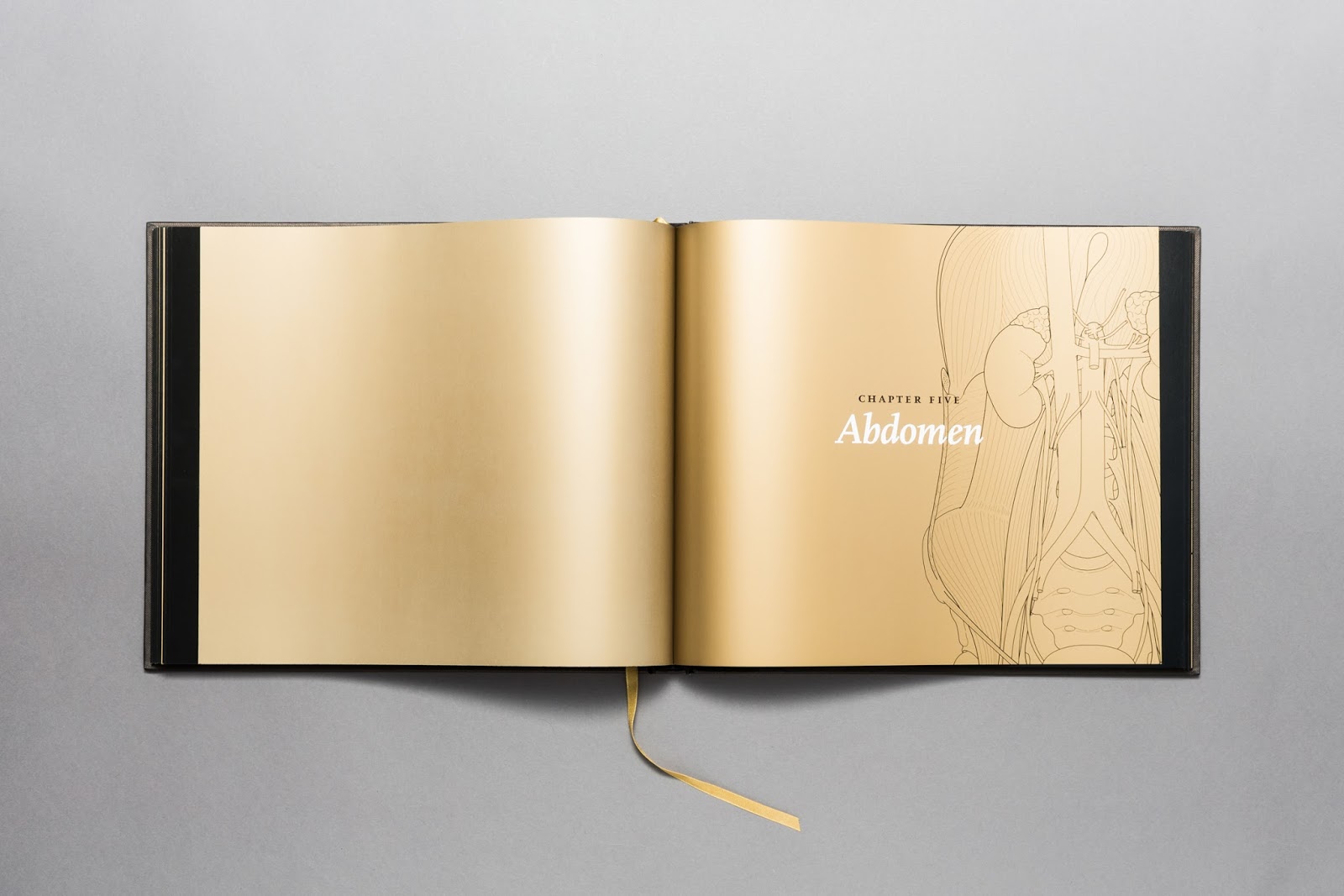
Anatomy in Black: A New Anatomical Atlas in Black and Gold by Artist and Anatomist Emily Evans

http://morbidanatomy.bigcartel.com/product/anatomy-in-black-by-emily-evans-preorderhttp://morbidanatomy.bigcartel.com/product/anatomy-in-black-by-emily-evans-preorder
http://morbidanatomy.bigcartel.com/product/anatomy-in-black-by-emily-evans-preorder
Morbid Anatomy Artist and Anatomist in residence Emily Evans has just published a gorgeous and eminently covetable new anatomical atlas entitled Anatomy in Black. With over 250 illustrations custom created by Evans and rendered entirely in black and gold, this book will, in the words of its maker, lead "you stylishly through the human body from head to toe. This book is a perfect companion for those interested in anatomy, regardless of their previous knowledge of the subject matter."

The Morbid Anatomy Museum will be hosting a talk by Evans, and party to celebrate the release of the book this Wednesday, November 11th; you can find out more, and get tickets, by clicking here; you can also preorder a copy of the book by clicking here.

Morbid Anatomy asked Evans--who in addition to her illustration acts as Senior Demonstrator of Anatomy at Cambridge University, where she teaches dissection and anatomy--to share a bit about the book, and her motivation in making it; below is her response, in the form of a guest post:
I wanted to create a sophisticated and luxurious book of anatomy and the perfect object to have on your coffee table to dip into or spark conversations when guests are over for cocktails. A sexy anatomy book if you like!

I’ve spent years illustrating some of the most high profile medical textbooks of anatomy, which need to adhere to the ‘educational’ aesthetic. Although this makes them clear for learning, it’s not necessarily a book someone would want on display. This is particularly apt if someone hasn’t studied anatomy, they may feel the standard anatomy books, though having beautiful images, are completely inaccessible for someone who is merely a voyeur of anatomy.

Creating the book entirely in decadent gold and black was key to reproducing anatomical imagery in a contemporary format that had not been done before. This allows the images to be framed in a way that they appear quite abstract, and can be appreciated for their beauty, shape and design without the preconceptions of traditional anatomical imagery that we’re used to (the familiar coloured anatomical images that can trigger many people to feel squeamish or back at school).

It was crucial to me that the illustrative content of the book was a reflection of the same level that anatomy students need to know with nothing omitted or dampened for the lay audience. My experience teaching anatomy and human dissection for the last 14 years has aided me in including the relevant information in a clear and concise manner. The ultimate aim is that it is a book that showcases the beauty of human anatomy in a way that is of interest to both professionals and spectators alike.

Tuesday, October 7, 2014

The Carving of Guy of Gaunt: A Modern Day Transi Tomb Sculpture: Guest Post by Sculptor Eleanor Crook


Friend of Morbid Anatomy and future Artist in Residence Eleanor Crook--an amazing sculptor and waxworker--is currently crowdsourcing a project to carve a new wooden "transi," or type of tomb sculpture popular in late Medieval Europe which depicts the rotting body cadaver in the grave below. She is doing this project in tandem with Dr. Christina Welch of Winchester University in England, a researcher and cataloger of historical transi.

Following, in Eleanor's own words, is a brief history of the transi, and a description of her proposed project; to find out more, watch the video above or click here. You can support this very worthy project by clicking here. For a recent post on one of the most famous historical transis--that of René de Chalon--click here.

The Carving of Guy of Gaunt: A Modern Day Medieval Cadaver Tomb and a Transi for Everyone 
Guest Post by Sculptor Eleanor Crook

The most morbid and anatomical tomb statues  ever made were the Transi tombs of late Medieval Europe. (“Transi” in Latin means “I have passed over.”) Wealthy aristocrats and high-ranking churchmen arranged for their grave monuments to show them in death as an emaciated, naked corpse in a funeral shroud, with a skeletal grimace leering in the face of mortality (see image above).

The exact meaning of so graphic an image of death on the monuments of the powerful has been shrouded (sorry) in mystery for five centuries, but is now the subject of a scholarly study by Dr Christina Welch of Winchester University in England. She has visited, photographed and catalogued the Transis and compared them with what is known about late Medieval Catholic beliefs about the Afterlife, and will shortly be publishing her fascinating findings. She has invited me, an anatomical and morbid sculptor (known to some of you in Morbid Anatomy through my workshops and exhibitions over the last few years)  to join in the research by carving a new Transi in wood, a Transi for today and for us all.

The physical presence of the Transis is amazing; they are neither altogether alive nor altogether dead, and their anatomy is surprisingly accurate and lovingly carved, given a society where nakedness was shameful and clothing far from revealing. Their racked ribs heave upwards as though for a last breath; the veins stand out on their harrowed limbs, necks and temples. Their hollow eyes are often partly open, their mouths agape in a final agony. Although they depict specific historical figures, they stand in for any of us with our mortal body, our fear of what comes after, our vulnerable and failing flesh. Speaking as one who has worked in medical museums and dissection rooms, I truly believe they were carved from first hand observation of deceased persons by the sculptors as nothing else explains the astonishing realism – at a time when the sculptures of the living were still rather formalised and generalised. More lifelike than the living?  I would say so.


Some of the Transi tombs are like bunk beds – the idealised person shown laid in state above, the shrivelled corpse lying directly below like a bad conscience, raising questions about the soul, purgatory and the idea of bodily resurrection on the Day of Judgement.


They were often painted in lifelike ( deathlike) colours with blue veins and coloured skin. Some patrons commissioned them while they were still alive: one well known Bishop delivered his sermons from a pulpit right above his own completed Transi, which must have been a sobering experience for his flock and for him too.


British Transis are rare: Originating in late 14th century France, the first monument in England was that of Archbishop Henry Chichele (c.1364-1443), which was constructed around 1425 (almost twenty years before his death) and is in Canterbury Cathedral. The English carved cadaver memorials date from between c1425 to 1558. However, in art history they have not received the attention they deserve, inexplicably passed over despite their powerful appeal. Readers of the Morbid Anatomy Blog will be surprised to hear that many Transis are tucked away , forgotten and dusty in their local churches and cathedrals, their true meaning a mystery to most and their uncompromising gruesomeness  out of step with contemporary church sensibilities, given the British tendency to brush death under the carpet. Christina plans to publish a book on these neglected and little known monuments to mortality, with photographs and a chapter on techniques , and reinstate them as an important contribution to the art of the memorial.

And my Transi wood carving? I have long been fascinated with the matter of the body and how it can support life one moment and then become an inanimate object, a corpse, the next. I have had experience of dissection and autopsy, studied anatomy and drawn skeletons and specimens for years, all leading up to the  point where I can hew a universal image of bodily mortality from real sources and using the accumulated knowledge and fascination I  - and all readers of this blog no doubt - have. I learned wood carving at a traditional school in the Austrian Alps where the Catholic Church still requires wooden painted saints. Bellow is my carving of the head of St. Edmund , an early Christian martyr who lost his head to Vikings (but the head kept calling out to his faithful followers!)


If you would like to be involved in the new Cadaver Tomb, you can , by contributing to our Crowdfunding appeal to pay for the seasoned prepared block of suitable wood and transport of a two – meter high block to my studio and to the exhibitions (I am donating my time and strong right arm for free) -  in return for prints of Christina’s photos of Transis or prints of my drawings of them, depending on contribution. Our appeal is 74% funded at time of writing and I have been overjoyed at the collective excitement at the idea of a new Transi carving, the first in over 500 years: I will be carving it in honour of all of those of us who are bold and proud in facing the mortality of the body and the mystery of the human condition.
Eleanor Crook, Sculptor

To support the carving of Guy the  Gaunt please pledge at
http://www.crowdfunder.co.uk/guy-the-gaunt/

For more information on the Carved Cadaver memorials please visit http://carvedcadavers.wix.com/eccm 

For more information on Eleanor Crook please visit http://www.eleanorcrook.com.


Images, top to bottom:
  1. Archbishop Henry Chichele c.1364-1443, Canterbury Cathedral
  2. Detail of image 1
  3. Transi Tomb of John FitzAlan, 14th Earl of Arundel, at Arundel Castle chapel
  4. Unidentified Transi, Hemingbrough, UK
  5. Eleanor Crook's carving of St. Edmund
  6. Transi of William Parkhouse, Exeter Cathedral

Tuesday, May 20, 2014

Life and Death Contrasted (ca.1770), The Public Domain Review

From one of my very favorite websites, The Public Domain Review via The Wellcome Library:
A striking image from the British engraver and publisher Valentine Green, illustrating the idea that life, with all its frivolity and distractions (symbolized by the romance novel, parlor games, and high society lady in all her finery) is in fact – echoing the sentiment of Ecclesiastes (quoted on the obelisk) – nothing but “vanity”, all lives as they do inevitably ending in death. The subtitle – “an essay on woman” – does, however, raise the question of whether Green is making a further comment on womanhood itself...
To read the full story--and see an additional image--click here.

Sunday, February 16, 2014

"Machina del Mondo," Etching with Hand-Coloring, 1675-1710

 
"Machina del Mondo, ogn'un cerca di star sopra il compagno;" etching with hand-coloring, 1675-1710

Described on the British Museum website thusly: "A pyramid of ten persons climbing on top of each other, the poor at the bottom, the king at the top; Death appears to take them all."

Found via BibliOdyssey; more here.

Wednesday, February 5, 2014

"A Skeleton as a Woman Warning of the Dangers of Fornication," Oil on Canvas, French or Spanish School, c.1680

"A Skeleton as a Woman Warning of the Dangers of Fornication"
French or Spanish School, c.1680
Oil on canvas , 174 x 73 cm
From Wellcome Images; More here.

Tuesday, February 4, 2014

Please Welcome Frederik Ruysch's 18th Century "Thesaurus Anatomicus" to the Morbid Anatomy Museum Collection!

We are thrilled to announce the newest addition to the Morbid Anatomy Museum library collection: "Thesaurus Anatomicus," an 18th century guide to anatomist and artist Frederik Ruysch's museum and cabinet, lavishly illustrated by Cornelis Huyberts. If you ever wondered where the image on our t-shirts and tote bags were sourced, this is the place!

This acquisition will be the inspiration for future lectures (by folks like Evan Michelson, our scholar in residence, seen above) as well as exhibitions and publications, so stay tuned for more on that as it develops.
You can find out more about the fabulous Ruysch--whom we consider the patron saint of Morbid Anatomy, with works that so beautifully blurthe boundaries of art, religion and science--by clicking here and here.

More about the book, from Christie's auction house:
Probably the most original artist in the history of anatomical preparations, the anatomist, Frederik Ruysch enjoyed making up elaborate three-dimensional emblems of mortality from his specimens. These fantastic, dream-like concoctions constructed of human anatomical parts are illustrated in the Thesaurus on large folding plates mostly engraved by Cornelis Huyberts, who also engraved plates for the painter Girard de Lairesse, illustrator of Bidloo's anatomy. In their dreamlike qualities many of the plates depicting the preparations reflect surrealism centuries before surrealism became fashionable. Ruysch's Thesaurus Anatomicus and his Thesaurus Animalium describe and illustrate the spectacular collections of "Anatomical Treasures" which he produced for display in his home museum between 1701 and 1716 using secret methods of anatomical injection and preservation.

Ruysch's unique anatomical preparations attracted many notables to his museum, including Czar Peter the Great of Russia, who was so fascinated with the preparations that he attended Ruysch's anatomy lectures, and in 1717 he bought Ruysch's entire collection, along with that of the Amsterdam apothecary Albert Seba, for Russia's first public museum, the St. Petersburg Kunstkammer. Over the years most of the dry preparations in St. Petersburg deteriorated or disappeared, but some of those preserved in glass jars remain. A few later specimens by Ruysch, auctioned off by his widow after his death, are also preserved in Leiden. Because most of the preparations did not survive, Ruysch's preparations, and his museum, are known primarily from these publications.

Ruysch's methods allowed him to prepare organs such as the liver and kidneys and keep entire corpses for years. He used a mixture of talc, white wax, and cinnabar for injecting vessels and an embalming fluid of alcohol made from wine or corn with black pepper added. Using his injection methods Ruysch was the first to demonstrate the occurrence of blood vessels in almost all tissues of the human body, thereby destroying the Galenic belief that certain areas of the body had no vascular supply. He was also the first to show that blood vessels display diverse organ-specific patterns. He investigated the valves in the lymphatic system, the bronchial arteries and the vascular plexuses of the heart, and was the first to point out the nourishment of the fetus through the umbilical cord. Ruysch's discoveries led him to claim erroneously that tissues consisted solely of vascular networks, and to deny the existence of glandular tissue.

Thesaurus Animalium
first appeared in ten parts published in Amsterdam between 1701 and 1716.

Monday, February 3, 2014

Memorial Portrait of Prince Maurice of Saxe-Zeitz (1652-1653), Oil on Canvas, 1653

Memorial portrait of Prince Maurice of Saxe-Zeitz (1652-1653) The portrait shows the seven moths old second-born Prince Maurice after his death. Oil on canvas, circa 1653.

Via Museum Schloss Moritzburg Zeitz; you can find out more here.


Sunday, February 2, 2014

Unton Memorial Picture, Oil on Panel, Unknown Artist, c.1596.


The Unton Memorial Picture, oil on panel, by unknown artist, c.1596. Note the wonderful skeleton on his shoulder (click on image to see larger version)!

More on the painting, from the London National Portrait Gallery's website (which houses the peice):
This highly unusual narrative portrait of Unton's life was commissioned as a posthumous commemoration by his widow Dorothy Wroughton, and is recorded in her will (1634). At the heart of the composition is the portrait of Unton, flanked by figures of Fame (top left) and Death (top right), and surrounded by scenes from his life and death. These are (anti-clockwise, starting in the bottom right hand corner): 1. As an infant in the arms of his mother, Anne Seymour, formerly Countess of Warwick, at the Unton house of Ascott-under-Wychwood. 2. Studying at Oriel College, Oxford, where he took his degree in 1573. 3. Travelling beyond the Alps to Venice and Padua (1570s). 4. Serving with Leicester in the Netherlands (1585-6), with Nijmegen in the distance. 5. On his embassy to Henry IV at Coucy La Fère in northwest France, in an unsuccessful attempt to avert a peace treaty between France and Spain (1595-6). 6 On his deathbed, with a physician sent by Henry IV. 7. His body brought back to England across the Channel in a black ship. 8. His hearse on its way back to his home at Wadley House, Faringdon, near Oxford. 9. (centre right) Unton's life at Wadley House, with scenes showing him sitting in his study (top), talking with learned divines (bottom left), making music (above left), and presiding over a banquet, while a masque of Mercury and Diana is performed, accompanied by musicians. From the house his funeral procession leads, past a group of the poor and lame lamenting his death, to : 10. (left) Faringdon Church with this funeral (8 July 1596) in progress, and, in the foreground, his monument with Unton's recumbent effigy and the kneeling figure of his widow. More detailed information about this portrait to be found at www.npg.org.uk/research/programmes/making-art-in-tudor-britain/case-studies/the-portrait-of-sir-henry-unton-c.-1558-1596.php.

Thursday, September 12, 2013

Anatomical Venuses in 19th Century NYC, Gallivanting Fetal Skeletons and Human Anatomy in 18th Century Color: Morbid Anatomy Guest Posts for the New York Academy of Medicine Blog

Interested in knowing more about Anatomical Venuses on display to the paying public in 19th century New York City (top image)? Or maybe you'd like to see some adorably animated fetal skeletons drawn from a circa 1600 publication (middle image)? Or perhaps you'd be interested in learning about vibrant color renderings of human anatomy dating back to the early 1700s?

If any or all of these things are of interest, click here to check out some new, heavily-illustrated Morbid Anatomy guest posts on the wonderful New York Academy of Medicine's "Books, Health and History" Blog!

Wednesday, August 28, 2013

"Physica Sacra," Johannes Jacob Scheuchzer, 1731: Guest Post for The New York Academy of Medicine "Books, Health and History" Blog

In the run-up to the New York Academy of Medicine's upcoming Wonder Cabinet and Medical History Festival (co-curated by Morbid Anatomy and Lawrence Weschler; more here) I have been invited to write a series of guest posts for NYAM's "Books, Health and History" blog about the treasures and curiosities I have found in the Academy's vast historical collection.

I just finished the first post in that series, dedicated to one of my all-time favorite books: Johannes Jacob Scheuchzer's enigmatic and fascinating Physica Sacra, a large-scale, 4-volume high baroque extravaganza of art, science, mysticism, and all worldly knowledge. You can see one of my favorite, extremely Ruysch-esque images from that book above; you can find out more about this image, see many others, and learn more about this curious book on NYAM's Books, Health and History" blog by clicking here.

On a related aside: I am currently working on a new project with some lovely folks who have just purchased for our nascent collection a full, 4 volume, 1st edition Physica Sacra with a provenance tracing back to 18th century prime minister of Denmark Ove Høegh-Guldberg (!!!). Stay tuned for more very soon on that book and project!

Friday, August 16, 2013

Perfect Specimens: Photo Exhibition by Mark Kessell, Last Rites Gallery, NYC

I just found out about "Perfect Specimens," an interesting looking exhibition featuring work by one of our favorite Observatory presenters Mark Kessell. The opening reception is free and open to the public and will take place tomorrow night--August 17th--from 7-11 PM, at Last Rites Gallery in New York City; the exhibition will be on view through September 21st. Full details follow; all images ©Mark Kessell; more details below:
Perfect Specimen: Photos by Mark Kessell
August 17-September 21
Last Rites Gallery
Hours: Tues-Fri 2-9pm, Sat 2-9pm, Sun 2-6pm
Phone: 212.529.0666
Location: 511 W. 33rd Street, between 10th & 11th Avenues (3 blocks from Penn Station), 3rd floor, New York, NY 10001
Last Rites Gallery presents Perfect Specimens, a solo exhibition by New York photographer and artist Mark Kessell. For Kessell, art is truly a matter of life and death. Kessell, who trained as a physician, has spent the last two decades interrogating our existence through works that focus closely on the human life cycle, a universal yet intensely personal issue. Perfect Specimens explores the fundamental processes of human becoming and unbecoming, documenting what he describes as a species portrait, a map of our existence from the first stirring of life to the final phase of post-mortem decay.

These eleven works, images of the not-quite-born and the not-entirely-dead, drawn from a total of thirty-nine in the series, represent specific moments in the cycle. Initially created as daguerreotypes - a historical photographic process known as much for its potentially lethal toxicity as for its weirdly reflective surface - these works now appear as large-scale prints that allow viewers to delve deeply into both the subject and themselves.

Kessell poses a simple question: "When does being human begin and end?" As the fetuses and dying faces of Perfect Specimens illustrate, the answer is elusive. For many, the issues are moral and ethical, but this artist's approach is purely analytical.

Despite its capacity to provoke complex and sometimes disturbing emotions, Perfect Specimens is not intended to shock. Instead, its forthright depiction of the human life cycle allows space for personal reflection, an acute awareness of a shared experience. It is a chronicle of the finite nature of life.

At times, Kessell has shown us that horror, from a certain dark perspective, can be a form of entertainment - we see this, for example, in his movie-poster image for Eli Roth's Hostel - but Perfect Specimens offers no such escape. In this artist's uncomfortable perception, the human animal lives its life without drama and without significance. We come. We go. We leave barely a trace.

From our tenuous beginning to our irrevocable end, Mark Kessell's lyrical but clear-eyed gaze shows us the triumphs and horrors of being human. He brings grace and beauty to the complex questions of our existence.

Watch Mark Kessell's interview on YouTube here.

About the Artist
Originally trained as a medical doctor, Mark Kessell has been a professional photographer since graduating from the School of Visual Arts in 2000. After initially working as a daguerreotype artist, his practice has expanded to include installation, animation and sound as well as photography. His work focuses on the intersections between art, science and technology, with a particular emphasis on the construction of human identity. His works have been featured in a range of newspapers and magazines, and have served as illustrations for movie posters. He has been featured in the documentary feature film "Artists and Alchemists," as well as in the New York Times. His works are held in major collections worldwide including Los Angeles County Museum of Art, The Museum of Fine Art Houston, the International Center for Photography and George Eastman House.
You can find out more by clicking here.

All images by Mark Kessell Images, top to bottom:
  1. The Residue Of Vision
  2. Continuing To Act
  3. The New New

Thursday, August 15, 2013

Art and Anatomy Intensive Summer School Course with Sarah Simblet, Brian Catling and Eleanor Crook: Ruskin School of Drawing and Fine Art, Oxford, 2013

My good friend--and one of my favorite artists--Eleanor Crook just brought to my attention a fantastic looking art and anatomy intensive course taking place this summer at the Ruskin School of Drawing and Fine Art in Oxford. At £950.00 its a bit on the cost-y side, but what a great looking week of classes! By the end of the 7th day, you will have learned the skeleton and musculature and you will leave the course with your own hand-crafted wax model of the head and neck and ecorché (muscle figure) and, as the copy puts it, "a portfolio of new work, a much wider understanding of the subject explored and a wealth of ideas for future artistic development." Plus you get to learn from such wonderful artists as Sarah Simblet, Brian Catling and Eleanor Crook.

There are two sessions to choose form; the first is Sunday 4th August - Saturday 10th August
and the second is from Sunday 1st September - Saturday 7th September. Full details follow; You can find out more here and book a place by clicking here.
Art and Anatomy Course
Ruskin School of Drawing and Fine Art, Oxford
With instructors Dr Sarah Simblet, Brian Catling and Eleanor Crook
Session 1: Sunday 4th August - Saturday 10th August 2013
Session 2: Sunday 1st September - Saturday 7th September 2013
(Please note, both courses offer the same programme)
The fee for each course is £950.00; Places can be booked here.
I found this course a unique opportunity as it is taught by artists that have learned directly from dissecting bodies. Also, the tutors present the subject with an exciting approach as this is what they are passionate about.’
--Jaime, Summer School Participant 2011

‘Such intensity of learning the musculature was really interesting, now fully appreciate how intricately the tissues intertwined.  I’m fascinated!’  -- Summer School Participant 2012
Dr Sarah Simblet continues to offer her highly successful Art and Anatomy course in 2013. Based around Dr Simblet’s best selling book, Anatomy for the Artist, Dorling Kindersley,this year we have extended the course to 7 days. The course continues to cover aspects of human anatomy, its drawing and history.For the third year, the Ruskin will be offering two non-residential courses on Art and Anatomy. Human anatomy is explored through intensive workshops, lectures and group discussions, with time for personal studio work. Participants need to bring their own drawing materials and the Ruskin will provide easels, paper and life models. No academic or artistic criteria is required for attendance at either course although all participants must be 16 years old and over.
Participants can expect to leave our Summer School with a portfolio of new work, a much wider understanding of the subject explored and a wealth of ideas for future artistic development.

To book a place on either of these courses, please go to the University’s online booking page for Short Courses: http://www.oxforduniversitystores.co.uk
Programme
Day 1         :    Structural Drawing
Day 2         :    The Skeleton
Day 3         :    Musculature
Days 4       :    Wax Modelling Head & Neck
Day 5         :    Wax Modelling Ecorché (muscle figure)
Day 6         :    Personal studio time with tutor
Day 7         :    Life Drawing
COURSE TEACHING STAFF

Dr Sarah Simblet
Sarah Simblet is an artist who writes and draws. She is also a broadcaster, lecturer and anatomist with broad research interests in the relationship between art, science and history. She has published three major art reference books with Dorling Kindersley: ‘Anatomy for the Artist’, ‘The Drawing Book’ and ‘Botany for the Artist’ and exhibits her drawings through her books. Sarah contributes to contemporary art shows, festivals and live events and her work is held in national and private collections. She contributes regularly to British, American and international television and radio programmes about science and art, and consults on national exhibitions. She is Tutor in Anatomy at the Ruskin School of Drawing and Fine Art, University of Oxford, a freelance lecturer at the National Gallery London, and Barts and the London School of Medicine and Dentistry, and is an academic member of Wolfson College, Oxford.
http://unitedagents.co.uk/sarah-simblet
http://www.guardian.co.uk/uk/2005/sep/25/arts.artsnews
http://www.dorlingkindersley-uk.co.uk/nf/Book/BookDisplay/0,,9780751334418,00.html

Professor Brian Catling
An academic, poet and contemporary artist who has had a life long fascination with the visualisation of human anatomy in everything from wood blocks to science fiction.  Brian is a Professor at the University of Oxford, on the teaching staff at the Ruskin and a Fellow at Linacre College.
http://briancatling.com/

Eleanor Crook
Eleanor Crook is one of the world’s leading anatomical modellers in wax: a contemporary artist who uses traditional and newly invented techniques to express and explain the drama of the human body.
https://www.youtube.com/watch?v=RVL7nE4UiIs
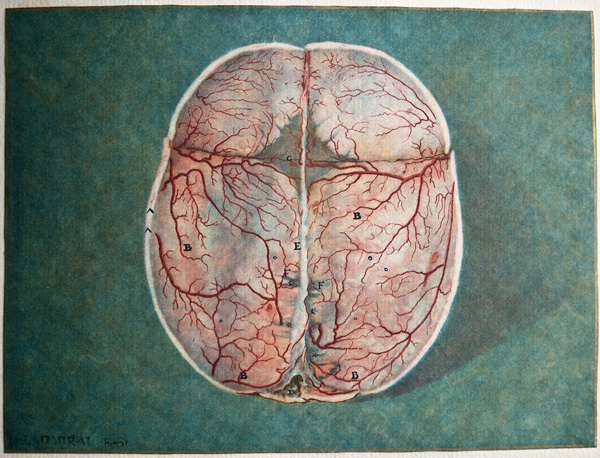
Image: Side of Head Without Skin, from Anatomia Humani Corporis or Ontleding des Menschelyken Lichaams, Govard Bidloo, 1690

Saturday, May 11, 2013

"Vision of Ezekiel," Giovanni Batista Britano Ghisi or Mantuano, 1554

Title: 'Dabo super Vos Ner Vos Et Succrescere Facia sup Vos Carne'
Maker: Giovanni Batista Britano Ghisi or Mantuano
Year: 1554, published by Gio Iacomo de Rossi in Roma alla Pace in ca.1660
Description: Rare antique print  (copper engraving) of the Vision of Ezekiel by Giovanni Batista Britano Ghisi also called Mantuano (1520-1582), printed by Gio Iacomo de Rossi in Roma alla Pace.
The text on the ribbon is ’Dabo super Vos Ner Vos Et Succrescere Facia sup Vos Carne’ (I will lay sinews and flesh upon you) The tablet (lower left) shows the inscription ‘Io: Baptista Britano Mantuan In’. The water mark of the paper shows a ‘fleur de lis’ in a circle 
Subject: Antique religious prints / Vision of Ezekiel
For sale at ISCRA antiquarians in The Netherlands; more here. Click on top image to see larger, finer version.

Wednesday, May 8, 2013

"The Devil Examining the Head of a Boy" Frontspiece to a Manual on Phrenology; 1847, The Wellcome Library


From the wonderful Wellcome Library where I am busy doing research at the next week or so:
The devil examining the head of a boy; three other boys lurk under the devil’s wings; frontispiece to a manual on phrenology. Steel engraving

1847 By: Hippolyte Bruyères after: Jean Denis Nargeot
Published: Aubert & c.ie,[Paris (Place de la Bourse, 29) : 1847

V0009469 Credit: Wellcome Library, London
Clink on image to see larger version. You can learn more on Wellcome Images.

Sunday, April 28, 2013

Italian Ex Votos, 20th Century

I just stumbled upon a phenomenal collection of Italian ex votos--from which the above are drawn--on a Facebook page dedicated to outsider, visionary, and self-taught art.

You can see the full wonderful set of eighty four images--which I highly recommend!--by clicking here. You can visit the page which hosts them by clicking here.

I am unsure where the images were sourced; the text that accompanied the image set was general and follows below:
Italian ex votos
An ex-voto is created when an individual's prayers for a miracle are answered. After praying to a saint for a miraculous healing, an individual would commission a local artist to create a small painting that would be hung in the local church as a public testimony of that individual's faith and gratitude for a miracle. Usually done on canvas or tin, ex-votos generally consist of three basic elements: the illustrative depiction of the event, the narrative, and the depiction of the saint or deity. Variations of this standard form can be seen over time, but the central elements remain the same. Ex-votos are not only symbols of faith and devotion, but also serve to document diseases and their treatments including smallpox and tuberculosis. Emphasis is placed on the dramatic aspects of an illness including exaggerated symptoms evoking sympathy for the sufferer and validating the importance of the divine in the sufferer's recovery. Many depictions take place in the home where doctors and family members tend to the sick. Homes are generally modestly decorated and always include religious icons. Settings also include hospitals and operating rooms where doctors and nurses can be seen using surgical instruments and other medical equipment. Patients are seen in bed or on an operating room table. They appear calm and serene as their faith and devotion enables them to transcend their pain and suffering.

More info:
http://en.wikipedia.org/wiki/Ex-voto
http://www.nlm.nih.gov/exhibition/exvotos/italian.html
http://www.mariolinasalvatori.com/?p=10

Tuesday, April 16, 2013

"Eros et Thanatos: Amour et Mort dans la Gravure du XVI au XX," Exhibition and Artwork Sale, Through April 26th, Galerie B. J. F. Antiquitiés, Paris


I just got an email about a very wonderful looking exhibition entitled "Eros et Thanatos: Amour et Mort dans la Gravure du XVI au XX" on view at Paris' Galerie B. J. F. Antiquitiés through April 26th. The exhibition consists of a collection of around one hundred artworks dating from the 16th to the 20th century exploring, in the words of the gallerist, "Eros et Thanatos, Love and Death, as a simplification of day by day life along history....to show how, as in the Baroque Vanitas, life is short and so, for this reason it is important to take advantage of all the time we’re living." Seems like an even more apt message then usual today, on the heels of the terrible news of the Boston Marathon bombing.

The exhibition--created in collaboration with Palau Antiguitats, a Barcelona-based dealer of old prints and drawings--features works by such famed artists as Goya, Piranesi, Hogarth, Beardsley, Rops, Kubin and Rouault alongside a number of more unusual works by lesser- or un-known artists.
It is free and open to the public; viewing hours are Tuesday through Saturday, 2:00- 7:00 PM. The collectors among you will be also delighted to learn that all pieces are available for sale. And fairly reasonably, to boot.

You can view a complete, illustrated list of works with full information and prices by clicking here; you can view the exhibition flyer by clicking here, and can find out more by about the exhibition by clicking here. If you have any questions, you can contact the gallery directly at galerie.bjf [at] wanadoo.fr. And, if you do go end up purchasing a piece, please make sure to mention that you read about it on Morbid Anatomy!

Above are a selection of an assortment of my favorite pieces from the exhibition; full captions and price information follows. And please note: all images are courtesy of the gallery; all the rights reserved for all to Palau Antiguitats (Barcelona).
  1. Omnem in Home Venustatem Mors Abolet, Hans Sebald Beham (1500-1550), Nuremberg, 1547, 3.200 €
  2. Retrat doble amb personatge i mort, Johann Jakob Kleinschmidt (1687-1772), Augsburg, Segle XVIII, 750 €
  3. E Terra ut rerum primordia cuneta refurgunt, Sic, rursum in terram mortua cuncta cadunt, Gerard de Jode (editor), Flandes, finales s. XVI, 900 €
  4. Sin título. “Triunfo de la muerte,” Anónimo, Francia, siglo XVIII, 350 €
  5. Vita quid est hominis? Flos umbraq fumu... Anònim, Alemanya, principis segle XVII, 250 € 
  6. Miserere Nostri, Crucifixió de Crist, Maters Dolorosa i Purgatori, Anònim, Catalunya, segle XVIII. Tiratge s. XIX, 350 €
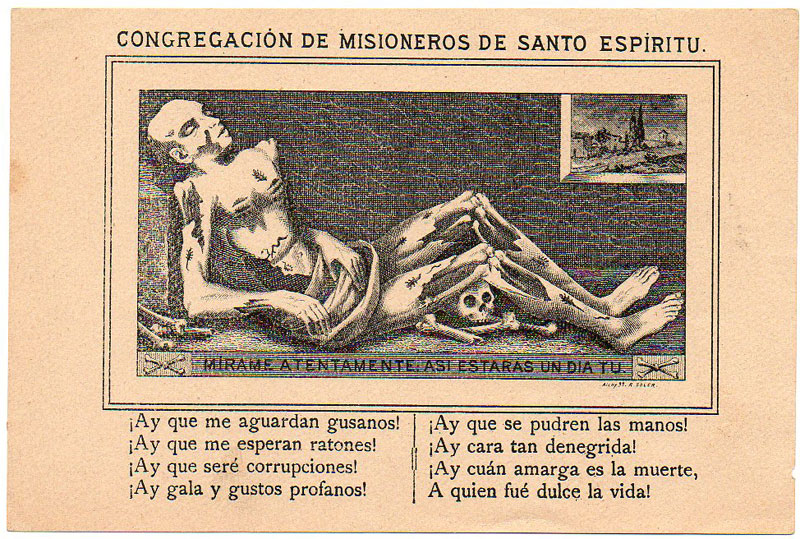
  7. “Mirame atentamente, así estarás un día tu,” Congregación de los misioneros del Santo Espíritu, Fotogravat, Espanya, 150 €
  8. Sicut Foenum Dies Elus Sicut Flos Agri Sic Efflorebit, Hoefnagel, Georg [ designer ], Hoefnagel, Jacob [ engraver ], Frontispici part 4a llibre “Archetypa Atudiaque Patris Georgii
    Hoefnageli,” Escola Alemanya, 1592, 1.200 €
  9. Fantasia, seducción ò... Ca. 1875-1880, Tinta i llapis sobre paper., Segell testamentari signat pel fill de l’artista, 750 €
  10. Conjunt de quatre estampes de divinitats eròtiques, Bacus i Ariadna; Psique i Cupido; Apollo i Climene; Venus i Mercuri; Jean-Jacques Achille Devéria (1800-1857) (dibuix i
    litografia); Goupil (editors), París, ca. 1830, 1000 € (conjunt)
  11. Bathyllus taking the pose, Juvenal Scourging Woman, Aubrey Beardsley (1872-1898), Londres, 1894-1896, Tipografia sobre paper vitel·la, 150 €