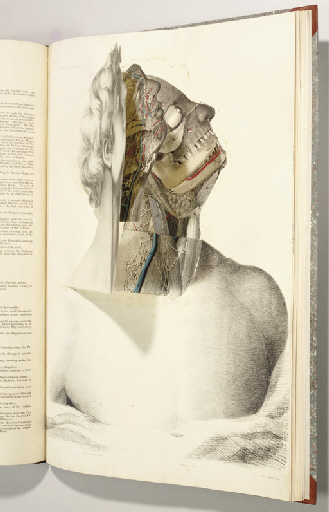
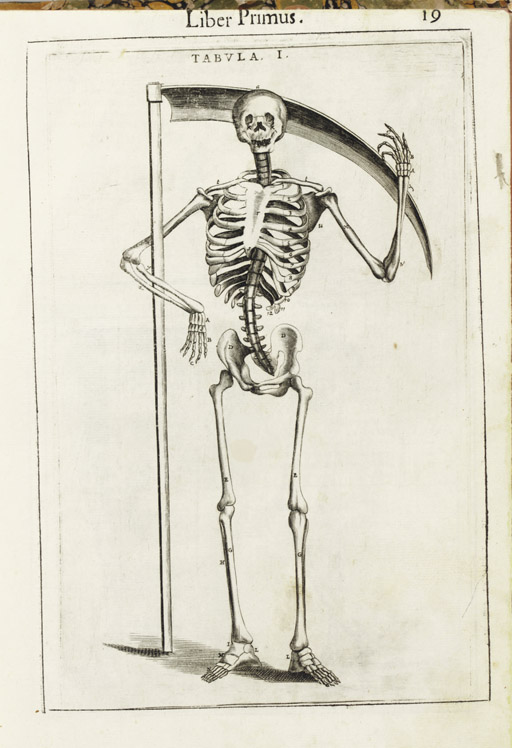
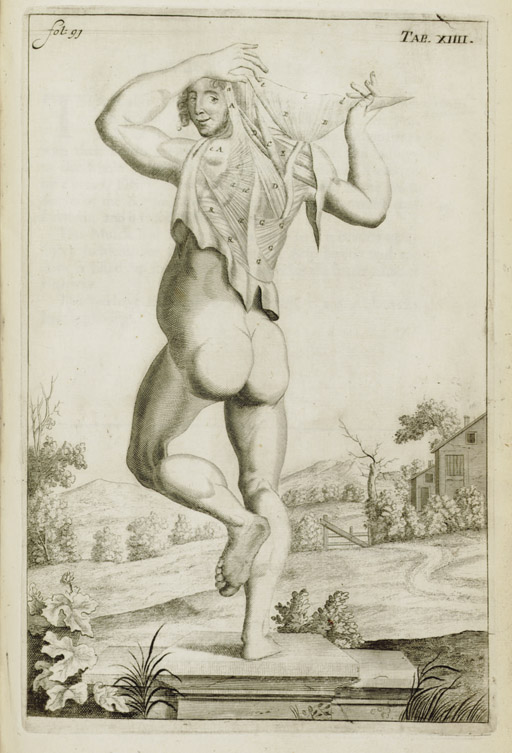
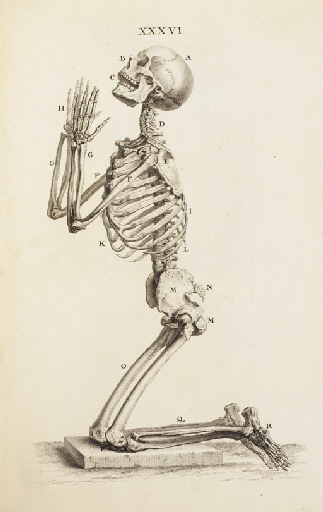
Play with Johan Remmelin's anatomical flap-book Catoptrum Microcosmicum (1619) on this ingenious interactive website produced by the University of Iowa library.


In posing a strapping young nude contemplating a skeleton her size, Wiertz vividly confronts the two fundamental forces, love and aggression, Eros and death, which, according to Sigmund Freud, unceasingly battle fr supremacy over the human mind.


This porcelain cup, saucer, and bowl cover were part of a coffee service exported to Western Europe from Jingdezhen, China during the 18th century. They most likely arrived in the Netherlands undecorated, where an anonymous artist painted the en grisaille anatomical images, probably during the 1760s. Though the print source remains unidentified, it has been suggested that the images could be based on the work of Danish physician Thomas Bartholin, whose work was published in London and Leiden. It has also been suggested that the unknown author "Pira," credited on the bowl cover, might have been a surgeon in the Dutch East India Company, copying anatomical works for the service.

 The book came up repeatedly in my google searches, and was also recommended by a Morbid Anatomy reader (thanks AH!) It features an entire chapter devoted to the topic of morgues as popular amusement and tourist attraction, a portion of which I quoted in my lecture for Anatomcial Theatre. Following is the portion I quoted; Image: Paris Morgue in 1883, via blog Squirm.
...the morgue transformed the banality everyday life by spectacularizing it. To us, looking at dead bodies seems at best an exercise in morbid curiosity. And some of the late nineteenth-century Parisian press did consider the attraction rather morbid. Yet, as cultural critic Jay Ruby argued [in his book Secure the Shadow: Death and Photography in America] , assuming morbidity as the impulse to represent death merely reflects "our culturally encouraged need to deny death." In fact, although the morgue clearly displayed dead bodies, the discussion of the popularity of public visits to the Paris Morgue generally placed it outside the death-related and morbid topics of its day: cemeteries, slaughterhouses and executions. Instead, the morgue was characterized as "part of the cataloged curiosities of things to see, under the same heading as the Eiffel Tower,Yvete Guilbert, and the Catacombs.