Showing posts sorted by relevance for query anatomical venuses. Sort by date Show all posts

Wednesday, April 16, 2008

Florentine Anatomical Venus in Rare American Appearance!


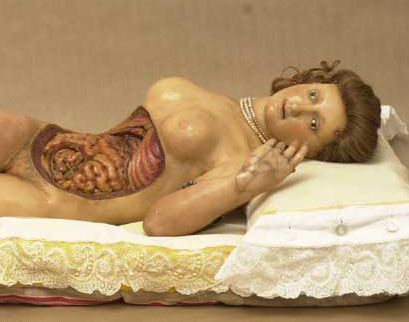
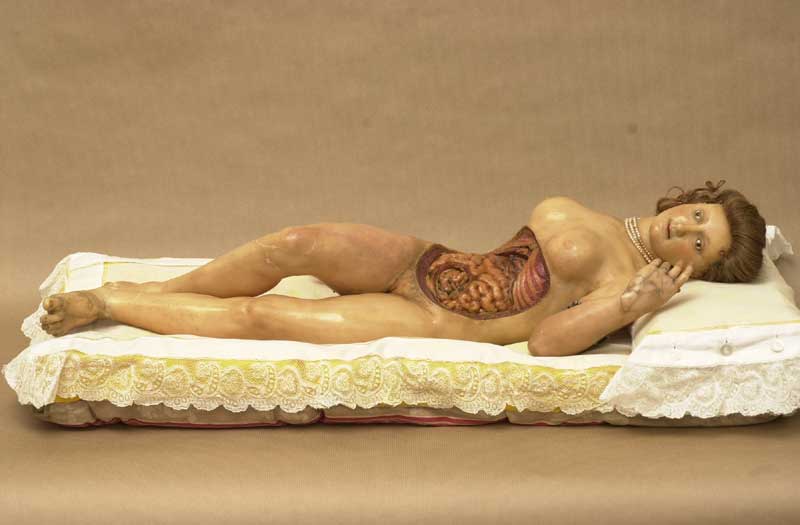
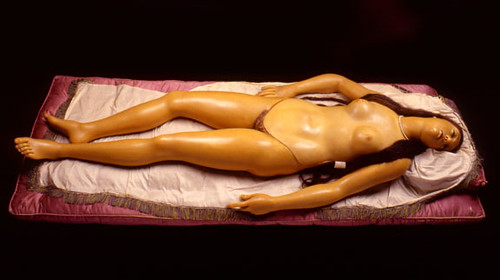
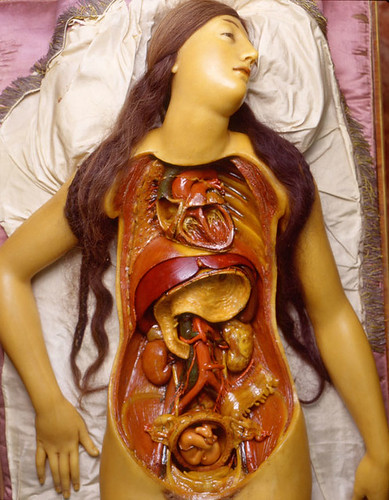
The Getty Villa in Malibu, California has an interesting show up called "The Color of Life: Polychromy in Sculpture from Antiquity to the Present." The exhibition showcases the many ways artists have used color in figural sculpture for centuries, and, to my excitement, includes an actual Anatomical Venus from the famed La Specola collection in Florence!

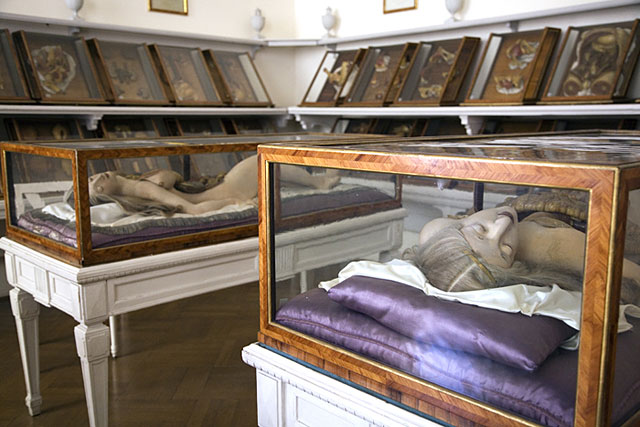
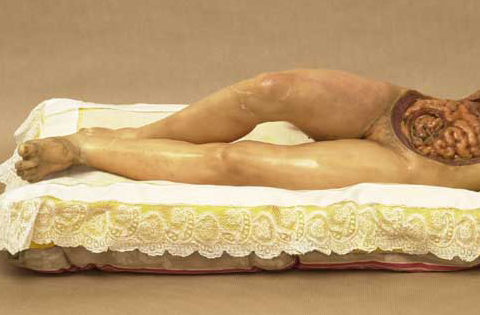
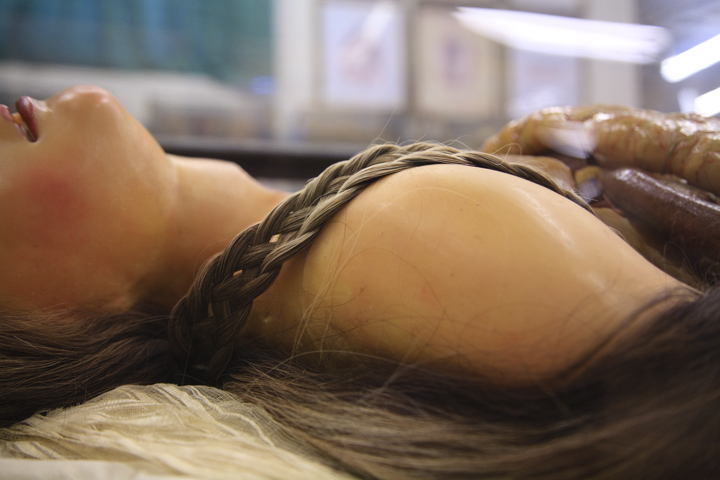
Anatomical Venuses are life-sized wax anatomical models of idealized women, extremely realistic in appearance and often adorned with real hair and ornamental jewelry. These figures consist of removable parts that can be "dissected" to demonstrate anatomy-- a breast plate is lifted to reveal the inner workings of the mysterious female body, often with a fetus to be found nestling in the womb (see before and after above). This was a way to share anatomical discovery with a larger audience without the need for an actual human dissection.

Anatomical Venuses are probably the most historically popular form of anatomical models; in the 19th-Century, they were the centerpiece of museums and itinerant shows of all kinds, and possessed great power to draw crowds. The 18th-Century Florentine Venuses are the best remembered today, in no small part due to Taschen's Encyclopaedia Anatomica,and are considered, by some, to be the finest examples of Anatomical Venuses known to exist.

This Anatomical Venus featured in the Getty show, completed in 1782 by Clemente Susini and his workshop, is truly a masterwork of the genre, and outshines the many copies held by medical museums throughout Europe who, impressed by the veracity and workmanship of the Florentine Venuses, commissioned their own from Susini's workshop. For example, the core of the collection of the Viennese Josephinum Museum consists of 1192 models commissioned by Emperor Joseph from the Susini workshop in 1784 for the training of his military doctors. As a body of work they are interesting, but somehow the models in this collection pale in comparison to the La Specola models. The workmanship is a bit shoddier, the visages a bit less alluring.

The Anatomical Venus exhibited in the Getty exhibition is one of the finest, and almost never leaves her home in Florence--she has only been transported twice in her long history, and even has a specially-built traveling case to protect her delicate wax body. This means that, sadly, you will not see her in her original setting--an elegant rosewood and Venetian glass case-- but the relative accessibility of the piece (i.e. in the United States) should make up for this lack.

It is really great to see anatomical models being seriously approached as artwork in an exhibition of this sort; I consider it a bold move on the part of the curators, and cannot help wondering what strings the curators had to pull in order to acquire one of these rare and fragile Venuses on loan. It is also nice to see that, in reviews of the show, the Venus seems to be a real standout. This supports my belief that, if more people knew of these Venuses and other anatomical models, they would be seen as intriguing artworks and cultural documents, worthy of a greater amount of study as well as inclusion in the medical art canon.

From the UCLA paper The Daily Bruin:
The two most impressive pieces of the whole exhibition, which may please even marble lovers, both shock and fascinate at the same time. One of them is an 18th-century wax model of a nude life-size woman called the “Anatomical Venus,” which shows the multicolored exterior and interior of a female body with an almost uncanny precision.

And from the LA Times review of the show:
The strangest, without a doubt, is an 18th century wax figure known as the "Anatomical Venus": a comely young woman, life-sized and nude, lying prostrate on a pink silk cushion in what looks to be a state of sensual rapture, her torso flayed and all her glistening organs -- including a womb containing a tiny fetus -- revealed. Her long brown hair is real, her eyes are open and unfocused, and the cloth of her pillow is crumpled -- she might as well be writhing. The product of one sculptor's clearly intimate experience with cadavers, she suggests an Enlightenment-era St. Teresa ravished by communion with the invisible forces of science.


To learn more about the show, which runs until June 23 of this year, visit the exhibition website, complete with gallery slideshow. Better yet, visit the show in person if you are able. This might be your only chance EVER to see an Anatomical Venus of this quality without traveling to Florence. To see more images of Anatomical Venuses and other anatomical models, see the Anatomical Theatre Gallery. To learn more about medical models, see Susan Lamb's An Analysis of Anatomy Models and A. W. Bates' abstract for Anatomical Venuses: The Aesthetics of Anatomical Modeling in 18th- and 19th-Century Europe. You can also see the Venus in all states of metaphorical undress in Taschen's Encyclopaedia Anatomica.

Thanks to the Getty for supplying the above images and answering my barrage of questions. Photographs of the Anatomical Venus by Saulo Bambi, Museo di Storia Naturale "La Specola"; Florence, Italy

And if any Morbid Anatomy readers are in the Los Angeles area and could take a photo of the model in context of the show and send me a copy, I'd very much appreciate it.

Tuesday, February 7, 2012

"Anatomical Venuses, The Slashed Beauty, and Fetuses Dancing a Jig," Morbid Anatomy Lecture, The Velaslavasay Panorama, LA, The Day After Tomorrow!


Just a reminder; for those of you in the greater Los Angeles area,I would love to see you the night after tomorrow at The Velaslavasay Panorama, where I will be giving a lecture entitled "Anatomical Venuses, The Slashed Beauty, and Fetuses Dancing a Jig: A Journey into the Curious World of the Medical Museum." The images above--drawn from my recent photo exhibitions The Secret Museum and Anatomical Theatre--constitute a tiny sampling of the many images I will be showing in the presentation.

Full details follow; very much hope very much to see you there.
Anatomical Venuses, The Slashed Beauty, and Fetuses Dancing a Jig:
A Journey into the Curious World of the Medical Museum
An Illustrated Lecture by Joanna Ebenstein
_______

The Velaslavasay Panorama
1122 West 24th Street, Los Angeles, CA
Thursday, February 9th, 2012 (The day after tomorrow!)
8 o’clock PM
Tickets $10 {$8 VPES Members, Students, Seniors}
Advance Tickets Available here:
http://www.brownpapertickets.com/event/221012

The Velaslavasay Panorama welcomes photographer and researcher Joanna Ebenstein, who will be here Thursday, February 9th at 8 pm to present an illustrated lecture entitled Anatomical Venuses, The Slashed Beauty, and Fetuses Dancing a Jig: A Journey into the Curious World of the Medical Museum. Abounding with images and insight, Ms. Ebenstein’s lecture will introduce you to the Medical Museum and its curious denizens, from the Anatomical Venus to the Slashed Beauty, the allegorical fetal skeleton tableau to the taxidermied bearded lady, the flayed horseman of the apocalypse to the three fetuses dancing a jig. Ebenstein will discuss the history of medical modeling, survey the great artists of the genre, and examine the other death-related arts and amusements which made up the cultural landscape at the time that these objects were originally created, collected, and exhibited.

Joanna Ebenstein is a New York-based artist and independent researcher. She runs the popular Morbid Anatomy Blog and the related Morbid Anatomy Library, where her privately held cabinet of curiosities and research library are made available by appointment. Her work has been shown and published internationally, and she has lectured at museums and conferences around the world. For more information, visit http://morbidanatomy.blogspot.com
Tickets available here. You can find out more about the lecture on Flavorpill and in The LA Weekly. You can find out more about the panorama (one of my favorite spots in LA! highly recommended!) by clicking here.

Images top to bottom, as drawn from my recent photo exhibitions The Secret Museum and Anatomical Theatre:
  1. "Anatomical Venus" Wax wodel with human hair and pearls in rosewood and Venetian glass case, "La Specola" (Museo di Storia Naturale), Florence, Italy, Probably modeled by Clemente Susini (around 1790)
  2. "Slashed Beauty" Wax wodel with human hair and pearls in rosewood and Venetian glass case, "La Specola" (Museo di Storia Naturale), Florence, Italy, Probably modeled by Clemente Susini (around 1790)
  3. "Anatomical Venuses," Wax Models with human hair in rosewood and Venetian glass cases,The Josephinum, Workshop of Clemente Susini of Florence circa 1780s, Vienna, Austria
  4. The Mütter Museum : Philadelphia, Pennsylvania, Pathological model; 19th Century?
  5. Wax Model of Eye Surgery, Musée Orfila, Paris. Courtesy Université Paris Descartes
  6. Wax Anatomical Models in Rosewood and Venetian Glass Boxes, The Josephinum, Workshop of Clemente Susini of Florence circa 1780s, Vienna, Austria
  7. Wax moulages; Probably by Carl Henning (1860-1917) or Theodor Henning (1897-1946); Early 20th Century; Federal Pathologic-Anatomical Museum (Pathologisch-anatomisches Bundesmuseum): Vienna, Austria, Austria
  8. Plaster Models in Pathological Cabinet, The Museum of the Faculty of Medicine at the Jagiellonian University, Krakow
  9. Skeleton and hand models for "la médecine opératoire" Musée Orfila, Paris. Courtesy Université Paris Descartes

Friday, January 13, 2012

"Anatomical Venuses, The Slashed Beauty, and Fetuses Dancing a Jig," Morbid Anatomy Lecture, The Velaslavasay Panorama, Los Angeles, Feb. 9


For those of you in the greater Los Angeles area: I would love to see you next month at at one of my very favorite Los Angeles attractions--The Velaslavasay Panorama--where I will be giving a lecture entitled "Anatomical Venuses, The Slashed Beauty, and Fetuses Dancing a Jig: A Journey into the Curious World of the Medical Museum." The images above--drawn from my recent photo exhibitions The Secret Museum and Anatomical Theatre--constitute a tiny sampling of the many images I will be showing in the presentation.

Full details follow; very much hope very much to see you there.
Anatomical Venuses, The Slashed Beauty, and Fetuses Dancing a Jig:
A Journey into the Curious World of the Medical Museum
An Illustrated Lecture by Joanna Ebenstein
_______

The Velaslavasay Panorama
1122 West 24th Street, Los Angeles, CA
Thursday, February 9th, 2012
8 o’clock PM
Tickets $10 {$8 VPES Members, Students, Seniors}
Advance Tickets Available here:
http://www.brownpapertickets.com/event/221012

The Velaslavasay Panorama welcomes photographer and researcher Joanna Ebenstein, who will be here Thursday, February 9th at 8 pm to present an illustrated lecture entitled Anatomical Venuses, The Slashed Beauty, and Fetuses Dancing a Jig: A Journey into the Curious World of the Medical Museum. Abounding with images and insight, Ms. Ebenstein’s lecture will introduce you to the Medical Museum and its curious denizens, from the Anatomical Venus to the Slashed Beauty, the allegorical fetal skeleton tableau to the taxidermied bearded lady, the flayed horseman of the apocalypse to the three fetuses dancing a jig. Ebenstein will discuss the history of medical modeling, survey the great artists of the genre, and examine the other death-related arts and amusements which made up the cultural landscape at the time that these objects were originally created, collected, and exhibited.

Joanna Ebenstein is a New York-based artist and independent researcher. She runs the popular Morbid Anatomy Blog and the related Morbid Anatomy Library, where her privately held cabinet of curiosities and research library are made available by appointment. Her work has been shown and published internationally, and she has lectured at museums and conferences around the world. For more information, visit http://morbidanatomy.blogspot.com

Tickets available here. You can find out more about the panorama (one of my favorite spots in LA! highly recommended!) by clicking here.

Images top to bottom, as drawn from my recent photo exhibitions The Secret Museum and Anatomical Theatre:
  1. "Anatomical Venus" Wax wodel with human hair and pearls in rosewood and Venetian glass case, "La Specola" (Museo di Storia Naturale), Florence, Italy, Probably modeled by Clemente Susini (around 1790)
  2. "Slashed Beauty" Wax wodel with human hair and pearls in rosewood and Venetian glass case, "La Specola" (Museo di Storia Naturale), Florence, Italy, Probably modeled by Clemente Susini (around 1790)
  3. "Anatomical Venuses," Wax Models with human hair in rosewood and Venetian glass cases,The Josephinum, Workshop of Clemente Susini of Florence circa 1780s, Vienna, Austria
  4. The Mütter Museum : Philadelphia, Pennsylvania, Pathological model; 19th Century?
  5. Wax Model of Eye Surgery, Musée Orfila, Paris. Courtesy Université Paris Descartes
  6. Wax Anatomical Models in Rosewood and Venetian Glass Boxes, The Josephinum, Workshop of Clemente Susini of Florence circa 1780s, Vienna, Austria
  7. Wax moulages; Probably by Carl Henning (1860-1917) or Theodor Henning (1897-1946); Early 20th Century; Federal Pathologic-Anatomical Museum (Pathologisch-anatomisches Bundesmuseum): Vienna, Austria, Austria
  8. Plaster Models in Pathological Cabinet, The Museum of the Faculty of Medicine at the Jagiellonian University, Krakow
  9. Skeleton and hand models for "la médecine opératoire" Musée Orfila, Paris. Courtesy Université Paris Descartes

Thursday, September 30, 2010

Lecture: "Anatomical Venuses, The Slashed Beauty, and Fetuses Dancing a Jig," University College London, Thursday October 7, 6:00 PM


For all you Londoner's out there: on Thursday, October 7th at 6:00 PM, I will be giving a free lecture at University College London about anatomical museums and their curious denizens, heavily illustrated with many photographs I have been collecting over the years, such as those seen above.

The lecture is free and open-to-the-public. Full details follow; hope to see you there!
Anatomical Venuses, The Slashed Beauty, and Fetuses Dancing a Jig:
A Journey into the Curious World of the Medical Museum

Date: Thursday, October 7th
Time:
6 PM
Location: UCL, Department of History of Art
20 Gordon Square, WC1E 6BT London, Room 3-4 (first floor)

Tonight's lecture will introduce you to the the Medical Museum and its curious denizens, from the Anatomical Venus (see above) to the Slashed Beauty, the allegorical fetal skeleton tableau to the taxidermied bearded lady, the flayed horseman of the apocalypse to the three fetuses dancing a jig. The lecture will contextualize these artifacts by situating them within their historical context via a discussion of the history of medical modeling, a survey of the great artists of the genre, and an examination of the other death-related diversions which made up the cultural landscape at the time that these objects were originally created, collected, and exhibited.
You can download an invitation to the event by clicking here.

All Images From The Secret Museum Exhibition;" Top to bottom:
  1. Anatomical Venuses," Wax Models with human hair in rosewood and Venetian glass cases,The Josephinum, Workshop of Clemente Susini of Florence circa 1780s, Vienna, Austria
  2. Wax Model of Eye Surgery, Musée Orfila, Paris. Courtesy Université Paris Descartes
  3. Fetal Skeleton Tableau, 17th Century, University Backroom, Paris

Friday, May 30, 2008

19th C Anatomical Venus, Unknown Modeller and Workshop, Museu d'Història de la Medicina de Catalunya


Wax anatomical model of an Anatomical Venus, pregnant woman with a foetus. Barcelona, unknown modeller and workshop, second half of the 19th Century, Museu d'Història de la Medicina de Catalunya.

From the museum website:
It is difficult to set exactly the origin and manufacturing date of this piece, though we must doubtlessly place it in the 19th Century. It was in the first decades of that century that anatomical Venuses became extremely popular in some European museums of anatomy. This is due to the fact that the exhibition of whole-body anatomical figures allowed knowledge popularisation, without any effort by the observer, through a precise representation of Nature. These elements can be found in the Anatomical Venus, which shows an evident external beauty, combined with anatomical rigor of internal components, yielded by the medical knowledge acquired through dissectional practice. In fact, the carrying out of anatomical models through different materials always harbours to two basic aims regarding pedagogical and, in a lesser way, artistic or aesthetic aspects. The persistence over time of this form of artificial representation of human anatomy reminds us of the complementary role of pedagogical comprehension that these models had in faculties of medicine, where the expert anatomist directed the work of the modeller artist.

In the case of the Anatomical Venus, two objectives come together: education and entertainment. Through an intense realism, the woman we find is lying in a resting position and invites the viewer to come closer. Female nudity constituted a pretext for public exhibition while avoiding moral incorrectness and attracting a greater number of observers. As in other resembling models preserved in European museums, such as in Vienna or Florence, the resting woman is pregnant and allows access to her body’s inside through successive dissections all the way to the foetus. The aim to instruct a wide segment of non-expert public was achieved from a representation of Nature, utterly live and natural, based on the construction of a kind of perfect human body, that of Venus’ beauty.

For more on "Anatomical Venuses," see these recent Morbid Anatomy posts. To find out more about Museu d'Història de la Medicina de Catalunya, visit the museum website here.

Sunday, January 20, 2013

"Ode to an Anatomical Venus," Article, Women's Studies Quarterly, Enchantment Issue


Regular readers of this blog are no doubt already aware of my near-obsession with the "Anatomical Venus," a kind of female wax anatomical model popularized in the 18th century. Over the past six years, I have made it my goal to find and photograph as many of these uncannily amazing pieces as possible (top 8 photos above), and to learn as much as I can about these lovely ladies, the historical moment in which they rose to prominence as the ideal way to illuminate the anatomy of woman for a popular audience, and their artistic and cultural legacy.

I was recently invited to contribute an article on this very topic to Women's Studies Quarterly's special "Enchantment" issue; you can read entire piece by clicking here, and an excerpt here:
Ode to an Anatomical Venus
“The purpose of anatomical images during the period of the Renaissance to the 19th century had as much to do with what we would call aesthetic and theological understanding as with the narrower interests of medical illustrators as now understood. . . They were not simply instructional diagrams for the doctor technician, but statements about the nature of human beings as made by God in the context of the created world as a whole . . . they are about the nature of life and death. . .”
—Martin Kemp and Marina Wallace, Spectacular Bodies
Clemente Susini’s Anatomical Venus, created around 1790, is, the central object of my artistic and scholarly contemplation. She is, in my opinion, the perfect object; one whose luxuriously bizarre existence challenges belief. It—or, better she—was conceived of as a means to teach human anatomy without need for constant dissection, which was messy, ethically fraught, and subject to quick decay. The Venus also tacitly communicated the relationship between the human body and a divinely created cosmos, between art and science, between nature and mankind as understood in its day.

Referred to also as “The Demountable Venus,” this life-sized, dissectible wax woman- -who can still be viewed in her original Venetian glass and rosewood case at La Specola Museum of Zoology and Natural History in Florence, Italy, as well as in a number of other European museums--is adorned with glass eyes and human hair and can be dismembered into dozens of parts revealing, at the final remove a beatific fetus curled in her womb. Her sisters—also anatomical models made under the artistic leadership of Susini, and referred to by such names as “The Slashed Beauty” and “The Dissected Graces” can be visited at a handful of European museums. Supine in their glass boxes, they beckon with a gentle smile or an ecstatic downcast gaze; one idly toys with a plait of real golden human hair; another clutches at the plush, moth-eaten velvet cushions of her case as her torso erupts in a spontaneous, bloodless auto-dissection, another is crowned with a golden tiara, while yet another has a silk ribbon tied in a bow tied around a dangling entrail

Since their creation in late-eighteenth-century Florence, these wax women have seduced, intrigued, and instructed. Today, they also confound, troubling the edges of our neat categorical divides: life and death, science and art, body and soul, effigy and pedagogy, spectacle and education, kitsch and art. They are corporeal martyrs, anatomical odalisques, the uncanny incarnate. These wax models are the pinnacle of “artificial anatomies,” a tradition of three-dimensional, anatomical teaching tools stretching back to the turn of the eighteenth century. The genre came into being around 1700 when Gaetano Giulio Zummo, known as Zumbo accepted the commission of French surgeon Guillaume Desnoues to create a likeness of an important medical dissection that was beginning to decompose. Zumbo was a Sicilian abbot who delighted in the creation of wax miniature series “Theatres of Death” boasting names such as “The Plague” (bottom image) and “The Vanity of Human Greatness,” and featuring exactingly rendered dead and tortured bodies. The product of Desnoues’ and Zumbo’s collaboration was the first wax anatomical teaching model, and established the tradition of an artistic/medical partnership in the creation of such tools.
The Venus and her sisters were intended, from their very conception, not only to instruct, but also to delight and elicit the wonder of a popular audience and, beginning with their public debut in the 1790s, they did just that, attracting throngs of both local Tuscans and visitors on the Grand Tour circuit. Their popularity was so great that they ultimately inspired a series of knockoffs—first a series of similar models by the same workshop for Napoleon and Joseph II of Vienna and, later, in series of models, often advertised as “Florentine” (8th image down) or “Parisian” or even automated breathing Venuses that toured Europe, attracting masses of visitors to the popular anatomical displays found in Europe well into the twentieth century. The uncanny allure of these somnambulant, neither-dead-nor-alive women was not lost on surrealist artists such as Paul Delvaux —who cited his visits to the Spitzner Collection (as seen in his painting "Le Musee Spitzner" of 1943, second to bottom image), with its famous breathing Venus as a life and art-changing moment— and Marcel Duchamp, whose enigmatic peepshow Étant donnés (bottom image) seems to have been inspired, at least in part, by the paradoxes embodied by such figures...
 You can find out more about Women's Studies Quarterly by clicking here and more about the "Enchantment" issue by clicking here. You can read my entire "Ode to an Anatomical Venus" by clicking here.

Please note: this piece could simply not exist without the wonderful work of scholars as Roberta Ballestriero, Alessandro Riva, Lucia Dacome, Kathryn Hoffmann, Ludmilla Jordanova, Martin Kemp and Marina Wallace, Anna Maerker, Rebecca Messbarger, and Roberta Panzanelli. A much more detailed bibliography and list of citations can be found in the article itself. I am entirely indebted to their work in all of my research on this topic.

All images except the bottom four are my own; please click on them to see larger, finer version. Captions, top to bottom:
  1. "Anatomical Venus" Wax wodel with human hair and pearls in rosewood and Venetian glass case, "La Specola" (Museo di Storia Naturale), Florence, Italy; Probably modeled by Clemente Susini (around 1790)
  2. The "Venerina" or “Little Venus” anatomical model by Clemente Susini, 1782, as seen at the Palazzo Poggi in Bologna, Italy. Described on the museum website thusly: "The agony of a young woman is represented in her last instant of life as she abandons herself to death voluptuously and completely naked. The thorax and abdomen can be opened, allowing the various parts to be disassembled so as to simulate the act of anatomic dissection."  
  3. Detail of the ”Venerina" (Little Venus) anatomical model by Clemente Susini, 1782, Palazzo Poggi, Bologna, Italy
  4. Anatomical model by Clemente Susini representing ‘deep lymphatic vessels in a female subject’, human hair, wax, 1794, Museum of the History of the University, Pavia, Italy
  5. "The Slashed Beauty"Wax model with human hair in rosewood and Venetian Glass case; Probably modeled by Clemente Susini (around 1790), “La Specola” (Museo di Storia Naturale), Florence, Italy
  6. "Slashed Beauty" Wax wodel with human hair and pearls in rosewood and Venetian glass case, "La Specola" (Museo di Storia Naturale), Florence, Italy, Probably modeled by Clemente Susini (around 1790)
  7. "Anatomical Venus" Wax wodel with human hair and pearls in rosewood and Venetian glass case, "La Specola" (Museo di Storia Naturale), Florence, Italy, Probably modeled by Clemente Susini (around 1790)
  8. "Anatomical Venuses" Wax models with human hair in rosewood and Venetian glass cases; Workshop of Clemente Susini of Florence, 1781-1786 The Josephinum, Vienna, Austria
  9. Advertisement for display of Anatomical Venus, Wellcome Library
  10. "Le Musee Spitzner," Paul Delvaux, 1943
  11. "Étant Donnés," Marcel Duchamp, 1946–1966, Philadelphia Museum of Art, Philadelphia; Image found here
  12. The Theatre of Death: Plague. Gaetano Giulio Zumbo; 1691-94; sourced here.
  13.  

Saturday, February 26, 2011

"Anatomical Venuses, Slashed Beauties, and Three Fetuses Dancing a Jig," Lecture, Dittrick Medical History Center and Museum, This Tuesday, March 1st


If anyone out there has plans to be in or around the lovely city of Cleveland, Ohio this Tuesday, March 1, why not come by the Dittrick Medical History Center and Museum to take in an illustrated introduction I will be delivering on the the topic of medical museums?

The lecture--entitled "Anatomical Venuses, Slashed Beauties, and Three Fetuses Dancing a Jig?"--is open to the general pubic and, to the best of my knowledge, free to attend. The lecture is scheduled to being and 6:00 PM and will be followed by a reception at 7:00 PM.

Full details follow; would love to see you there!
Anatomical Venuses, Slashed Beauties, and Three Fetuses Dancing a Jig:
An Illustrated Journey into the Curious World of Medical Museums
Date: March 1, 2011
Time: 6:00 PM Powell Room, 2nd floor
Reception: 7:00 PM, in the Percy Skuy Gallery, of the Dittrick Medical History Center and Museum (Allen Memorial Medical Library, 11000 Euclid Avenue).
Please RSVP by February 25th, phone 216-368-3648, or e-mail jennifer.nieves@case.edu

In April 2007 Joanna Ebenstein created a fascinating blog, Morbid Anatomy, where she has since been "surveying the interstices of art and medicine, death and culture." Medical museums, like the Dittrick, provide much of the content for Morbid Anatomy. But Ebenstein has cast her net still further, exploring arcane and curious collections across Europe and the UK. She'll be sharing with us her take on the often macabre and sometimes beautiful fruit of that search. From wax moulages of syphilitics in Paris to obstetric models in Bologna, and from pathology specimens in London to fetal skeletons in Leiden, Ebenstein explores the wonder of things found in medical museums. In the process, she will offer insights on the psychology of collecting, and reveal the secret life of objects and collections in these intriguing spaces.

Lecture: 6:00 PM Powell Room, 2nd floor, Reception: 7:00 PM, in the Percy Skuy Gallery, of the Dittrick Medical History Center and Museum (Allen Memorial Medical Library, 11000 Euclid Avenue).

Parking is available in the visitors lot under Severance Hall.
Full info available here.

Image: The Bolognese "Venerina," Anatomical Venus, Clemente Susini, 1780-1782, housed at the Museo di Palazzo Poggi in Bologna, Italy where the Venerina is housed; More on that here.

Wednesday, July 11, 2012

This Friday the Thirteenth: A Highly Illustrated Virtual Tour of Medical Museums of the Western World by Morbid Anatomy at Observatory!

Just a friendly reminder: if you are looking for a way to celebrate this upcoming Friday the 13th--and who isn't, really?--why not come down to Observatory for a special event: a highly illustrated and subjective tour of medical museums of the Western World by Morbid Anatomy's Joanna Ebenstein, followed by music and delicious artisanal cocktails compliments of Friese Undine?

Why not, indeed!

Full details follow; hope very much to see you there!
Anatomical Venuses, The Slashed Beauty, and Fetuses Dancing a Jig
A heavily illustrated lecture by Morbid Anatomy founder Joanna Ebenstein, followed by afterparty featuring thematic music and specialty cocktails by Friese Undine
Date: Friday, July 13
Time: 8:00
Admission: $10
Presented by Morbid Anatomy 
Since 2005, artist, independent scholar and Morbid Anatomist Joanna Ebenstein has travelled the world seeking out--and photographing whenever possible--the most fascinating, curious, and overlooked medical collections and wunderkammern, backstage and front, private and public. In the process, she has amassed not only an astounding collection of images but also a great deal of knowledge about the history and cultural context of these fascinating and uncanny artifacts.  
This Friday the Thirteenth, please join us for a heavily illustrated lecture based on this research, followed by a thematic afterparty. In her lecture "Anatomical Venuses, The Slashed Beauty, and Fetuses Dancing a Jig," Ebenstein will lead you on a highly-illustrated tour of medical museums and introduce you to many of their most curious and enigmatic denizens, including the Anatomical Venus, the Slashed Beauty, the allegorical fetal skeleton tableau (as seen above), the flayed horseman of the apocalypse, and three fetuses dancing a jig. Ebenstein will contextualize these artifacts via a discussion of the history of medical museums and modeling, a survey of great artists of the genre, and an examination of other death-related arts and amusements which made up the cultural landscape at the time that these objects were originally created, collected, and exhibited. Following, please stick around for an afterparty featuring thematic tunes and inventive artisanal cocktails complements of the omni-talented Friese Undine.  
Joanna Ebenstein is a multi-disciplinary artist with an academic background in intellectual history. She runs the Morbid Anatomy blog and related open-to-the-public Brooklyn-based Morbid Anatomy Library. She is also the founding member of Observatory, a Brooklyn based arts and events space devoted to the revival of the 18th century notions of the dilettante and rational amusements. Her recent work—which includes photography, curation, installation, blogging, museum consulting, lecturing and writing—centers on anatomical museums and their artifacts, collectors and collecting, curiosities and marvels, 18th and 19th Century natural history and, as the subtitle of her blog states, “surveying the interstices of art and medicine, death and culture.” She has lectured at a variety of popular and academic venues, and her work has been shown and published internationally; she is the current Coney Island Musuem artist in resident, and recent solo exhibitions include The Secret Museum and Anatomical Theatre. You can find out more at her at her website astropop.com and her blog Morbid Anatomy; you can view much of her photography work by clicking here. She can be reached at morbidanatomy [at] gmail.com.
You can find out more about this event here.

Images top to bottom, as drawn from my recent photo exhibitions The Secret Museum and Anatomical Theatre:
  1. "Fetal Skeleton Tableau, 17th Century, University Backroom, Paris; © Joanna Ebenstein, 2010
  2. Skeleton and hand models for "la médecine opératoire" Musée Orfila, Paris. Courtesy Université Paris Descartes; © Joanna Ebenstein, 2010
  3. Plaster Models in Pathological Cabinet, The Museum of the Faculty of Medicine at the Jagiellonian University, Krakow; © Joanna Ebenstein, 2010
  4. Wax Anatomical Models in Rosewood and Venetian Glass Boxes, The Josephinum, Workshop of Clemente Susini of Florence circa 1780s, Vienna, Austria; © Joanna Ebenstein, 2007
  5. "Slashed Beauties" in Rosewood and Venetian Glass Boxes, The Josephinum, Workshop of Clemente Susini of Florence circa 1780s, Vienna, Austria; © Joanna Ebenstein, 2007

Monday, March 23, 2009

"Reveries of Sleeping Beauty: Slumber and Death in Anatomical Museums, Fairground Shows, and Art" Event Tomorrow Night at Observatory!


Just a friendly reminder that tomorrow night--Tuesday, March 24th--Kathryn A. Hoffman will be presenting her illustrated lecture "Reveries of Sleeping Beauty: Slumber and Death in Anatomical Museums, Fairground Shows, and Art" at Observatory. Hope you can make it! Full details below, for your convenience. Oh, and I should mention. There will also be wine.

P.S. If you'd like to get a taste of the delights that await you tomorrow night, check out Bioephemera's wonderful post "Invading Hands, Sleeping Beauties," inspired by a similarly themed Hoffman lecture, by clicking here.
Morbid Anatomy Presents at Observatory
"Reveries of Sleeping Beauty: Slumber and Death in Anatomical Museums, Fairground Shows, and Art "
Kathryn A. Hoffmann, University of Hawaii at Manoa
Tuesday March, 24th at 7:30 PM (Door open at 7:00)
Free of Charge

This illustrated talk will follow the paths of sleeping beauties: lovely young women who lie on silk sheeted beds in glass cases in anatomical museums and fairground shows, who recline on sofas in Belgian train stations, and sometimes in the middle of streets. Often the women were nude. Sometimes they were adorned with a piece of jewelry or a bow, and sometimes they wore white dresses. One breathed gently in a glass case on a fairground verandah for nearly a century. Others lay quietly in caskets under flowers. Some were wax, some were real, some were dead, and some merely pretended to be dead. Sometimes, in the imagination of artists like the surrealist Paul Delvaux, they got up and walked about; pretty somnambulists wandering through natural history museums, arcades and streets, through modern cities and ancient Alexandria, Ephesus, and Rhodes.

Using photographs, posters, advertisements, and paintings, the talk will follow models known as “Anatomical Venuses” through one of the great wax anatomical museums of the world (La Specola in Florence) and an extraordinarily long-lived popular museum that traveled the fairground routes of Europe in the nineteenth and twentieth centuries (Pierre Spitzner’s Great Anatomical and Ethnological Museum). It will take side trips into some of the visual worlds the Venuses drew from or helped inspire, including fairground sleeping beauty acts, morgue shows, mortuary photography, reliquary displays, and art. In the paths of the sleeping beauties, it is clear that death and slumber, pedagogy and entertainment, science and reverie long shared strange borders.

Kathryn A. Hoffmann is the author of books and numerous articles on the body, including “Sleeping Beauties in the Fairground.” She is Professor at the University of Hawaii at Manoa, where she teaches courses on anomalous bodies and the histories of medicine and the fairground. She has received awards for her writing, and lectures frequently for associations, libraries, and museums in the fields of the history of medicine, literature, and art.

Practical Details
"Reveries of Sleeping Beauty: Slumber and Death in Anatomical Museums, Fairground Shows, and Art "
Kathryn A. Hoffmann, University of Hawaii at Manoa
Tuesday March, 24th at 7:30 PM (Door open at 7:00)
Admission: Free
Observatory, 543 Union Street (at Nevins) Brooklyn, New York 11215
Entry via Proteus Gowanus Interdisciplinary Gallery and Reading Room; go through back door of gallery, then take a left to find event. Directions here or call 718.243.1572.
Feel free to email me at morbidanatomy@gmail.com with any questions.

Image: DELVAUX - Le musée Spitzner - 1943, via Picstout's Flickr page.

Friday, June 11, 2010

This Sunday! "Anatomical Venuses, The Slashed Beauty, and Fetuses Dancing a Jig" Lecture, Coney Island Museum, Sunday June 13th, 4:30 PM


Just a brief reminder that I will be waxing [sic] poetic on the wonders of medical museum this Sunday at the Coney Island Museum as part of their "Ask the Experts" series.

Full details follow; hope to see you there!
Anatomical Venuses, The Slashed Beauty, and Fetuses Dancing a Jig: A Journey into the Curious World of the Medical Museum
Date: THIS SUNDAY, June 13th
Time: 4:30 PM

Admission: $5
Location: Coney Island Museum (208 Surf Ave. Brooklyn)

This afternoon's highly-illustrated lecture will introduce you to the the Medical Museum and its curious denizens, from the Anatomical Venus to the Slashed Beauty, the allegorical fetal skeleton tableau to the taxidermied bearded lady, the flayed horseman of the apocalypse to the three fetuses dancing a jig. The lecture will contextualize these artifacts by situating them within their historical context via a discussion of the history of medical modeling, a survey of the great artists of the genre, and an examination of the other death-related diversions which made up the cultural landscape at the time that these objects were originally created, collected, and exhibited.
You can find out more by clicking here and can get directions by clicking here.

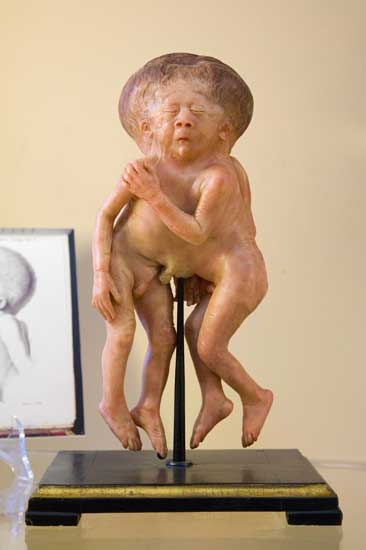
Image: From the Anatomical Theatre exhibition: "Museum of Anatomical Waxes “Luigi Cattezneo” (Museo Delle Cere Anatomiche “Luigi Cattaneo”): Bologna, Italy "Iniope–conjoined twins" Wax anatomical model; Cesare Bettini, Early 19th Century