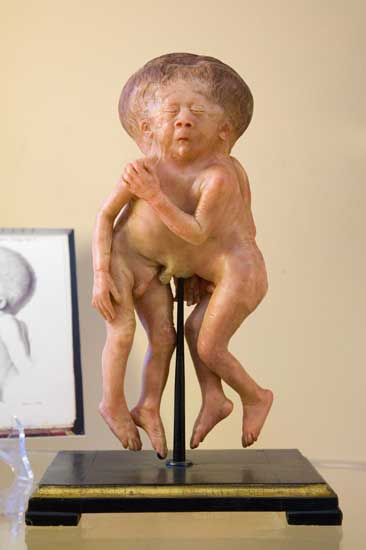
Transport of the Bavaria (torso), 1850, Alois Löcherer.
Found at the ICP-Bard MFA Blog. Click on image to see much larger, finer image.


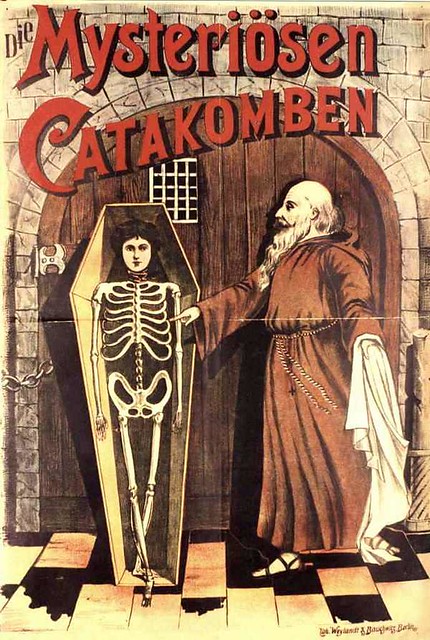





...He had, in Castra Regis, a large collection of curious and interesting things formed in the past by his forebears, of similar tastes to his own. There were all sorts of strange anthropological specimens, both old and new, which had been collected through various travels in strange places: ancient Egyptian relics from tombs and mummies; curios from Australia, New Zealand, and the South Seas; idols and images--from Tartar ikons to ancient Egyptian, Persian, and Indian objects of worship; objects of death and torture of American Indians; and, above all, a vast collection of lethal weapons of every kind and from every place--Chinese "high pinders," double knives, Afghan double-edged scimitars made to cut a body in two, heavy knives from all the Eastern countries, ghost daggers from Thibet, the terrible kukri of the Ghourka and other hill tribes of India, assassins' weapons from Italy and Spain, even the knife which was formerly carried by the slave-drivers of the Mississippi region. Death and pain of every kind were fully represented in that gruesome collection.This quotation is drawn from chapter 11--entitled "Mesmer's Chest"--of Bram Stoker's 1911 publication Lair of the White Worm which went on to inspire Ken Russell's suitably over-the-top film of the same name.
That it had a fascination for Oolanga goes without saying. He was never tired of visiting the museum in the tower, and spent endless hours in inspecting the exhibits, till he was thoroughly familiar with every detail of all of them. He asked permission to clean and polish and sharpen them--a favour which was readily granted. In addition to the above objects, there were many things of a kind to awaken human fear. Stuffed serpents of the most objectionable and horrid kind; giant insects from the tropics, fearsome in every detail; fishes and crustaceans covered with weird spikes; dried octopuses of great size. Other things, too, there were, not less deadly though seemingly innocuous--dried fungi, traps intended for birds, beasts, fishes, reptiles, and insects; machines which could produce pain of any kind and degree, and the only mercy of which was the power of producing speedy death....
"The Culture of Curiosity"You can find out more about the event by clicking here. Hope to see you there!
An illustrated lecture by Evan Michelson of Obscura Antiques and Oddities
Date: Sunday, August 15
Time: 4:30 PM
Admission: $5
Location: The Coney Island Museum
From humble parlor to Princely treasury, the Culture of Curiosity has endured for hundreds of years. In equal parts uncanny obsession, camp statement, melancholy musing, frivolous commentary and timeless metaphor, ultimately it's all about mystery.
Come and join Evan Michelson (Morbid Anatomy Scholar in Residence) in an exploration of the continuing appeal of curated chaos in the home.
Evan Michelson is an inveterate collector and museum aficionado. She has spent a lifetime obsessing over specimens, lurking in crypts, touring necropoli and gathering information on all things fading from the collective memory.
For about two decades Evan was in and out of various aggressively confrontational/decadent bands. She is currently co-owner of Obscura Antiques and Oddities, and Scholar-in-Residence at the Morbid Anatomy Library. She lives in Victorian excess with her husband, a few pets, and many esoteric and uncanny objects.

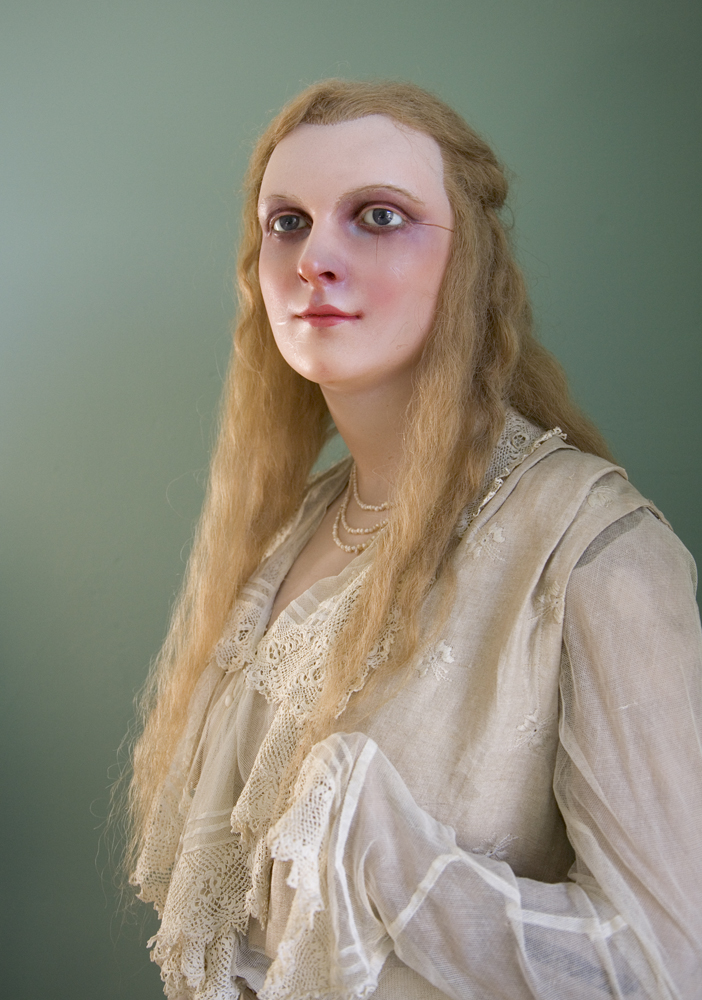
This anatomical wax model shows the internal organs in a female torso and head, including the lungs, liver, stomach, kidneys and intestines. Complete with the veins and arteries, the heart is entirely removable. The figure was made by Francesco Calenzuoli (1796-1821), an Italian model maker renowned for his attention to detail. Wax models were used for teaching anatomy to medical students because they made it possible to pick out and emphasise specific features of the body, making their structure and function easier to understand. This made them especially useful at a time when few bodies were available for dissection. The model was donated by the Department of Human Anatomy at the University of Oxford.Yet more (recent posts here: 1, 2, 3) riches from the London Science Museum's magnificently inexhaustable Brought to Life web exhibit. You can see much, much more by clicking here. Also, please click on images to see them in their full large-scale glory.
Object number: 1988-249


He shoots in concentration camps, sterile medical laboratories, crumbling archives, curious private collections. He notes that about 90% of his work is done in the Catholic world, places “richly fixated on the body of Mary, the body of Christ, the bodies of the martyrs” and with a “history of sensually violent and death-riddled art.” It’s a tradition that doesn’t exist in North America, and his book serves as a reminder of “everything we left; everything that made us, and somehow drove us to undo that and make ourselves over.--"Jack Burman: Book of the Dead," The Canadian National PostCanadian photographer Jack Burman's new book--titled, simply, The Dead--is a breathtaking book. Gorgeously produced and sober, this quiet and lovely book is filled with Burman's large-scale photographs exploring the topic of death via a meditative documentation of a variety of human remains. Many of the 52 images which make up this book picture artifacts--from specimens to mummies to medical preparations--that will be familiar to aficionados of medical museums and ossuaries, but the quiet restraint and rich detail Burman achieves in his classically composed images elevate the book above the usual fare.
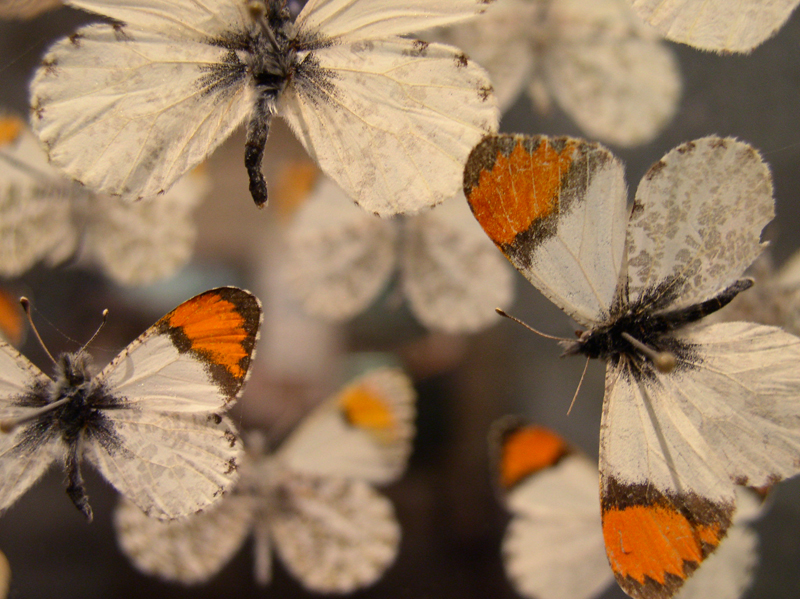
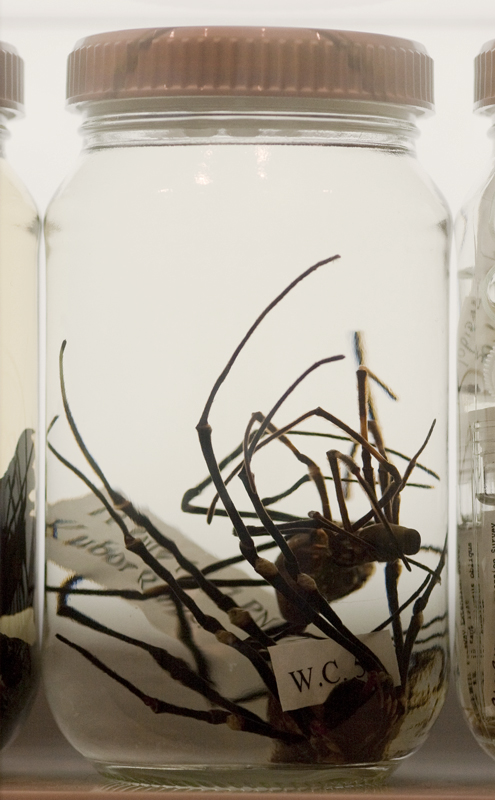
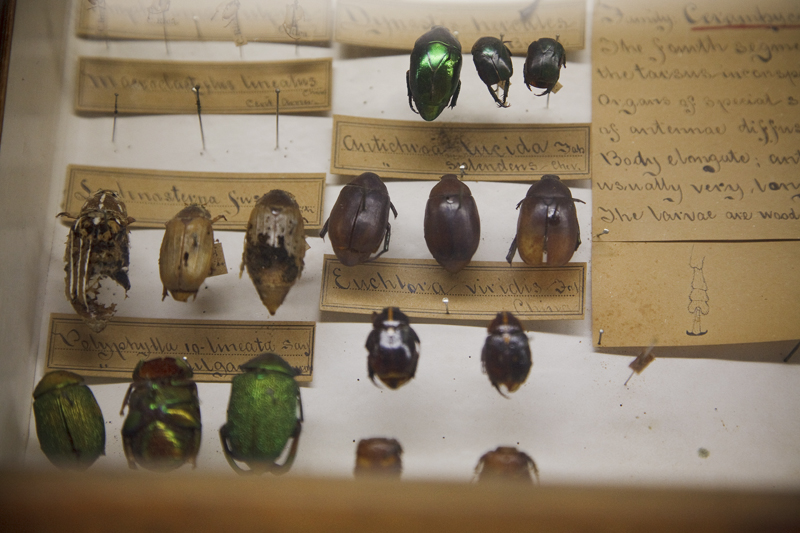
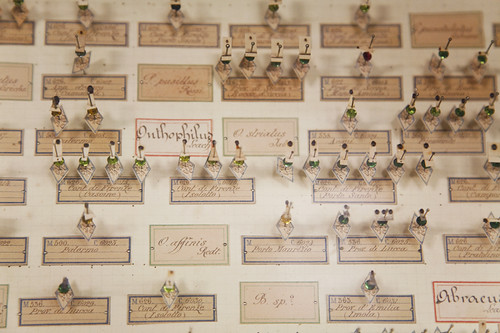
They’re all around us…in our homes, in our places of work, in our backyards, and in the air…what are we talking about? Insects. On this week's Cityscape, we're exploring the world of bugs. We'll talk with the author of a new book called Insectopedia, visit a Manhattan eatery that serves grasshoppers (and eat them too), talk with a Brooklyn artist who dabbles in insect photography and meet a pair of professional "insect-pinners" in SoHo.The recent Cityscapes radio show "Bugging Out" plumbs the fascinating world of insects, as described above; one segment--that about the "Brooklyn artist who dabbles in insect photography"--features an interview with me about my insect photographs as shown in the recent Entomologia exhibition at Observatory.


Mr. Bill Smith was kind enough to lend one of his container bogs (pictured above) for my Observatory talk this Thursday night in Brooklyn. He would like to inform you folks out in the netiverse that he is offering this three year-old bog garden for sale at the very reasonable price of $200--an excellent bargain, since purchasing these mature plants separately would cost considerably more.You can find out more about Lord Whimsy's presentation here. You can get directions to Observatory--which is next door to the Morbid Anatomy Library (more on that here)--by clicking here. You can find out more about Observatory here, join our mailing list by clicking here, and join us on Facebook by clicking here.
The container is hollow resin, and can be left outside year-round without worry of cracking. The plants in the bog include: Purple Pitcher Plant (Sarracenia purpurea 'Jersey Girl'), Yellow Trumpet Pitcher (S. flava), Catesby's S. purpurea x S. flava hybrid pitcher plant (S. x Catesbei), Grass Pink Orchid (Calopogon tuberosus), 'Hamilton' dwarf cranberry, Spade leafed sundew (Drosera intermedia), and Thread leafed sundew (D. filiformis). A marvelous, mature grouping of classic North American bog plants, suitable for rooftop gardens and decks. No fertilizer necessary. Very low maintenance: just keep in full sun with regular waterings. Can be left outside year-round. All plants are cold hardy in zone 6b.
Interested parties may contact me (email [at] lordwhimsy.com) and claim their purchase after my lecture on Thursday evening.
Similar container bogs of all sizes can be had at Rarefind Nursery.
Augustine included curiositas in his catalog of vices, identifying it as one of the three forms of lust (concupiscentia) that are the beginning of all sin (lust of the flesh, lust of the eyes, and ambition of the world). The overly curious mind exhibits a “lust to find out and know,” not for any practical purpose but merely for the sake of knowing. Thanks to the “disease of curiosity” people go to watch freaks in circuses and charlatans in the piazzas. Augustine saw no essential difference between such perverse entertainments and the “empty longing and curiosity [that is] dignified by the names of learning and science.”I just came across a nice meditation on the history of the debate of curiosity as value or vice on the website of Author William Eamon, author of Science and the Secrets of Nature and The Professor of Secrets: Mystery, Medicine, and Alchemy in Renaissance Italy:
The Disease Called CuriosityYou can read this piece in its entirety--and find out more about William Eamon and his work-- by clicking here.
Nowadays we think of curiosity as an emotion necessary for the advancement of knowledge, indeed as the well-spring of scientific discovery. It was not always so.
Saint Augustine, in the fourth century, stated the traditional medieval view of curiosity, and it wasn’t favorable. In the Confessions, the Bishop of Hippo made inquisitiveness in general the subject of a vicious polemic, thereby setting the tone for the debate over intellectual curiosity for centuries. Augustine included curiositas in his catalog of vices, identifying it as one of the three forms of lust (concupiscentia) that are the beginning of all sin (lust of the flesh, lust of the eyes, and ambition of the world). The overly curious mind exhibits a “lust to find out and know,” not for any practical purpose but merely for the sake of knowing. Thanks to the “disease of curiosity” people go to watch freaks in circuses and charlatans in the piazzas. Augustine saw no essential difference between such perverse entertainments and the “empty longing and curiosity [that is] dignified by the names of learning and science.”
No difference between gawking at freaks in a sideshow and making investigations in natural philosophy? That’s what the saint said: “From the same motive,” Augustine wrote, “men proceed to investigate the workings of nature, which is beyond our ken—things which it does no good to know and which men only want to know for the sake of knowing.” Augustine’s severe judgment of intellectual curiosity, linking it with the sin of pride, the black arts, and the Fall, became conventional in medieval thought. In the Renaissance, it gave rise to such memorable characters as Doctor Faustus, who bartered his soul to the devil to satisfy his insatiable curiosity and quest for power.
Yet gawking curiosity was the perpetuum mobile of Renaissance science. Early modern curiosity was insatiable, never content with a single experience or object. Whereas Augustine linked curiosity to sensual lust and human depravity, Renaissance natural philosophers saw it as being driven by wonder and the engine of discovery...
...Venice’s maritime empire and its rich craft tradition provided plentiful fuel for wonder and curiosity. The continual contact with exotic commodities, whether herbs from the New World, mechanical toys from Persia, or fake dragons and basilisks, fueled Renaissance curiosity. All that evoked curiosity and wonder became prized objects for collectors, who displayed rare and exotic natural and artifical objects in curiosity cabinets, like peacocks proudly displaying their colorful feathers—indeed, peacock feather, too, were prized objects for collectors.
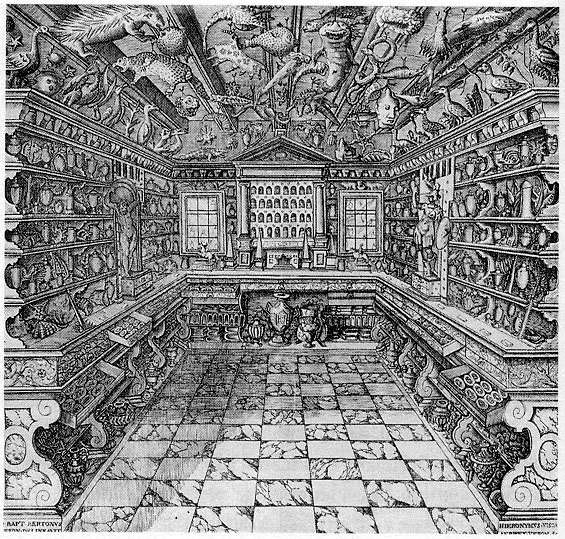
Pharmacies displayed the curiosities of Renaissance culture. The cabinet of pharmacist Francesco Calzolari at Verona, pictured here, displayed dried herbs, minerals, preserved animals, birds and snakes, including a supposed unicorn horn.
Such objects would become the “curious” things of early modern science. Saint Paul’s admonition, Noli alta sapere, “Do not seek to know high things,” gave way in the Renaissance to Horace’s more hopeful Sapere aude, “Dare to know.”
The transformation of curiosity in the Renaissance was a precondition of modernity. Without curiosity, there can be no scientific discovery, and without discovery, there can be no new knowledge.

You can find out more about thes presentation here and here. You can get directions to Observatory--which is next door to the Morbid Anatomy Library (more on that here)--by clicking here. You can find out more about Observatory here, join our mailing list by clicking here, and join us on Facebook by clicking here.
Nature as Miniaturist: An Illustrated Survey of the Bogs of Southern New Jersey An Illustrated lecture and specimen demonstration with author, artist, and Gentleman Naturalist Lord Breaulove Swells Whimsy
Date: Thursday, August 5th
Time: 8:00
Admission: $5
Presented by Morbid Anatomy
Copies of Whimsy's book The Affected Provincial’s Companion, Volume One will be available for sale and signing
Tonight, author, artist and Gentleman Naturalist Lord Breaulove Swells Whimsy will be giving an illustrated lecture on the botanical oddities found in the ancient, Ice Age bogs of the New Jersey Pine Barrens. These tiny, alien worlds are home to rare orchids, carnivorous plants, and bizarre species of plants and animals–some of which are found nowhere else on Earth. Whimsy, a lifelong resident of the Pine Barrens, will also give a demonstration of how to build and maintain your own container garden for these strange, wonderful plants. Live specimens of these plants will be on display, and care sheets for carnivorous plants like Venus Flytrap will also be made available. Whimsy’s book The Affected Provincial’s Companion, Volume One will also be available for sale and signing.
Lord Breaulove Swells Whimsy (aka V. Allen Crawford III) is an artist, designer, author, failed dandy, bushwhacking aesthete, and middle-aged dilettante. Whimsy is the author of The Affected Provincial’s Companion, Volume One (Bloomsbury), which has been optioned for film by Johnny Depp’s production company, Infinitum Nihil. He and his wife are proprietors of Plankton Art Co., an illustration and design studio. Their most notable project to date is the collection of 400 species identification illustrations that are on permanent display at the American Museum of Natural History’s Hall of Ocean Life.
Photo courtesy Bruce Hamilton
The Pornographic Arcades Project: Adaptation, Automation, and the Evolution of Times Square (1965-1975) An Illustrated lecture with Amy Herzog, professor of media studies and film studies program coordinator at Queens College, CUNY
Date: Friday, August 6
Time: 8:00
Admission: $5
Presented by Morbid Anatomy
Walter Benjamin, in his fragmentary Das Passagen-Werk, illuminated the resonances between urban architectural structures and the phenomena that define a cultural moment. “The Pornographic Arcades Project” is a work-in-progress, seeking to build on Benjamin’s insight to ask what a study of pornographic peep show arcades might reveal about the cultural imaginary of the late twentieth century.
Motion picture “peeping” machines have existed since the birth of cinema, and were often stocked with salacious titles. Public arcades devoted to pornographic peep booths only began to appear in the late 1960s, however, although once established, they proliferated wildly, becoming ubiquitous features in urban landscapes. Outfitted with recycled technologies, peep arcades were distinctly local enterprises that creatively exploited regional zoning and censorship laws. They became sites for diverse social traffic, and emerged as particularly significant venues for gay men, hustlers, prostitutes, and other marginalized groups. The film loops themselves often engage in a strange inversion of public and private, as “intimate interiors” are offered up to viewers, at the same time that the spectators are called out by the interface of the machines, and by the physical structures of the arcades.
Peep arcades set in motion a complex dynamic, one that sheds light on wider contemporary preoccupations: surveillance videography and social control; commodification, fetishization, and sexual politics; debates regarding vice and access to the public sphere. Less obvious are they ways in which the arcades subvert far older fascinations, such as technologies of anatomical display and the aesthetics of tableaux vivants.
Amy Herzog is associate professor of media studies and coordinator of the film studies program at Queens College, CUNY. She is the author of Dreams of Difference, Songs of the Same: The Musical Moment in Film (Minnesota, 2010). She recently curated an exhibition at The James Gallery, CUNY Graduate Center on the dialogue between pornographic peep loops and contemporary art practices; you can find out more about that exhibition, entitled “Peeps”, by clicking here.


Diableries, Medical Oddities and Ghosts in Amazing Victorian 3D!You can find out more about this presentation here. You can find out more about the Diablaries by clicking here. You can get directions to Observatory--which is next door to the Morbid Anatomy Library (more on that here)--by clicking here. You can find out more about Observatory here, join our mailing list by clicking here, and join us on Facebook by clicking here.
An illustrated lecture and artifact display by filmmaker and collector Ronni Thomas
Date: Friday, July 30th
Time: 8:00 PM
Admission: $5
Presented by Morbid Anatomy
Tonight, join Observatory for a night of unique 3D stereo-views from the 1800s featuring HAUNTING double exposure ghost images, DISTURBING medical anomalies and the ever ELUSIVE french Diableries (or devil tissues)!
3D is very much in the news these days, and while hollywood has finally come close to perfecting this technology for the silver screen, people are largely unaware that the Victorians were also aficionados of 3D technologies, and that this interest often took a turn towards the macabre. Tonight, filmmaker and collector Ronni Thomas will lecture on the history of macabre 3D spectacles of the Victorian age, especially the infamous Diableries series–masterfully designed 3D stereo ’tissues’ created in france in the 19th century, backlit and featuring ornate scenes depicting the daily life of Satan in Hell (see image to left for example). Tongue in cheek and often controversial, these macabre spectacles give us a very interesting look at the 19th century’s lighthearted obsession with death and the macabre, serving as a wonderful demonstration of the Victorian fascination with themes such as the afterlife, heaven, hell and death.
In addition to the lecture, Thomas will display original Diablaries and other artifacts from his own collection. Guests are encouraged to bring their own pieces and, better yet, a stereo-viewer.


“As you can imagine,” Heggestad writes, “after spending the past three years learning about his multifaceted life, I have become a great Wallace fan.” He notes that the cabinet is no longer on exhibit, but is still at the American Museum of Natural History cared for by Dr. David Grimaldi, Curator of Diptera, Fossil Insects & Lepidoptera, who will publish a paper on the historical and scientific significance of the collection. “I think this is a fabulous thing…a national treasure, actually,” says Dr. Grimaldi.You can read this story in its entirety and see the full image collection (from which the above were excerpted) by clicking here. You can read more about the discovery of the cabinet by Mr. Heggestad by clicking here. To find out more about Alfred Russel Wallace, click here. To find out more about Mark Dion's artpiece, click here.
The collection contains some 1679 specimens in 26 glass-topped drawers that were originally hermetically sealed. “Of dragon-flies, I have many pretty species…” Wallace wrote in a letter from Singapore in 1854, and indeed the cabinet contains 36 dragon and caddis flies (1st image). The drawers in which the 398 butterflies and 294 moths were pinned had been built with a compartment along the front filled with camphor crystals, used to prevent damage to insect collections by other small insects. Wallace’s butterfly specimens include a “cracker” butterfly (Papilio amphinome, 2nd image), native to South America and named for the unusual sound the males produce as part of their territorial displays; a brush-footed butterfly collected in Brazil and commonly known as an “88” because of the pattern on its wings. The moths include a blue underwing, named for the bright hindwings hidden beneath dull forewings, and 2 species of sphinx moth, known for their quick and sustained flying ability, for which they are often mistaken for hummingbirds. Of the sphinx moth, Wallace wrote, “this moth, shortly after its immergence from the cocoon, as shown by the bloom on its unruffled scales, may be seen poised stationary in the air, with its long hair-like proboscis uncurled and inserted into the minute orifices of flowers; and no one, I believe, has ever seen this moth learning to perform its difficult task which requires such unerring aim.”
Among the 396 shells (3rd image) and stones and 86 pods and botanical specimens (4th image) is the fruit of a large leguminous tree of Brazil, the pulpy center of which is pulpy and edible. But perhaps the most intriguing specimen is the skin of an African sun bird (5th image), an Old World bird also reminiscent of hummingbirds because of the iridescent coloration of the males.
The collection also includes a British butterfly that is now extinct, fireflies and bedbugs captured by Wallace when he was 11 years old, and glasswing butterflies. The cabinet includes 2 specimens of the death’s-head moth featured in “The Silence of the Lambs.” Wallace gathered insects with “protective resemblances” - beetles that look like dewdrops, and moths that look like leaves, sticks, and bird droppings – and insects that mimic each other. He had many examples of protective coloration. He collected multiples of a single species to show individual variation. Wallace believed “that a superior intelligence, acting nevertheless through natural and universal laws, has guided the development of man in a definite direction and for a special purpose” - a more theistic view than Darwin, and the equivalent of today’s theory of “intelligent design.”


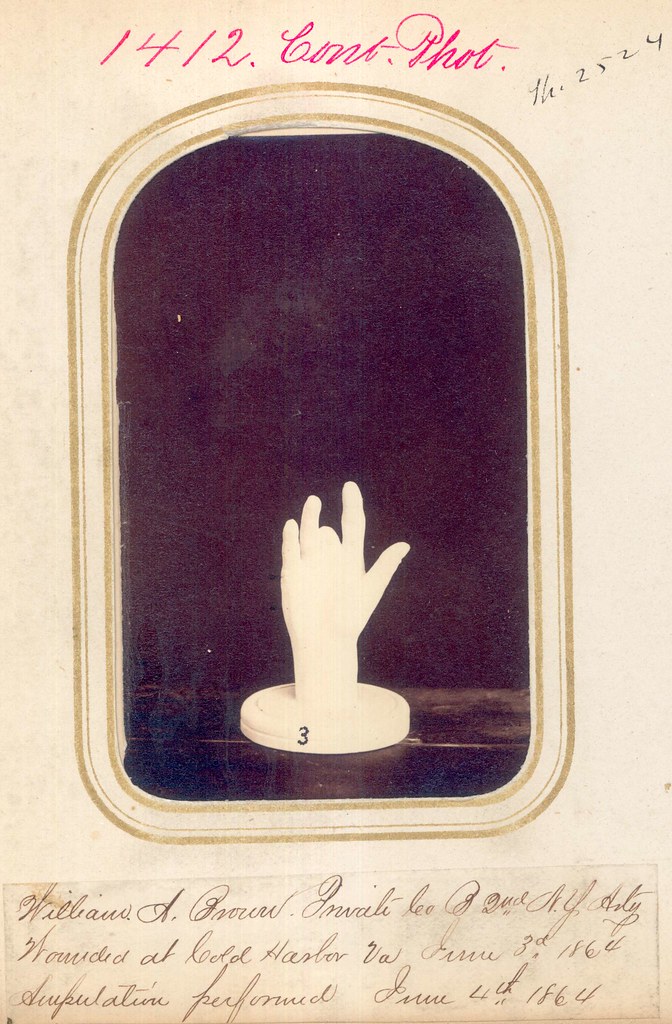
Contributed Photograph # 1412Via the wonderful Flickr photostream of the National Museum of Health and Medicine; more here. Click on image to see larger version.
Name: BROWN, WILLIAM A.
Specimen # 2524 SS
Rank: PVTCompany: B
Regiment: 3
State: NY
MOS: ARTILLERY
Battle: COLD HARBOR, VA
Date of Injury: 3 JUNE 1864
Contributor: ARMSBY, JAMES H.
Photographer: WOOD & BROTHER
Studio: OVER POST OFFICE, ALBANY, NY
Comments: BOUND IN IRA HARRIS, VOL. 6.

Now a particularly enduring Catholic practice is on prominent display in, of all places, Florence’s history of science museum, recently renovated and renamed to honor Galileo: Modern-day supporters of the famous heretic are exhibiting newly recovered bits of his body — three fingers and a gnarly molar sliced from his corpse nearly a century after he died — as if they were the relics of an actual saint.The above image--of Galileo Galileo's preserved finger in its reliquary as now on display in Florence’s history of science museum--and text are drawn from an article that ran in today New York Times. You can read the article--which traces the history of Galileo as well as his preserved fingers and other assorted remains--in its entirety by clicking here.
“He’s a secular saint, and relics are an important symbol of his fight for freedom of thought,” said Paolo Galluzzi, the director of the Galileo Museum, which put the tooth, thumb and index finger on view last month, uniting them with another of the scientist’s digits already in its collection.
“He’s a hero and martyr to science,” he added.