Showing posts sorted by relevance for query Cabaret du Néant. Sort by date Show all posts

Friday, August 24, 2007

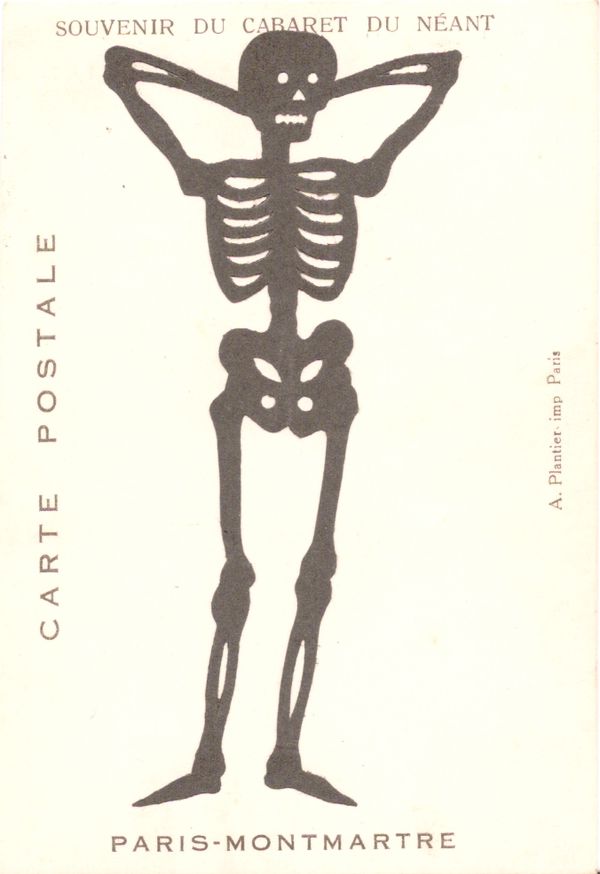
Cabaret du Néant (Tavern of the Dead) c.1890


Came across a reference to the fascinating (and kind of unbelievable) Cabaret du Néant in the book Wonder Shows: Performing Science, Magic, And Religion In America.The quote reads:
In the 1890s, the Cabaret du Néant (of Tavern of the Dead) first opened its production in Paris and later in New York City. After entering the Cabaret, spectators followed a "monk" down a blackened hall to a café with candles on coffin-shaped tables where they could order refreshments from waiters in funeral garb. A lectured called their attention to paintings of figures that dissolved into paintings of skeletons. While bells tolled and a funeral march played, the monk led the audience to a second chamber; here, a volunteer was asked to step up on a stage and enter a standing casket. After the volunteer was wrapped in a white shroud the spectators gasped at an apparent "X-ray" effect--actually a simpler optical effect--as the man dissolved into a skeleton and then once again returned to plain sight as the skeleton disappeared. In the last chamber, using a similar optical effect, a live spirit appeared to walk around an audience volunteer who mounted the stage to sit at a table.

Early goth amusement? Death themed bar? Were the 1890s the coolest time to be alive? More here and here, but little real information I could find in English. Does anyone have any more information on this? If so, please share!

Friday, August 9, 2013

Death Themed Drinking Establishments of the Near and Distant Past: "Cafe le Macabre," London and "The Conclave," New Orleans


He: "Oh look; they have The Grave, The Dead March and the Danse Macabre."She: "Oh, that sounds ever so nice!"
--Look at Life - Coffee Bar, 1959
Readers of this blog will already be familiar with one of my favorite historical curiosities, fin de siècle Paris's Cabaret du Néant, or "Tavern of the Dead," which I have reported on here, here and here. I have just learned about two similarly-themed drinking establishments from days gone by; the first is London's "Cafe le Macabre," as pictured above in images drawn from a late 1950s newsreel documenting the nascent London coffee craze. You can watch that newsreel directly above this text block or by clicking here; the segement on "Cafe le Macabre" begins about 7 minutes in.

This Soho-based haunt--with Danse Macabre on the jukebox, death and the maiden-inspired murals and skull ashtrays--was featured in Mark Pilkington and Will Fowler's recent Vampires of London talk at the Morbid Anatomy Lecture Series at the Last Tuesday Society. I am happy to report that Mr. Pilkington will be writing a piece on the topic for volume two of the Morbid Anatomy Anthology, so stay tuned for more on that!

The second establishment, "The Conclave" of New Orleans, came to my attention just a few days ago; Colin Dickey--co-editor of volume 1 of The Morbid Anatomy Anthology--sent the following quotation my way, found in Herbert Asbury's The French Quarter: An Informal History of the New Orleans Underground:
The Conclave was one of the few concert-saloons to maintain a bar as well as table service, and the arrangement in the back bar aroused much comment--it was fitted up as an exact replica of a section of burial vaults, complete with marble slabs on which were chiseled "Brandy, Whisky, Gin," etc. The bartenders were clad as undertakers, and when one of them served a customer he opened a vault in the back bar and pulled out a small silver-handled coffin filled with bottles of the desired liquor. The Conclave was always very popular among sightseers, but never gained great favor with hard drinkers.
Sadly, I was unable to locate any images for "The Conclave;" If anyone knows of any, please send them along to morbidanatomy [at] gmail.com!

Also, for those who wish to know still more about the wonderful Cabaret du Néant (and really, who doesn't?), the heavily illustrated final chapter of the upcoming Morbid Anatomy Anthology--“Hell Époque: Death-Themed Cabarets and other Macabre Entertainments of Nineteenth Century Paris" by Vadim Kosmos--is for you. You can still order a copy of the book by hitting the black "pre-order" button on the upper right of this blog.

Also, for the California-based among you, you will have an opportunity to learn yet more--and sample cocktails made from original Cabaret du Néant recipes (!!!)--under the tutelage of the incomparable Mel Gordon at the Morbid Anatomy segment of LA Death Salon this October 19th. Hope very much to see you there!

Monday, October 19, 2009

"Cabaret du Néant" (Tavern of the Dead) Revisited, Paris, 1899


I just stumbled across a new and extensive reference to the Cabaret du Néant ("Tavern of the Dead")--the fully immersive, death-themed nightclub which graced Paris during the fin de siècle. The Cabaret (which careful readers might remember from this recent Morbid Anatomy post) was a popular, macabre, and spectacular attraction which re-translated the phantasmagoria of the 18th Century into decadent nightclub for the turn-of-the-nineteenth-century Parisian sophisticate.

The reference, which I came across on the Voyages Extraordinaires blog, is sourced from the 1899 publication Bohemian Paris of To-day, by William Chambers Morrow, and features a very detailed eyewitness account of a visit to the Cabaret. This is probably the closest we 21st century folk will ever get to a virtual visit (unless some inspired film-maker or event-planner is reading this right now?) so I have posted the excerpt here in its entirety:
As we neared the Place we saw on the opposite side of the street two flickering iron lanterns that threw a ghastly green light down upon the barred dead-black shutters of the building, and caught the faces of the passers-by with sickly rays that took out all the life and transformed them into the semblance of corpses. Across the top of the closed black entrance were large white letters, reading simply:

C A F E D U N É A N T

The entrance was heavily draped with black cerements, having white trimmings, such as hang before the houses of the dead in Paris. Here patrolled a solitary croque-mort, or hired pall-bearer, his black cape drawn closely about him, the green light reflected by his glazed top-hat. A more dismal and forbidding place it would be difficult to imagine. Mr. Thompkins paled a little when he discovered that this was our destination, this grisly caricature of eternal nothingness, and hesitated at the threshold. Without a word Bishop firmly took his arm and entered. The lonely croque-mort drew apart the heavy curtain and admitted us into a black hole that proved later to be a room. The chamber was dimly lighted with wax tapers, and a large chandelier intricately devised of human skulls and arms, with funeral candles held in their fleshless fingers, gave its small quota of light.

Large, heavy, wooden coffins, resting on biers, were ranged about the room in an order suggesting the recent happening of a frightful catastrophe. The walls were decorated with skulls and bones, skeletons in grotesque attitudes, battle-pictures, and guillotines in action. Death, carnage, assassination were the dominant note, set in black hangings and illuminated with mottoes on death. A half-dozen voices droned this in a low monotone: "Enter, mortals of this sinful world, enter into the mists and shadows of eternity. Select your biers, to the right, to the left; fit yourselves comfortably to them, and repose in the solemnity and tranquility of death; and may God have mercy on your souls!"

A number of persons who had preceded us had already pre-empted their coffins, and were sitting beside them awaiting developments and enjoying their consommations, using the coffins for their real purpose, tables for holding drinking-glasses. Alongside the glasses were slender tapers by which the visitors might see one another.

There seemed to be no mechanical imperfection in the illusion of a charnel-house; we imagined that even chemistry had contributed its resources, for there seemed distinctly to be the odor appropriate to such a place. We found a vacant coffin in the vault, seated ourselves at it on rush-bottomed stools, and awaited further developments.

Another croque-mort a garcon he was came up through the gloom to take our orders. He was dressed completely in the professional garb of a hearse-follower, including claw-hammer coat, full-dress front, glazed tile, and oval silver badge. He droned, "Bon soir, Macchabees! [This word (also Maccabe, argot Macabit) is given in Paris by sailors to cadavers found floating in the river] Buvez les crachats d'asthmatiques, voila des sueurs froides d'agonisants. Prenez done des certificats de deces, seulement vingt sous. C'est pas cher et c'est artistique !"

Bishop said that he would be pleased with a lowly bock. Mr. Thompkins chose cherries a l'eau-de-vie, and I, une menthe.

"One microbe of Asiatic cholera from the last corpse, one leg of a lively cancer, and one sample of our consumption germ!" moaned the creature toward a black hole at the farther end of the room. Some women among the visitors tittered, others shuddered, and Mr. Thompkins broke out in a cold sweat on his brow, while a curious accompaniment of anger shone in his eyes. Our sleepy pallbearer soon loomed through the darkness with our deadly microbes, and waked the echoes in the hollow casket upon which he set the glasses with a thump.

"Drink, Macchabees!" he wailed: "drink these noxious potions, which contain thvilest and deadliest poisons!"

"The villain!" gasped Mr. Thompkins; "it is horrible, disgusting, filthy!"

The tapers flickered feebly on the coffins, and the white skulls grinned at him mockingly from their sable background. Bishop exhausted all his tactics in trying to induce Mr. Thompkins to taste his brandied cherries, but that gentleman positively refused, he seemed unable to banish the idea that they were laden with disease germs.

After we had been seated here for some time, getting no consolation from the utter absence of spirit and levity among the other guests, and enjoying only the dismay and trepidation of new and strange arrivals, a rather good-looking young fellow, dressed in a black clerical coat, came through a dark door and began to address the assembled patrons. His voice was smooth, his manner solemn and impressive, as he delivered a well-worded discourse on death. He spoke of it as the gate through which we must all make our exit from this world, of the gloom, the loneliness, the utter sense of helplessness and desolation.

As he warmed to his subject he enlarged upon the follies that hasten the advent of death, and spoke of the relentless certainty and the incredible variety of ways in which the reaper claims his victims. Then he passed on to the terrors of actual dissolution, the tortures of the body, the rending of the soul, the unimaginable agonies that sensibilities rendered acutely susceptible at this extremity are called upon to endure. It required good nerves to listen to that, for the man was perfect in his role. From matters of individual interest in death he passed to death in its larger aspects. He pointed to a large and striking battle scene, in which the combatants had come to hand-to-hand fighting, and were butchering one another in a mad lust for blood. Suddenly the picture began to glow, the light bringing out its ghastly details with hideous distinctness.

Then as suddenly it faded away, and where fighting men had been there were skeletons writhing and struggling in a deadly embrace. A similar effect was produced with a painting giving a wonderfully realistic representation of an execution by the guillotine. The bleeding trunk of the victim lying upon the flap-board dissolved, the flesh slowly disappearing, leaving only the white bones. Another picture, representing a brilliant dance-hall filled with happy revellers, slowly merged into a grotesque dance of skeletons; and thus it was with the other pictures about the room.

All this being done, the master of ceremonies, in lugubrious tones, invited us to enter the chambre de la mort. All the visitors rose, and, bearing each a taper, passed in single file into a narrow, dark passage faintly illuminated with sickly green lights, the young man in clerical garb acting as pilot. The cross effects of green and yellow lights on the faces of the groping procession were more startling than picturesque. The way was lined with bones, skulls, and fragments of human bodies.

"O Macchabees, nous sommes devant la porte de la chambre de la mort!" wailed an unearthly voice from the farther end of the passage as we advanced. Then before us appeared a solitary figure standing beneath a green lamp. The figure was completely shrouded in black, only the eyes being visible, and they shone through holes in the pointed cowl. From the folds of the gown it brought forth a massive iron key attached to a chain, and, approaching a door seemingly made of iron and heavily studded with spikes and crossed with bars, inserted and turned the key; the bolts moved with a harsh, grating noise, and the door of the chamber of death swung slowly open.

"O Macchabees, enter into eternity, whence none ever return!" cried the new, strange voice.

The walls of the room were a dead and unrelieved black. At one side two tall candles were burning, but their feeble light was insufficient even to disclose the presence of the black walls of the chamber or indicate that anything but unending blackness extended heavenward. There was not a thing to catch and reflect a single ray of the light and thus become visible in the blackness.

Between the two candles was an upright opening in the wall; it was of the shape of a coffin. We were seated upon rows of small black caskets resting on the floor in front of the candles. There was hardly a whisper among the visitors. The black-hooded figure passed silently out of view and vanished in the darkness.

Presently a pale, greenish-white illumination began to light up the coffin-shaped hole in the wall, clearly marking its outline against the black. Within this space there stood a coffin upright, in which a pretty young woman, robed in a white shroud, fitted snugly. Soon it was evident that she was very much alive, for she smiled and looked at us saucily. But that was not for long. From the depths came a dismal wail: "O Macchabee, beautiful, breathing mortal, pulsating with the warmth and richness of life, thou art now in the grasp of death! Compose thy soul for the end!"

Her face slowly became white and rigid; her eyes sank; her lips tightened across her teeth; her cheeks took on the hollowness of death, she was dead. But it did not end with that. From white the face slowly grew livid... then purplish black... The eyes visibly shrank into their greenish-yellow sockets... Slowly the hair fell away... The nose melted away into a purple putrid spot. The whole face became a semi-liquid mass of corruption. Presently all this had disappeared, and a gleaming skull shone where so recently had been the handsome face of a woman; naked teeth grinned inanely and savagely where rosy lips had so recently smiled. Even the shroud had gradually disappeared, and an entire skeleton stood revealed in the coffin. The wail again rang through the silent vault: "Ah, ah, Macchabee! Thou hast reached the last stage of dissolution, so dreadful to mortals. The work that follows death is complete. But despair not, for death is not the end of all. The power is given to those who merit it, not only to return to life, but to return in any form and station preferred to the old. So return if thou deservedst and desirest."

With a slowness equal to that of the dissolution, the bones became covered with flesh and cerements, and all the ghastly steps were reproduced reversed. Gradually the sparkle of the eyes began to shine through the gloom; but when the reformation was completed, behold! there was no longer the handsome and smiling young woman, but the sleek, rotund body, ruddy cheeks, and self-conscious look of a banker. It was not until this touch of comedy relieved the strain that the rigidity with which Mr. Thompkins had sat between us began to relax, and a smile played over his face, a bewildered, but none the less a pleasant, smile. The prosperous banker stepped forth, sleek and tangible, and haughtily strode away before our eyes, passing through the audience into the darkness. Again was the coffin-shaped hole in the wall dark and empty.

He of the black gown and pointed hood now emerged through an invisible door, and asked if there was any one in the audience who desired to pass through the experience that they had just witnessed. This created a suppressed commotion; each peered into the face of his neighbor to find one with courage sufficient for the ordeal. Bishop suggested to Mr. Thompkins in a whisper that he submit himself, but that gentleman very peremptorily declined. Then, after a pause, Bishop stepped forth and announced that he was prepared to die. He was asked solemnly by the doleful person if he was ready to accept all the consequences of his decision. He replied that he was. Then he disappeared through the black wall, and presently appeared in the greenish-white light of the open coffin. There he composed himself as he imagined a corpse ought, crossed his hands upon his breast, suffered the white shroud to be drawn about him, and awaited results, after he had made a rueful grimace that threw the first gleam of suppressed merriment through the oppressed audience. He passed through all the ghastly stages that the former occupant of the coffin had experienced, and returned in proper person to life and to his seat beside Mr. Thompkins, the audience applauding softly.

A mysterious figure in black waylaid the crowd as it filed out. He held an inverted skull, into which we were expected to drop sous through the natural opening there, and it was with the feeling of relief from a heavy weight that we departed and turned our backs on the green lights at the entrance...
You can visit the original post on Voyages Extraordinaires by clicking here; click here to peruse the entire online version of Morrow's 1899 Bohemian Paris of To-day on Archive.org.

Images sources: 1, 2, 3, 4, 5, 6

Wednesday, May 16, 2012

Café or Cabaret de L’Enfer (Hell's Café), Paris, France, Late 19th Century


Good friend and Midnight Archive auteur Ronni Thomas just brought Paris's Café de L’Enfer to my attention. Between this and the equally delightful (and previously discussed) Cabaret du Néant (or Tavern of the Dead), I am becoming stronger in my conviction that fin de siècle Paris was probably the most perfect place ever.

As described on the National Geographic Website:
MARAIS
Hell's Swells
A hot spot called Hell's Café lured 19th-century Parisians to the city's Montmartre neighborhood—like the Marais—on the Right Bank of the Seine. With plaster lost souls writhing on its walls and a bug-eyed devil's head for a front door, le Café de l'Enfer may have been one of the world's first theme restaurants. According to one 1899 visitor, the café's doorman—in a Satan suit—welcomed diners with the greeting, "Enter and be damned!" Hell's waiters also dressed as devils. An order for three black coffees spiked with cognac was shrieked back to the kitchen as: "Three seething bumpers of molten sins, with a dash of brimstone intensifier!"
Found via Retronaut who sourced it from Cool Stuff in Paris; all images via Retronaut; more to be found at the original link.

Friday, October 18, 2013

Morbid Anatomy Day at The Death Salon: TOMORROW Saturday October 19, Center for Inquiry, Los Angeles, California

Tomorrow, Saturday October 19 from 11AM - 6 PM: Hope to see you at Morbid Anatomy Day at the Los Angeles, California Death Salon! 

Full details follow; this event is free and open to the public, no tickets necessary; just come on by!!
------------------------------------------------------------
SATURDAY OCTOBER 19
Morbid Anatomy Day
Center for Inquiry
Saturday, October 19, 201311 AM-6 PM
4773 Hollywood Blvd., Los Angeles, CA
A one day, open-to-the-public Morbid Anatomy pop-up event which will explore the interstices of art and medicine, death and culture with screenings, a mini-symposium, a lecture on fin de siècle Parisian death themed cabarets with recreations of their classic drinks, and a panel on saints and mortification of the flesh.
11-1: Morbid Anatomy Anthology book panel of mini lectures, Midnight Archive screenings and panel discussion moderated by Lord Whimsy featuring:
1-2: Lunch
2-5:  Obliterated Bodies, Dissected Souls: Panel Moderated by Colin Dickey
Mortification of the Feminine Flesh: Elizabeth Harper
From the fatal anorexia of St. Catherine of Sienna to St. Rose of Lima's hidden crown of nails, self-inflicted pain has become part of a well-worn path to holiness for many Catholic women. However, these shocking acts become comprehensible and even logical when seen as a response to the transformation of the Church from the egalitarian early Christian church to the strict patriarchy of the Catholic Church as we know it. This change, coupled with Catholicism's unique views on death and martyrdom have lead many holy women to believe that to perfect a woman's soul, her body must be destroyed.
The Annihilated Saint: The Signifying Body of Bartholomew: Colin Dickey
Colin Dickey discusses images of torture in the cult of Christian saints, particularly Saint Bartholomew, who was flayed alive and who is regularly depicted holding his own skin. Inverting the traditional relationship of torturer and powerless victim, Christian imagery turned the act of torture into empowerment, where specific methods of torture became iconically associated with specific saints. As the cult of the saints waned, these images of torture began to filter into European consciousness in bizarre and fascinating ways, as Bartholomew's singular torture found its way into the lexicon of Renaissance anatomy textbooks, creating a new relationship between the sublime body and the dissected corpse.
Bringing Out the Dead: The "Anatomy Art" of Gunther von Hagens: Allison de Fren
Filmmaker/media scholar Allison de Fren discusses the corporeal displays of controversial German anatomist Gunther von Hagens. Using examples from both his traveling exhibition of human cadavers, Bodyworlds, and his UK television series Anatomy for Beginners, she will show how von Hagens recycles the visual motifs of Renaissance anatomy theatre and art to resuscitate the practice of public dissection for contemporary audiences
 5-6: ”Cabarets of Death” : Lecture followed by fin de siècle Parisian death-themed cabarets cocktails from original recipes with Mel Gordon
Highly illustrated lecture with reprints of the Cabaret du Néant’s menu and a recreation of their classic drinks from original recipes.
Image: Giulio Casserio, Anatomische Tafeln...Frankfurt, 1656. Copperplate engraving. National Library of Medicine; from Dream Anatomy Exhibition, National Library of Medicine

Thursday, May 9, 2013

Éditions Baleine, Paris

A publisher that uses photos of the waxes from the Spitzner Collection on all its book covers, sells postcards of the Cabaret du Néant, and has made veritable tatty cabinet of curiosities out its front window? Yes, please!

If you are in Paris, I highly recommend you check it out; you will find it at 11 rue Muller, 75018, on the way up the hill to Sacre Coeur. You can find out more here.

Monday, October 14, 2013

Vampires of London Talk and Screening! Death Salon, Los Angeles! Death in America, Dracula, Walking Tours and Taxidermy Galore: Upcoming Morbid Anatomy Events

We hope very much to see you tomorrow (Tuesday, October 15th) at an evening devoted to "The Vampires of London," with an illustrated lecture and film clips (from whence the images above!) presented by Mark Pilkington of London's Strange Attractor Press!

If that does not appeal, we have many more offerings in the weeks and months to come, including next weekend's Los Angeles based "Death Salon," a symposium devoted "to discussions of mortality and its cultural implications" (October 18-20); a new walking tour (Forgotten Dark Histories of Lower Manhattan, October 19); a class in Halloween prosthetic make-up (October 20); a lecture on death in America and the green cemetery movement (November 7); An illustrated lecture entitled "Children of the Night”: Dracula, Degeneration and Syphilitic Births at the Fin de Siècle (November 22); bunches of new taxidermy classes including one devoted to the legendary Jackalope (November 3); and much more.

The images above are from tomorrow night's lecture. Full info follows on all events and workshops; Hope very much to see you at one or more!
_______________________________________________

The Vampires of London: A Cinematic Survey
Illustrated lecture with Mark Pilkington, Strange Attractor Press
Date: Tuesday, October 15
Time: 8:00 PM
Admission: $10
Presented by Morbid Anatomy
In late 1969, as Swinging London entered its terminal phase, reports began to emerge of a tall, malevolent entity prowling the decaying gothic splendor of London's Highgate Cemetery. Wielding stakes, crucifixes, garlic bulbs and a lot of crushed velvet, a group of local youths invaded the cemetery in search of the supernatural; newspapers quickly picked up on the story and so the legend of  Highgate Vampire was born.

In this heavily illustrated presentation, Mark Pilkington looks at the many themes and influences – cultural, social and geographical –  that made the appearance of The Vampire an eerie inevitability. Armed with a wealth of stories, photographs and film clips – from Hammer classics and Pathe newsreels to period television and Mondo obscurities – Mark will add flesh to the bones of this undying monster.

Mark Pilkington is the author of Mirage Men and runs Strange Attractor Press.

_______________________________________________

Death Salon, Los Angeles, California
A weekend symposium devoted to to discussions of mortality and its cultural implications with special programming by Morbid Anatomy and The Order of the Good Death
Dates: October 18 - 20
Full info and registration her
S C H E D U L E
Friday, October 18, 2013
8:00 PM
The Order of the Good Death

Death Salon Cabaret
Bootleg Theater
2220 Beverly Blvd., Los Angeles

Death Salon Cabaret with talks, music, and short films hosted by Lord Whimsy with speakers including Paul Koudounaris, Author of The Empire of Death; Bess Lovejoy, author of Rest in Pieces: The Curious Fates of Famous Corpses; Lindsey Fitzharris, Wellcome Trust Postdoctoral Research Fellow; and Sarah Troop, host of The Cabinet of Curiosities Podcast. There will also be  musical performances by Jill Tracy and Adam Arcuragi. More details can be found here.
------------------------------------------------------------
Saturday, October 19, 2013
Morbid Anatomy
Day
11 AM-6 PM
A one day, open-to-the-public Morbid Anatomy pop-up event which will explore the interstices of art and medicine, death and culture with screenings, a mini-symposium, a lecture on fin de siècle Parisian death themed cabarets with recreations of their classic drinks, and a panel on saints and mortification of the flesh.
11-1: Morbid Anatomy Anthology book panel of mini lectures, Midnight Archive screenings and panel discussion moderated by Lord Whimsy featuring:
1-2: Lunch
2-5:  Obliterated Bodies, Dissected Souls: Panel Moderated by Colin Dickey
Mortification of the Feminine Flesh: Elizabeth Harper
From the fatal anorexia of St. Catherine of Sienna to St. Rose of Lima's hidden crown of nails, self-inflicted pain has become part of a well-worn path to holiness for many Catholic women. However, these shocking acts become comprehensible and even logical when seen as a response to the transformation of the Church from the egalitarian early Christian church to the strict patriarchy of the Catholic Church as we know it. This change, coupled with Catholicism's unique views on death and martyrdom have lead many holy women to believe that to perfect a woman's soul, her body must be destroyed.
The Annihilated Saint: The Signifying Body of Bartholomew: Colin Dickey
Colin Dickey discusses images of torture in the cult of Christian saints, particularly Saint Bartholomew, who was flayed alive and who is regularly depicted holding his own skin. Inverting the traditional relationship of torturer and powerless victim, Christian imagery turned the act of torture into empowerment, where specific methods of torture became iconically associated with specific saints. As the cult of the saints waned, these images of torture began to filter into European consciousness in bizarre and fascinating ways, as Bartholomew's singular torture found its way into the lexicon of Renaissance anatomy textbooks, creating a new relationship between the sublime body and the dissected corpse.
Bringing Out the Dead: The "Anatomy Art" of Gunther von Hagens: Allison de Fren
Filmmaker/media scholar Allison de Fren discusses the corporeal displays of controversial German anatomist Gunther von Hagens. Using examples from both his traveling exhibition of human cadavers, Bodyworlds, and his UK television series Anatomy for Beginners, she will show how von Hagens recycles the visual motifs of Renaissance anatomy theatre and art to resuscitate the practice of public dissection for contemporary audiences
 5-6: ”Cabarets of Death” : Lecture followed by fin de siècle Parisian death-themed cabarets cocktails from original recipes with Mel Gordon
Highly illustrated lecture with reprints of the Cabaret du Néant’s menu and a recreation of their classic drinks from original recipes.
_______________________________________________

Forgotten Dark Histories of Lower Manhattan : A Walking Tour
Date: Saturday, October 19th
Time: 3:00pm - 5:00pm
Admission: $20
*** Must pre-order tickets here: http://forgotten-dark-histories-nyc.eventbrite.com/
Max. number of attendees: 25
Meeting Point: Bowling Green, in front of the National Museum of the American Indian
This tour is approximately 2 hours in duration and one mile in length. Runs rain or shine, except in cases of severely inclement weather (e.g. hurricane). In case of cancellation, rain date will be Nov. 2, at the same time.
Today, learn about the ghastly, strange and shockingly dark history of Lower Manhattan on a walking tour which wends its way through the oldest parts of New York City. On this tour, you will visit the site of Barnum's American Museum, which unwittingly became its own horrific spectacle during an eerie disaster in 1865; encounter  lingering guests at one of New York's oldest and "most haunted" taverns; learn about the violent uprisings from when New York was still a slave state; hear the tale of New York City's very own Burke & Hare, and the riots that followed in their wake; discover the ironic meaning of the "Holy Ground" behind St. Paul's Chapel; learn about the dissolute actor who sold his head to science (while he was still alive!) and much more.

Andrea Janes is a writer and tour guide who lives in Brooklyn, New York. Her interest in urban history and terrifying tales led to her career of conducting walking tours of macabre locations in New York City. She is also the author of BOROUGHS OF THE DEAD: New York City Ghost Stories. The book is a work of fiction, but in the course of her research, she discovered the city was a wealth of ghostly, gory stories, and decided she wanted to share them with the world. Find out more at www.boroughsofthedead.com.
_______________________________________________

Halloween Prosthetic Make-up Class with SFX Expert David Rodriguez (Mindfeargorefx)
Date: Sunday, October 20
Time: 1:00pm - 6pm
Admission: $80
*TICKETS MUST BE PRE-ORDERED HERE: http://www.brownpapertickets.com/event/476489
***Offsite at The Fabricoscope (41 Willow Place, #2, 11201 Brooklyn) (MAP)
Subway: Court St, Borough Hall, Jay St. Metro Tech.

What are you planning to be for Halloween this year? Avoid that last minute "vampire" costume with this special effects makeup class! From slit throats to dermatological diseases, SFX Expert David Rodriguez will help you create an original and spooky costume of your very own using the techniques made famous by the great Hollywood film studios. Each student will leave with several prosthetic wounds/masks suitable for Halloween and the skills to make their own pieces in the future.

This 5 hour workshop will include :
  • Introduction to materials and tools (such as wax, latex, gelatin and tubing) and their application; students will also learn to make bald caps and mix convincing blood.
  • Skin and Burns Tutorial – Students will learn to apply latex and gelatin to create convincing 1st to 3rd degree burns and blisters as well as other skin diseases and conditions.
  • Zombie FX Tutorial - Students will learn the techniques of great zombie makeup, from the freshly dead to the extremely decomposed.
  • Casualty and Wound Tutorial – Students will learn how to mix thick blood and create entrails; they will also learn the art of spectacular cuts, scrapes and bruises as well as basic blood effects.
The price will cover all materials, including :
  • Makeup pallet with basic colors
  • Latex
  • Gelatin
  • Sponges
  • Armature for creating mask
  • Brushes
  • Blood
David Rodriguez is a self taught New York makeup artist, Trained in traditional Fine Art and Medical Illustration at schools such as Art and Design as well as SVA always inspired by horror and film he began doing special effects and makeup for the New York indy film scene learning from production to production eventually working with such companies as MTV, Cartoon Network, Showtime, HBO and Syfy channel working with the show Face/Off and nearly being a contestant. He now owns and operates Mindfeargore FX a makeup and Special effects stdio providing a line of quality services and products ranging from prosthetics to animatronics for the Professional and amateur costumer, Filmmaker, performer, LARPer and Cosplayer.

Image: Tony Laurent putting on horror makeup for show at the Grand Guignol Theater” by Hans Wild; found in Life Magazine. Source: HERE.
_______________________________________________
Reliquary Wax Doll Workshop with Artist and Ceroplast Sigrid Sarda
Date: Saturday, October 26th 
Time: 11:3 – 6:30 PM
Price: $350
Must RSVP via sigrid.sarda(at)gmail.com to sign up.
This class is part of The Morbid Anatomy Art Academy
***Offsite at The Fabricoscope (41 Willow Place, #2, 11201 Brooklyn) (MAP)
Subway: Court St, Borough Hall, Jay St. Metro Tech.
Wax artist Sigrid Sarda has returned for a special class teaching the art of doll making. This class will revolve entirely on the creation of a wax doll in the image of the student’s chosen saint with the relic of their choice.
The wax doll represented as a human figure has always fascinated man. In early times these dolls were connected to witchcraft, magic, exorcisms for priests, and effigies. For this class they represent talismans and reliquaries for the student’s own personal interpretation of the saint’s meaning. The doll then becomes an object of prayer and veneration.
Each student will receive a handmade wax doll by Sigrid, either male or female and in turn will learn to set eyes, root hair, color the skin tone and add special physical quirks the saint may have, an example being stigmata or a particular wound. The student will then realize their own decorated costumes for the saints using patterns in the art of Victorian paper clothes making for dolls.
This class will consist of:
  • short talk on the history of the wax doll and everyone’s chosen saint and what it
  • means to them.
  • inserting glass eyes
  • rooting hair
  • Lunch break
  • rooting hair, beginning of skin coloring and adding any special physical quirks.
followed by
  • finish up skin coloring and quirks
  • insert / add relic
  • lunch break
  • make and decorate clothing for doll
  • dress doll
Materials are included though the student is expected to bring their own relic. The relic can be a lock of hair, a fingernail, bone, anything that has meaning to the student. The trims, spangles and paper for the costumes are either antique or vintage as are the glass eyes.
The dolls will be approx 6"-8".
Sigrid Sarda is self taught in the art of ceroplastics. She has been featured on such programs as The Midnight Archive, TV's Oddities, and has exhibited in London and NYC. She has an upcoming residency at The Gordon Museum in London, recreating the Black Dahlia for NoirCon 2014 and will be giving a demonstration in the art of medical wax moulage for The New York Academy of Medicine this fall.

_______________________________________________

Anthropomorphic Mouse Taxidermy Class-Halloween Special with Divya Anantharaman
Date: Sunday, October 27
Time: 12:00pm - 6pm
Admission: $110
*TICKETS MUST BE PRE-ORDERED AT http://halloweenmousetaxidermy.brownpapertickets.com/
***Offsite at The Fabricoscope (41 Willow Place, #2, 11201 Brooklyn) (MAP)
Subway: Court St, Borough Hall, Jay St. Metro Tech.

Anthropomorphic taxidermy--a practice in which taxidermied animals are posed as if engaged in human activities--was an artform made famous by Victorian taxidermist and museologist Walter Potter. In this class, as profiled by the New York Times, students will learn to create--from start to finish--anthropomorphic mice inspired by the charming and imaginative work of Mr. Potter. Your final project might take the form of a bespectacled, whiskey swilling, top hat tipping mouse; or perhaps a rodent mermaid queen of the burlesque world? With some props and some artful styling, your mouse can become whatever or whomever you want; this is the joy of anthropomorphic taxidermy.

*In this special HALLOWEEN edition, the usual selection of miniatures and props provided for student use will be supplemented by some extra spooky bonus items. Students are also welcome to don costumes and other festive attire (but it is in no way required). To further celebrate one of my favorite holidays, we will end the class with a dark cocktail and delicious treat :) Again, Halloween spirit is not required, but sure is fun!*

This class will teach students everything involved in producing a fully finished mount, including initial preparation, hygiene and sanitary measures, fleshing, tail stripping, and dry preservation. Once properly preserved, the mice will be posed and outfitted as the student desires, with a selection of props and accessories provided. Students are also encouraged to bring their own accessories and bases. All other supplies will be provided for use in class.

Each student will leave class with a fully finished piece, and the knowledge to create their own pieces in the future.

Divya Anantharaman is a Brooklyn based artist whose taxidermy practice was sparked by a lifelong fascination with natural mythology and everyday oddities. After a journey filled with trial and error, numerous books, and an inspiring class (Sue Jeiven's popular Anthropomorphic Mouse Taxidermy Class at Observatory!), she has found her calling in creating sickly sweet and sparkly critters. Beginning with mice and sparrows, her menagerie grew to include domestic cats, woodchucks, and deer. Recently profiled on Vice Fringes, the New York Observer, and other publications, she will also be appearing in the upcoming season of Oddities-and is definitely up to no good shenanigans. You can find out more at www.d-i-v-y-a.com
Also, some technical notes:
  • We use NO harsh or dangerous chemicals.
  • Everyone will be provided with gloves.
  • All animals are disease free.
  • Although there will not be a lot of blood or gore, a strong constitution is necessary; taxidermy is not for everyone
  • All animals were already dead, nothing was killed for this class.
  • Please do not bring any dead animals with you to the class.
_______________________________________________

Jackalope Taxidermy Class with Rogue Taxidermist Katie Innamorato
Sunday, November 3rd
Time: 12 – 6 PM
Admission: $250
***MUST RSVP at katie.innamorato [at] gmail.com
This class is part of The Morbid Anatomy Art Academy
***Offsite at The Fabricoscope (41 Willow Place, #2, 11201 Brooklyn) (MAP)
Subway: Court St, Borough Hall, Jay St. Metro Tech.
This class will introduce students to the process and techniques behind more advanced basic small mammal taxidermy. Students will learn how to skin, prep, preserve, mount, and position the animal. Attention will be focused on how to properly split, turn, and position rabbit ears. Basic armatures will be used and custom made forms (made by me) will be provided. Students will learn how to make a custom body for their specimens using an old traditional taxidermy technique of wrapping a body. Using the carcass for reference, students will learn how to build up and craft the bodies. Pre-sculpted antlers or antler tips will be provided. Students encouraged to bring in any props they may want to dress the animal up in. I will provide all specimens, materials, and tools for the class. Each student will leave with his or her own finished mount.

---------------------------
Katie Innamorato, artist and Rogue Taxidermist, is a member of the M.A.R.T. or Minnesota Association of Rogue Taxidermists. She is professionally and self taught in taxidermy; winning awards and ribbons every year at the GSTA. She explores the commercial relationships between animals and our society and her work questions the idea of bringing nature inside. She also examines the cyclical connections between life and death, and growth and decomposition. As with all M.A.R.T. members she adheres to strict ethical guidelines when acquiring specimens. She uses roadkill, scrap skins from other taxidermists and the garment industry, and donated skins to create her artworks; almost every part of the animal is utilized.

Her work has been featured recently on the new Science Channel show, "Odd Folks Home," on the hit Science and Discovery Channel TV show, "Oddities," and exhibited at La Luz de Jesus Gallery in Los Angeles, CA.

Her website and blogs-
www.afterlifeanatomy.com
www.afterlifeanatomy.tumblr.com
www.facebook.com/afterlifeanatomy
www.etsy.com/shop/afterlifeanatomy
_______________________________________________
Death in America and the Green Cemetery Movement
An Illustrated lecture by funeral director Amy Cunningham
Date: Thursday, November 7
Time: 8:00 PM
Admission: $8
Location: Observatory, Brooklyn (543 Union Street (at Nevins), Brooklyn, NY 11215)

Each year in the U.S., the death care industry buries enough formaldehyde to fill eight Olympic sized swimming pools, enough metal in caskets form to rebuild the Golden Gate Bridge, and enough concrete in burial vaults to construct a two-lane highway running halfway across the country. While our cemeteries are rich with national and local histories, natural habitats and remembrances of the dead, they’re also a blazing locus of waste and pollution.

In tonight's illustrated lecture, funeral director Amy Cunningham will share the history of American death practices from Victorian family-centric rituals to contemporary ideas of the "green cemetery," a grassroots movement dedicated to the development of ecologically responsible and meaningful end-of-life rituals.

Amy Cunningham is a New York licensed funeral director and celebrant who specializes in helping families plan sustainable end-of-life rituals. A former magazine journalist, she maintains a blog called TheInspiredFuneral.com.

_______________________________________________

Ermine Taxidermy Class with Divya Anantharaman
Date: Sunday, November 10
Time: 12:00pm - 6pm
Admission: $185
*TICKETS MUST BE PRE-ORDERED AT http://ermine-taxidermy.brownpapertickets.com/
***Offsite at The Fabricoscope (41 Willow Place, #2, 11201 Brooklyn) (MAP)
Subway: Court St, Borough Hall, Jay St. Metro Tech.

In this hands-on class, we will study the wiley ermine! Also known as a white weasel (they are actually brown in the summer, and turn white in the winter), this small creature used to be harvested by the hundreds for the plush robes of royalty-but not so much anymore. It has become less profitable since they are small animals (and do not yield lots of fur like the more popular fox or coyote)-so much that the ones used in class were collected from a game farm and tannery downsizing business and discarding old stock of unwanted frozen animals. Students will create a fully-finished mount in a naturalistic or anthropomorphic position. Students will learn everything involved in producing a finished mount - from initial preparation, hygiene and sanitary measures, to proper technique and dry preservation.

The class will teach how to create a wrapped body form using the ermine's own body as reference. Students will have the choice of cleaning and reconstructing the skull, or carving one using the natural one as reference. The use of anatomical study, reference photos, and detailed observation will also be reviewed as important tools in recreating the natural poses and expressions that magically reanimate a specimen. A selection of props will be provided, however, students are welcome to bring their own bases and accessories if something specific is desired. All other supplies will be provided for use in class.

Each student will leave class with a fully finished piece, and the knowledge to create their own pieces in the future.

Divya Anantharaman is a Brooklyn based artist whose taxidermy practice was sparked by a lifelong fascination with natural mythology and everyday oddities. After a journey filled with trial and error, numerous books, and an inspiring class (Sue Jeiven's popular Anthropomorphic Mouse Taxidermy Class at Observatory!), she has found her calling in creating sickly sweet and sparkly critters. Beginning with mice and sparrows, her menagerie grew to include domestic cats, woodchucks, and deer. Recently profiled on Vice Fringes, the New York Observer, and other publications, she will also be appearing in the upcoming season of Oddities-and is definitely up to no good shenanigans. You can find out more at www.d-i-v-y-a.com
Also, some technical notes:
  • We use NO harsh or dangerous chemicals.
  • Everyone will be provided with gloves.
  • All animals are disease free.
  • Although there will not be a lot of blood or gore, a strong constitution is necessary; taxidermy is not for everyone
  • All animals were already dead, nothing was killed for this class.
  • Please do not bring any dead animals with you to the class.
_______________________________________________

Mother Machine: an ‘Uncanny Valley’ in the Eighteenth Century Illustrated lecture with Dr. Brandy Schillace
Date: Thursday, November 21
Admission: $8
Time: 8:00 PM
Location: Observatory, Brooklyn (543 Union Street (at Nevins), Brooklyn, NY 11215)


Known by a variety of names—“this most curious machine,” “this mock woman,” and the “celebrated Apparatus” —Dr. William Smellie’s mechanized obstetrical phantom was both science and spectacle in the eighteenth century. Strangely, however, though crucial to the training of at least 900 man-midwives in ten years, the machine disappears from both the actual and rhetorical "scene" of 18th-century obstetrical science.

This illustrated talk will explore the mitigating factors contributing to the machine's disappearance. Why was such a valuable teaching tool auctioned to the public after Smellie’s death? Why did famed obstetrician William Hunter agree to sell his own copy of the machine to Dr. Foster of the Dublin Rotunda? And why—after so much popular debate—does the machine disappear from public notice by the latter part of the century? Dr. Schillace will also document her own rather circuitous journey of discovery, that is, the necessary labor of unearthing (if not birthing) a medical artifact’s unusual history.

Dr. Brandy Schillace
is an interdisciplinary, medical-humanist scholar. She writes about cultural production, history of science, and intersections of medicine and literature. She is the managing editor of Culture, Medicine and Psychiatry, an international journal of cross-cultural health research and a guest curator and blogger for the Dittrick Medical History Museum. Dr. Schillace was the keynote speaker for the annual meeting of the Archivists and Librarians in the History of Health Sciences 2013, and is the recent recipient of the Chawton House Library Fellowship (for study of 18th century women writers) and the Wood Institute travel grant from the Philadelphia College of Physicians. She has also an edited book collection under contingent contract with Cambria Press: Birthing the Monster of Tomorrow: Unnatural Reproductions. For a selection of recently published work, please visit http://fictionreboot-dailydose.com/publications-and-press.

Image: A late eighteenth-century “birthing phantom.” Unlike Smellie’s machine, these were not intended to be exactly like the living body, but rather a basic replica allowing midwives to understand the position of the child in the birth canal. By permission of the Dittrick Medical History Center and Museum
_______________________________________________

“Children of the Night”: Dracula, Degeneration and Syphilitic Births at the Fin de Siècle
Illustrated lecture with Dr. Brandy Schillace and custom cocktails and DJed music by Friese Undine
Date: Friday, November 22
Admission: $10
Time: 8:00 PM
Location: Observatory, Brooklyn (543 Union Street (at Nevins), Brooklyn, NY 11215)

Bram Stoker’s Dracula is often read as a narrative of reverse colonization, revealing fears of degeneration at the fin de siècle. Anxieties over the decline of empire and—as both symptom and consequence—the degeneration of masculinity in Victorian Britain resulted in a number of dystopic narratives, each revealing an uneasy relationship between evolution and devolution, sexuality, sexual identity and mental health. However, the signal terror of Stoker’s vampires lies not only in their overt sexuality and promiscuity—but also in their fecundity. As Van Helsing warns, the vampire is not a single foe but a potential army. Both “father” and unnatural mother, Count Dracula is capable of reproducing the undead—and yet his victims do not, it seems reproduce themselves.

In this presentation Dr. Schillace will explore accounts of syphilitic infection as a means of understanding the complexities of infection among the “innocents,” Lucy Westenra and the children she victimizes. Culminating in a re-examination of the only human birth in Stoker’s novel—Mina Harker’s son Quincy—this project seeks to provide new insight into 19th century anxieties about degeneration’s naissance.

Dr. Brandy Schillace is an interdisciplinary, medical-humanist scholar. She writes about cultural production, history of science, and intersections of medicine and literature. She is the managing editor of Culture, Medicine and Psychiatry, an international journal of cross-cultural health research and a guest curator and blogger for the Dittrick Medical History Museum. Dr. Schillace was the keynote speaker for the annual meeting of the Archivists and Librarians in the History of Health Sciences 2013, and is the recent recipient of the Chawton House Library Fellowship (for study of 18th century women writers) and the Wood Institute travel grant from the Philadelphia College of Physicians. She also an edited book collection under contingent contract with Cambria Press: Birthing the Monster of Tomorrow: Unnatural Reproductions. For a selection of recently published work, please visit http://fictionreboot-dailydose.com/publications-and-press.
_______________________________________________

Small Rabbit Taxidermy Class "Trophy Plaque" or Full Size Mount with Divya Anantharaman
Date: Sunday, November 24
Time: 12:00pm - 6pm
Admission: $250
*TICKETS MUST BE PRE-ORDERED AT http://smallrabbittaxidermy.brownpapertickets.com/
***Offsite at The Fabricoscope (41 Willow Place, #2, 11201 Brooklyn) (MAP)
Subway: Court St, Borough Hall, Jay St. Metro Tech.

In this intimate, hands-on class (limited to only six students), we will study the happy and hoppy rabbit! Students will create a fully-finished rabbit mount in a naturalistic or anthropomorphic position. There is also the option to create a "trophy style" shoulder mount (where the head and shoulder is mounted on a wooden plaque). When purchasing ticket, please specify which you would like to do.

Students will learn everything involved in producing a finished mount - from initial preparation, hygiene and sanitary measures, to proper technique and dry preservation. The class will teach how to create a wrapped body form using the rabbit's own body as reference, and how to reconstruct a rabbit head using the skull as reference. Students will also be introduced to the techniques of ear turning and ear carding. The use of anatomical study, reference photos, and detailed observation will also be reviewed as important tools in recreating the natural poses and expressions that magically reanimate a specimen. A selection of props will be provided, however, students are welcome to bring their own bases and accessories if something specific is desired. All other supplies will be provided for use in class.

Each student will leave class with a fully finished piece, and the knowledge to create their own pieces in the future.

Divya Anantharaman is a Brooklyn based artist whose taxidermy practice was sparked by a lifelong fascination with natural mythology and everyday oddities. After a journey filled with trial and error, numerous books, and an inspiring class (Sue Jeiven's popular Anthropomorphic Mouse Taxidermy Class at Observatory!), she has found her calling in creating sickly sweet and sparkly critters. Beginning with mice and sparrows, her menagerie grew to include domestic cats, woodchucks, and deer. Recently profiled on Vice Fringes, the New York Observer, and other publications, she will also be appearing in the upcoming season of Oddities-and is definitely up to no good shenanigans. You can find out more at www.d-i-v-y-a.com

Also, some technical notes:
  • We use NO harsh or dangerous chemicals.
  • Everyone will be provided with gloves.
  • All animals are disease free.
  • Although there will not be a lot of blood or gore, a strong constitution is necessary; taxidermy is not for everyone
  • All animals were already dead, nothing was killed for this class.
  • Please do not bring any dead animals with you to the class.
Full list and more information on all events can be found here. More on the Morbid Anatomy Art Academy can be found here.