Showing posts sorted by relevance for query anatomical venus. Sort by date Show all posts

Wednesday, April 16, 2008

Florentine Anatomical Venus in Rare American Appearance!


The Getty Villa in Malibu, California has an interesting show up called "The Color of Life: Polychromy in Sculpture from Antiquity to the Present." The exhibition showcases the many ways artists have used color in figural sculpture for centuries, and, to my excitement, includes an actual Anatomical Venus from the famed La Specola collection in Florence!

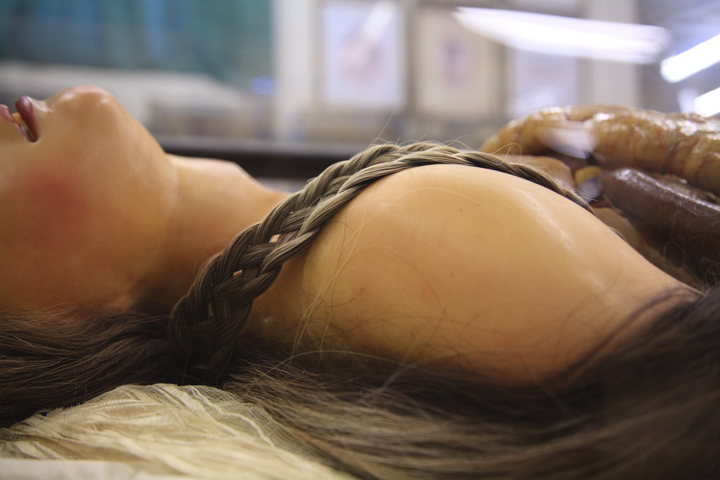
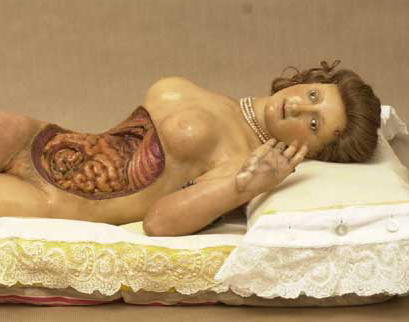
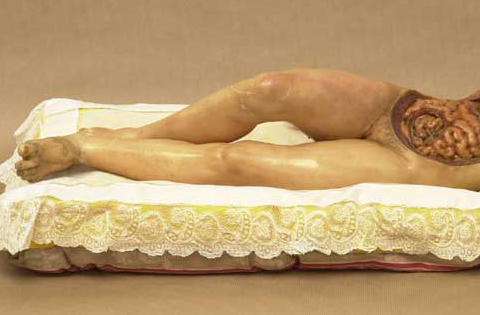
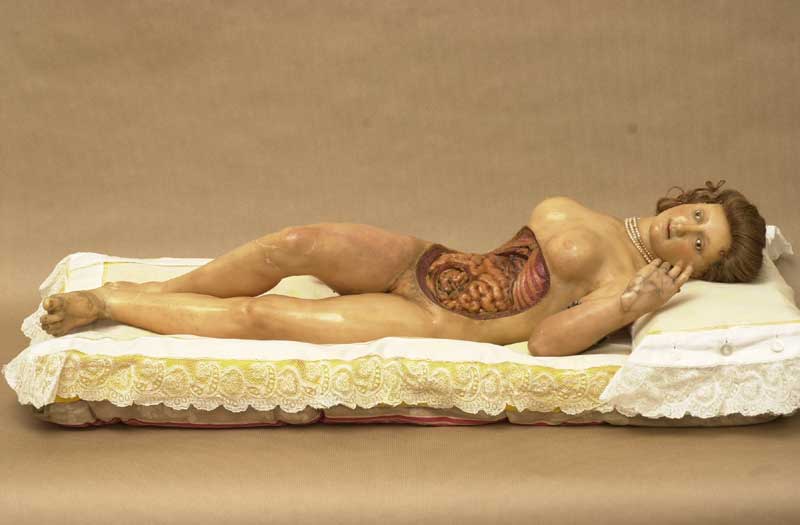
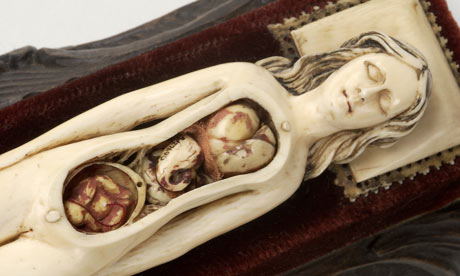
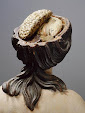
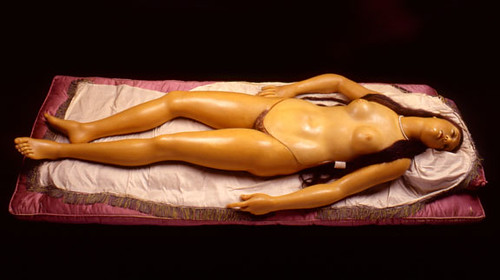
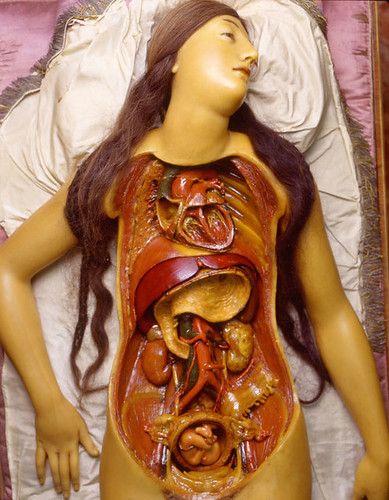
Anatomical Venuses are life-sized wax anatomical models of idealized women, extremely realistic in appearance and often adorned with real hair and ornamental jewelry. These figures consist of removable parts that can be "dissected" to demonstrate anatomy-- a breast plate is lifted to reveal the inner workings of the mysterious female body, often with a fetus to be found nestling in the womb (see before and after above). This was a way to share anatomical discovery with a larger audience without the need for an actual human dissection.

Anatomical Venuses are probably the most historically popular form of anatomical models; in the 19th-Century, they were the centerpiece of museums and itinerant shows of all kinds, and possessed great power to draw crowds. The 18th-Century Florentine Venuses are the best remembered today, in no small part due to Taschen's Encyclopaedia Anatomica,and are considered, by some, to be the finest examples of Anatomical Venuses known to exist.

This Anatomical Venus featured in the Getty show, completed in 1782 by Clemente Susini and his workshop, is truly a masterwork of the genre, and outshines the many copies held by medical museums throughout Europe who, impressed by the veracity and workmanship of the Florentine Venuses, commissioned their own from Susini's workshop. For example, the core of the collection of the Viennese Josephinum Museum consists of 1192 models commissioned by Emperor Joseph from the Susini workshop in 1784 for the training of his military doctors. As a body of work they are interesting, but somehow the models in this collection pale in comparison to the La Specola models. The workmanship is a bit shoddier, the visages a bit less alluring.

The Anatomical Venus exhibited in the Getty exhibition is one of the finest, and almost never leaves her home in Florence--she has only been transported twice in her long history, and even has a specially-built traveling case to protect her delicate wax body. This means that, sadly, you will not see her in her original setting--an elegant rosewood and Venetian glass case-- but the relative accessibility of the piece (i.e. in the United States) should make up for this lack.

It is really great to see anatomical models being seriously approached as artwork in an exhibition of this sort; I consider it a bold move on the part of the curators, and cannot help wondering what strings the curators had to pull in order to acquire one of these rare and fragile Venuses on loan. It is also nice to see that, in reviews of the show, the Venus seems to be a real standout. This supports my belief that, if more people knew of these Venuses and other anatomical models, they would be seen as intriguing artworks and cultural documents, worthy of a greater amount of study as well as inclusion in the medical art canon.

From the UCLA paper The Daily Bruin:
The two most impressive pieces of the whole exhibition, which may please even marble lovers, both shock and fascinate at the same time. One of them is an 18th-century wax model of a nude life-size woman called the “Anatomical Venus,” which shows the multicolored exterior and interior of a female body with an almost uncanny precision.

And from the LA Times review of the show:
The strangest, without a doubt, is an 18th century wax figure known as the "Anatomical Venus": a comely young woman, life-sized and nude, lying prostrate on a pink silk cushion in what looks to be a state of sensual rapture, her torso flayed and all her glistening organs -- including a womb containing a tiny fetus -- revealed. Her long brown hair is real, her eyes are open and unfocused, and the cloth of her pillow is crumpled -- she might as well be writhing. The product of one sculptor's clearly intimate experience with cadavers, she suggests an Enlightenment-era St. Teresa ravished by communion with the invisible forces of science.


To learn more about the show, which runs until June 23 of this year, visit the exhibition website, complete with gallery slideshow. Better yet, visit the show in person if you are able. This might be your only chance EVER to see an Anatomical Venus of this quality without traveling to Florence. To see more images of Anatomical Venuses and other anatomical models, see the Anatomical Theatre Gallery. To learn more about medical models, see Susan Lamb's An Analysis of Anatomy Models and A. W. Bates' abstract for Anatomical Venuses: The Aesthetics of Anatomical Modeling in 18th- and 19th-Century Europe. You can also see the Venus in all states of metaphorical undress in Taschen's Encyclopaedia Anatomica.

Thanks to the Getty for supplying the above images and answering my barrage of questions. Photographs of the Anatomical Venus by Saulo Bambi, Museo di Storia Naturale "La Specola"; Florence, Italy

And if any Morbid Anatomy readers are in the Los Angeles area and could take a photo of the model in context of the show and send me a copy, I'd very much appreciate it.

Monday, March 28, 2016

New Morbid Anatomy Book on the Uncanny Allure of the Anatomical Venus!

The strangest, without a doubt, is an 18th century wax figure known as the "Anatomical Venus": a comely young woman, life-sized and nude, lying prostrate on a pink silk cushion in what looks to be a state of sensual rapture, her torso flayed and all her glistening organs -- including a womb containing a tiny fetus -- revealed. Her long brown hair is real, her eyes are open and unfocused, and the cloth of her pillow is crumpled -- she might as well be writhing. The product of one sculptor's clearly intimate experience with cadavers, she suggests an Enlightenment-era St. Teresa ravished by communion with the invisible forces of science.
--"Exposing classical art's true colors: A Getty Villa exhibit adds brilliant hues to works once thought to be unadorned." Holly Myers for the Los Angeles Times, 2008
Morbid Anatomy began in 2007 as a research tool for an exhibition called Anatomical Theatre, which explored the uncanny allure of historical wax medical models. Of all those models, by far the most seductive and fascinating is life-sized, ecstatically posed Anatomical Venus.

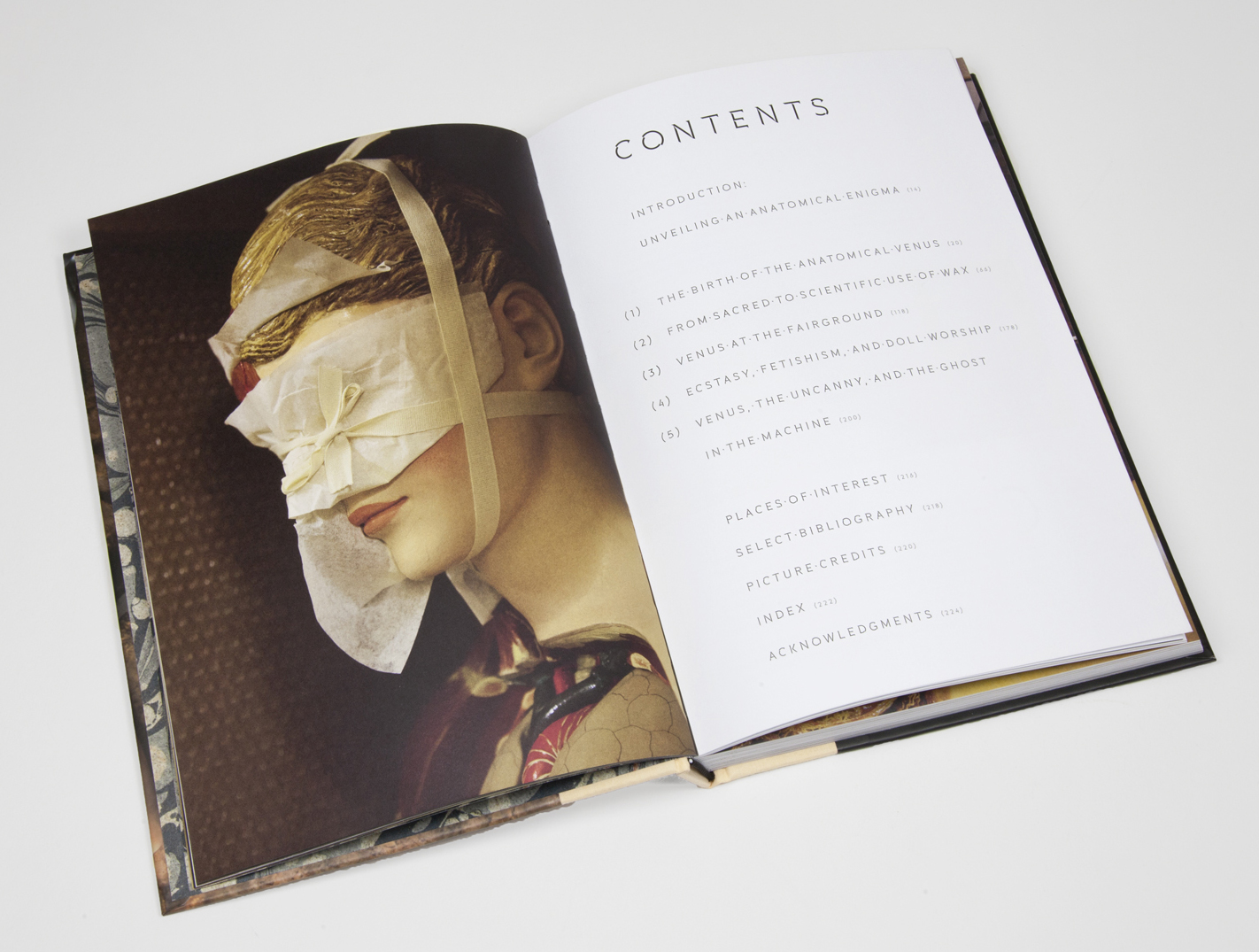
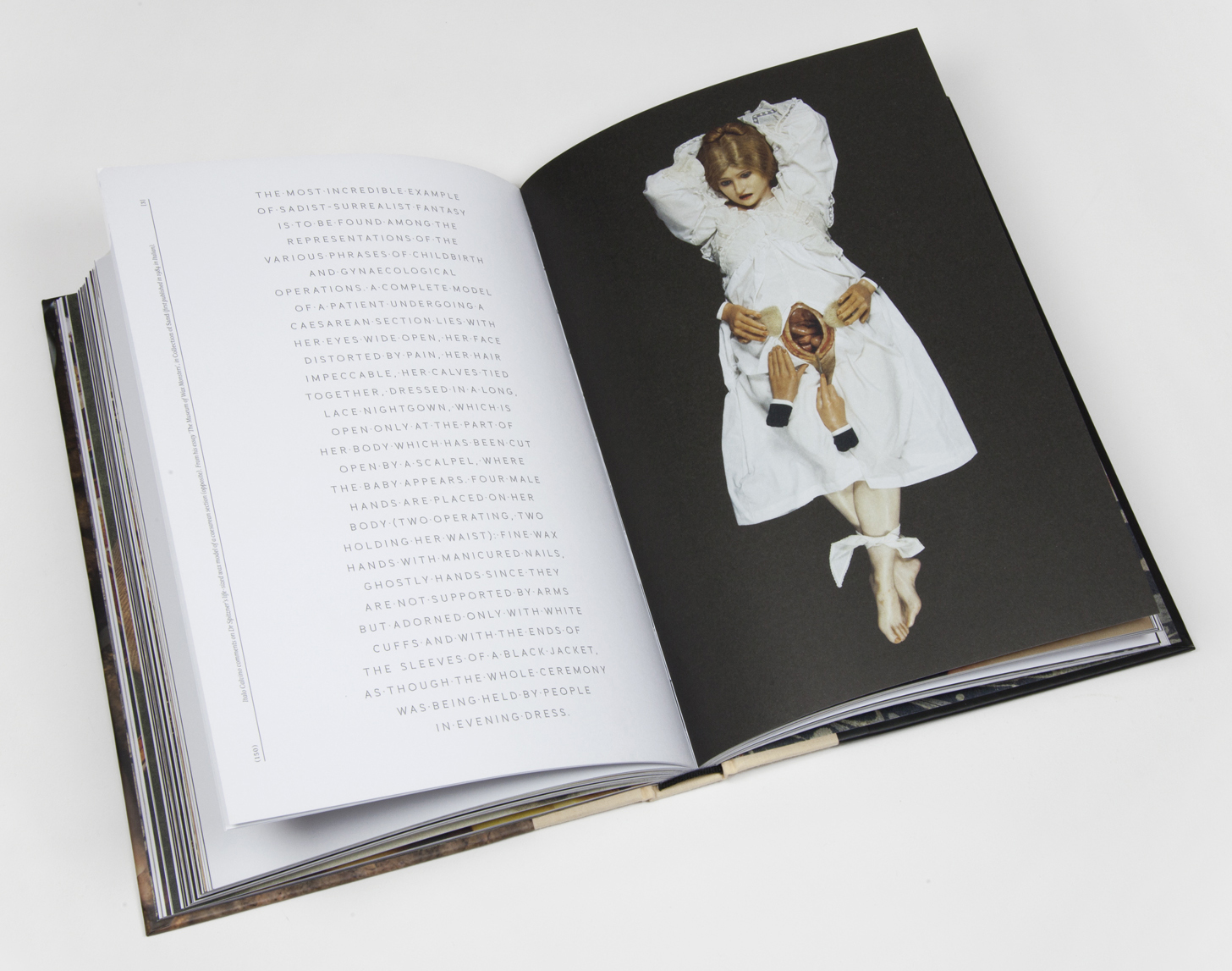
Since that time, the Anatomical Venus has served as both a guide and a muse for the entire Morbid Anatomy project, inspiring research and trips around the world; exhibitions including Exquisite Bodies at the Wellcome Collection; a variety of lectures and articles; and, as of May 24th, a brand new, hardcover, gorgeously designed and lavishly illustrated (see sample page spreads above) 224 page book entitled The Anatomical Venus, published by Thames and Hudson in the UK (top image) and by DAP (second image) in the USA.

The book uses The Anatomical Venus as a point of departure to explore the many paths that lead from her; it situates her within her "historical and cultural context in order to reveal the shifting attitudes toward death and the body that today render such spectacles strange. It reflects on connections between death and wax, the tradition of life-sized simulacra and preserved beautiful women, the phenomenon of women in glass boxes in fairground displays, and ideas of the ecstatic, the sublime and the uncanny."

The full official ad copy for the book follows; stay tuned for information on parties and symposia to celebrate its release taking place in both New York City and London! And, although the book will not be officially released until mid-May, it can be pre-ordered in the USA here, and here for the rest of the world.
Of all the artifacts from the history of medicine, the Anatomical Venus—with its heady mixture of beauty, eroticism and death—is the most seductive. These life-sized dissectible wax women reclining on moth-eaten velvet cushions—with glass eyes, strings of pearls, and golden tiaras crowning their real human hair—were created in eighteenth-century Florence as the centerpiece of the first truly public science museum. Conceived as a means to teach human anatomy, the Venus also tacitly communicated the relationship between the human body and a divinely created cosmos; between art and science, nature and mankind. Today, she both intrigues and confounds, troubling our neat categorical divides between life and death, body and soul, effigy and pedagogy, entertainment and education, kitsch and art.

The first book of its kind, The Anatomical Venus, by Morbid Anatomy founder and Morbid Anatomy Museum co-founder and director Joanna Ebenstein, features over 250 images—many never before published—gathered by its author from around the world. Its extensively researched text explores the Anatomical Venus within her historical and cultural context in order to reveal the shifting attitudes toward death and the body that today render such spectacles strange. It reflects on connections between death and wax, the tradition of life-sized simulacra and preserved beautiful women, the phenomenon of women in glass boxes in fairground displays, and ideas of the ecstatic, the sublime and the uncanny. 

Sunday, January 20, 2013

"Ode to an Anatomical Venus," Article, Women's Studies Quarterly, Enchantment Issue


Regular readers of this blog are no doubt already aware of my near-obsession with the "Anatomical Venus," a kind of female wax anatomical model popularized in the 18th century. Over the past six years, I have made it my goal to find and photograph as many of these uncannily amazing pieces as possible (top 8 photos above), and to learn as much as I can about these lovely ladies, the historical moment in which they rose to prominence as the ideal way to illuminate the anatomy of woman for a popular audience, and their artistic and cultural legacy.

I was recently invited to contribute an article on this very topic to Women's Studies Quarterly's special "Enchantment" issue; you can read entire piece by clicking here, and an excerpt here:
Ode to an Anatomical Venus
“The purpose of anatomical images during the period of the Renaissance to the 19th century had as much to do with what we would call aesthetic and theological understanding as with the narrower interests of medical illustrators as now understood. . . They were not simply instructional diagrams for the doctor technician, but statements about the nature of human beings as made by God in the context of the created world as a whole . . . they are about the nature of life and death. . .”
—Martin Kemp and Marina Wallace, Spectacular Bodies
Clemente Susini’s Anatomical Venus, created around 1790, is, the central object of my artistic and scholarly contemplation. She is, in my opinion, the perfect object; one whose luxuriously bizarre existence challenges belief. It—or, better she—was conceived of as a means to teach human anatomy without need for constant dissection, which was messy, ethically fraught, and subject to quick decay. The Venus also tacitly communicated the relationship between the human body and a divinely created cosmos, between art and science, between nature and mankind as understood in its day.

Referred to also as “The Demountable Venus,” this life-sized, dissectible wax woman- -who can still be viewed in her original Venetian glass and rosewood case at La Specola Museum of Zoology and Natural History in Florence, Italy, as well as in a number of other European museums--is adorned with glass eyes and human hair and can be dismembered into dozens of parts revealing, at the final remove a beatific fetus curled in her womb. Her sisters—also anatomical models made under the artistic leadership of Susini, and referred to by such names as “The Slashed Beauty” and “The Dissected Graces” can be visited at a handful of European museums. Supine in their glass boxes, they beckon with a gentle smile or an ecstatic downcast gaze; one idly toys with a plait of real golden human hair; another clutches at the plush, moth-eaten velvet cushions of her case as her torso erupts in a spontaneous, bloodless auto-dissection, another is crowned with a golden tiara, while yet another has a silk ribbon tied in a bow tied around a dangling entrail

Since their creation in late-eighteenth-century Florence, these wax women have seduced, intrigued, and instructed. Today, they also confound, troubling the edges of our neat categorical divides: life and death, science and art, body and soul, effigy and pedagogy, spectacle and education, kitsch and art. They are corporeal martyrs, anatomical odalisques, the uncanny incarnate. These wax models are the pinnacle of “artificial anatomies,” a tradition of three-dimensional, anatomical teaching tools stretching back to the turn of the eighteenth century. The genre came into being around 1700 when Gaetano Giulio Zummo, known as Zumbo accepted the commission of French surgeon Guillaume Desnoues to create a likeness of an important medical dissection that was beginning to decompose. Zumbo was a Sicilian abbot who delighted in the creation of wax miniature series “Theatres of Death” boasting names such as “The Plague” (bottom image) and “The Vanity of Human Greatness,” and featuring exactingly rendered dead and tortured bodies. The product of Desnoues’ and Zumbo’s collaboration was the first wax anatomical teaching model, and established the tradition of an artistic/medical partnership in the creation of such tools.
The Venus and her sisters were intended, from their very conception, not only to instruct, but also to delight and elicit the wonder of a popular audience and, beginning with their public debut in the 1790s, they did just that, attracting throngs of both local Tuscans and visitors on the Grand Tour circuit. Their popularity was so great that they ultimately inspired a series of knockoffs—first a series of similar models by the same workshop for Napoleon and Joseph II of Vienna and, later, in series of models, often advertised as “Florentine” (8th image down) or “Parisian” or even automated breathing Venuses that toured Europe, attracting masses of visitors to the popular anatomical displays found in Europe well into the twentieth century. The uncanny allure of these somnambulant, neither-dead-nor-alive women was not lost on surrealist artists such as Paul Delvaux —who cited his visits to the Spitzner Collection (as seen in his painting "Le Musee Spitzner" of 1943, second to bottom image), with its famous breathing Venus as a life and art-changing moment— and Marcel Duchamp, whose enigmatic peepshow Étant donnés (bottom image) seems to have been inspired, at least in part, by the paradoxes embodied by such figures...
 You can find out more about Women's Studies Quarterly by clicking here and more about the "Enchantment" issue by clicking here. You can read my entire "Ode to an Anatomical Venus" by clicking here.

Please note: this piece could simply not exist without the wonderful work of scholars as Roberta Ballestriero, Alessandro Riva, Lucia Dacome, Kathryn Hoffmann, Ludmilla Jordanova, Martin Kemp and Marina Wallace, Anna Maerker, Rebecca Messbarger, and Roberta Panzanelli. A much more detailed bibliography and list of citations can be found in the article itself. I am entirely indebted to their work in all of my research on this topic.

All images except the bottom four are my own; please click on them to see larger, finer version. Captions, top to bottom:
  1. "Anatomical Venus" Wax wodel with human hair and pearls in rosewood and Venetian glass case, "La Specola" (Museo di Storia Naturale), Florence, Italy; Probably modeled by Clemente Susini (around 1790)
  2. The "Venerina" or “Little Venus” anatomical model by Clemente Susini, 1782, as seen at the Palazzo Poggi in Bologna, Italy. Described on the museum website thusly: "The agony of a young woman is represented in her last instant of life as she abandons herself to death voluptuously and completely naked. The thorax and abdomen can be opened, allowing the various parts to be disassembled so as to simulate the act of anatomic dissection."  
  3. Detail of the ”Venerina" (Little Venus) anatomical model by Clemente Susini, 1782, Palazzo Poggi, Bologna, Italy
  4. Anatomical model by Clemente Susini representing ‘deep lymphatic vessels in a female subject’, human hair, wax, 1794, Museum of the History of the University, Pavia, Italy
  5. "The Slashed Beauty"Wax model with human hair in rosewood and Venetian Glass case; Probably modeled by Clemente Susini (around 1790), “La Specola” (Museo di Storia Naturale), Florence, Italy
  6. "Slashed Beauty" Wax wodel with human hair and pearls in rosewood and Venetian glass case, "La Specola" (Museo di Storia Naturale), Florence, Italy, Probably modeled by Clemente Susini (around 1790)
  7. "Anatomical Venus" Wax wodel with human hair and pearls in rosewood and Venetian glass case, "La Specola" (Museo di Storia Naturale), Florence, Italy, Probably modeled by Clemente Susini (around 1790)
  8. "Anatomical Venuses" Wax models with human hair in rosewood and Venetian glass cases; Workshop of Clemente Susini of Florence, 1781-1786 The Josephinum, Vienna, Austria
  9. Advertisement for display of Anatomical Venus, Wellcome Library
  10. "Le Musee Spitzner," Paul Delvaux, 1943
  11. "Étant Donnés," Marcel Duchamp, 1946–1966, Philadelphia Museum of Art, Philadelphia; Image found here
  12. The Theatre of Death: Plague. Gaetano Giulio Zumbo; 1691-94; sourced here.
  13.  

Monday, May 23, 2016

Anatomical Venus Book Release Events at The Strand Rare Book Room and The Morbid Anatomy Museum!

http://www.amazon.com/Joanna-Ebenstein/e/B00LGYS6TQ
The Anatomical Venus--an "epically illustrated" new book by Morbid Anatomy founder Joanna Ebenstein--explores the curious history of seductive female anatomical wax models, created in the 18th century and peaking in fashion in the 19th. The book traces--in images and words--the evolution of these enigmatic sculptures from wax effigy to fetish figure and the embodiment of the uncanny.

Described by Publisher's Weekly as "the strangest book of 2016," The Anatomical Venus officially launches tomorrow, and we are celebrating with two events. The first will be a conversation on Thursday, June 2 between Joanna Ebenstein and Evan Michelson of the Science Channel’s Oddities taking place at the Rare Book Room at The Strand (more here) followed by a book signing.

For the more committed among you, on Saturday June 4th The Morbid Anatomy Museum will host a day long symposium exploring the range of topics covered by the book including anatomized women, wax, the ecstatic, Catholicism and the cult of the saints, the uncanny, and more; featured speakers include Joanna Ebenstein, Mel Gordon, Stephen Asma, Mark Dery, Mike Sappol, Amy Herzog, Asti Hustvedt, Shannon Taggart, Margaret Schwartz, Ronni Thomas, Marie Dauenheimer, Colin Dickey Lissa Rivera, and Karen Bachman; you can see the full line up below, or by clicking here. There will also be an afterparty at our favorite bar Halyards featuring DJ Friese Undine and films curated by David Cory. 

At both events, Museum co-founder and board chair Tracy Hurley Martin will make opening remarks, and books will be available for sale and signing.

You can learn more about the book here; read reviews in Vice, The Telegraph, Publisher's Weekly, Bust and The Guardian; and hear an interview about The Venus with the author on BBC 4's Women's Hour here. You can order the UK (Thames and Hudson) and US (DAP) edition of the book here.

Anatomical Venus Book Release Party and Symposium

Date: Saturday, June 4
Time: 11 AM -7:15 PM
Admission: $45 ( Admission + Book ), $10 ( Morbid Anatomy Member Symposium Admission ); $15 ( Regular Symposium Admission )
***Copies of The Anatomical Venus will be available for sale and signing.
*** Admission also includes access to museum exhibits including House of Wax
Tickets here

The Anatomical Venus--a new Morbid Anatomy book by our co-founder and creative director, Joanna Ebenstein--explores the curious history of seductive female anatomical wax models, created in the 18th century and peaking in fashion in the 19th. The book traces--in images and words--the evolution of these enigmatic sculptures from wax effigy to fetish figure and the embodiment of the uncanny.

On June 4, we hope you'll join us for a one-day symposium to celebrate the release of The Anatomical Venus with a symposium exploring the range of topics covered by the book including anatomized women, wax, the ecstatic, Catholicism and the cult of the saints, the uncanny, and more. After, join us for an after party at our local bar, Halyards, with DJ stylings by Friese Undine and films curated by David Cory. Books will be available for sale and signing.
11:00 AM
Introductory Remarks by Tracy Hurley Martin (Morbid Anatomy Museum Co-Founder and Board Chair)

11:10 AM
Joanna Ebenstein (Morbid Anatomy Founder, Morbid Anatomy Museum Co-Founder and Creative Director): "An Enlightenment-era St Teresa Ravished by Communion with the Invisible Forces of Science": A Brief Introduction to The Anatomical Venus

11:30 AM
Introductory Talk: Evan Michelson (Scholar in Residence, TV's Oddities): An Anatomical Pilgrimage

12:00 - 1:45
PANEL ONE: Agalmatophilia, or People who Fall in Love with Non-animate Humans
-- Margaret Schwartz (Fordham Univsersity): "I Buried Her Standing Because She Had Balls!" The Strange Afterlife of Eva Perón.
-- Lissa Rivera (Artist): The History of Sex Dolls
-- Ronni Thomas (Filmmaker in Residence): Mad Science, Mysticism, Romance and Necrophilia: The Strange Tale of Carl von Cosel and Elena Hoyos

1:45 - 2:45: Lunch Break

2:45 - 4:00
PANEL TWO: Corpo Sancto: Faith, Metaphysics and The Body
-- Stephen Asma (author of Stuffed Animals and Pickled Heads): The Redemptive Body: a Theology of Anatomy
-- Colin Dickey (author of Cranioklepty and Afterlives of the Saints): Saint Teresa and the Erotics of Reading
-- Karen Bachman (Hair Artist in Residence): Holy Body Parts!: Speaking Reliquaries and Catholic Saints
-- Brian Cotnoir (Alchemist in Residence): How to Animate a Statue
 
4:00 - 5:00
PANEL THREE: Entranced Women on Display
-- Shannon Taggart (Programmer in Residence): In the Spirit Cabinet
-- Asti Hustvedt (author of Medical Muses, editor of Zone's Decadent Reader): The Hysterical Venus

5:00-6:30
PANEL FOUR: The Pleasures of Anatomy and the Anatomical Gaze
-- Mark Dery (Cultural Critic, Author of I Must Not Think Bad Thoughts): On The Pathological Sublime: Dark Matter and Aesthetic Rapture
-- Marie Dauenheimer (Medical Illustrator): Albinus, Wanderlaar and the Creation of the Homo Perfectus
-- Mel Gordon (Author of Voluptuous Panic): Showcases of the Marvelous - The Rise and Fall of Berlins Panopticums (1888-1923)
-- Michael Sappol (National Library of Medicine): Queer Anatomies: Perverse desire, medical illustration, and the epistemology of the anatomical closet

6:30- 7:15
Keynote Lecture: Amy Herzog (Queens College): Women in Boxes

7:15: Afterparty at Halyards with DJ stylings by Friese Undine and films curated by David Cory.

Saturday, April 30, 2016

Morbid Anatomy London Based Events This May: Morbid Anatomy Salon and One Day Anatomical Venus Symposium

The Morbid Anatomy Salon at London's Wellcome Collection is sadly now fully booked; apologies it sold out so fast! The good news is the event will be filmed and you'll be available to watch online soon after the live event. Stay tuned for more.

Those who were unable to get tickets for this event might be interested in our other upcoming event in London, a one day symposium in honor of our new book on The Anatomical Venus on May 15th. It features a few of the same speakers, such as Chiara Ambrosio, Ross MacFarlane, and Morbid Anatomy founder and museum creative director Joanna Ebenstein. Other presenters include Strange Attractor's Mark Pilkington, wax sculptor and Morbid Anatomist at Large Eleanor Crook, Anatomist in residence Emily Evans, historian of medicine James Kennaway, John Troyer of the Centre for Death and Society, magic lanternist Mervyn Heard, Stephen Coates of The Real Tuesday Weld, and much more.

Since their creation, The Anatomical Venus--an18th century life-sized wax woman created to teach a general public about anatomy--have seduced, intrigued and amazed; this symposium will also attempt to explore the ways in which, to the contemporary eye, they also confound, flickering on the edges of medicine and magic, votive and vernacular, fetish and fine art.

Full line up follows; ticket link should be added by Monday!
THE ANATOMICAL VENUS, MORBID ANATOMIES AND STRANGE ATTRACTORS: A ONE DAY SYMPOSIUM TO MARK THE LAUNCH OF THE ENW BOOK "THE ANATOMICAL VENUS"
TIME: 10:00 AM – 7:00 PM
PRICE: £13/ £7 STUDENTS
OFFSITE AT London's Horse Hospital
TICKETS LINK ADDED SOON!
Please join Morbid Anatomy and Strange Attractor as we celebrate the release of the new book “The Anatomical Venus” (published by Thames and Hudson in the UK and DAP in the US), which explores the strange and fascinating history of seductive female anatomical wax models, which peaked in fashion in the 19th century. Filled with never before published images from around the world, and documented in intricate detail, the book is the result of Morbid Anatomy founder Joanna Ebenstein’s global, ten-year photographic quest. Since their creation, these wax women have seduced, intrigued and amazed; this symposium will also attempt to explore the ways in which, to the contemporary eye, they also confound, flickering on the edges of medicine and magic, votive and vernacular, fetish and fine art.
SCHEDULE
10:00 AM: Joanna Ebenstein, Morbid Anatomy, Author of “The Anatomical Venus: “An Enlightenment-era St Teresa Ravished by Communion with the Invisible Forces of Science: A Brief Introduction to The Anatomical Venus

10:15: Keynote: Eleanor Crook, Wax Sculptor: The Deliquescent Self: Wax, Anatomies and the Fear of Melting

10:45-12:45: Panel One: Faith, Magic, Theology & The Body: Moderated by Ross MacFarlane, Wellcome Collection
  • Chiara Ambrosio, Filmmaker: My Grandfather the Spirit Doctor & Me: Listening to Bones and the Voices in the Ether
  • Emily Evans, Artist and Anatomist: The Use of Human Hair in Art and the Divine
  • William Maclehose, Historian of Religion and Medicine, UCL: Sleeping with the Divine: Incubation and Dream Healing in the Premodern World
  • Ross MacFarlane, Research Engagement Office, Wellcome Library: An Intimate Collection? Tracing Emotions in Edward Lovett’s Amulets and Charms
  • James Kennaway, Historian of Medicine, Newcastle: The Role of Music in Mesmerism
12:45-1:45: Lunch Break

1:45-3:45: Panel 2: Natural and Supernatural: Moderated by Mark Pilkington, Strange Attractor Press
  • Mark Pilkington, Strange Attractor Press: Echoes of Afterlife: Comparing Textual and Medical Models of Post-Mortem Existence
  • Christopher Josiffe, Cataloguer at Senate House Library and Writer: Gef! The Strange Tale of An Extra Special Talking Mongoose
  • Jonathan Allen. Artist, Writer and Educator: The Tarot of Austin Osman Spare
  • Kirsten Norrie, Artist, Writer, Performer: Second Sight in Highland Tradition
3:45-5:00: Panel 3: Wax: Moderated by Eleanor Crook, Wax Sculptor
  • Eleanor Crook: Talk and Wax Modeling Demonstration
  • Nathalie Latour, Wax Conservator, Paris: André Pierre Pinson, the Wax Modeler of the French Revolution
5:00 – 7:00 Panel 4: Morbid Amusements: Moderated by John Troyer, Centre for Death and Society
  • John Troyer, Director of the Centre for Death and Society, Bath: That’s Not Funny!: Morbidly Amusing Necrophilia Law
  • Lili Sarnyai, University of London, Graduate Student: Sleeping Beauties
  • Professor Mervyn Heard, performer, scholar and author of Phantasmagoria: The Secret Life of the Magic Lantern: Phantasmagoria: Ghost-raising for Fun and Profit in the 18th Century
  • Steven Coates, Musician (The Real Tuesday Weld) and Author: Xray Audio: Soviet Music on the Bone
Image: Anatomical Venuses created by the workshop at La Specola, Florence, Josephinum Museum, Vienna, Austria. Photo by Joanna Ebenstein

Friday, May 30, 2008

19th C Anatomical Venus, Unknown Modeller and Workshop, Museu d'Història de la Medicina de Catalunya


Wax anatomical model of an Anatomical Venus, pregnant woman with a foetus. Barcelona, unknown modeller and workshop, second half of the 19th Century, Museu d'Història de la Medicina de Catalunya.

From the museum website:
It is difficult to set exactly the origin and manufacturing date of this piece, though we must doubtlessly place it in the 19th Century. It was in the first decades of that century that anatomical Venuses became extremely popular in some European museums of anatomy. This is due to the fact that the exhibition of whole-body anatomical figures allowed knowledge popularisation, without any effort by the observer, through a precise representation of Nature. These elements can be found in the Anatomical Venus, which shows an evident external beauty, combined with anatomical rigor of internal components, yielded by the medical knowledge acquired through dissectional practice. In fact, the carrying out of anatomical models through different materials always harbours to two basic aims regarding pedagogical and, in a lesser way, artistic or aesthetic aspects. The persistence over time of this form of artificial representation of human anatomy reminds us of the complementary role of pedagogical comprehension that these models had in faculties of medicine, where the expert anatomist directed the work of the modeller artist.

In the case of the Anatomical Venus, two objectives come together: education and entertainment. Through an intense realism, the woman we find is lying in a resting position and invites the viewer to come closer. Female nudity constituted a pretext for public exhibition while avoiding moral incorrectness and attracting a greater number of observers. As in other resembling models preserved in European museums, such as in Vienna or Florence, the resting woman is pregnant and allows access to her body’s inside through successive dissections all the way to the foetus. The aim to instruct a wide segment of non-expert public was achieved from a representation of Nature, utterly live and natural, based on the construction of a kind of perfect human body, that of Venus’ beauty.

For more on "Anatomical Venuses," see these recent Morbid Anatomy posts. To find out more about Museu d'Història de la Medicina de Catalunya, visit the museum website here.

Thursday, October 20, 2016

Morbid Anatomy is Coming to Los Angeles with a Symposium, Temple Tour, and Anatomical Venus Book Event


We are delighted to announce our first ever California popup, taking place in Los Angeles this October 29th and 30th! It will consist of a day long symposium at La Luz de Jesus Gallery, a tour of the Templo Mayor de la Santa Muerte with its High Priestess, and a free book event for our new book The Anatomical Venus, also at La Luz de Jesus!

Full schedule below. Hope to see you at one or more of these great events!

Saturday, October 29th
12-6 pm
Day Long Symposium at La Luz de Jesus; Tickets and more can be found here.

12.00 Tracy Hurley Martin: Introductory remarks
12.15 Richard Faulk: Witches, Weavers, Pimps, and Whores: Curse Tablets and the Rarely Seen Working Class in Ancient Rome
12.45 Megan Rosenbloom: Anthropodermic Bibliopegy: Books Bound in Human Skin
1.15 Elizabeth Harper: The Miraculous Relics of "Uncle Vincent"
1.45 Joanna Ebenstein: The Morbid Anatomy Museum
2.15 Stephen Vesesky: Kraftwerk: Sex, Lies and Audiotape
2.45 Tonya Hurley & Tracy Hurley Martin: Solo-Me-O
3.15 - Break
3.45 Louis Sahagun: Master of Mysteries: The Life and Death of Manly Palmer Hall
4.15 Daniel Paul: Dr. Jaggers, Miss Velma, the Universal World Church, and Christmas
5.00 Ronni Thomas: Screening of The Man Who Married Kitten: Documentary on the Victorian Taxidermist Walter Potter
5.30 Tomas Prower: The Cult of Santa Muerte

Sunday, October 30
1:00 PM
Tour of the Templo Mayor de la Santa Muerte with High Priestess and Tomas Prower
Templo Mayor de la Santa Muerte (7602 Pacific Blvd., Huntington Park, CA 90255)
Tickets and more here.

Tour of Los Angeles' Templo Mayor de la Santa Muerte with the temple's high priestess and Tomas Prower, author of the book La Santa Muerte: Unearthing the Magic and Mysticism of Death. Attendees will get a tour of the temple, and have an opportunity learn all about Santa Muerte--literally "saint" or "holy" death, a female manifestation of death whose devotion originated in Mexico but has spread throughout the diaspora.

Sunday, October 30

4:00 PM
The Anatomical Venus Book Event
La Luz de Jesus
FREE and non-ticketed (just show up)

Join us to celebrate the new Morbid Anatomy book The Anatomical Venus: Wax, God, Death and The Ecstatic with its author, The Morbid Anatomy Museum's co-founder and creative director Joanna Ebenstein. The book was the product of ten years of research, image collection and photography.

Learn all about the fascinating life and afterlives of The Anatomical Venus -- a life-sized dissectible wax woman with Venetian glass eyes, real human hair and strings of pearls created in late eighteenth-century Florence as the centerpiece of the first truly public science museum. Once seen as an ideal way to entice a general public into the study of human anatomy, today, she also confounds, troubling our neat categorical divides between life and death, body and soul, effigy and pedagogy, entertainment and education, kitsch and art.

Thursday, March 10, 2016

Anatomical Venus Book Release Party and Symposium Saturday June 4: SAVE THE DATE

On Saturday June 4, we hope you’ll join us at The Morbid Anatomy Museum to celebrate the release of The Anatomical Venus, a new Morbid Anatomy book coming out this May (by DAP in the US and Thames and Hudson elsewhere) which explores the strange and fascinating history of seductive female anatomical wax models which peaked in fashion in the 19th century. Packed with over 250 images--many never before published images--from around the world and documented in intricate detail, the book is the result of Morbid Anatomy founder Joanna Ebenstein's ten-year photographic quest.

The book's text explores the Anatomical Venus within her historical and cultural context in order to reveal the shifting attitudes toward death and the body that today render such spectacles strange. It reflects on connections between death and wax, the tradition of life-sized simulacra and preserved beautiful women, the phenomenon of women in glass boxes in fairground displays, and ideas of the ecstatic, the sublime and the uncanny.

To celebrate, we will host a symposium exploring the range of topics covered by The Anatomical Venus including (but certainly not limited to) anatomized women, wax, the ecstatic, agalmatophilia (people who fall in love with non-animate humans), Catholicism and the cult of the saints, the uncanny, and more.

Full lineup and details to come. You can sign up to attend the event on Facebook to be alerted to more information as it is released, or simply watch this space.
Image: Venerina (Little Venus), life-sized dissectible wax model created by the workshop of Clemente Susini at Florence’s La Specola for Museo di Palazzo Poggi, Bologna, Italy, 1782. Photo by Joanna Ebenstein

Friday, July 17, 2009

"Exquisite Bodies: or the Curious and Grotesque History of the Anatomical Model," Exhibition, July 30 - October 18, Wellcome Collection, London


[the] exhibition "Exquisite Bodies: or the Curious and Grotesque History of the Anatomical Model" is inspired by the craze for anatomy museums during the 19th century, when displays of wax models conveyed information about the human body to wider audiences than ever before. ‘Exquisite Bodies’ includes a superb variety of historic anatomical waxes, from the academic to the fantastical, examining how they circulated in contexts as disparate as the laboratory and the fairground. --Kate Forde, Curator, the Wellcome Collection
The Wellcome Collection--by far my favorite contemporary medical museum--is launching an incredibly exciting new exhibition, which I have had the honor and delight of participating in as curatorial adviser and graphic designer. Thus the long gap in my blog posting, for which I apologize.

Entitled "Exquisite Bodies: or the Curious and Grotesque History of the Anatomical Model" and running from July 30 to October 18 2009, this exhibition takes as subject the under-appreciated and rarely glossed history of the popular anatomical display (see recent MA posts here, here, here, here and here). Popular anatomical displays were a kind of popular, spectacular, democratized version of scholarly or professional medical museums. Often exhibiting objects intended for (or perhaps even once presented in) an academic context, these displays--which were extremely popular in the 19th Century and could be widely found at fairgrounds and in "popular anatomical museums" until the beginning of the 20th Century-blended education and entertainment, public health and spectacle, scholarship and prurience for a mass audience.

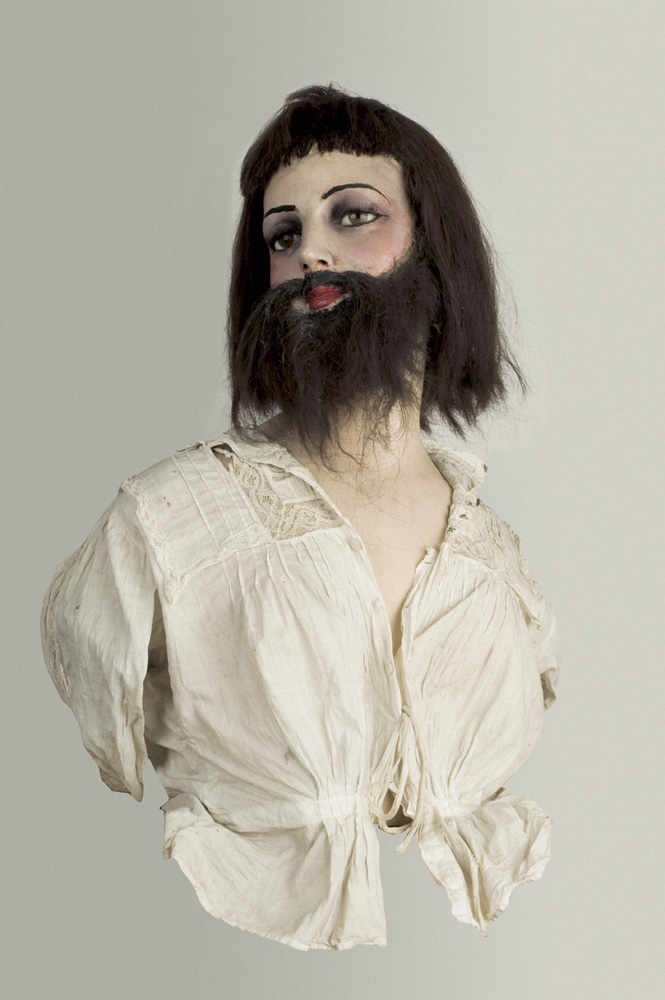
The centerpiece of these displays was usually the Anatomical Venus--a beautiful, life-like woman, generally made of wax, often life-sized, and demonstrating--upon the delicate removal of her breastplate--the mysteries of the inner female body (see 5th image down; more on this concept here and here). This central Venus was generally supplemented by waxes and other sorts of models, wet preparations, and illustrations parsing topics such as the ideal and compromised female body, the ravages of sexually transmitted diseases, the aberrant body (ie. freaks; see bearded lady, 2nd image), the mysteries of generation, and the ill effects of spermatorhea (aka "abnormally frequent emission of the semen without copulation", seen as a real public health issue at the time).

The exhibition will bring together an amazing collection of models--many of them breathtakingly exquisite waxes--and ephemera never seen together under one roof. Objects have been drawn from--in the proud tradition of the popular anatomical displays to which this exhibition pays tribute--both academic and popular collections. Objects from The Gordon Museum of London, The Museum Dr Guislain of Ghent, Musée de la Médicine in Brussels, the University of Cambridge, the London Science Museum, and the Wellcome Library will be featured.

Here's more about the exhibition and the phenomenon of popular medical displays, from the Wellcome Collection press release:
In the 19th century, despite the best efforts of body snatchers, the demand from medical schools for fresh cadavers far outstripped the supply. One solution to this gruesome problem came in the form of lifelike wax models. These models often took the form of alluring female figures that could be stripped and split into different sections. Other models were more macabre, showing the body ravaged by 'social diseases' such as venereal disease, tuberculosis and alcohol and drug addiction.

With their capacity to titillate as well as educate, anatomical models became sought-after curiosities; displayed not only in dissecting rooms but also in sideshows and the curiosity cabinets of wealthy Victorian gentlemen. For a small admission fee, visitors seeking an unusual afternoon's entertainment could visit displays of these strange dolls in London, Paris, Brussels and Barcelona.
This show promises to be truly marvelous in every sense of the word. If you find yourself in London between July 30th and October 18th, be sure to check it out! And drop me a line and let me know what you think!

To find out more about the exhibition, click here. To visit the Wellcome image gallery related to the exhibition (from where many of the above images are drawn), click here. To play with the Wellcome interactive Anatomical Venus (!!!), click here.

All of the above images are of objects that will be included in the exhibition. Captions, top to bottom:

1) Head exhibiting syphilis, c.1900, Collection Family Coolen, Antwerp/Museum Dr Guislain, Ghent, Belgium

2) Bearded lady, Undated (c. 1900), Collection Family Coolen, Antwerp/Museum Dr Guislain, Ghent, Belgium

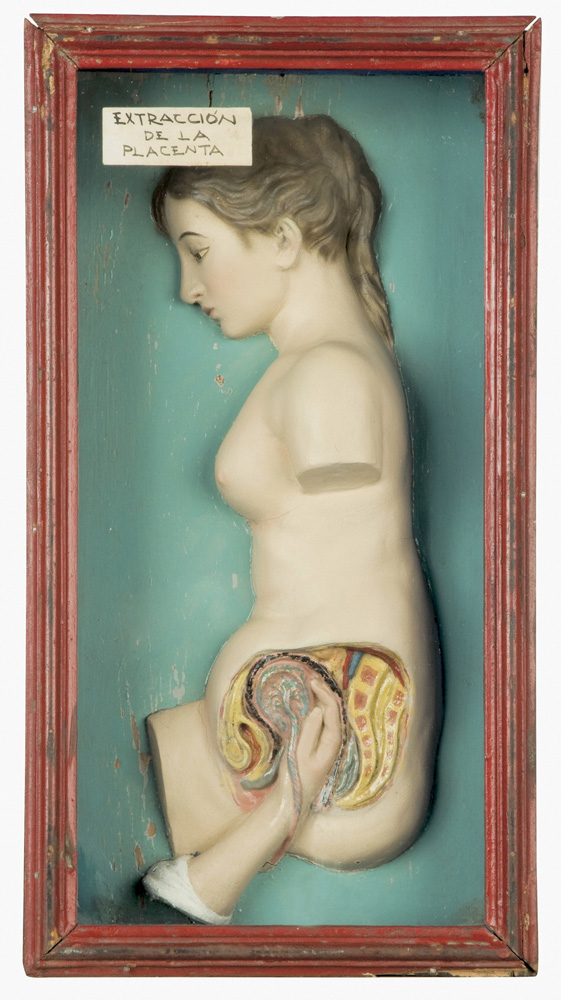
3) Extraction of the placenta: Plaster relief from a series illustrating the stages of childbirth, Undated (c.1900) Collection Family Coolen, Antwerp/Museum Dr Guislain, Ghent, Belgium

4) Anatomical female figure, Germany, undated (1600-1800), Ivory, The Science Museum, London

5) Wax Venus - anatomical figure made in Florence, 1771-1800, Courtesy of the Science Museum, London

6) Poster from the Roca collection. Collection Family Coolen, Antwerp/Museum Dr Guislain, Ghent, Belgium

Wednesday, November 26, 2014

Henry Wellcome's Anatomical Venus: A Missing Link? Guest Post by Joanna Ebenstein for the Wellcome Collection Blog

I was recently invited to select a single object from Blythe House--the storehouse containing the remains of early 20th century pharmaceutical magnate Henry Wellcome's once million strong collection--for an episode of the Wellcome Collection's “The Thing Is…" From the over 100,000 amazing objects in the collection--including ivory anatomical mannequins, wax vanitas busts, antique sexual aids, Greek anatomical otives, torture devices, statues of saints and even a Peruvian mummy--I chose, it will not surprise regular readers to discover, Henry Wellcome's Wax Anatomical Venus (see above).

I had been curious about this enigmatic creature ever since Kate Forde and I featured her in the Wellcome’s 2009 Exquisite Bodies exhibition. Although diminutive--she is only three feet in length while most others are life-sized--she is still an extraordinarily uncanny and charismatic object. She was also a very mysterious object, with very little I could discover, despite my best efforts, about her provenance.

To prepare for this talk--hosted by journalist and historian Frances Stonor Saunders--I delved, with the help of my friend Ross MacFarlane, deeply into the Wellcome Library and its archives to see what I might be able learn about this mysterious artifact.

To read the full report I wrote for the Wellcome Collection blog detailing my findings--and to see many more images, including another animated GIF like the one above, compliments of Russell Dornan!--click here.

Image:
  1. Wellcome Collection’s Anatomical Venus in various stages of dissection as shown in an animated GIF. Courtesy of Wellcome Images.
  2. Catalog card for the Wellcome Anatomical Venus.

Sunday, July 13, 2008

Anatomical Venus Tattoo!


Morbid Anatomy reader Heather Whiteside has designed (and had permanently applied to her skin!) a tattoo based on the anatomical venus wax sculptural tradition.

To design the tattoo, she consulted a number of historical precedents, such as the famous La Specola Venus, a popular anatomical model from the William Bonardo Collection of Wax Anatomical Models, and a photograph of a wax anatomical model by photographer Herbert List (more on his work in a future post.) Of the tattoo, Heather writes:

This tattoo signifies my decision to register with the University of Alabama-Birmingham's Anatomical Donor Program, i.e. making a bequest of my body to medical research after my death. I had the tattoo artists at the shop, Blue Rose Tattoo in Huntsville, sign as my witnesses on the donor form. :) Greg Ross did the fine tattoo work from my original design. The imagery is a combination of  memento mori funeral portraiture and versions of anatomical venus type wax models.
 
If I were going to add a literary quotation to acccompany the tattoo, it would be the following: "Grave: a place in which the dead are laid to await the coming of the medical student." DEVIL'S DICTIONARY. Ambrose Bierce. 1911. I do wonder what the future medical students might make of this tattooed cadaver?

Nice work, Heather!

Wednesday, December 4, 2013

The Modern Anatomical Venus at Leiden's Museum Boerhaave: Guest Post by Bart Grob, The Boerhaave Museum

Just a few weeks ago, the new exhibition Amazing Models, on the Emotional, Medical and Cultural History of Anatomical Models opened at Leiden's Boerhaave Museum. To commemorate the opening of this incredible looking exhibition, here is a guest post by Bart Grob, conservator and curator at that museum, about the publicity image commissioned by the exhibition seen above (top image):
Is it fashion, is it a glamor, or is it anatomy?
In fact it's all three. This modern day anatomical Venus (top image), in style of the famous anatomical models from the Viennese Josephinum museum (bottom image) is portrait of Dutch actress Georgina Verbaan.
She was photographed by Koen Hauser who has a large interest in anatomy, and is well known for this anatomy series. He combined an image of an original wax model from the Museum Boerhave collections with a glamorous photo of the model, thus reconstructing an image of the time when female anatomical models where not only about the anatomy of the body. Skilled hands of Florentine waxmodellers delivered beautiful, sensual and elegant models of the female body.
Yesterday, the 20th of November, Amazing Models, a new exhibit on the emotional, medical and cultural history of anatomical models, opened to the public at the Museum Boerhaave. To address all these different themes this reconstruction of the anatomical Venus was chosen as image for the publicity campaign. The heyday of spectacular anatomy seem to be back again!
You can find out more about this exhibition, on view until June of 2014, by clicking here. And stay tuned for news of a Morbid Anatomy Museum pop-up event series taking place in partnership with the Boerhaave Museum, the Vrolik Museum and more Netherlands-based institutions, coming soon!

Top image: Fotocredits: Koen Hauser, photography Hair and Make up, Luise van Huisstede, Model Georgina Verbaan

Bottom image: "Anatomical Venuses," Wax Models with human hair in rosewood and Venetian glass cases,The Josephinum, Workshop of Clemente Susini of Florence circa 1780s, Vienna, Austria, from The Secret Museum, by Joanna Ebenstein

Tuesday, January 22, 2013

Must-See Exhibition of Astounding Anatomical Artworks: "Doctors, Dissection and Resurrection Men," Exhibition, Museum of London, Through April 2013


Whilst over in London recently, I spent a fascinating afternoon with curator Jelena Bekvalac as she guided me through her exhibition "Doctors, Dissection and Resurrection Men" now on view at the Museum of London. The exhibition is not, I am delighted to report, your average history of medicine fare; it functions more as a must-see exhibition of astounding, idiosyncratic, and beautifully macabre anatomical artworks languishing backstage at London Museums than a straightforward history of human dissection in London. And this is, of course, in my opinion, a good thing!

One of Bekvalac's characteristically brilliant curatorial choices was the inclusion of one of my all-time favorite anatomical artworks, a piece which perfectly illuminates the confounding interweaving of the spectacular, the educational, and the macabre which draws me to many early medical artifacts: the Royal Academy's "Anatomical Crucifixion of James Legg" (top three images). This piece is a plaster life-size écorché--or skinless muscle man figure, a common art trope stretching back to The Renaissance. But this écorché is no mere artistic depiction; instead, it is an actual plaster cast taken directly from the the body of executed murderer James Legg after it was flayed and crucified (!!!) by three members of the Royal Academy around 1801 "... in order to settle an artistic debate...  to prove their belief that most depictions of the Crucifixion were anatomically incorrect." You can find out more about this astounding artifact at this recent blog post.

Other highlights of the exhibition include a fabulous early 19th century Florentine wax anatomical woman on loan from The Science Museum/Wellcome Collection (4th down; more on that piece here); some wonderful Joseph Towne waxes and moulages from The Gordon Museum (8th and 9th down); some of my all-time favorite memento mori figurines, also from The Science Museum/Wellcome Collection (5th down); a handbill advertising the display of an Anatomical Venus on Regent Street in the early 19th century (9th down); an artful preparation of part of a human stomach injected to demonstrate the blood vessels by Edward Jenner (6th down); a salacious late 18th century watercolor entitled 'The Persevering Surgeon' by Thomas Rowlandson (10th down); an original anatomical drawing of a human skeleton for a anatomy student's ticket from 1840 (11th down); a mid-19th century skeletal preparation of a boy, dissected in a somewhat anguished pose (on loan from the St. Bart's Pathology Museum); and a number of anatomical artworks by Jacques Fabien Gautier D'Agoty and other artists of the time.

For any Morbid Anatomy readers in the London area, I highly recommend a visit to this exhibition; thanks to Bekvalac's eye and excellent knowledge of rarely seen and idiosyncratically spectacular pieces backstage in local collections, it is much more interesting than you might expect by the title!

More about the exhibition, from the press release:
Doctors, Dissection and Resurrection Men
Until 14 April 2013

In 2006, Museum of London archaeologists excavated a burial ground at the Royal London Hospital in Whitechapel. What they found was both extraordinary and unexpected.

The excavation revealed some 262 burials. In the confusing mix of bones was extensive evidence of dissection, autopsy and amputation, bones wired for teaching, and animals dissected for comparative anatomy.

Dating from a key period – that of the Anatomy Act of 1832 – the discovery is one of the most significant in the UK, offering fresh insight into early 19th century dissection and the trade in dead bodies.

Now, 180 years later, you can uncover this intriguing story in Doctors, Dissection and Resurrection Men, a major new exhibition at the Museum of London. Bringing together human and animal remains, exquisite anatomical models and drawings, documents and original artefacts, the exhibition reveals the intimate relationship between surgeons pushing forward anatomical study and the ‘Resurrection men’ who supplied them; and the shadowy practices prompted by a growing demand for corpses.

You’ll discover the story of Bishop, Williams and May – London’s Burke and Hare – and find out how the excavation findings shed new light on the case of an alleged resurrectionist. You’ll also pore over unrivalled evidence of surgery and amputation – before anaesthetic – and of dissection, anatomical teaching and students practising their craft.  

As the exhibition draws to a close, you’ll be encouraged to debate the Anatomy Act, reflect on medical ethics and cultural attitudes today, and ask what questions still remain.

It may leave you asking: who really owns your body?
This exhibit will be on view through April 14th, 2013; You can find out more here. Please click on images to see larger versions; most are my own; 6th and 11th down are both © Science Museum / Science and Society Picture Library; the 10th down is from the collection of the Hunterian Museum, London.

Images top to bottom:
  1. "Anatomical Crucifixion of James Legg," 1801, Royal Academy
  2. "Anatomical Crucifixion of James Legg," 1801, Royal Academy, detail
  3. "Anatomical Crucifixion of James Legg," 1801, Royal Academy, detail
  4.  Female wax anatomical model showing internal organs 1818, The Science Museum
  5. Memento Mori Figures, The Science Museum
  6. Part of human stomach dissected by Edward Jenner 1790-1823 C Science Museum, Science Museum, Science and Society Picture Library.jpg
  7. Wax moulage by Joseph Towne showing hand with smallpox, 19th century, The Gordon Museum
  8. Wax model of human torso by Joseph Towne, 19th century, The Gordon Museum
  9. Handbill advertising display of anatomical Venus, 1810-1840 
  10. Thomas Rowlandson, 'The Persevering Surgeon', late 18th century, from the collection of the Hunterian Museum, London
  11. Anatomical drawing of a skeleton 1840 C Science Museum, Science and Society Picture Library