Saturday, April 10, 2010

"The Secret Museum" Exhibition Opening, Observatory, TONIGHT! April 10, 7-10 PM


Hi all! Just a reminder that tonight is the opening party for my new exhibition at Observatory "The Secret Museum," an exploration of the poetics of hidden, untouched and curious collections from around the world in photographs and artifacts." This show is produced in conjunction with the Congress for Curious People, which encompasses a slew of exciting events and begins this Monday!

Full details follow. Hope to see you there!
Exhibition: "The Secret Museum"
Opening party: Saturday April 10th, 7-10 PM
On view from April 10th-May 16th
Admission: Free

An exhibition exploring the poetics of hidden, untouched and curious collections from around the world in photographs and artifacts, by Joanna Ebenstein, co-founder of Observatory and creator of Morbid Anatomy.

Photographer and blogger Joanna Ebenstein has traveled the Western world seeking and documenting untouched, hidden, and curious collections, from museum store-rooms to private collections, cabinets of curiosity to dusty natural history museums, obscure medical museums to hidden archives. The exhibition “The Secret Museum” will showcase a collection of photographs from Ebenstein’s explorations–including sites in The Netherlands, Italy, France, Austria, England and the United States–which document these spaces while at the same time investigating the psychology of collecting, the visual language of taxonomies, notions of “The Specimen” and the ordered archive, and the secret life of objects and collections, with an eye towards capturing the poetry, mystery and wonder of these liminal spaces. In tandem with this exhibition, Ebenstein has organized a 2 week “Collector’s Cabinet” at the The Coney Island Museum, which will showcase astounding objects held in private collections, including artifacts featured in her Private Cabinet photo series of 2009.

To download press release, which includes sample images, please click here.

ASSOCIATED LECTURES AND EVENTS
Congress for Curious People at the Coney Island Museum
2-day symposium exploring the idea of collecting curiosities in the 21st century as well as the politics, history, and changing methodology of collecting and collections. Also on view will be “The Collector’s Cabinet,” an installation of astounding artifacts held in private collections. A week of themed lectures at the Coney Island Museum will precede the symposium:

The Saddest Object in the World
An Illustrated Meditation by Evan Michelson, Obscura Antiques and Oddities, Morbid Anatomy Library Scholar in residence
Date: Monday, April 12th
Time: 7:00 PM
LOCATION: * Coney Island Museum, Brooklyn

Taxidermy in the Fine ArtsRobert Marbury of the Minnesota Association of Rogue Taxidermists
Date: Tuesday, April 13th
Time: 7:00 PM
LOCATION: * Coney Island Museum, Brooklyn

A Brief History of Automate
An Illustrated Lecture and Demonstration by Mike Zohn, Obscura Antiques and Oddities
Date: Wednesday, April 14th
Time: 7:00 PM
LOCATION: * Coney Island Museum, Brooklyn

A History of Taxidermy: Art, Science and Bad Taste
An Illustrated Presentation By Dr. Pat Morris, Royal Holloway, University of London
Date: Thursday, April 15th
Time: 7:00 PM
LOCATION: * Coney Island Museum, Brooklyn

Charles Wilson Peale and the Birth of the American Museum
An Illustrated Presentation by Samuel Strong Dunlap, PhD, Descendant of Charles Wilson Peale
Date: Friday, April 16th
Time: 7:00 PM
LOCATION: * Coney Island Museum, Brooklyn

Museums, Monsters and the Moral Imagination
An Illustrated lecture with Professor Stephen Asma, author of Stuffed Animals and Pickled Heads and On Monsters.
Date: Thursday, April 22
Time: 8:00 PM
LOCATION: * Observatory, Brooklyn

Experimenting with Death: An Introduction to Terror Management Theory
An Illustrated Lecture by Michael Johns, Former Assistant Professor of Psychology at the University of Wyoming
Time: 8:00 PM
Date: Friday, May 7
LOCATION: * Observatory, Brooklyn
You can find out more by clicking here. You can get directions to Observatory by clicking here. You can find out more about the "Congress for Curious People" by clicking here. You can get on our mailing list by clicking here can join Observatory on Facebook by clicking here.

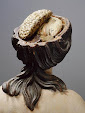
Image credits: Images 1-3: Tim Knox and Todd Longstaffe-Gowan Collection, London. Image 4: Archives 2009-015, Academy of Natural Sciences, Philadelphia. Image 5: Natural History Museum Store-room; Image 6: Muséum d'Histoire Naturelle de Rouen, Store-room; Image 7: "Femme à barbe," Musée Orfila. Courtesy of Paris Descartes University.

Friday, April 9, 2010

Animal Body Worlds at the Neunkirchen Zoo, Saarland, Germany


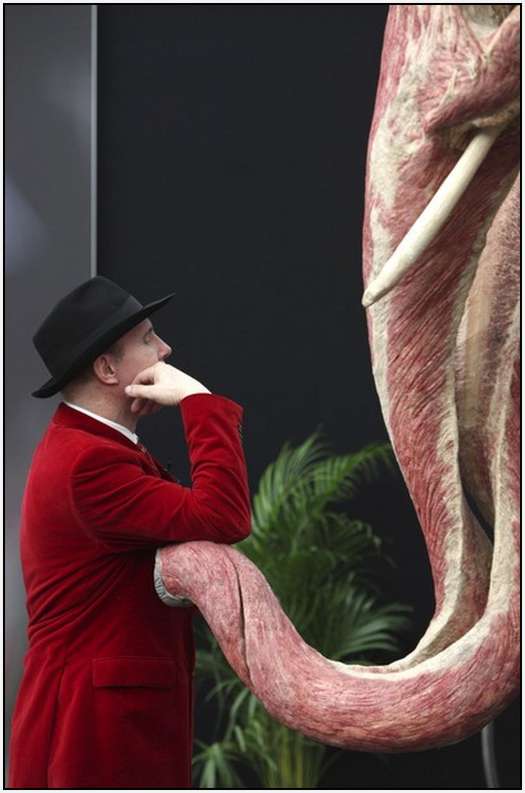
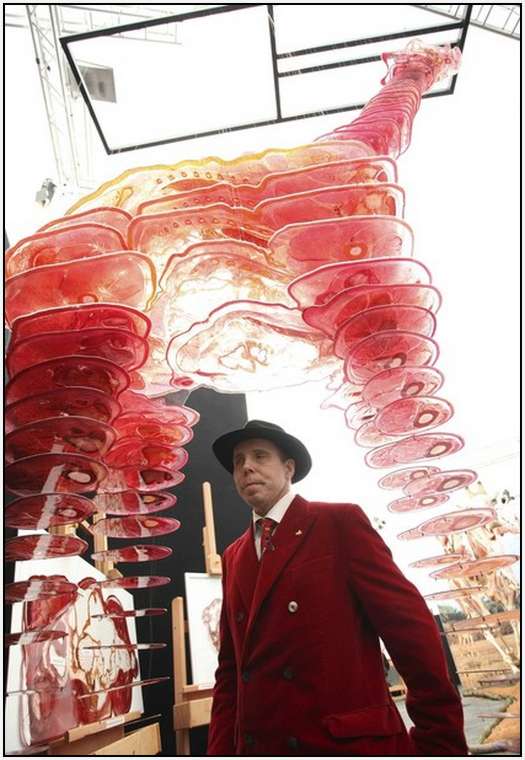
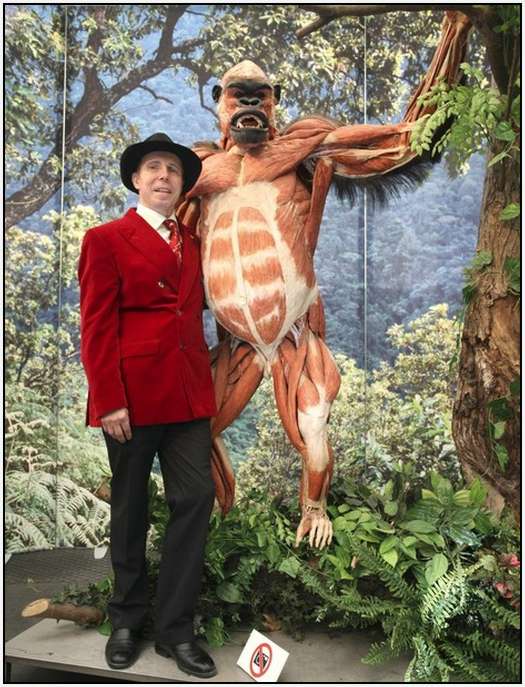
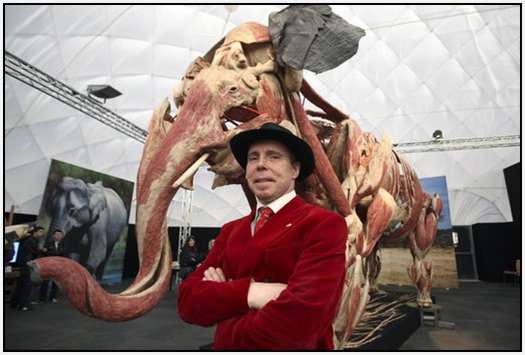
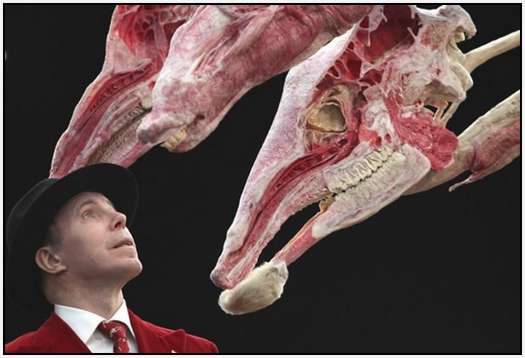
The controversial Body Worlds creator Gunther von Hagens opens his latest anatomical exhibition at the Neunkirchen Zoo in the state of Saarland, Germany. The 'anatomical safari' contains over 100 animals in various degrees of dissection showing von Hagen's famed plastination process. Presented as a holistic and sculptural anatomical menagerie, the display features the most revered species in the animal kingdom: among them a long-lashed, freckled tall blonde—a giraffe; and two regal, husky, graceful, behemoth elephants.The animal revue posed immense technical challenges for Dr. von Hagens and his plastination team. "Samba" with her size of 6 meters long and 3.5 meters tall is the largest creature that Dr. von Hagens has ever plastinated – the specimen is as heavy as three passenger cars. The preservation required 64,000 working hours, four tons of silicone and 40,000 liters of acetone. By comparison, a human plastinate is completed in 3,000 hours. The exhibition allows a peek under the thick yet light-sensitive skin of an elephant. Its trunk with its network of 40,000 muscles is a feat of design excellence, as well as virtuosity. Visitors will see a plastinated giraffe and learn how its unique cardiovascular system prevents it from being in permanent cardiac arrest and allows it to overcome the challenges of its extreme physique....
From Moolf.com; click here to see full story with more images.

Wednesday, April 7, 2010

Job Opportunities at the Medical Museion, University of Copenhagen


My friend Thomas of the wonderful Biomedicine on Display blog and Medical Museion in Copenhagen just passed along a job description for two new positions at the Museion; From the intelligent and provocative discussions that regularly occur on his blog I get the distinct sense that this the Museion would be a most progressive and absorbing work place. Full details follow; please contact Thomas at the email below with any questions!
Medical Museion, University of Copenhagen, is looking for applicants for two new positions as asst./assoc. professor in medical science communication and medical heritage production, respectively.

Medical Museion is an integrated research and museum unit for promoting medical science communication based on the material and visual medical heritage. The research profile is centered around the contemporary history of the biomedical sciences, medical science communication studies, and studies of the production of the material and visual medical scientific heritage. The museum has a world-class collection of historical medical artefacts and images, an active program for the acquisitioning and preservation of the contemporary biomedical and biotechnological heritage, a permanent medical-historical public gallery, and an innovative temporary exhibition program.

The museum is looking for two new members of faculty to contribute to our integrated research, teaching, heritage and outreach programme focussing on late 20th century and contemporary medical and health sciences in a cultural, aesthetic and historical perspective. The aim of the programme is to develop new modes of research-based collecting, exhibition making and web-based outreach by combining scientific content, cultural interpretation and aesthetic expression in innovative ways.

On the outreach side, we are developing research-based science communication practices for a variety of audiences – spanning from health professionals to the general public – in the form of exhibitions and web products, and with special attention to the aesthetics of science communication.

On the acquisition side, we are in the process of developing research-based curatorial practices (heritage production) in close cooperation with research institutions, hospitals, pharma, biotech and medical device companies, and patient organisations in the region (‘museum 2.0’) .

The appointees are required to do research at an international level and research-based teaching; however most of the teaching obligations are substituted with museum work.

This is a summary only. The full announcement can be read here: http://tinyurl.com/ye8wtep, or here: http://www.corporeality.net/museion/2010/03/09/1-2-associate-assistant-professors-in-medical-science-communication-andor-medical-science-heritage-production. Application deadline is 25 May 2010.

Further info from professor Thomas Soderqvist, Medical Museion, University of Copenhagen, +45 2875 3801; thss@sund.ku.dk; www.corporeality.net/museion.
Image: Thomas Soderqvist, standing in front of a medical device installation in the former temporary exhbition 'Split & Splæice: Fragments From the Age of Biomedicine'.

First International Hygiene Exhibition in Dresden, Poster, Franz von Stuck, 1911


Poster for the First International Hygiene Exhibition in Dresden, designed by Franz von Stuck, 1911.

Via dhmd.de.

Found on Billyjane Tumblr.

Tuesday, April 6, 2010

"The Secret Museum" Exhibition Opening, Observatory, This Saturday, April 10, 7-10 PM


This Saturday, April 10th, Observatory in Brooklyn, New York will be hosting the opening party for my new exhibition "The Secret Museum." Full details follow. Hope to see you there!
Exhibition: "The Secret Museum"
Opening party: Saturday April 10th, 7-10 PM
On view from April 10th-May 16th
Admission: Free

An exhibition exploring the poetics of hidden, untouched and curious collections from around the world in photographs and artifacts, by Joanna Ebenstein, co-founder of Observatory and creator of Morbid Anatomy.

Photographer and blogger Joanna Ebenstein has traveled the Western world seeking and documenting untouched, hidden, and curious collections, from museum store-rooms to private collections, cabinets of curiosity to dusty natural history museums, obscure medical museums to hidden archives. The exhibition “The Secret Museum” will showcase a collection of photographs from Ebenstein’s explorations–including sites in The Netherlands, Italy, France, Austria, England and the United States–which document these spaces while at the same time investigating the psychology of collecting, the visual language of taxonomies, notions of “The Specimen” and the ordered archive, and the secret life of objects and collections, with an eye towards capturing the poetry, mystery and wonder of these liminal spaces. In tandem with this exhibition, Ebenstein has organized a 2 week “Collector’s Cabinet” at the The Coney Island Museum, which will showcase astounding objects held in private collections, including artifacts featured in her Private Cabinet photo series of 2009.

To download press release, which includes sample images, please click here.

ASSOCIATED LECTURES AND EVENTS
Congress for Curious People at the Coney Island Museum
2-day symposium exploring the idea of collecting curiosities in the 21st century as well as the politics, history, and changing methodology of collecting and collections. Also on view will be “The Collector’s Cabinet,” an installation of astounding artifacts held in private collections. A week of themed lectures at the Coney Island Museum will precede the symposium:

The Saddest Object in the World
An Illustrated Meditation by Evan Michelson, Obscura Antiques and Oddities, Morbid Anatomy Library Scholar in residence
Date: Monday, April 12th
Time: 7:00 PM
LOCATION: * Coney Island Museum, Brooklyn

Taxidermy in the Fine ArtsRobert Marbury of the Minnesota Association of Rogue Taxidermists
Date: Tuesday, April 13th
Time: 7:00 PM
LOCATION: * Coney Island Museum, Brooklyn

A Brief History of Automate
An Illustrated Lecture and Demonstration by Mike Zohn, Obscura Antiques and Oddities
Date: Wednesday, April 14th
Time: 7:00 PM
LOCATION: * Coney Island Museum, Brooklyn

A History of Taxidermy: Art, Science and Bad Taste
An Illustrated Presentation By Dr. Pat Morris, Royal Holloway, University of London
Date: Thursday, April 15th
Time: 7:00 PM
LOCATION: * Coney Island Museum, Brooklyn

Charles Wilson Peale and the Birth of the American Museum
An Illustrated Presentation by Samuel Strong Dunlap, PhD, Descendant of Charles Wilson Peale
Date: Friday, April 16th
Time: 7:00 PM
LOCATION: * Coney Island Museum, Brooklyn

Museums, Monsters and the Moral Imagination
An Illustrated lecture with Professor Stephen Asma, author of Stuffed Animals and Pickled Heads and On Monsters.
Date: Thursday, April 22
Time: 8:00 PM
LOCATION: * Observatory, Brooklyn

Experimenting with Death: An Introduction to Terror Management Theory
An Illustrated Lecture by Michael Johns, Former Assistant Professor of Psychology at the University of Wyoming
Time: 8:00 PM
Date: Friday, May 7
LOCATION: * Observatory, Brooklyn
You can find out more by clicking here. You can get directions to Observatory by clicking here. You can find out more about the "Congress for Curious People" by clicking here. You can get on our mailing list by clicking here can join Observatory on Facebook by clicking here.

Image credits: Images 1-3: Tim Knox and Todd Longstaffe-Gowan Collection, London. Image 4: Archives 2009-015, Academy of Natural Sciences, Philadelphia. Image 5: Natural History Museum Store-room; Image 6: Muséum d'Histoire Naturelle de Rouen, Store-room; Image 7: "Femme à barbe," Musée Orfila. Courtesy of Paris Descartes University.
Friday, April 2, 2010

"The Congress for Curious People," in Conjunction with The Coney Island Museum, April 9-18th


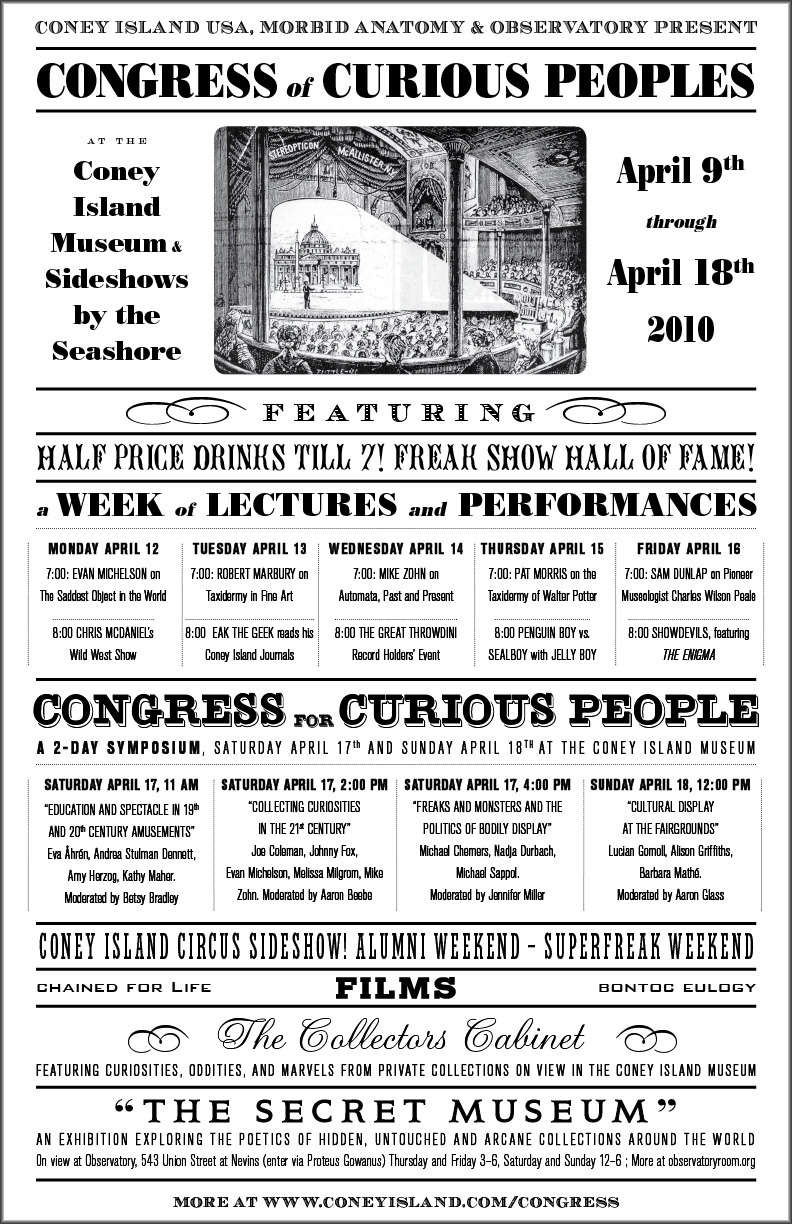
Click on image or here to download full-sized broadside as seen above. Prints up to 11 X 17.

Morbid Anatomy and Observatory are pleased to present, in conjunction with the Coney Island Museum, "The Congress for Curious People!"

The Congress will span 10 days--from April 9 to April 18th--and will include the following:
  • A week of nightly lectures (supplemented by half-price drinks at the bar till 7!) covering such topics as the taxidermy of Victorian curiosity-collector Walter Potter, the history of automata featuring an actual automata demonstration, a meditation on "the saddest object in the world," taxidermy in the fine arts by a Minnesota Rogue Taxidermist, and the first American museologist Charles Wilson Peale discussed by one of his descendants!

  • A 2-week "Collectors Cabinet"on view for the entirety of the event, showcasing astounding objects held in private collections!

  • Opening party for "The Secret Museum," an exhibition hosted by Observatory exploring the poetics of hidden, untouched and curious collections from around the world in photographs and artifacts.
As you can see, this is a very complicated beast of an event, and, to make it yet more complicated, the Congress for Curious People is part of a larger Coney Island USA event called the Congress of Curious Peoples! Here is how the Coney Island Museum website manages to explain the whole:
Since the 1860's, Coney Island has been a beacon for strange and interesting people. For generations, it has attracted the curious and the enlightened, the onlooker and the performer. Every spring Coney Island USA convenes The Congress of Curious Peoples, a 10-day gathering of unique individuals at Sideshows by the Seashore and the Coney Island Museum, celebrating Coney Island's subversive and exciting power and exploring its political, artistic, and spectacular possibilities through performances, exhibitions, and films by important artists in the world of the 21st century sideshows.

Adding to the madness, this year, in conjunction with Observatory and the Morbid Anatomy Library, Coney Island USA introduces the Congress for Curious People. Consisting of a 2-day symposium and 5-day lecture series, this additional congress will take a scholarly yet popular approach to the curiosities and wonders of Coney Island and seek to investigate--via lectures and and a scholarly conference--the relationship between education and spectacle in American amusements, the collection of curiosities from the renaissance to the present, and the display of "freaks" and "primitive peoples" in fairgrounds and worlds fair settings. The series will celebrate the interdisciplinarity of Dime Museums while calling into question both popular and scholarly assumptions about the importance of Coney Island's legacy, its sordid past, and its titillating present.
Full details on the "Congress of Curious People" can be found by clicking here. Full details for the "Congress for Curious People" below and organized in the broadside above. Very much hope to see at one (or all!) of these amazing events!

CONGRESS FOR CURIOUS PEOPLE 2-DAY SYMPOSIUM

Date: Saturday April 17th and Sunday April 18th
Location: Coney Island Museum, 1208 Surf Ave. Brooklyn ADMISSION: $25 for full weekend admission
Presented by Morbid Anatomy and Observatory with Coney Island USA
The Congress for Curious People is a 2-day symposium exploring education and spectacle, collectors of curiosities, historical fairground displays and more, in conjunction with The Coney Island Museum. The symposium will feature panels of humanities scholars discussing with the audience the intricacies of collecting, the history of ethnographic display, the interface of spectacle and education, and the politics of bodily display in the amusement parks, museums, and fairs of the Western world. Also on view in the museum will be "The Collector's Cabinet," an installation of astounding artifacts held in private collections. In conjunction with the events at the Coney Island Museum, Observatory's Gallery space will host "The Secret Museum," an exhibition exploring the poetics of hidden, untouched and curious collections from around the world.

The Congress for Curious People will serve as an academic counterpoint to Coney Island's Congress of Curious Peoples, which Coney Island USA has convened since 2007 at Sideshows by the Seashore. In the past, the Congress has included performances by artists like Joe Coleman and Harley Newman, feats of strength, and world-record breaking attempts, among others. You can find out more about the Congress of Curious Peoples at www.coneyisland.com/congress.shtml.

Saturday, April 17th 11 AM-12:30 PM – Education and Spectacle in 19th and 20th Century Amusements, Lectures and Panel Discussion
Eva Åhrén, author of Death, Modernity, and the Body : Sweden 1870-1940
Andrea Stulman Dennett, author of Weird and Wonderful: The Dime Museum in America
Amy Herzog, author of Dreams of Difference, Songs of the Same: The Musical Moment in Film
Kathy Maher, Executive Director of the Barnum Museum
Moderated by Betsy Bradley, New York Public Library

LUNCH 2-3:30 PM– Cabinets of Curiosity: Collecting Curiosities in the 21st Century, Lectures and Panel Discussion
Joe Coleman, collector and artistLink
Johnny Fox, collector, performer, founder of The Freakatorium
Evan Michelson, Antique and Oddity Dealer, Obscura Antiques and Oddities and Morbid Anatomy Library scholar in residence
Melissa Milgrom, author of Still Life: Adventures in Taxidermy
Mike Zohn, Antique and Oddity Dealer, Obscura Antiques and Oddities
Moderated by Aaron Beebe, Director of the Coney Island Museum

4-5:30 PM – Freaks and Monsters: The Politics of Bodily Display, Lectures and Panel Discussion
Mike Chemers, author of Staging Stigma: A Critical History of the American Freak Show
Nadja Durbach, author of Spectacle of Deformity: Freak Shows and Modern British Culture
Michael Sappol, Historian of the National Library of Medicine and author of A Traffic of Dead Bodies: Anatomy and Embodied Social Identity in Nineteenth-Century America
Moderated by Jennifer Miller, Bearded Lady and founder of Circus Amok

6-8 PM Drinks and light fare

Sunday, April 18th 12-2 PM – A History of Cultural Display in World’s Fairs and Sideshows, Lectures and Panel Discussion
Lucian Gomoll, University of California at Santa Cruz
Alison Griffiths, author of Wondrous Difference: Cinema, Anthropology, and Turn of the Century Visual Culture
Barbara Mathé, Archivist, American Museum of Natural History
Moderated by Aaron Glass, author of The Totem Pole: An Intercultural Biography and In Search of the Hamat’sa: A Tale of Headhunting

2 PM – Closing remarks

A WEEK OF THEMATIC LECTURES AT THE CONEY ISLAND MUSEUM WILL PRECEDE THE SYMPOSIUM:


The Saddest Object in the World
An Illustrated Meditation by Evan Michelson,
Obscura Antiques and Oddities and Morbid Anatomy Library scholar in residence
Date: Monday, April 12th
Time: 7:00 PM
LOCATION:
The Coney Island Museum
“The Saddest Object in the World” is a meditation on one particular artifact; an exercise in Proustian involuntary memory, aesthetic critique, and philosophical bargaining.

Sometimes objects have consequences.

Evan Michelson is an antiques dealer, lecturer, accumulator and aesthete; she tirelessly indulges a lifelong pursuit of all things obscure and melancholy. She currently lives in another place and time.


A Rogue's Approach to Stuffing It: Taxidermy in Contemporary Pop, Art and Sub-Cultures
Robert Marbury of the Minnesota Association of Rogue Taxidermists
Date: Tuesday, April 13th
Time: 7:00 PM
LOCATION:
The Coney Island Museum
ave you seen a rise in taxidermy in the world around you? What could be causing this resurgence? A Rogue’s Approach to Taxidermy will identify prominent practitioners of natural history art; discuss popular trends in preservation, presentation and representation; and delve into the sub-culture of artistic taxidermy. Robert will also discuss the highs and lows of running a taxidermy art group, and offer suggestions on which emails to return and who to not let into your house.

Robert Marbury received his BA in Anthropology from Connecticut College and a post-Bac from the Minneapolis College of Art and Design. He is the co-founder of the Minnesota Association of Rogue Taxidermists. Robert is currently curating a Rogue Taxidermy show which will run from May 7th to May 30th at La Luz de Jesus in Los Angeles. He lives and works in Brooklyn.


A Brief History of Automata
An Illustrated Lecture and Demonstration by Mike Zohn,
Obscura Antiques and Oddities
Date: Wednesday, April 14th
Time: 7:00 PM
LOCATION:
The Coney Island Museum
In this illustrated lecture, Obscura Antique and Oddities‘ Mike Zohn will demonstrate his 19th Century taxidermy automata, as featured in last year’s Carnivorous Nights Taxidermy Contest. He will explain its curious mechanisms, and, in an illustrated lecture, will introduce us to the history of these fascinating uncanny machines, tracing their trajectory from tools of religious coercion to prince’s plaything to Disney’s imagineering experiments.
Mike Zohn is co-proprietor of Obscura Antique and Oddities. He fixes automata in his spare time.

A History of Taxidermy: Art, Science and Bad Taste
An Illustrated Presentation By Dr. Pat Morris, Royal Holloway, University of London
Date: Thursday, April 15th
Time: 7:00 PM
LOCATION:
The Coney Island Museum
Should taxidermy be viewed as art, science, or bad taste? And why is it so interesting? Dr. Pat Morris’ illustrated lecture “A History of Taxidermy: Art, Science and Bad Taste” will explore these topics and more. His talk will range over the history of stuffed animals, considering how a small-time taxidermist business operated in the 19th century and exploring the many diverse and amusing uses of taxidermy and the taxidermist’s products ranging from major museum exhibits to stuffed pets, hunting trophies, animal furniture, kitten weddings (see above, Walter Potter, circa 1890s), frogs eating spaghetti and squirrels playing cards. He will discuss in detail the work of anthropomorphic taxidermist Walter Potter and his eponymous “Museum of Curiosities,” as detailed in his own lavishly illustrated book on that topic, which will be available for sale at the lecture.

Dr. Pat Morris is a retired staff member of Royal Holloway College (University of London), where he taught biology undergraduates and supervised research on mammal ecology. In that capacity he has published many books and scientific papers and featured regularly in radio and TV broadcasts. The history of taxidermy has been a lifelong hobby interest and he has published academic papers and several books on the subject. With his wife Mary he has travelled widely, including most of Europe and the USA, seeking interesting taxidermy specimens and stories. They live in England where their house is home to the largest collection and archive of historical taxidermy in Britain.


Charles Wilson Peale and the Birth of the American Museum
An Illustrated Presentation by Samuel Strong Dunlap, PhD, Descendant of Charles Wilson Peale
Date: Friday, April 16th
Time: 7:00 PM
LOCATION:
The Coney Island Museum
Long time historian and editor of the Peale Family Papers Dr. Lillian B. Miller (now deceased) described Charles Willson Peale as a true renaissance man. Peale is perhaps best remembered today as the founder of America’s first cabinet-of-curiosity like museum–the Philadelphia Museum (later the Peale Museum)–which housed a diverse collection of botanical, biological, and archaeological specimens and can be viewed in the image above. Famously, Peale’s museum also pioneered the habitat group–or natural history diorama–an art form memorably perfected by such museums as the American Museum of Natural History and Chicago’s Field Museum in the early 20th Century.

In this illustrated lecture, we will learn about Peale the museologist, and examine how his museological work continuously overlap with his inventive, artistic, scientific, literary and exploratory interests. Peale was a friend or acquaintance with most of the military, scientific, diplomatic and foreign individuals who played significant roles in our revolutionary war and the early growth of our democracy.


RELATED EXHIBITIONS

The Secret Museum
An exhibition exploring the poetics of hidden, untouched and curious collections from around the world in photographs and artifacts, by Joanna Ebenstein, co-founder of Observatory and creator of Morbid Anatomy.
Location: Observatory
Opening Party: Saturday, April 10, 7-10; on view On view from April 10th-May 16th, 3-6 Thursday and Friday, 12-6 Saturday and Sunday
Admission: Free

The Collectors Cabinet
An exhibition which will showcase astounding objects held in private collections, including artifacts featured in Joanna Ebenstein's Private Cabinet photo series of 2009. Featured cabinetists include Curious Expeditions and Observatory's Michelle Enemark and Dylan Thuras, Obscura Antiques and Oddities, and Morbid Anatomy and Observatory's Joanna Ebenstein.
LOCATION: * Coney Island Museum, Brooklyn

Image: "Femme à Barbe, Musée Orfila.Courtesy of Paris Descartes University.
To find out more about this event and the larger Congress of Curious Peoples--including nightly performances and the epic opening night party--click here. For more about the Congress for Curious People, click here. Click on image or click here to download a hi-res copy of the above broadside.

Tuesday, March 30, 2010

Observatory's First Birthday and Lecture, this Thursday, April Fools Day!


This Thursday, April 1st (April Fools Day! Yes, we know, and no, this is not a trick!) we at Observatory will be celebrating our 1st birthday with a party and a lecture. Come early--the evening will begin at 7:00--to enjoy DJ Davin Kuntze spinning 78s on his Victrola and your first glass(es) of wine. At 8, we will file into Observatory for David Suisman's lecture "The Birth of the Music Industry: Phonographs, Song Factories, and the Selling of Sound" (see below for details). Stick around for the free after-party, and enjoy DJ Platterhead (aka music journalist John Swenson) spinning from his incredible collection of 45s. And, of course, there will be drinks. Many of them.

Hope to see you there!
The Birth of the Music Industry: Phonographs, Song Factories, and the Selling of Sound
A reading and illustrated lecture by David Suisman, followed by Observatory's 1st birthday party celebration!
Date: Thursday, April 1 (April Fools Day. Yes, we know!)
Time: 8:00 PM (Music and drinks begin at 7:00 PM)
Admission: $5


***Happy First Birthday, Observatory! To celebrate, come early (7:00 PM) and enjoy antique melodies played at 78 rpm on DJ Davin Kuntze's old Victrola, accompanied by drinks. Following the lecture, please join us for a party featuring drinks, snacks, and the sound stylings of DJ Platterhead (aka music journalist John Swenson), spinning vintage 45s from his own collection. Admission to party is free. Please Note: This is NOT an April Fools prank. There will really, truly be a party! And a lecture. Hope to see you there.

We are immersed in music. We hear it virtually everywhere, from cars to restaurants to airports, not to mention the mobile sounds that reach our ears via iPods and ringtones. This is not a “natural” state of affairs, a simple by-product of people’s love for melody. Rather, this musical culture was created a century ago, David Suisman will show, when the modern music industry took shape. From Tin Pan Alley to grand opera, player-pianos to phonographs, the rise of the music business lay the foundations of today’s aural world and produced many of the ideas and assumptions we hold about music today.

In his acclaimed new book Selling Sounds: The Commercial Revolution in American Music, Suisman explores the formation in the early twentieth century of a radically new musical culture, driven by new products, technologies, and commercial strategies to incorporate music into the daily rhythm of modern life. Popular songs filled the air with a new kind of musical pleasure, phonographs brought opera into the parlor, and celebrity performers like Enrico Caruso captivated the imagination of consumers nationwide. In tonight’s lecture and reading, Suisman will uncover the origins of this new kind of culture industry and chronicle how music ignited an auditory explosion that still reverberates today.

***

David Suisman’s first book Selling Sounds: The Commercial Revolution in American Music was published in 2009 by Harvard University Press. It appeared on numerous year-end Top Ten lists and was named a Choice Outstanding Academic Title of 2009. He is also co-editor (with Susan Strasser) of Sound in the Age of Mechanical Reproduction (University of Pennsylvania Press, 2009). His articles have appeared in The Believer, Social Text, the Journal of American History and other publications. He is also an occasional disc jockey at WFMU and an assistant professor of history at the University of Delaware. He lives in Philadelphia.
You can get directions to Observatory--which is next door to the Morbid Anatomy Library--by clicking here. You can find out more about Observatory here, join our mailing list by clicking here, and join us on Facebook by clicking here.

Image: "Edison Phonograph magazine ad from around October of 1904, depicting a two-minute cylinder record-playing phonograph." Via Carolina History Project.

Friday, March 26, 2010

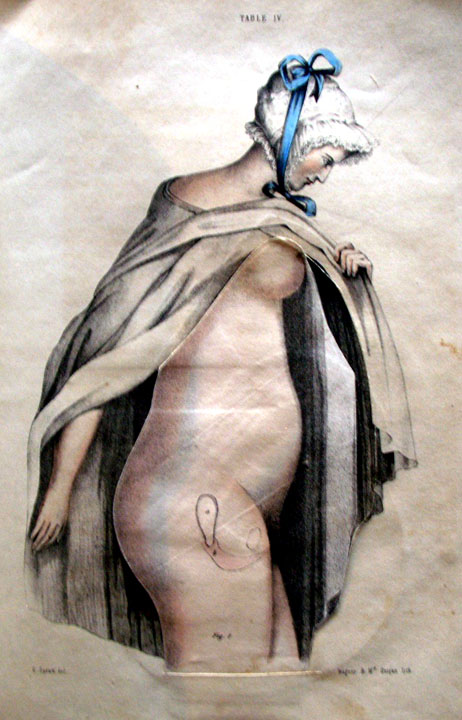
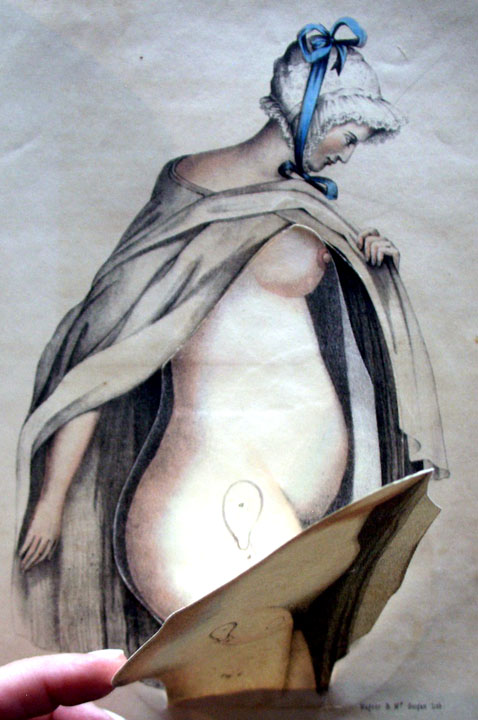
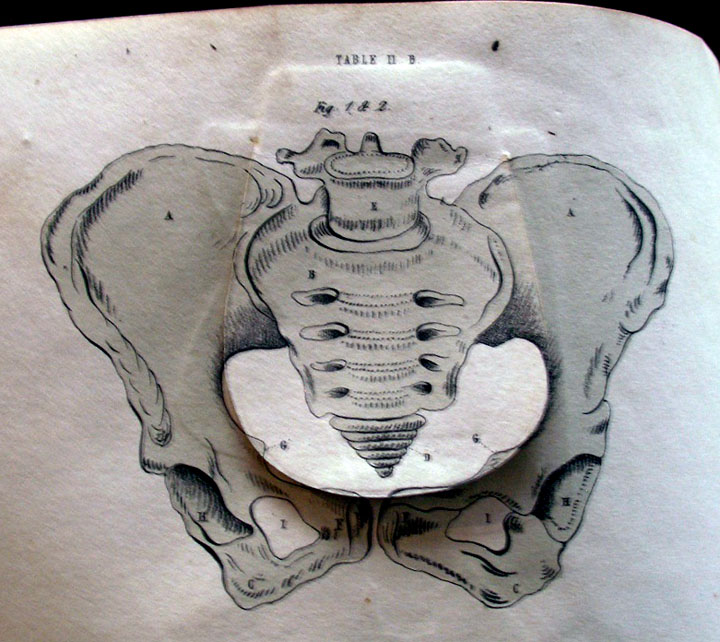
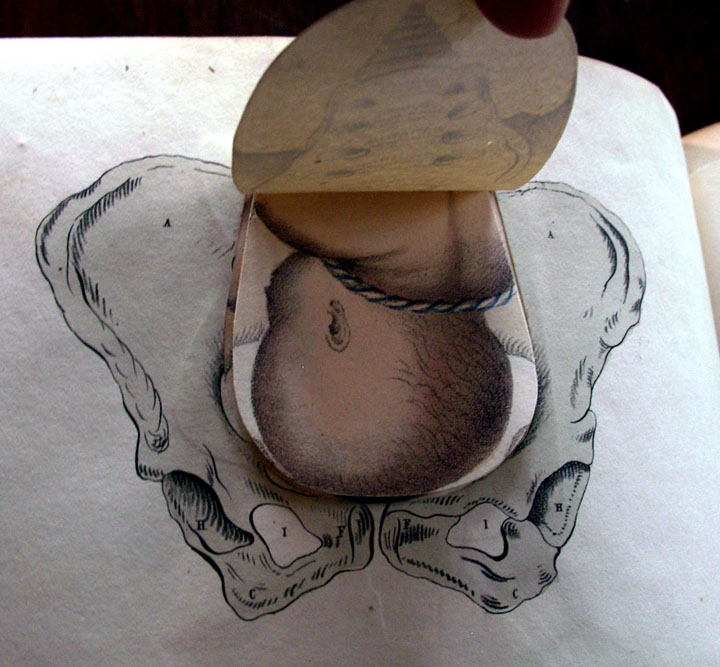
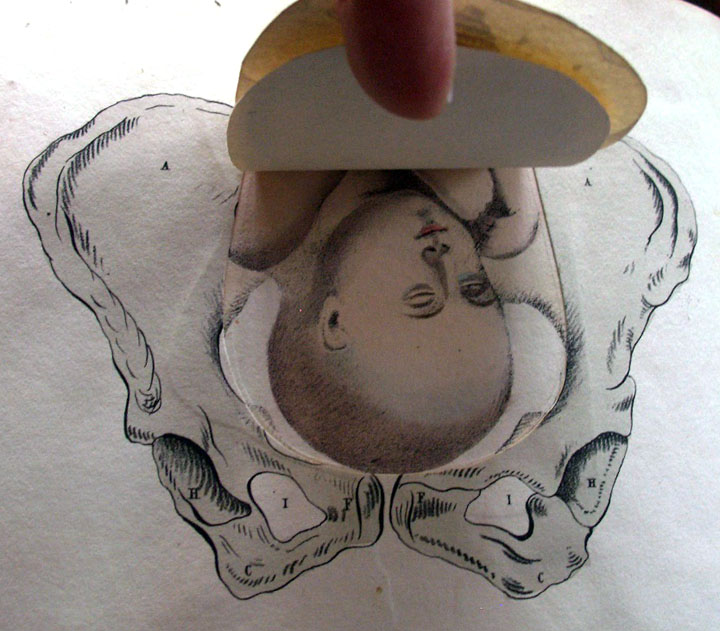
"Obstetric Tables: Comprising Graphic Illustrations, with Descriptions and Practical Remarks..." George Spratt, 1833


In 1538, Vesalius created Tabulae Sex, attaching a second printed image on top of the first that could be lifted to show the inside and outside of the human body. Euclid’s Elements of Geometry in 1570 incorporated flaps to help the reader envision three dimensional objects (Ex Oversize 2654.331.570q). By the early nineteenth century, the British printmaker George Spratt (ca. 1784-1840) used the same overlay technique for an anatomy atlas entitled Obstetric Tables. Spratt’s volume, first published in London in 1833, includes fifty hand-colored, tipped on flaps, sometimes layered four or five to the same image...
Find out more on Princeton University's Graphic Arts blog--from which all text and images are drawn--by clicking here.

Pictured above: George Spratt, Obstetric Tables: Comprising Graphic Illustrations, with Descriptions and Practical Remarks: Exhibiting on Dissected Plates Many Important Subjects in Midwifery (Philadelphia: James A. Bill, 1850). Lithographs. Gift of Joseph V. Meigs, Class of 1915. Graphic Arts GAX 2010. In process

Thursday, March 25, 2010

Morbid Anatomy Presents at Observatory: "Modern Ruins, Urban Archaeology, and the Post-Industrial Sublime" Tonight!


Tonight, Morbid Anatomy Presents at Observatory: "Modern Ruins, Urban Archaeology, and the Post-Industrial Sublime." This event--a series of presentations followed by a panel discussion on the allure of The Ruin--has generated a lot of interest, including this Flavorpill mention, so please come early to ensure seating. Hope to see you there!
Modern Ruins, Urban Archaeology, and the Post-Industrial Sublime: Presentations by Ian Ference, Tarikh Korula, and Julia Solis, followed by a discussion moderated by Alan Rapp
Date: Tonight, March 25th, 2010
Time: 8:00 PM
Admission: $5


Ruins as an aesthetic category were born in the eighteenth century, and they continue to seduce and thrill the contemporary imagination. But rather than antiquity’s shattered agorae or the stripped medieval abbeys that littered the English countryside, the ruins that captivate us today are of the relatively recent past—not just the industrial era that established Western hegemony, but now an even more recent service/retail age that dominated American culture until the crash of the late 00s.

A few dedicated individuals are committed to investigating and documenting this ruinous legacy. These intrepid photographer-researchers infiltrate a variety of hidden and abandoned sites, often risking physical danger or arrest, to capture and share stirringly uncanny photographs expressing the grandeur and pathos of these majestically crumbling spaces.

On March 25th, join a panel of photographers and aficionados of the post-industrial sublime for a discussion that will explore the allure and fascination of visiting, photographing, and viewing these mysterious spaces. The evening will begin with a series of short presentations about the history and photography of The Modern Ruin. Following these presentations, moderator Alan Rapp will lead a discussion that will seek to explore the art, history, and culture of The Ruin and its depiction, from ancient examples to these modern ruins that span the abandoned lunatic's asylum and tuberculosis wards, decrepit factory complexes and dead shopping malls. We will also probe the question of “why now,” with a special eye towards the acceleration of history which can make a ruin of sites as recent as a shopping mall, and ask if this contemporary fascination might speak to us of the twilight of our own empire.

Alan Rapp is a visual book editor and writer on the topics of architecture, photography, and design. He blogs at Critical Terrain and is currently completing his MFA in Design Criticism at School of Visual Arts.

Ian Ference has been discovering and traversing abandoned buildings for a decade and a half; sometime in the early 2000s, he decided to teach himself photography in order to capture the disappearing structures. He is particularly fascinated by insane asylums and quarantine hospitals, both for their uniquely purposed architecture and for the particular threads of history they embody. Ian's work has been widely featured, notably in the Brooklyn Museum and the New York Daily News. He has recently begun sharing his work online in a blog, The Kingston Lounge.

Tarikh Korula is a multidisciplinary artist whose work has included composition, performance, hacking, and sculpture. His practice is a playful meditation on experimental, political, sensuous, dark, or absurd themes. For the past decade, Korula has been exploring sound through improvisation, field recording and handmade electronics. He has performed at PS1 Contemporary Art Center and his sculpture has been exhibited at the New Museum. Korula was a founding member of the New York City Independent Media Center and has written for Punk Planet and Make Magazine. Korula co-founded Uncommon Projects in 2005 and lives in New York.

Julia Solis conducts archaeological parlor games and investigates ruined urban spaces. As the founder of Dark Passage, she started the creative preservation group Ars Subterranea in 2002 with the object of staging scavenger hunts and exhibitions in unusual locations in New York. She is an officer of the Madagascar Institute and Place in History, the locations producer of the film /American Ruins/, a co-founder of Furnace Press, and recipient of a fellowship from the New York Foundation for the Arts. Publications include New York Underground: The Anatomy of a City (Routledge, 2004) and Scrub Station (Koja Press, 2002).
You can get directions to Observatory--which is next door to the Morbid Anatomy Library--by clicking here. You can find out more about Observatory here, join our mailing list by clicking here, and join us on Facebook by clicking here.

Photo: "Still from 'Stages of Decay' by Julia Solis

Tuesday, March 23, 2010

"Remember That You Will Die: Death Across Cultures," Rubin Museum, Through August 9th, 2010


Eerie personifications of death greet the visitor in the form of two pairs of sculptures of skeleton figures: weathered lindenwood figures from 17th-century Germany extend bony, beckoning hands, while macabre bronzes from Tibet portray a yogic brother and sister engrossed in a mad dance—as skin peels off like furled ribbons. Both sculptural pairs warn of the fleeting nature of life: in the Western tradition, as memento mori, and in the Tibetan Buddhist tradition, as an incentive to make diligent use of precious human rebirth...
I just found out about an excellent sounding exhibition on view through August 9th at the Rubin Museum in New York City. Entitled "Remember That You Will Die: Death Across Cultures," the exhibition seeks to explore the "fascinating parallels and significant differences in the depiction of death over the centuries...focusing on works of art from Medieval and Early Renaissance Europe and Tibet."

It seems that the curators for this exhibition have cast a refreshingly broad net in their search for artifacts; the exhibition includes objects drawn from the American Museum of Natural History, London's Wellcome Collection, the Harvard Museum or Art and the New York Public Library as well as from the Rubin's permanent collection. I am incredibly curious to see this show and hope to see more broad, multi-disciplinary shows like this one in this museum's future!

Full details, from the press release:
Remember That You Will Die: Death Across Cultures
The Rubin Museum of Art finds fascinating parallels and significant differences in the depiction of death over the centuries in "Remember That You Will Die," an exhibition focusing on works of art from Medieval and Early Renaissance Europe and Tibet.

Serving as memento mori (death remembrances), the 84 works of art and artifacts on view range from a 12th-century be-jeweled bronze reliquary arm from Belgium to a wooden club carved into the shape of a skeleton from Tibet. The one contemporary work, a video by the American artist Bill Viola entitled The Three Women, is being exhibited in New York for the first time.

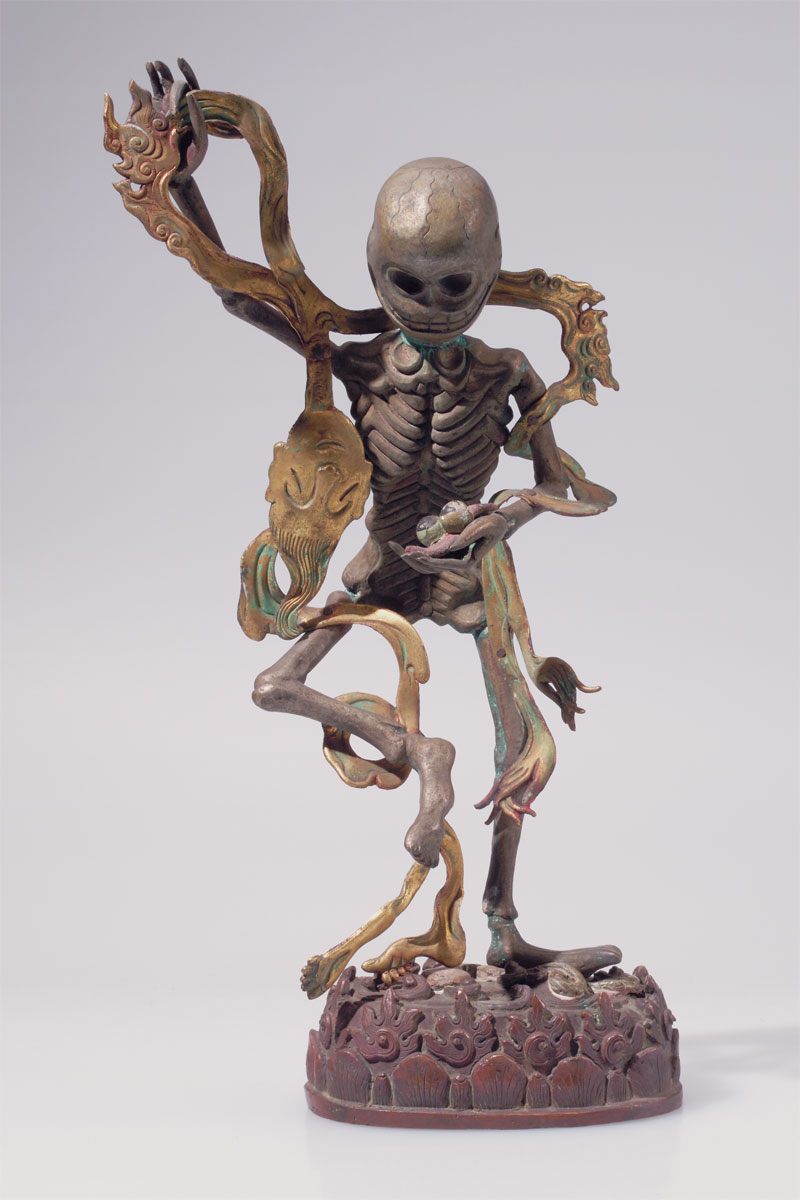
Eerie personifications of death greet the visitor in the form of two pairs of sculptures of skeleton figures: weathered lindenwood figures from 17th-century Germany extend bony, beckoning hands, while macabre bronzes from Tibet portray a yogic brother and sister engrossed in a mad dance—as skin peels off like furled ribbons. Both sculptural pairs warn of the fleeting nature of life: in the Western tradition, as memento mori, and in the Tibetan Buddhist tradition, as an incentive to make diligent use of precious human rebirth.

“We have found one common denominator in the works of art we have gathered for Remember That You Will Die: whether from Europe or Tibet, all serve as reminders to the righteous that life is transient and volatile and that the believer must adhere to religious guidelines in order to safeguard a better hereafter,” says Martin Brauen, chief curator, Rubin Museum of Art. Dr. Brauen has organized the exhibition in collaboration with Karl Debreczeny, senior curator, Rubin Museum of Art, and Bonnie B. Lee, curatorial consultant.

Among the subjects found in the section of the presentation devoted to Western works are the danse macabre, or Dance of Death, and heaven, purgatory, and hell; among the Buddhist works, the landscape of the afterlife, whether it be paradise or hell, and brutal scenes of charnel grounds (considered ideal places to confront the fear of death through meditation).

"Remember That You Will Die" is to be shown concurrently at the Rubin Museum of Art with Bardo (February 12 through September 6, 2010), an exhibition, named for the intermediate state between death and enlightenment or rebirth in Tantric Buddhism, featuring works of art that have been used for centuries to prepare the initiate for death.

Exhibition Highlights
A number of the featured objects in "Remember That You Will Die" draw from popular folk traditions reflecting the societal preoccupation with death in Europe in the wake of The Black Death (14th century). Among these is The Dance of Death (1538), an engraving by Hans Holbein the Younger, depicting the danse macabre, an allegory for death not found in the Bible but acted out in plays and painted in church frescoes across the European continent to prompt Christian believers into piety as a way to guarantee salvation. Here, Holbein shows a peddler going along a country road with his wares as Death drags him in the opposite direction—to the underworld— while another Death figure in the shadows plays a long mandolin/violin-like bowed instrument, with his back turned to the peddler. Death, especially in the danse macabre form, often is seen to dance gaily and/or play musical instruments.

Two rosaries and two scrolls demonstrate the manner in which Christian and Buddhist works can take intriguingly similar forms. Two rosaries are featured in the exhibition, one a 16th-century German example of intricately carved ivory beads in the shape of human skulls, the other a 19th- century Tibetan beads of 100 skull-shaped beads more abstractly and coarsely carved from human bone.

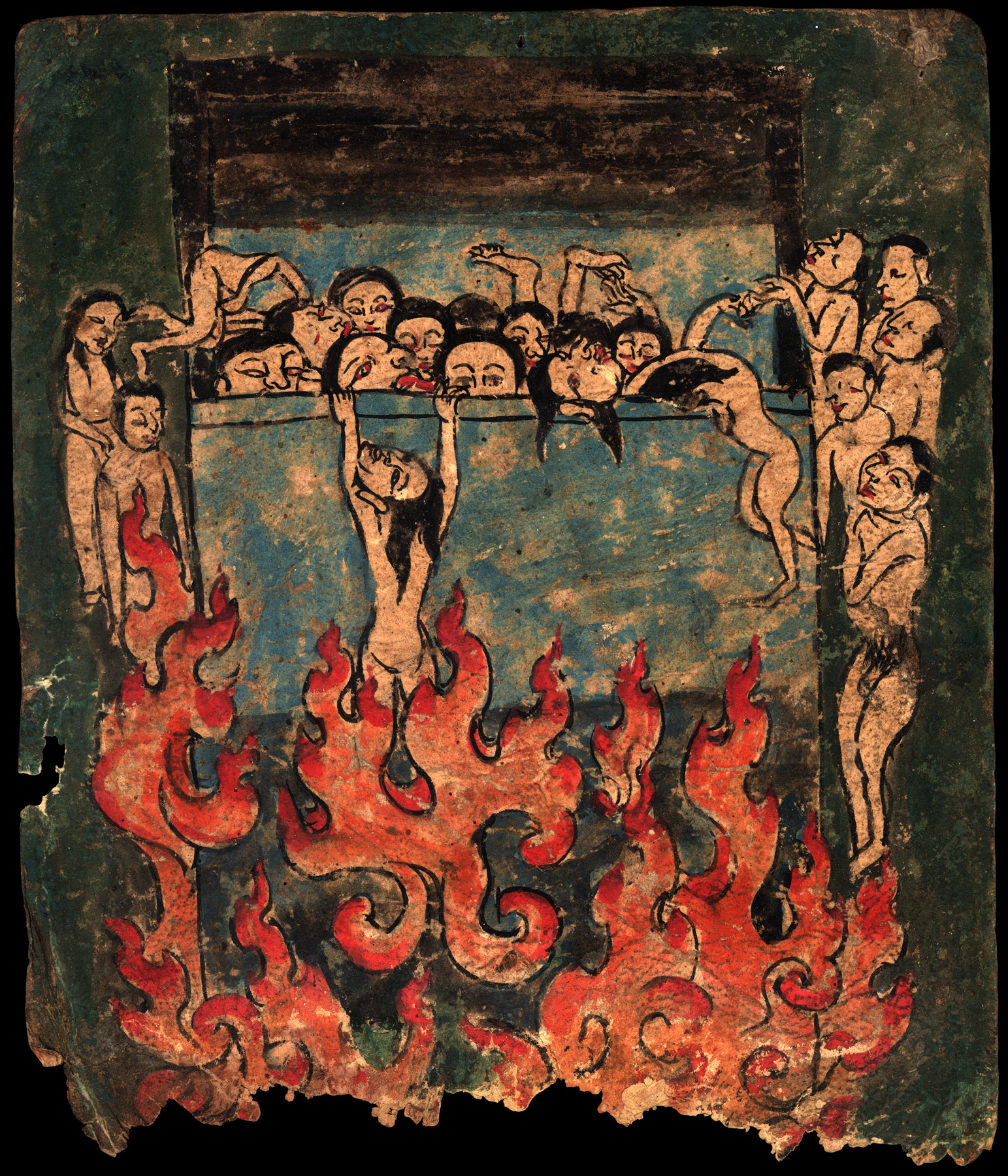
Created for the wall of a chapel in the Marienkirche in Lubeck, Germany, the Lubeck Dance of Death scroll is an eight-foot long engraving showing Death as the universal social equalizer. The engraving starts on the left showing the greatest ecclesiastical power on Earth, the Pope, headed toward Death, and goes all the way down to the farmer and peasant, a young boy, young maiden, and infant. The brightly colored Charnel Grounds scroll from 19th-century Tibet unfolds more than seven feet, depicting eight cemeteries and the faithful who go there to meditate. Because dead bodies are left out, not buried, in charnel grounds, there could be no starker reminder of mortality than the corpses, ogres, hungry ghosts, and zombies depicted here.

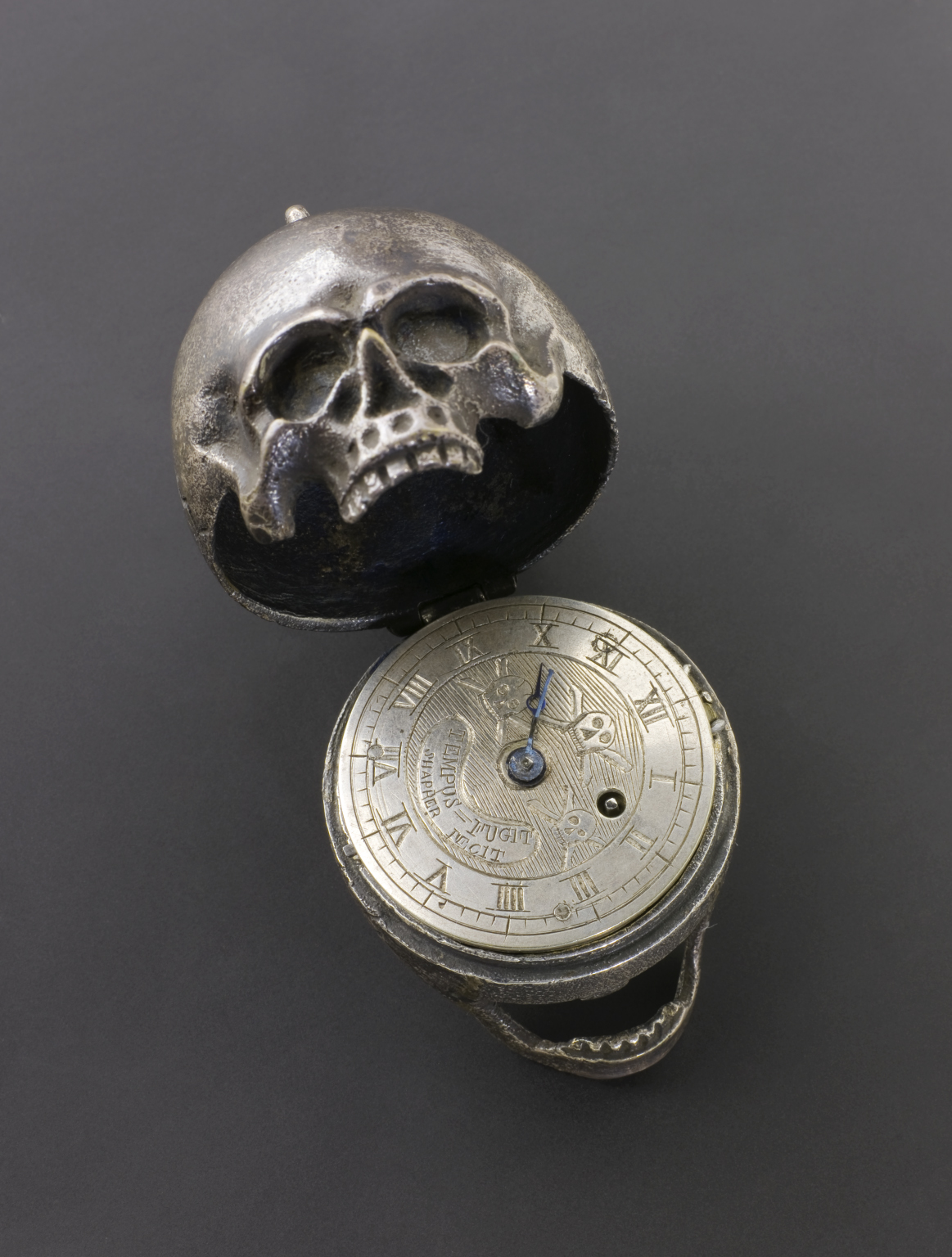
A Buddhist initiation card, ritual bone apron, painted skull hand drum, and shinbone trumpet are among other objects on view from Tibet, to be seen nearby such European artifacts as a pocket watch in the form of a silver skull, a silver gilt pendant in the shape of a coffin, containing a skeleton with a frog sitting on its chest, and a doctor’s walking stick with a skull-shaped knob.
For more about this exhibition, visit the Rubin Museum webpage by clicking here. Click on images to see much larger, more detailed versions. And thanks so much, Pam, for letting me know about this show!

Images, Top to bottom:
  1. Skull Pocket Watch, Europe; 1701-1900; Silver model of a human skull which opens up to show a pocket watch inside inscribed with skull and cross bone; Silver; Science Museum, London
  2. Lord of the Charnel Grounds; Tibet; ca early 19th century; Bronze, American Museum of Natural History
  3. Tsagli (Initiation Cards); Tibet; Date?; Pigments on paper, Rubin Museum of Art

Monday, March 22, 2010

"The Great Sarah Bernhardt Asleep in Her Coffin," Silver gelatin print, circa 1882


The Great Sarah Bernhardt Asleep in Her Coffin, Silver gelatin print, circa 1882

This iconoclastic Frenchwoman was arguably the most famous actress of the 19th century. She went on to become a film star in the early 20th century. In the 1880s, Bernhardt (1844-1923) made her own funeral arrangements. She picked out her own coffin because she was going to “sleep” in it forever. She had it delivered to her home and regularly slept in it. In her 1907 autobiography she wrote, “My bedroom was very tiny. The big bamboo bed took up all the room. In front of the window was my coffin, where I frequently installed myself to learn my lines.”

Bernhardt has this photograph taken in the classic postmortem style of the early 1880s. Though she was 78 years old when she died, this photograph depicts her in a death pose while she was still young and beautiful. Thus, this ersatz postmortem photo is the image many associate with her death.

From Sleeping Beauty II - Grief, Bereavement and the Family in Memorial Photography by Stanley B. Burns, M.D.
Quote and image via Liquid Night Tumbr found via Wisdom and Life Tumblr (my apologies for the earlier mis-credit). You can find out more about the excellent book from which it was drawn--Sleeping Beauty II - Grief, Bereavement and the Family in Memorial Photography by Stanley B. Burns, M.D.--by clicking here.

Thursday, March 18, 2010

"Lenin's Embalmers," Ensemble Studio Theater, New York


"To keep the dream of the revolution alive, forever, we must keep Lenin alive, forever..."
Earlier this week, I had the good fortune to see the truly wonderful play "Lenin's Embalmers,"now showing at the Ensemble Studio Theater. This snappy, inventive, engrossing (sic) and splendidly acted play details the unlikely-yet-true story of the embalming-for-eternity of Vladamir Lenin's body in 1924 by two hapless Jewish scientists. At the time, this feat was considered something of a modern miracle; the resulting artifact, controversially (see below...), can still be visited--86 years later!--in Lenin's Mausoleum in Moscow's Red Square.

The play--narrated by the rueful and absurdist-joke-cracking ghost of Lenin (played by the uncannily Lenin-esque Peter Maloney, whose sad eyes haunt and blame)--is much more than the sum of its parts, and transforms the small, modest theater almost magically into a captivating, enthralling, and atmospheric drama. The dialogue is snappy, witty, and pitch-perfect; the themes--of science religion and magic, the Russian penchant for black humor in the face of unbearable circumstances, the madness of life under tyranny, and the very human drives of the people who make science and history--add depth and interest to the already incredibly compelling facts of the story.

Lenin's Embalming is playing at the Ensemble Studio Theater through March 28th. If you can make it before the run ends, I simply cannot recommend it more highly. Subtle, inventive, informative, splendidly acted... a play that really lingers with you, and a joy to watch. This play is also, notably, part of the Ensemble Studio Theatre/Alfred P. Sloan Foundation Science & Technology Project, "designed to stimulate artists to create credible and compelling new theatrical works exploring the worlds of science and technology, and to challenge existing stereotypes of scientists and engineers in popular culture." For more on this noble project, click here.

And, on a topical note: as if to prove the relevance of this seemingly arcane topic, just today, the Telegraph ran a story about a man arrested for attempting violence on Lenin's embalmed corpse, who, as the Telegraph describes, claimed "he wanted to let loose a volley of bullets at Lenin's carefully embalmed corpse, one of the Russian capital's most popular and ghoulish tourist attractions!" So, as you can see, the potent symbol of the incorruptible body of Communism continues to resonate and create controversy.

To find out more about the play, visit the theater website by clicking here. You can read a fascinating New York Times review, which parses much of the play's historical content and background, by clicking here. To find out about the book Lenin's Embalmers, which inspired (and provided the name for) the play, click here. You can read the alluded to Telegraph article about the man who tried to destroy the embalmed corpse of Lenin by clicking here. Although Lenin's embalmed body is still on display, it receives regular upkeep; click here to see an online photo show of Lenin's body getting its regular touch-up.

Full disclosure: I received tickets to see this show from the theater, who thought I might like to review it. I did not expect to love it as much as I did, and the free tickets had nothing to do for my ardor! Thanks, Ensemble Studio Theater, for such an excellent night of theater.

The Future of The Science Museum Debated by the New York TImes


Thanks so much, Matt, for sending me this really timely and thought-provoking article about the future of science museums--and a discussion of their fascinating past, as seen above--in today's New York Times. Much to mull over here, and it covers a lot of things that I have been thinking about of late. Following is an excerpt:
A science museum is a kind of experiment. It demands the most elaborate equipment: Imax theaters, NASA space vehicles, collections of living creatures, digital planetarium projectors, fossilized bones. Into this mix are thrust tens of thousands of living human beings: children on holiday, weary or eager parents, devoted teachers, passionate aficionados and casual passers-by. And the experimenters watch, test, change, hoping. ...

Hoping for what? What are the goals of these experiments, and when do they succeed? Whenever I’m near one of these museological laboratories, I eagerly submit to their probes, trying to find out. The results can be discouraging since some experiments seem so purposeless; their only goal might be to see if subjects can be persuaded to return for future amusement..... The experimentation may be a sign of the science museum’s struggle to define itself.

A century ago, such a notion would have been ridiculous. Museums were simply collections of objects. And science museums were collections of objects related to scientific inquiry and natural exploration. Their collections grew out of the “wonder cabinets” of gentlemen explorers, conglomerations of the marvelous.

Museums ordered their objects to reflect a larger natural order. In 1853, when a new natural history museum at Oxford University was being proposed, one advocate suggested that each specimen should have “precisely the same relative place that it did in God’s own Museum, the Physical Universe in which it lived and moved and had its being.” The science museum was meant to impress the visitor with the intricate order of the universe, the abilities of science to discern that order, and the powers of a culture able to present it all in so imposing a secular temple.

Not all of this was disinterested. Natural history museums typically treated non-Western cultures as if they were subsidiary branches in an evolutionary narrative; deemed closer to nature, these cultures were treated as part of natural history rather than as part of history. Self-aggrandizing posing was generally mixed in with the museum project.

But you can still feel its energy. Go to any science museum with an extensive collection and walk among its oldest display cases. The London Science Museum, for example, which had its origins in the Crystal Palace of the Great Exposition of 1851, has collections that still invoke the churning energies of the Industrial Revolution and its transformations.

One of the most astonishing collections I have seen is the Wellcome Collection, also in London. It includes moccasins owned by Florence Nightingale, Napoleon’s toothbrush, amputation saws, an array of prosthetic limbs, a Portuguese executioner’s mask, Etruscan votive offerings and obstetrical forceps. Henry Wellcome, who had made his fortune with the invention of the medicinal pill, owned over a million objects by the mid-1930s and imagined them fitting into a great “Museum of Man” that would encyclopedically trace humanity’s concerns with the body. After his death, the collection was partly dispersed, but even what is left is as exhilarating as it is bewildering. You look at such collections and sense an enormous exploratory enterprise. You end up with an enlarged understanding of the world’s variety and an equally enlarged sense of the human capacity to make sense of it.

But that ambition is gone and so is the trust in ourselves. This may be the crux of the uncertainty in contemporary science museums. Where does the museum place us, its human creators? ...
You can read the full article--which I really recommend!--by clicking here. I love that the reviewer was as happily intrigued by the Wellcome Collection as I; more on that wonderful institution (perhaps my favorite medical museum--if you can call it that--in the world!) here, here, here, here and here. Click on image to see much larger version.

Image: "Scarabattolo" (1675) by Domenico Remps (c. 1621-1699). Found at About.com.

Wednesday, March 17, 2010

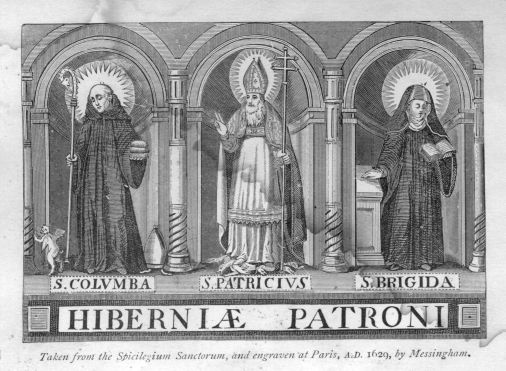
Happy Saint Patrick's Day!


Image: Frontispiece: Images of Saint Columba, Saint Patrick, and Saint Brigida, Taken from the Spicilegium Sanctorum, and engraved at Paris, A.D. 1629, by Messingham. From The Most Ancient Lives of Saint Patrick, by Various Edited by James O'Leary, 1880, as found on Project Gutenberg; more here.

Reminder: Call for Papers, Congress of the European Association of Museums of the History of Medical Sciences, Copenhagen, September 16-19


This year's Congress of the European Association of Museums of the History of Medical Sciences will take place from September 16th-19th at the Medical Museion at the University of Copenhagen. As I said in an earlier post on this topic, "if the Museion's awesome blog Biomedicine on Display is any indication, this conference--which aims to investigate ways in which museums can respond to the challenge raised by the "molecularisation, miniaturisation...digitalisation and intangibilisation" of new medicine--will be thought-provoking, innovative, and revelatory."

I just received a reminder from Thomas Soderqvist, the conference organizer, for paper submissions. The deadline is March 29th. For more, see Thomas' email below:
Just to remind you about the forthcoming meeting in Copenhagen in September about the challenge to museums posed by contemporary developments in biomedical science and medical technology.

How do museums today handle the material and visual heritage of contemporary medical and health science and technology? How do curators wield the increasing amount and kinds of more or less intangible and invisible scientific, medical and digital objects? Which intellectual, conceptual, and practical questions does this challenge give rise to?

We're aiming for two intensive days with visually enhanced presentations, good discussions and excellent food in beautiful surroundings.

Read the full call here:
http://tinyurl.com/ylx5atx or here:
http://www.corporeality.net/museion/2009/12/09/contemporary-medical-science-and-technology-as-a-challenge-for-museums-copenhagen-16-19-september-2010

Further information here: http://www.mm.ku.dk/sker/eamhms.aspx

Send proposals for presentations, panels etc. to ths@sund.ku.dk, not later than Monday 29 March.

Program committee:
Ken Arnold, Wellcome Collection, London
Robert Bud, Science Museum, London
Judy Chelnick, National Museum of American History, Washington, D.C.
Mieneke te Hennepe, Boerhaave Museum, Leiden
Thomas Soderqvist, Medical Museion, University of Copenhagen (chair).
If you would like further information or have any questions, please contact Thomas Soderqvist at ths@sund.ku.dk. You can visit the Medical Museion website by clicking here, and its immensely readable blog "Biomedicine on Display" by clicking here. Visit the EAMHMS website by clicking here. Information about the last awesome EAMHMS conference can be found by clicking here.

Image: David Gregory & Debbie Marshall, Wellcome Images; SEM of blood corpuscles in clot. Scanning electron micrograph of red blood corpuscles and a single white blood cell entangled in the fibrin mesh of a clot, computer-coloured red/yellow/white; Scanning electron micrograph 2003; Collection: Wellcome Images

Tuesday, March 16, 2010

"The True and Horrid Story of Burke and Hare," Illustrated Lecture by Lisa Rosner, Observatory, Thursday March 18th


This Thursday we have a really exciting lecture at Observatory: Professor and scholar Lisa Rosner will be on hand to tell us the "true and spectacular history" of Williams Burke and Hare, perpetrators, in the name of medicine, of "the most atrocious murder spree of the century, outflanking even Jack the Ripper's," as detailed in her book The Anatomy Murders.

As she explains in an interview on the Dead Guys in Suits blog:
Between November 1827 and November 1828, in Edinburgh, Scotland, William Burke and William Hare killed 16 people – 3 men, 12 women, and 1 child – in order to sell their cadavers to an anatomy lecturer, Dr. Robert Knox. These were the first serial killings to gain media attention, 60 years before Jack the Ripper. The link between murder-for-profit and medical progress has fascinated people ever since. Robert Louis Stevenson wrote a short story based on it, called The Body Snatcher, which was turned into a terrific horror flick in 1945, starring Boris Karloff and Bela Lugosi..
Hear the entire story, get a tutorial on the eponymous practice of "burking," and purchase signed copies of her book the day after tomorrow at Observatory! Full details follow; very much hope to see you there!
The True and Horrid Story of Burke and Hare
An illustrated lecture and book signing by Lisa Rosner,
Professor of History at Richard Stockton College of New Jersey.

Date: Thursday, March 18th
Time: 8:00 PM
Admission: $5

Up the close and down the stair,
But and Ben with Burke and Hare.
Burke's the butcher, Hare's the thief,
Knox the man who buys the beef.
—anonymous street song

On March 18, 2010, Lisa Rosner will be discussing the myths and realities of the Burke and Hare case, resurrected in her recent book The Anatomy Murders: Being the True and Spectacular History of Edinburgh's Notorious Burke and Hare and of the Man of Science Who Abetted Them in the Commission of Their Most Heinous Crimes.

On Halloween night 1828, in the West Port district, a woman sometimes known as Madgy Docherty was last seen in the company of William Burke and William Hare. Days later, police discovered her remains in the surgery of the prominent anatomist Dr. Robert Knox. Docherty was the final victim of the most atrocious murder spree of the century, outflanking even Jack the Ripper's. Together with their accomplices, Burke and Hare were accused of killing sixteen people over the course of twelve months in order to sell their corpses as "subjects" for dissection. The ensuing criminal investigation raised troubling questions about the common practices by which medical men obtained cadavers, the lives of the poor in Edinburgh's back alleys, and the ability of the police to protect the public from cold-blooded murder.

Lisa Rosner is Professor of History at Richard Stockton College of New Jersey. She received her AB from Princeton University and her PhD from Johns Hopkins University. She has been awarded fellowships from the American Philosophical Society, the National Endowment of the Humanities, the Chemical Heritage Foundation, and the New Jersey Historical Commission. The Anatomy Murders is the third book in her historical trilogy on Edinburgh medicine. "The Worlds of Burke and Hare," the companion website to The Anatomy Murders, is available at Burke and Hare. You can find out more about her book by clicking here. You can find out more about her work by clicking here.
You can get directions to Observatory--which is next door to the Morbid Anatomy Library--by clicking here. You can find out more about Observatory here, join our mailing list by clicking here, and join us on Facebook by clicking here. You can read Lisa Rosner's entire interview on the Dead Guys in Suits blog by clicking here. To find out more about her book The Anatomy Murders, click here.

Image used by permission of the Library of the Royal College of Physicians of Edinburgh.