Thursday, October 20, 2011

"From the Magnificent to the Macabre: Send-Offs for the Dead," Tonight at Observatory!


Tonight at Observatory! Hope very much to see you there.

From the Magnificent to the Macabre: Send-Offs for the Dead
Illustrated talk and book signing with Sarah Murray, author of Making an Exit
Date: Tonight, Thursday, October 20th
Time: 8:00 PM
Admission: $5 Presented by Morbid Anatomy
*** Thematic DJed after-party will follow the lecture; Books will be also available for sale and signing

Sending off the dead is something mankind does spectacularly well. There’s perhaps no human condition to which more attention has been devoted—faced with death, we create elaborate ceremonies and build great architectural edifices. We bury our loved ones in the ground or burn them in fire. We leave corpses as carrion for the birds, hang them in trees, or stow them in caves. We arrange for riderless horses to accompany the cortege to the cemetery or toss the remains of our fellows into sacred rivers amid the sound of bells and the swirl of incense.

In researching her latest book, Making an Exit (St Martin’s Press), Sarah Murray traveled the world in search of the best send offs. She will describe her encounters with everything from a spectacular Balinese royal cremation and a chandelier in the Czech Republic made entirely from human bones to the American death care industry’s biggest road show and a ghoulish Sicilian crypt where mummified corpses line the walls. Join Sarah for an engaging and highly personal discussion in which she will also present some of the unusual objects and artifacts she collected on her travels (she might even tell you about the plans for her own eventual send off).

Sarah Murray’s new book is Making an Exit: From the Magnificent to the Macabre—How We Dignify the Dead (St Martin’s Press, October 2011). She is also author of Moveable Feasts: From Ancient Rome to the 21st Century, the Incredible Journeys of the Food We Eat (St Martin’s Press 2007, Picador 2008). A longtime Financial Times contributor and freelance writer, she lives in New York City.

To be alerted to future events, "like" Morbid Anatomy on Facebook by clicking here or sign up for the Observatory mailer by clicking here. You can find directions to Observatory here and more on all events here. You can find out more about these events by clicking here.

Wednesday, October 19, 2011

Skull Fracture with Hematoma, ca 1700


Citation (unconfirmed) reads: skull fracture with hematoma, ca. 1700

Found here.

Tuesday, October 18, 2011

19th Century Horror Theatre! An Ode to Absinthe and her Kin! COMPLEMENTARY ABSINTHE!!! Decadent Paris Weekend at Observatory, November 11-12


I am super excited to announce the newly announced Decadent Paris Weekend at Observatory. Night one will feature author and scholar Mel Gordon, one of the best speakers we have ever had at Observatory, presenting a heavily-illustrated and highly-engaging lecture on the largely forgotten history of The Parisian Grand Guignol Theatre (1897-1962). Night two will feature Observatory favorite--and Midnight Archive director--Ronni Thomas for an alcohol-drenched and image-heavy ode to absinthe and her kin. Both events will be supplied with free absinthe (!!!) compliments of La Fée Absinthe, the first traditional absinthe distilled in France since the 1915 ban and is the only absinthe endorsed by the Musée de l'Absinthe, Auvers-sur-Oise.

These are both going to be events not to miss. Hope very much to see you there!

gg-poster

The Grand Guignol: Parisian Theatre of Fear and Terror 1897-1962
Illustrated lecture/booksigning with author and scholar Mel Gordon
Date: Friday, November 11th
Time: 8:00 PM
Admission: $8
Presented by Morbid Anatomy
***Complimentary absinthe provided by our sponsor La Fée Absinthe, the first traditional absinthe distilled in France since the 1915 ban and is the only absinthe endorsed by the Musée de l'Absinthe, Auvers-sur-Oise
***Signed copies of Gordon's long out-of-print Grand Guiginol will be available for sale at $30 (copies generally go for $60-150)

Hidden among the decadence and sleaze of Pigalle with its roughnecks and whores, in the shadows of a quiet, cobbled alleyway, stands a little theatre... --"Grand Guignol: The French Theatre or Horror," Hand and Wilson

From its beginnings in turn-of-the-century Paris and through its decline in the 1960s, the Theatre of the Grand Guignol--literally "grand puppet show"--gleefully celebrated horror, sex, and fear. Its infamous productions featured innocent victims, mangled beauty, insanity, mutilation, humour, sex, and monstrous depravity in a heady mix that attracted throngs of thrill-seekers from all echelons of society. By dissecting primal taboos in an unprecedentedly graphic manner, the Grand Guignol became the progenitor of all the blood-spilling, eye-gouging, and limb-hacking "splatter" movies of today.

Tonight, join Professor Mel Gordon--author of Grand Guiginol: Theatre of Fear and Terror--to learn about the largely forgotten history of the Le Théâtre du Grand-Guignol in this heavily-illustrated and highly engaging lecture.

Mel Gordon is the author of Grand Guiginol: Theatre of Fear and Terror, Voluptious Panic: The Erotic World of Weimar Berlin, and many other books. Voluptuous Panic was the first in-depth and illustrated book on the topic of erotic Weimar; The lavish tome was praised by academics and inspired the establishment of eight neo-Weimar nightclubs as well as the Dresden Dolls and a Marilyn Manson album. Now, Mel Gordon is completing a companion volume for Feral House Press, entitled Horizontal Collaboration: The Erotic World of Paris, 1920-1946. He also teaches directing, acting, and history of theater at University of California at Berkeley.


albert_maignan_-_la_muse_verte

Absinthe and Other Liquors of Fin de Siècle Paris: Lecture and Tasting
Illustrated lecture and liquor tasting with film maker Ronni Thomas
Date: Saturday, November 12th
Time: 8:00 PM
Admission: $10
Presented by Morbid Anatomy
***Complimentary absinthe provided by our sponsor La Fée Absinthe, the first traditional absinthe distilled in France since the 1915 ban and is the only absinthe endorsed by the Musée de l'Absinthe, Auvers-sur-Oise

On Saturday November 12th, join Ronni Thomas and Observatory for an exploration of the exotic and often diabolic liquids of France's antiquity featuring absinthe, a liquor known in fin de siècle Paris as "the green fairy" for its bewitching allure and poetically transporting nature. Among history's most infamous and romanticized liquors, absinthe became a symbol of decadence and was drink of choice of such bohemian luminaries as Oscar Wilde, Charles Baudelaire, Vincent van Gogh, Alfred Jarry, Édouard Manet, Henri Toulouse-Lautrec, and Pablo Picasso. By 1915, it was widely banned after having been publicly tied to sensational stories of madness, murder and degeneracy; recently re-legalized, it has developed a passionate contemporary fan base.

Tonight, absinthe devotee Ronni Thomas will deliver an illustrated lecture on the history of absinthe and other great elixirs of fin de siècle Paris--such as green chartreuse, armagnac, and ricard--complete with artwork and video excerpts; he will also screen his own contribution to the absinthe mythos: a promotional video he produced for contemporary absinthe maker Le Tourment Vert. Liquor samples for tasting will also be available throughout the evening, including complimentary absinthe from our sponsor La Fée. There will also a Francophile music-filled after party. It will be a night straight out of Brassaï's Paris right in the heart of Brooklyn.

Ronni Thomas filmmaker and creator of The Midnight Archive web series is an avid drinker who appreciates both the history of antique spirits and the effects they have on his self esteem. Incidentally, his favorite absinthe is tonight's sponsor La Fée.

Image: "La Muse Verte" (The Green Muse), Albert Maignan, 1895

To be alerted to future events, "like" Morbid Anatomy on Facebook by clicking here or sign up for the Observatory mailer by clicking here. More on all events here. You can find out more about these events by clicking here.

Sunday, October 16, 2011

Comparative Death Rituals; Halloween and Day of the Dead Costume Party; A "Dead Animal Man: This week at Observatory!

This week and beyond at Observatory; hope very much to see you there!

adam_card

"A Dead Animal Man": Screening and Q & A with Film Maker Lily Henderson
Date: Monday, October 17th
Time: 8:00 PM
Admission: $5

Presented by Morbid Anatomy

"A Dead Animal Man" is a new documentary film which profiles Nate Hill, public attention seeker and self-proclaimed rogue taxidermist, as he sets out to make A.D.A.M--A Dead Animal Man--from various animal parts gathered from NYC's Chinatown dumpsters. This film details Hill's quest from conception to completion, and contains vignettes ranging from the humourous to the bizarre to the extremely grotesque. At the end, Hill's desire for stardom is realized, but for what? The film saves us from extreme nausea but still pushes us far enough to the point where we ask ourselves--how far is too far?

Tonight, join us for a 25 minute sneak peak version of the film. Filmmakers will be in attendance to answer questions. Barf bags not included.

Lily Henderson is a filmmaker living in Brooklyn. She is an active member of the the Brooklyn Filmmakers Collective and recently released Lessons for the Living - a film about why certain people choose to spend their free time with dying strangers. More information can be found here. Henderson and her co-producer, Lila Dobbs, found Nate Hill's story intriguing but not because of the spectacle he was creating. Their goal was to find the deeper meaning in his public persona and the decaying Frankenstein body next to him.


VID00072.AVI

From the Magnificent to the Macabre: Send-Offs for the Dead
Illustrated talk and book signing with Sarah Murray, author of Making an Exit
Date: Thursday, October 20th
Time: 8:00 PM
Admission: $5
Presented by Morbid Anatomy
*** Thematic DJed after-party will follow the lecture; Books will be also available for sale and signing

Sending off the dead is something mankind does spectacularly well. There’s perhaps no human condition to which more attention has been devoted—faced with death, we create elaborate ceremonies and build great architectural edifices. We bury our loved ones in the ground or burn them in fire. We leave corpses as carrion for the birds, hang them in trees, or stow them in caves. We arrange for riderless horses to accompany the cortege to the cemetery or toss the remains of our fellows into sacred rivers amid the sound of bells and the swirl of incense.

In researching her latest book, Making an Exit (St Martin’s Press), Sarah Murray traveled the world in search of the best send offs. She will describe her encounters with everything from a spectacular Balinese royal cremation and a chandelier in the Czech Republic made entirely from human bones to the American death care industry’s biggest road show and a ghoulish Sicilian crypt where mummified corpses line the walls. Join Sarah for an engaging and highly personal discussion in which she will also present some of the unusual objects and artifacts she collected on her travels (she might even tell you about the plans for her own eventual send off).

Sarah Murray’s new book is Making an Exit: From the Magnificent to the Macabre—How We Dignify the Dead (St Martin’s Press, October 2011). She is also author of Moveable Feasts: From Ancient Rome to the 21st Century, the Incredible Journeys of the Food We Eat (St Martin’s Press 2007, Picador 2008). A longtime Financial Times contributor and freelance writer, she lives in New York City.

Image: Capuchin Catacombs in Sicily, photo by the author


Jose Posada: El Jarabe en Ultratumba (The Folk Dance Beyond the Grave)

Halloween and Day of the Dead Party with New Episodes of Ghoul A Go-Go and The Midnight Archive, Costume Contest, Music, and More!
Date: Saturday, October 22
Time: 8:00 PM
Admission: $12
Presented by Morbid Anatomy and Borderline Projects

Please join us on Saturday, October 22 for a Halloween/Day of the Dead costume party featuring brand new episodes of Ghoul A Go-Go and The Midnight Archive, as well as burlesque, music, piñata, food, beverages, sugar skulls, a costume contest, and more! Please, please (!!!) come in costume! All costumes welcomed!

The night's amusements will include:

ENTERTAINMENT!

  • Ghoul a Go Go: Premiere of a brand new episode
  • The Midnight Archive: Two new episodes of The Midnight Archive, Ronni Thomas' new web series based on Observatory
  • Music: Wavy gravy Halloween music for the all night dance party
  • Burlesque: A creepy Burlesque performance by Lil' Miss Lixx

FOOD AND DRINK!

  • Traditional Food and Drink Specials throughout the evening

COSTUME CONTEST!

  • Prizes for costumes inspired by either Vlad, Creighton, The Invisible Man, or any of the clips featured on Ghoul a Go Go

TRADITIONAL DAY OF THE DEAD ATTRACTIONS!

  • Day of the Dead Altar: Altar de Muertos, an installation by Rebeca and Salvador Olguin celebrating Mexico and its past, history and culture
  • Face painting: Have the Kiss of Death painted on your face by La Catrina
  • Pan de Muerto: Indulge in this traditional dessert called Bread of Death
  • Piñata: Dash death to smithereens with our annual death piñata!
  • Sugar skulls: Decorate and eat or bring home your own Day of the Dead sugar skull
  • Offerings to the Departed: In some places in Mexico, people leave small, coffin-like figures out for the souls of the departed. Guests are invited to leave their own offering; they will be available at the installation

Image: El Jarabe en Ultratumba (The Folk Dance Beyond the Grave), Jose Guadalupe Posada

October 24: Freaks and Pornography: Victorian Popular Anatomy Museums, Sex and the Unusual Body: Illustrated talk with author Sarah Kathryn York

November 6: Class: Mummification: Learn the art and ritual of animal mummification with instructor Sorceress Cagliastro *** Limited Class Size; Please RSVP to morbidanatomy [at] gmail.com


To be alerted to future events, "like" Morbid Anatomy on Facebook by clicking here or sign up for the Observatory mailer by clicking here. More on all events here. You can find out more about these events by clicking here.

Thursday, October 13, 2011

Postcards of the Taxidermic Tableaux of Walter Potter


3 postcards of the taxidermic tableaux of Herr Walter Potter, found on the Wunderkammer Tumblr.

On a related note, Morbid Anatomy now has in stock several more copies of Pat Morris' definitive illustrated books on Walter Potter and the history of taxidermy. More on those books here; you can order copies of them by clicking here.

"The Wellcome at 75," Financial Times Magazine, Article and Slide Shows


...you can’t grasp the Wellcome collection unless you can see the poetry in it. But until quite recently, the irrepressible curiosities and juxtapositions that make the collection captivating were regarded as an irrelevance, an embarrassment and a confounded nuisance to the people charged with putting it in order. When Henry Wellcome displayed his collection for the first time, he decreed that the museum should be “strictly professional and scientific in character”. His collection has resisted successfully ever since...
From the article "The Wellcome at 75" by Marek Kohn in the Financial Times magazine. You can read the full article--from which the above was excerpted--by clicking here. You can view the complete slideshows--from which the above images are drawn--by clicking here and here. Click on images to see much larger images.

Thanks to the afore mentioned Ross Macfarlane for bringing this article to my attention!

Image captions top to bottom:
  1. Models of human skulls in ivory, silver and wood
  2. A pair of phrenological busts, 1821
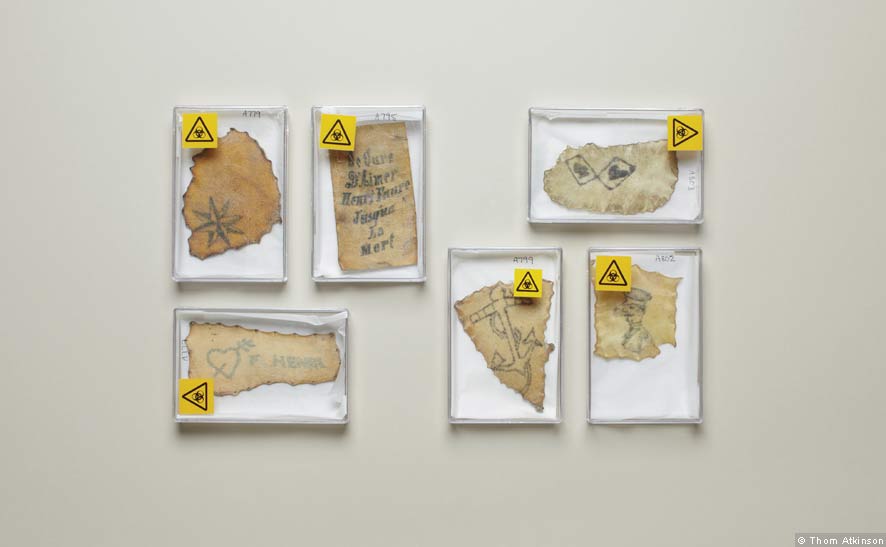
  3. Tattoos. Wellcome acquired 300 tattoos collected by a Paris surgeon who was active in the late 19th century. They are kept in boxes for fear that they were treated with toxic chemicals
  4. Ivory anatomical figures, 17th-18th century
  5. Roman votives. Romans would offer models of afflicted body parts to a god to beg or give thanks for cures. The model on the left is also Roman but was not one of these votive offerings. It came from Pompeii, where it may have adorned a shop front
  6. Wax model of decomposing body in coffin, Italian, late 1700s
  7. Plaster death mask of Victorian murderer James Bloomfield Rush
  8. Stuffed coiled snake, 1897
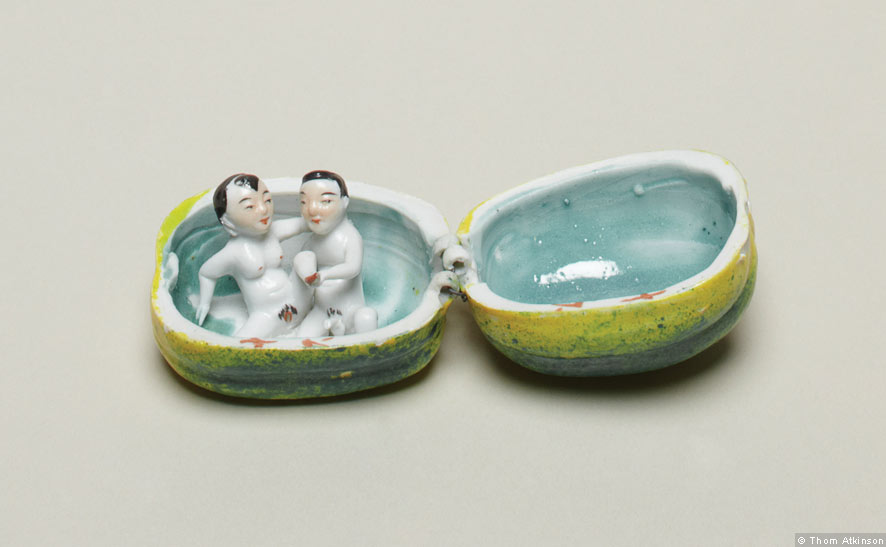
  9. Chinese porcelain fruit containing couple in sexual foreplay

Wednesday, October 12, 2011

"From Blue Beads to Hair Sandwiches: Edward Lovett's Folklore Collection," Lecture by Ross MacFarlane, The Wellcome Collection, November 10


Oh, if only I lived in London... November 10th at The Wellcome Collection:
From Blue Beads to Hair Sandwiches: Edward Lovett's Folklore Collection
Speaker: Ross MacFarlane, Research Officer, Wellcome Library.
Date: 10 November 2011, 15.00 - 16.00
Cost: This event is FREE. Reserve 90 minutes prior to start.

Explore the world of Edward Lovett, whose collection of amulets and curious objects lies at the heart of the 'Charmed Life' exhibition, through the Wellcome Library's archives.

You can pick up your free ticket for this event from the Information Point from 13.30 on the day. Tickets are issued on a first-come, first-served basis.

Please put coats and bags in the cloakroom to the rear of the foyer before meeting your guide, on the third floor, ten minutes before the event begins.
You can find out more by clicking here.

The Midnight Archive Episode 4: The Automata


The Midnight Archive--the new web-based video documentary series "centered around the esoteric and always exotic personalities that spring from Observatory"--has just launched a fantastic new episode, this one based the amazing Guinness Collection of Automata at the Morris Museum; you can view it above by clicking play.

Here is what Ronni Thomas, the film maker behind the series, has to say about this particular episode:
Tucked away, in a quiet and pleasant suberb of New Jersey, there exists one of the most fascinating collections of artistic engineering ever collected. The collection belonged to Murtogh Guinness, of the Guinness brewing company. Its contents are, what I can only describe as the early days of robotics, engineered for our ancestor’s entertainment. Dolls that perform incredible tasks, full orchestras in the middle of your parlor, and my favorite of course, a banjo that plays itself. The collection is maintained and managed by Jere Ryder who began his interest at a very early age. He is now entrusted to the collection at the Morris Museum located in Morristown New Jersey. Keep your eyes on the Brooklyn Observatory as they occasionally take a field trip out. The museum is located at 6 Normandy Heights Road Morristown, NJ and well worth the trip if you are nearby - Jere is not only very knowledgeable on the subject but also a fantastic tour guide... Thanks a ton, Mr. Ryder, we’ll see you soon no doubt!
For more on the series, to see former episodes, or to sign up for the mailing list so as to be alerted to future uploads, visit The Midnight Archive website by clicking here. You can also "like" it on Facebook--and thus be alerted--by clicking here. To find out more about Observatory, click here. To find out more about the Guinness collection at the Morris Museum, click here. There is also a wonderful, highly illustrated catalog for this exhibition, which Morbid Anatomy distributes. More on that here.

PS. To see brand new episodes of The Midnight Archive on the big screen and to meet the filmmaker, please come to the Observatory Halloween/Day of the Dead/Screening party! Click here for more on that.

Tuesday, October 11, 2011

Morbid Anatomy Library and Observatory, Open Studios, This Weekend 12-6!


This weekend, October 15th and 16th, please join the Morbid Anatomy Library and Observatory as we join dozens of other Gowanus-based galleries and artist studios in opening our spaces to the public for the Gowanus Artists Studio Tour, or "A.G.A.S.T."

Following are the full details: Hope to see you there!
Gowanus Artists Studio Tour (A.G.A.S.T.)
Saturday October 15th and Sunday October 16th 12-6
543 Union Street at Nevins, Brooklyn
Free and Open to the Public

Directions: Enter the Morbid Anatomy Library and Observatory via Proteus Gowanus Gallery

R or M train to Union Street in Brooklyn: Walk two long blocks on Union (towards the Gowanus Canal) to Nevins Street. 543 Union Street is the large red brick building on right. Go right on Nevins and left down alley through large black gates. Gallery is the second door on the left.

F or G train to Carroll Street: Walk one block to Union. Turn right, walk two long blocks on Union towards the Gowanus Canal, cross the bridge, take left on Nevins, go down the alley to the second door on the left.
You can find out more information about A.G.A.S.T., and get a full list of participants, by clicking here. You can find out more about Observatory and the exhibition now on view by clicking here.

Photo of The Morbid Anatomy Library by Shannon Taggart.

Valerie Hammond, 21st Century


I just stumbled upon the lovely wax and nature print artwork of artist Valerie Hammond. You can see more of her work by visiting her gallery website by clicking here. All images are drawn from this website.

Via the Phantasmaphile Tumblr.

Wellcome Object of the Month: Hair Mourning Jewelry


It is easy to miss these four little brooches, tucked away as they are in the far corner of Medicine Man alongside Egyptian canopic jars, mortuary crosses and even a shrunken head. But these examples of European mourning jewellery demonstrate an ambiguity at the heart of Henry Wellcome’s collection – the potential for the human subject to become material object after death.

Medicine Man is full of curios serving as literal or metaphorical extensions of the human body, and, like most medical collections, also features artefacts formerly part of the body itself. These brooches are no exception, each containing samples of human hair, neatly arranged and set behind glass.

Hair is certainly a material that occupies the narrow ground between person and thing – in life as much as death. Although it is ‘dead’ matter (as only the follicle contains living cells), once separated from the body, our hair is capable of outlasting us. These qualities of durability, alongside the fact that it is easily removed from the body and can be manipulated into almost any shape, led to the widespread use of hair in the 18th and 19th centuries as a tangible way to remember an absent loved one. Encased in a locket, ring or brooch, a lock of hair stood in for the recently departed, whose memory, it was hoped, would endure for as long as the jewellery itself.

But detached hair, alienated from its natural location on the body, can also provoke disgust – a reaction any of us who have found a stray hair in our food can identify with. The anthropologist Mary Douglas proposed that any ‘matter out of place’, including hair, becomes dirt, posing the threat of chaos and disorder unless carefully gathered and contained (1966)...
Read the full story from which the above image and text are excerpted on the Wellcome Collection blog by clicking here.

Image: Mourning brooches containing the hair of a deceased relative. Wellcome Images

Mask of Empress Eugenie of France, Edouard Wellin, 1867


Mask of Empress Eugenie of France surrounded with flowers and made with real hair (1867) – Edouard Wellin

Image and unverified citation found here.

"The Empire of Death: Spectacular Ossuaries and Relics in the 16th and 17th Centuries," Lecture and Book Signing: This Thursday at Observatory!


This Thursday at Observatory! Hope very much to see you there,.
The Empire of Death: Spectacular Ossuaries and Relics in the 16th and 17th Centuries
Lecture and book signing with Dr. Paul Koudounaris, author of The Empire of Death
Date: This Thursday, October 13
Time: 8:00 PM
Admission: $5
Presented by Morbid Anatomy and Atlas Obscura
** Books will be available for sale and signing

For five years, Dr. Paul Koudounaris has traveled the world to document a largely overlooked history: the decoration of religious shrines with human bones and remains in the sixteenth and seventeenth centuries. His newly published book The Empire of Death (Thames and Hudson) presents a collection of Koudounaris' photographs and texts chronicling these incredible sites, many of which are not open to the public and have never before been photographed.

The research for this unique book took the author to over 70 preserved charnel houses and skeletal shrines on four continents to document the once common use of human remains for the veneration of the dead in Christian culture. Among other tribulations, in the course of completing his research, the author was pursued by malevolent spirits, handcuffed to a table in a striptease bar by a prurient monk, forced to undergo a religious pilgrimage and exorcism, and arrested by the Austrian police.

Tonight, join Dr. Koudounarishis for an illustrated talk in which he will provide historical insights into the sites and people who created these marvelous objects and spaces, a discussion of the veneration of the dead in Christian culture, and fantastical travel anecdotes, all illustrated by his breathtaking photographs of these unforgettable artifacts.

Paul Koudounaris received a PhD in Art History from UCLA in 2006, which a specialty in the Baroque. He has taught at major universities in the Los Angeles area, and has written for dozens of magazines and newspapers in several countries, specializing in articles about veneration of the dead.

You can find out more--and get directions to Observatory--by clicking here. To find out more about the beautifully designed and richly illustrated book--and order a copy for yourself!--click here.

All Photo: © Dr. Paul Koudounaris, from his book The Empire of Death

Saturday, October 8, 2011

Dream Anatomy Video


The interior of our bodies is hidden to us. What happens beneath the skin is mysterious, fearful, amazing. In antiquity, the body's internal structure was the subject of speculation, fantasy, and some study, but there were few efforts to represent it in pictures. The invention of the printing press in the 15th century-and the cascade of print technologies that followed-helped to inspire a new spectacular science of anatomy, and new spectacular visions of the body. Anatomical imagery proliferated, detailed and informative but also whimsical, surreal, beautiful, and grotesque — a dream anatomy that reveals as much about the outer world as it does the inner self. --Introduction to Michael Sappol's Dream Anatomy exhibition
I have just stumbled upon a really nice video based on the now-legendary Dream Anatomy exhibition at the National Library of Medicine, curated by friend and friend-of-the-blog Michael Sappol. To check out--and purchase a copy of!--the beautifully illustrated and provocatively insightful catalog for the exhibition, click here.

Found on Street Anatomy.

Friday, October 7, 2011

Oddities TV Show Seeking Los Angeles Based Collectors for Future Episodes!


Calling any LA, California based collectors of Oddities! We would love to feature you on the show! Send the producers an email ASAP at Odditiesshow@gmail.com.
This call for collectors just in from Mike Zohn of "Oddities," the Discovery and Science Channel series based on the unrivaled Obscura Antiques and Oddities in New York City. If you are a collector of unusual things based in Los Angeles and interested in appearing on the show--or would like additional information--email Odditiesshow@gmail.com; more about Oddities can be found here.

Medical tricks and Victorian treats at The Florence Nightingale Museum, London, October 28th


This just in from my friend Natasha McEnroe, recently of the incredible Grant Museum and now at London's Florence Nightingale Museum:
Medical tricks and Victorian treats.....
10am – 5pm, Monday October 24th – Friday October 28th.
The Florence Nightingale Museum, London
Free with the price of admisison

Come and follow, if you dare, the Halloween Trail at the Florence Nightingale Museum. Medical tricks and Victorian treats fill the museum over Halloween half term. Take part in quizzes and quests, grisly games and ghoulish activities, and earn a bulging goody bag. Enter the Halloween competition for a chance to win a horribly good prize.

Feast your eyes on the vermin-infested Halloween banquet! Put your life in the hands of a crazed Victorian quack doctor! And come face to face with the monster lurking underneath the haunted bed....
More on this event can be found here.

European Association of Museums of the History of Medical Sciences (EAMHMS) Conference: Call for Papers!


I am excited to announce a call for papers for the 16th biannual conference of the European Association of Museums of the History of Medical Sciences (EAMHMS). The call is issued by Thomas Schnalke, director of the Berliner Medizinhistorisches Museum, the museum which will be hosting the 2012 conference, and reads as follows:
Dear friends and colleagues!

After a highly inspiring conference of the European Association of Museums of the History of Medical Sciences (EAMHMS) in Copenhagen in 2010, it is my pleasure to invite the members of the association, as well as interested scholars and curators from the community of medical history collections and museums to join in and actively participate in the next meeting of the organisation. The conference will be held at the Berlin Museum of Medical History at the Charité from 13 to 15 September 2012. As we all profited from the vibrant culture of debate and discussion, Thomas Söderqvist and his team had generated in Copenhagen, we would like to keep the idea of pre-circulating extended abstracts plus a short oral presentation of the core ideas in the conference (10 mins!). Beamer and laptop will be provided for Power-Point-Presentations. The language for abstracts, talks, and discussions will be English.

While the Copenhagen conference opened and fuelled the still ongoing debate on how to collect and present medical and medical history issues in times when objects tend to fade into the invisible and intangible cosmos of the virtual and nano biology, we want to address the attention back to the physical things we have and deal with: the objects in our collections, depots, and museums. These items are a mystery. They present strangely curved and shiny surfaces. They perform in all different shapes, materials and colours. And they are quiet. They usually don’t talk. But, and this is our chance and challenge, ideas and concepts had been inscribed into their physical make. Medical theories and practices as intricately mixed epistemic processes had found their specific materialisations in the defined structures of such things. Over the times of their preservation they might have lost their primary functions, won secondary ones, but more crucial: They have gained meaning for which we can seek, if we decide to take these objects as serious sources for our work as historians of medicine, science, technology, culture, art, humanities etc.

What we have to do is asking for the “text” in the object, i.e. sometimes a real text in, with or around the thing (may this be only a code, a chiffre or a number), or a “subtext” somehow embedded in the shaped materials implicitly or connected with the object but detached from it and stored elsewhere, as in added files, fascicles or publications. With the clues and information we get from there we can move on to reconstruct the object’s context. Only within this context, the object begins to speak. We can tell its story and biography.

The conference will therefore focus on objects, asking always for the hidden “texts” and “subtexts” on two different paths—a more practical and a conceptual one:
1. Hidden stories. What do medical objects tell?

We ask for papers that really focus on one medical object from your collections, depots or show rooms. Please slip into the role of a Sherlock Holmes to solve the case of this very object, i.e. by observing and describing the thing accurately, looking for clues (“texts”) and additional information (“subtexts”) and presenting your spiral analysis and interpretation around the item, thus telling us the full object story. You may chose any medical object of your personal interest—an ancient mask, medieval blood letting device, a scientific kymograph or a modern gene sequencer—from any time, culture and geographical zone. The only aim we ask you to keep in mind is to show us how far you get with your object-centred research, how far you can draw your interpretation surely consulting secondary archival material and relevant literature. Please also reflect on the limits of this approach.

2. How can we make our objects speak?
Here we ask for papers that reflect on a more conceptual base on how we can deal with objects in three different arenas:

- Research: Medical objects and collections form a unique source in performing research on various topics in the history of medicine and the sciences. What prerequisites and infrastructures do we need to study our objects effectively? What are innovative modes and approaches in a material culture of performing research on, with and around our objects? What forms of networking and funding do we need to support an object-centred research? What are adequate and new formats of publication for our object studies?

- Teaching: Medical Objects and collections offer a unique chance for visual and haptic forms of teaching in many fields. Can you share your thoughts and experiences on this field with us? What are the features, values, and potentials of an object-based teaching? What are possible limits here (delicacy of objects, climate, access, etc.)? What formats of object-based teaching have been tried out (best practice) or ought to be developed further towards a better training in the medical (historical) fields? What links of object-based teaching to research and public outreach have been built up and tried out with what results?

- Presenting: Medical Objects and collections form the core items for our exhibits. What do we want to achieve with our object presentations? What is the very nature, what are the features of exhibitions in our fields? Whom do we want to reach? What are good and innovative formats to make our objects speak and perform for a wider public in our showrooms? What connections with the arenas of research and teaching are possible and sensible? What is the status of an object-based thematic exhibition in our own eyes, in the minds of our external audiences, including the general public and the scientific community?

We ask you to choose a topic from the above-mentioned issues and send your abstract (maximum 700 characters) with a title, your name, the name of your institution (if you are attached to any) and your contact data (preferably e-mail address) until 31 October 2011 to thomas.schnalke [at] charite.de. A programme committee will select from the abstracts to compose a hopefully inspiring programme. If your contribution was chosen, you will be asked to work out and hand in an extended abstract (2 to 5 pages) until 15 May 2012. All papers will be put together in one pdf-file and sent out to all participants in time before the conference starts in Berlin on 13 September 2011. We will ask the participants to have read the papers, so that a short presentation (10 mins!) will be enough to focus on the core arguments.

Please help us to put together an inspiring conference. See you all in Berlin 2012.

Best wishes
Thomas Schnalke
Found on the always wonderful Biomedicine on Display. Image sourced here. Hope to see you there!

Thursday, October 6, 2011

A Steve Jobs Memento Mori


So by now I imagine we have all heard the sad news of Steve Jobs' death. What is really interesting to me is how his death has had the curious side effect of bringing a discussion of mortality and the contemplation thereof as a road to wisdom and a good life in the mainstream media. Steve Jobs' words on death, which are being excerpted in many online eulogies, are drawn from a commencement address he gave at Stanford University in 2005; they ring very true and refreshing, and are worth quoting here in their entirety:
My third story is about death.

When I was 17, I read a quote that went something like: "If you live each day as if it was your last, someday you'll most certainly be right." It made an impression on me, and since then, for the past 33 years, I have looked in the mirror every morning and asked myself: "If today were the last day of my life, would I want to do what I am about to do today?" And whenever the answer has been "No" for too many days in a row, I know I need to change something.

Remembering that I'll be dead soon is the most important tool I've ever encountered to help me make the big choices in life. Because almost everything — all external expectations, all pride, all fear of embarrassment or failure - these things just fall away in the face of death, leaving only what is truly important. Remembering that you are going to die is the best way I know to avoid the trap of thinking you have something to lose. You are already naked. There is no reason not to follow your heart.

About a year ago I was diagnosed with cancer. I had a scan at 7:30 in the morning, and it clearly showed a tumor on my pancreas. I didn't even know what a pancreas was. The doctors told me this was almost certainly a type of cancer that is incurable, and that I should expect to live no longer than three to six months. My doctor advised me to go home and get my affairs in order, which is doctor's code for prepare to die. It means to try to tell your kids everything you thought you'd have the next 10 years to tell them in just a few months. It means to make sure everything is buttoned up so that it will be as easy as possible for your family. It means to say your goodbyes.

I lived with that diagnosis all day. Later that evening I had a biopsy, where they stuck an endoscope down my throat, through my stomach and into my intestines, put a needle into my pancreas and got a few cells from the tumor. I was sedated, but my wife, who was there, told me that when they viewed the cells under a microscope the doctors started crying because it turned out to be a very rare form of pancreatic cancer that is curable with surgery. I had the surgery and I'm fine now.

This was the closest I've been to facing death, and I hope it's the closest I get for a few more decades. Having lived through it, I can now say this to you with a bit more certainty than when death was a useful but purely intellectual concept:

No one wants to die. Even people who want to go to heaven don't want to die to get there. And yet death is the destination we all share. No one has ever escaped it. And that is as it should be, because Death is very likely the single best invention of Life. It is Life's change agent. It clears out the old to make way for the new. Right now the new is you, but someday not too long from now, you will gradually become the old and be cleared away. Sorry to be so dramatic, but it is quite true.

Your time is limited, so don't waste it living someone else's life. Don't be trapped by dogma — which is living with the results of other people's thinking. Don't let the noise of others' opinions drown out your own inner voice. And most important, have the courage to follow your heart and intuition. They somehow already know what you truly want to become. Everything else is secondary.
You can read the full text of Steve Jobs' commencement address at Stanford University in 2005 here.

Image of memento mori figure sourced here.

Monday, October 3, 2011

Morbid Anatomy Presents This Week and Beyond at Observatory


Solitary vice? Sex and dissection in Georgian London
An illustrated lecture with Dr. Simon Chaplin of the Wellcome Library, formerly of the Hunterian Museum
Date: This Tuesday, October 4
Time: 8:00 PM
Admission: $5
Presented by Morbid Anatomy

In his watercolour of a 'Persevering Surgeon', the British artist Thomas Rowlandson made no bones about the darkly erotic nature of anatomical dissection. Poised over the body of a naked woman, erect knife in hand, Rowlandson's anatomist conjured images of the other solitary vice that consumed later 18th century moralists and medical men. But like Rowlandson - who combined popular satirical illustration with a more discreet trade in pornographic imagery - anatomists maintained a delicate balance between personal pursuits and public propriety. In this lavishly illustrated lecture, Simon Chaplin explores the sexual undertones of the anatomy schools of Georgian London, in which students dissected grave-robbed bodies in the back-rooms of their teachers' houses, while their masters explored new strategies for presenting their work to polite audiences through museums and lectures.

Dr Simon Chaplin is Head of the Wellcome Library in London. Before joining the Wellcome he was Director of the Hunterian Museum in London, one of the world's oldest anatomy collections. His research interests include the history of anatomy, surgery and museums, and his doctoral thesis explored the relationship between dissection and display through the work of the Hunterian Museum's founder, the surgeon John Hunter (1728-1793).

Image: Thomas Rowlandson, 'The Persevering Surgeon', late 18th century, from the collection of the Hunterian Museum, London

Born of the Floating World: A Brief Exploration of the Japanese Graphic Narrative
Illustrated talk with Japanese Scholar Dev Avidon
Date: This Thursday, October 6th
Time: 8:00 PM
Admission: $5
Presented by Morbid Anatomy and Oxberry Pegs

In 1988, the anime adaptation of Otomo Katsuhiro's perennial serialized manga Akira was released in Japan, shattering domestic attendance records for an animated film. Shortly thereafter, its distributor presented it to George Lucas and Steven Spielberg as the ideal anime for English-language adaptation. The two dismissed it offhand, deeming the very concept of a cerebral, macabre, challenging animated film as “completely unmarketable” in the United States. Animation in America was the sole purview of children, they reckoned, and throughout the 90s, those few anime that were adapted for the American market were heavily edited to remove any and all controversy or 'adult' themes, thus rendering them safe for Saturday mornings. In 2001, however, Disney took a chance, bringing a largely faithful, unedited translation of Hayao Miyazaki's Spirited Away to theaters. It was an astounding success, enjoying uniform critical acclaim and record profits for a foreign animated film, and sparking an unprecedented interest in anime and manga in America.

A decade later, with anime and manga's popularity in the United States at an all time high, Dev Avidon will present a brief history and overview of the two forms, and examine their provenance in 17th and 18th century Japanese pictorial narratives such as the Kibyoshi – arguably the first graphic novel in human history. What spawned anime and manga as media, and what defines them? How did their visual and narrative tropes and themes evolve from both a Japanese cultural tradition dating back as early as the 9th century, and a cross-pollination and interplay with Western art and animation styles during the 19th and 20th centuries? And how can we, as American viewers, reconcile our preconceptions of the 'cartoon' and 'comic book' with the realities of two artistic forms that, collectively, account for over half of all visual media produced in Japan annually?

Dev Avidon is a Brooklyn-based jazz composer/singer, sound engineer, small business owner and Japanese scholar. During his time in the Government and East Asian Languages and Civilizations departments at Harvard University he specialized in Japanese neo-nationalism and Japanese popular art, from the ukiyo-e and kibyoshi forms of the Edo period through the modern day Neopop and Superflat movements. His thesis for the Reischauer Institute of Japanese Studies at Harvard University, Allegories of the Empty Center: A study of Modern Japanese Nationalism explores how Japanese neo-nationalism as exemplified in cultural movements such as Superflat problematizes the core tenets of modern nationalist theory. He also played an instrumental role in the founding and cataloging of the anime and manga collections at the Harvard Yenching Library. A well-published author and scholar, Dev Avidon's current focus is on his upcoming sophomore album, Tears of Men, and melding the hard science of audio technology with the clean lines of Japanese aesthetic design and the artwork of master jewelers with his line of audiophile cables for Frost Audio, a boutique audio company he owns and co-founded in 2010. Visit him at www.devavidon.com or www.frost-audio.com.

Image: Hokusai's Manga

The Rest of October:

NOVEMBER:

You can find out more--and get directions to Observatory--by clicking here.

Saturday, October 1, 2011

"Good Neighbours: Faeries, Folklore and the Art of Tessa Farmer," Symposium, London, TODAY


I have just been alerted to a pretty amazing sounding day of presentations, readings, films and discussions taking place at Viktor Wynd Fine Art today to launch an exhibition work by Tessa Farmer. Full details below; wish I could be there!
Good Neighbours: Faeries, Folklore and the Art of Tessa Farmer
A day of presentations, readings, films and discussion
Saturday 1 October 2011, 11am til 7pm
Viktor Wynd Fine Art, 11 Mare St, London E8

* 11am Introduction - Tessa Farmer, Viktor Wynd and Mark Pilkington

* 11.30 Jeremy Harte – Faeries and Otherness

* 12.30 Gwilym Games – “The Obscure and Horrible Race of the Hills”, Arthur Machen’s faeries

* 1.30pm lunch

* 2.30 Wynd reads a faery tale to aid digestion

* 2.45pm Petra Lange Berndt – Swarming: Insects in art

* 3.45pm Diane Perkiss – The Changing Face of Faery

4.45 pm Quick tea break

*5pm Screening of Tessa Farmer and Sean Daniels’ three short films

* 5.15pm Catriona Mcara in discussion with Tessa Farmer and Mark Pilkington

* 6pm Carol Mavor faery tale reading

* 6.30 pm Closing discussion and questions

7pm close

Tickets are £25, though early bird tickets, and those bought from the gallery are only £15. You can book tickets here.
You can find out more by clicking here.