Showing posts with label anatomical venus. Show all posts

Monday, May 23, 2016

Anatomical Venus Book Release Events at The Strand Rare Book Room and The Morbid Anatomy Museum!

http://www.amazon.com/Joanna-Ebenstein/e/B00LGYS6TQ
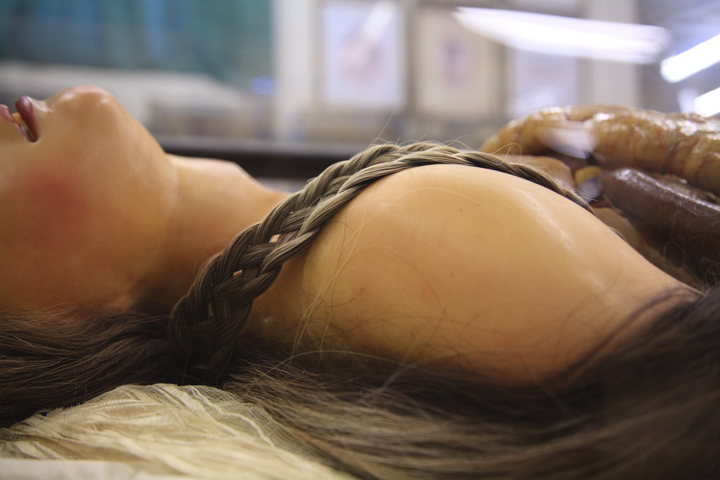
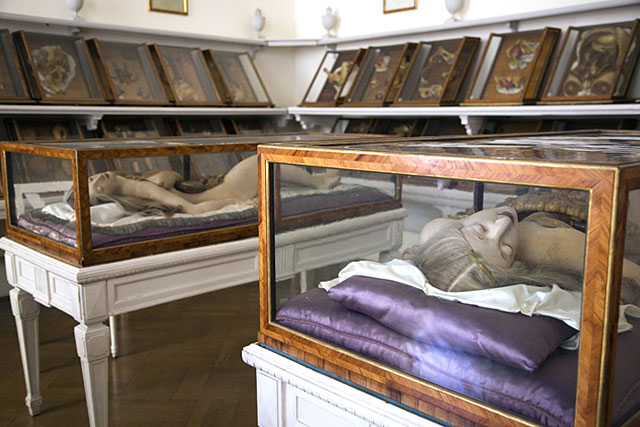
The Anatomical Venus--an "epically illustrated" new book by Morbid Anatomy founder Joanna Ebenstein--explores the curious history of seductive female anatomical wax models, created in the 18th century and peaking in fashion in the 19th. The book traces--in images and words--the evolution of these enigmatic sculptures from wax effigy to fetish figure and the embodiment of the uncanny.

Described by Publisher's Weekly as "the strangest book of 2016," The Anatomical Venus officially launches tomorrow, and we are celebrating with two events. The first will be a conversation on Thursday, June 2 between Joanna Ebenstein and Evan Michelson of the Science Channel’s Oddities taking place at the Rare Book Room at The Strand (more here) followed by a book signing.

For the more committed among you, on Saturday June 4th The Morbid Anatomy Museum will host a day long symposium exploring the range of topics covered by the book including anatomized women, wax, the ecstatic, Catholicism and the cult of the saints, the uncanny, and more; featured speakers include Joanna Ebenstein, Mel Gordon, Stephen Asma, Mark Dery, Mike Sappol, Amy Herzog, Asti Hustvedt, Shannon Taggart, Margaret Schwartz, Ronni Thomas, Marie Dauenheimer, Colin Dickey Lissa Rivera, and Karen Bachman; you can see the full line up below, or by clicking here. There will also be an afterparty at our favorite bar Halyards featuring DJ Friese Undine and films curated by David Cory. 

At both events, Museum co-founder and board chair Tracy Hurley Martin will make opening remarks, and books will be available for sale and signing.

You can learn more about the book here; read reviews in Vice, The Telegraph, Publisher's Weekly, Bust and The Guardian; and hear an interview about The Venus with the author on BBC 4's Women's Hour here. You can order the UK (Thames and Hudson) and US (DAP) edition of the book here.

Anatomical Venus Book Release Party and Symposium

Date: Saturday, June 4
Time: 11 AM -7:15 PM
Admission: $45 ( Admission + Book ), $10 ( Morbid Anatomy Member Symposium Admission ); $15 ( Regular Symposium Admission )
***Copies of The Anatomical Venus will be available for sale and signing.
*** Admission also includes access to museum exhibits including House of Wax
Tickets here

The Anatomical Venus--a new Morbid Anatomy book by our co-founder and creative director, Joanna Ebenstein--explores the curious history of seductive female anatomical wax models, created in the 18th century and peaking in fashion in the 19th. The book traces--in images and words--the evolution of these enigmatic sculptures from wax effigy to fetish figure and the embodiment of the uncanny.

On June 4, we hope you'll join us for a one-day symposium to celebrate the release of The Anatomical Venus with a symposium exploring the range of topics covered by the book including anatomized women, wax, the ecstatic, Catholicism and the cult of the saints, the uncanny, and more. After, join us for an after party at our local bar, Halyards, with DJ stylings by Friese Undine and films curated by David Cory. Books will be available for sale and signing.
11:00 AM
Introductory Remarks by Tracy Hurley Martin (Morbid Anatomy Museum Co-Founder and Board Chair)

11:10 AM
Joanna Ebenstein (Morbid Anatomy Founder, Morbid Anatomy Museum Co-Founder and Creative Director): "An Enlightenment-era St Teresa Ravished by Communion with the Invisible Forces of Science": A Brief Introduction to The Anatomical Venus

11:30 AM
Introductory Talk: Evan Michelson (Scholar in Residence, TV's Oddities): An Anatomical Pilgrimage

12:00 - 1:45
PANEL ONE: Agalmatophilia, or People who Fall in Love with Non-animate Humans
-- Margaret Schwartz (Fordham Univsersity): "I Buried Her Standing Because She Had Balls!" The Strange Afterlife of Eva Perón.
-- Lissa Rivera (Artist): The History of Sex Dolls
-- Ronni Thomas (Filmmaker in Residence): Mad Science, Mysticism, Romance and Necrophilia: The Strange Tale of Carl von Cosel and Elena Hoyos

1:45 - 2:45: Lunch Break

2:45 - 4:00
PANEL TWO: Corpo Sancto: Faith, Metaphysics and The Body
-- Stephen Asma (author of Stuffed Animals and Pickled Heads): The Redemptive Body: a Theology of Anatomy
-- Colin Dickey (author of Cranioklepty and Afterlives of the Saints): Saint Teresa and the Erotics of Reading
-- Karen Bachman (Hair Artist in Residence): Holy Body Parts!: Speaking Reliquaries and Catholic Saints
-- Brian Cotnoir (Alchemist in Residence): How to Animate a Statue
 
4:00 - 5:00
PANEL THREE: Entranced Women on Display
-- Shannon Taggart (Programmer in Residence): In the Spirit Cabinet
-- Asti Hustvedt (author of Medical Muses, editor of Zone's Decadent Reader): The Hysterical Venus

5:00-6:30
PANEL FOUR: The Pleasures of Anatomy and the Anatomical Gaze
-- Mark Dery (Cultural Critic, Author of I Must Not Think Bad Thoughts): On The Pathological Sublime: Dark Matter and Aesthetic Rapture
-- Marie Dauenheimer (Medical Illustrator): Albinus, Wanderlaar and the Creation of the Homo Perfectus
-- Mel Gordon (Author of Voluptuous Panic): Showcases of the Marvelous - The Rise and Fall of Berlins Panopticums (1888-1923)
-- Michael Sappol (National Library of Medicine): Queer Anatomies: Perverse desire, medical illustration, and the epistemology of the anatomical closet

6:30- 7:15
Keynote Lecture: Amy Herzog (Queens College): Women in Boxes

7:15: Afterparty at Halyards with DJ stylings by Friese Undine and films curated by David Cory.

Tuesday, April 5, 2016

Dissectable Anatomical Wax Venus from the Workshop of Rudolf Pohl, Münchner Stadtmuseum, 1930s

One thinks of Anatomical Venuses as an 18th and 19th century phenomenon, but here is material proof that they continued to be made at least until as the early 1930s. This dissectible life-sized wax Anatomical Venus was created around 1930 by the wax modeling workshop of Rudolf Pohl and exhibited at a fairground museum as part of Oktoberfest 1933 and 1934. You can see her today at the fabulous Münchner Stadtmuseum.

Learn more in new Thames and Hudson / Artbook / D.A.P. book The Anatomical Venus, out soon! More can be found here.

Photos by Joanna Ebenstein.


Monday, March 28, 2016

New Morbid Anatomy Book on the Uncanny Allure of the Anatomical Venus!

The strangest, without a doubt, is an 18th century wax figure known as the "Anatomical Venus": a comely young woman, life-sized and nude, lying prostrate on a pink silk cushion in what looks to be a state of sensual rapture, her torso flayed and all her glistening organs -- including a womb containing a tiny fetus -- revealed. Her long brown hair is real, her eyes are open and unfocused, and the cloth of her pillow is crumpled -- she might as well be writhing. The product of one sculptor's clearly intimate experience with cadavers, she suggests an Enlightenment-era St. Teresa ravished by communion with the invisible forces of science.
--"Exposing classical art's true colors: A Getty Villa exhibit adds brilliant hues to works once thought to be unadorned." Holly Myers for the Los Angeles Times, 2008
Morbid Anatomy began in 2007 as a research tool for an exhibition called Anatomical Theatre, which explored the uncanny allure of historical wax medical models. Of all those models, by far the most seductive and fascinating is life-sized, ecstatically posed Anatomical Venus.

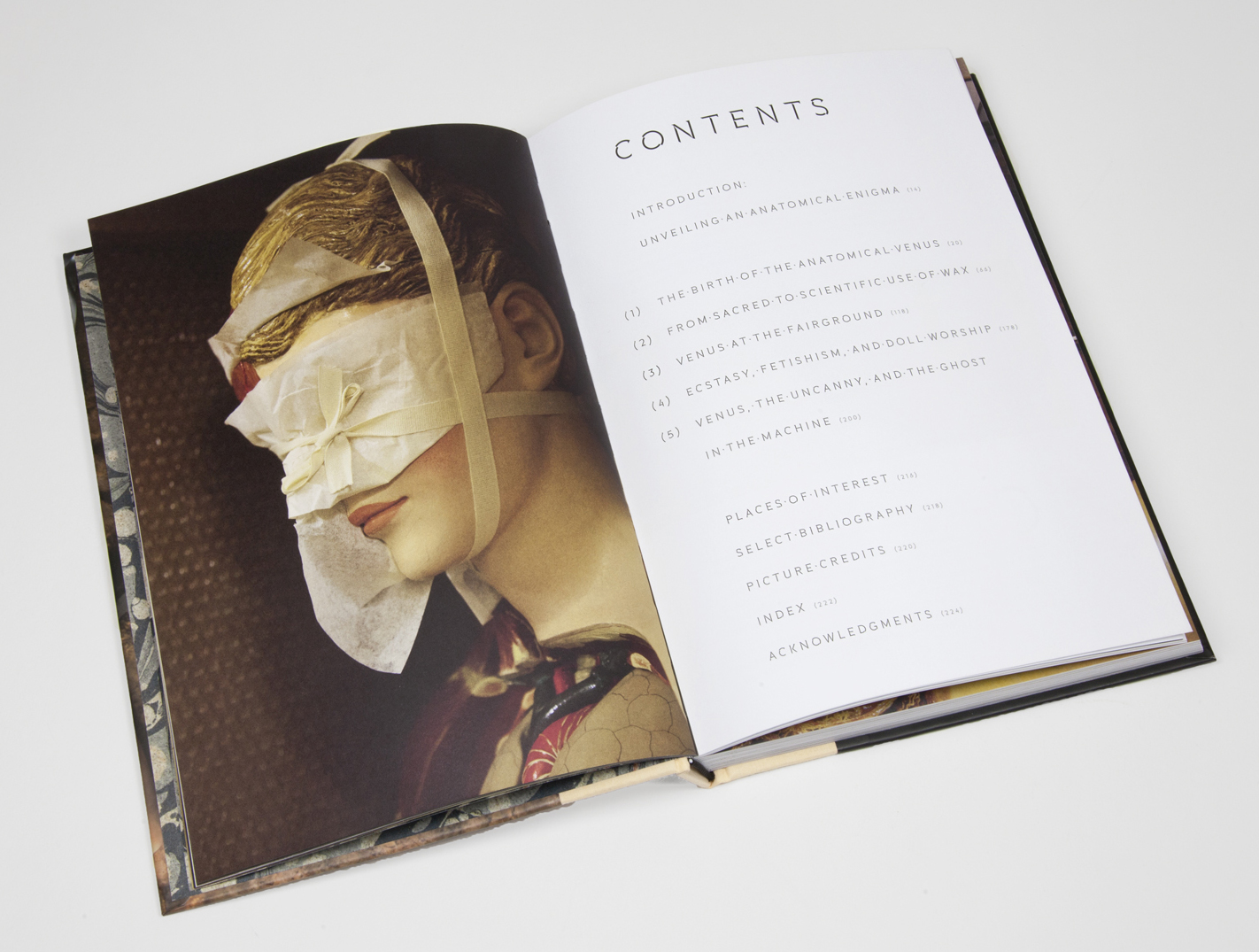
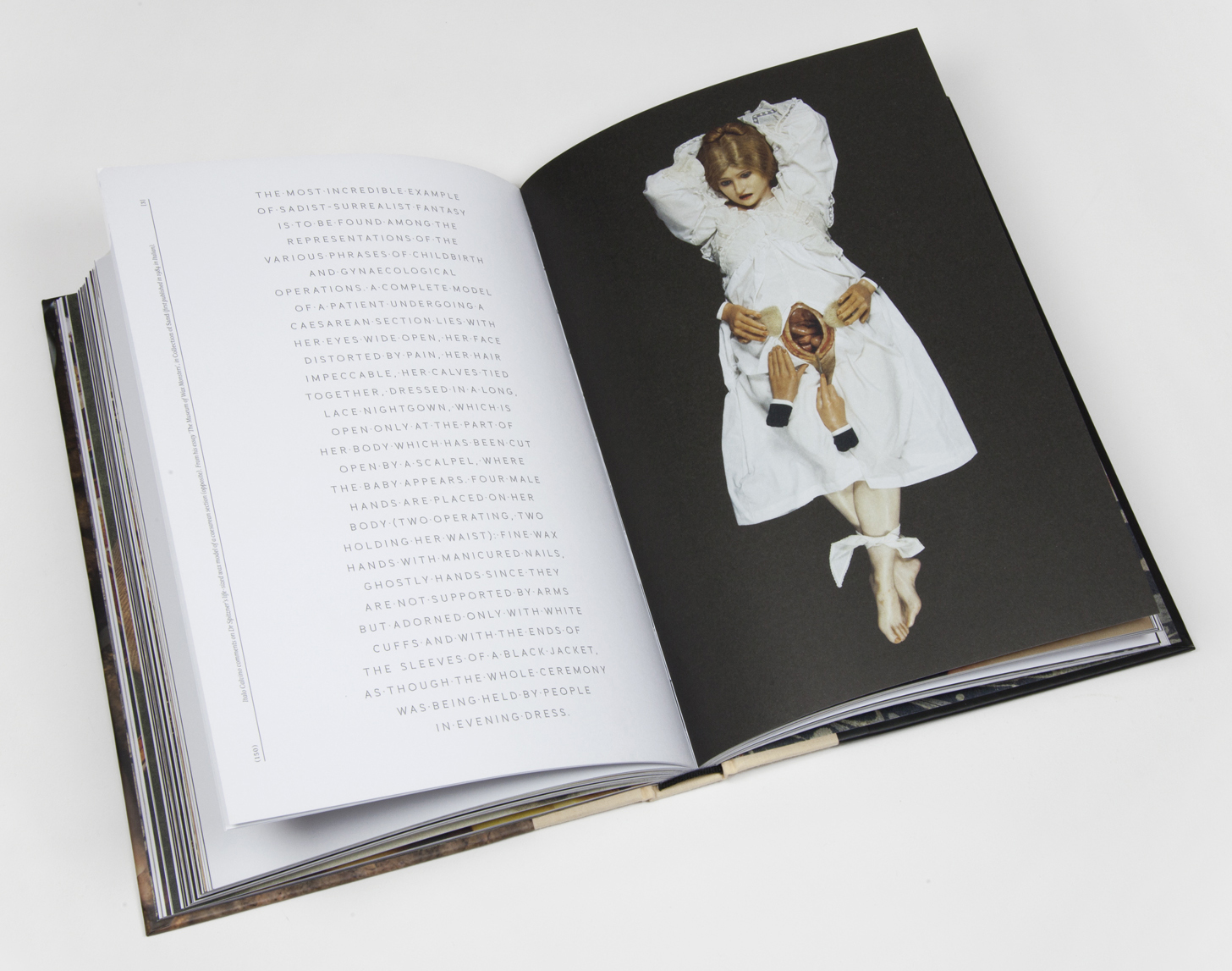
Since that time, the Anatomical Venus has served as both a guide and a muse for the entire Morbid Anatomy project, inspiring research and trips around the world; exhibitions including Exquisite Bodies at the Wellcome Collection; a variety of lectures and articles; and, as of May 24th, a brand new, hardcover, gorgeously designed and lavishly illustrated (see sample page spreads above) 224 page book entitled The Anatomical Venus, published by Thames and Hudson in the UK (top image) and by DAP (second image) in the USA.

The book uses The Anatomical Venus as a point of departure to explore the many paths that lead from her; it situates her within her "historical and cultural context in order to reveal the shifting attitudes toward death and the body that today render such spectacles strange. It reflects on connections between death and wax, the tradition of life-sized simulacra and preserved beautiful women, the phenomenon of women in glass boxes in fairground displays, and ideas of the ecstatic, the sublime and the uncanny."

The full official ad copy for the book follows; stay tuned for information on parties and symposia to celebrate its release taking place in both New York City and London! And, although the book will not be officially released until mid-May, it can be pre-ordered in the USA here, and here for the rest of the world.
Of all the artifacts from the history of medicine, the Anatomical Venus—with its heady mixture of beauty, eroticism and death—is the most seductive. These life-sized dissectible wax women reclining on moth-eaten velvet cushions—with glass eyes, strings of pearls, and golden tiaras crowning their real human hair—were created in eighteenth-century Florence as the centerpiece of the first truly public science museum. Conceived as a means to teach human anatomy, the Venus also tacitly communicated the relationship between the human body and a divinely created cosmos; between art and science, nature and mankind. Today, she both intrigues and confounds, troubling our neat categorical divides between life and death, body and soul, effigy and pedagogy, entertainment and education, kitsch and art.

The first book of its kind, The Anatomical Venus, by Morbid Anatomy founder and Morbid Anatomy Museum co-founder and director Joanna Ebenstein, features over 250 images—many never before published—gathered by its author from around the world. Its extensively researched text explores the Anatomical Venus within her historical and cultural context in order to reveal the shifting attitudes toward death and the body that today render such spectacles strange. It reflects on connections between death and wax, the tradition of life-sized simulacra and preserved beautiful women, the phenomenon of women in glass boxes in fairground displays, and ideas of the ecstatic, the sublime and the uncanny. 

Monday, March 21, 2016

Philippe Curtius' Sleeping Beauty: Breathing 1920s Waxwork Cast from original 1767 Mold; From the Morbid Anatomy Book "The Anatomical Venus"


The Sleeping Beauty, a waxwork whose breast rises and falls ever so slightly, as seen in the video above.

The model pictured here is a 1925 replica cast from his original mold after the original 1767 wax model destroyed in a fire and crafted by Philippe Curtius. Curtius was the uncle (or possibly the illegitimate father) of the Anne-Marie Grosholtz, who would rise to fame as a wax modeller in her own right under her married name Madame Tussaud. 

This piece can still be seen, breathing gently, at Madame Tussaud's in London. In her book Phantasmagoria, Scholar Marina Warner says of this piece: "The illusion of permanent sleep is invoked to deny the reality of death... The Sleeping Beauty functions as anti-memento mori....she promises immortality as the suspension of time."

Find out more in the new Morbid Anatomy book The Anatomical Venus, published by DAP in the US and Thames and Hudson in the rest of the world. You can find out more here.

Wednesday, November 26, 2014

Henry Wellcome's Anatomical Venus: A Missing Link? Guest Post by Joanna Ebenstein for the Wellcome Collection Blog

I was recently invited to select a single object from Blythe House--the storehouse containing the remains of early 20th century pharmaceutical magnate Henry Wellcome's once million strong collection--for an episode of the Wellcome Collection's “The Thing Is…" From the over 100,000 amazing objects in the collection--including ivory anatomical mannequins, wax vanitas busts, antique sexual aids, Greek anatomical otives, torture devices, statues of saints and even a Peruvian mummy--I chose, it will not surprise regular readers to discover, Henry Wellcome's Wax Anatomical Venus (see above).

I had been curious about this enigmatic creature ever since Kate Forde and I featured her in the Wellcome’s 2009 Exquisite Bodies exhibition. Although diminutive--she is only three feet in length while most others are life-sized--she is still an extraordinarily uncanny and charismatic object. She was also a very mysterious object, with very little I could discover, despite my best efforts, about her provenance.

To prepare for this talk--hosted by journalist and historian Frances Stonor Saunders--I delved, with the help of my friend Ross MacFarlane, deeply into the Wellcome Library and its archives to see what I might be able learn about this mysterious artifact.

To read the full report I wrote for the Wellcome Collection blog detailing my findings--and to see many more images, including another animated GIF like the one above, compliments of Russell Dornan!--click here.

Image:
  1. Wellcome Collection’s Anatomical Venus in various stages of dissection as shown in an animated GIF. Courtesy of Wellcome Images.
  2. Catalog card for the Wellcome Anatomical Venus.

Wednesday, December 4, 2013

The Modern Anatomical Venus at Leiden's Museum Boerhaave: Guest Post by Bart Grob, The Boerhaave Museum

Just a few weeks ago, the new exhibition Amazing Models, on the Emotional, Medical and Cultural History of Anatomical Models opened at Leiden's Boerhaave Museum. To commemorate the opening of this incredible looking exhibition, here is a guest post by Bart Grob, conservator and curator at that museum, about the publicity image commissioned by the exhibition seen above (top image):
Is it fashion, is it a glamor, or is it anatomy?
In fact it's all three. This modern day anatomical Venus (top image), in style of the famous anatomical models from the Viennese Josephinum museum (bottom image) is portrait of Dutch actress Georgina Verbaan.
She was photographed by Koen Hauser who has a large interest in anatomy, and is well known for this anatomy series. He combined an image of an original wax model from the Museum Boerhave collections with a glamorous photo of the model, thus reconstructing an image of the time when female anatomical models where not only about the anatomy of the body. Skilled hands of Florentine waxmodellers delivered beautiful, sensual and elegant models of the female body.
Yesterday, the 20th of November, Amazing Models, a new exhibit on the emotional, medical and cultural history of anatomical models, opened to the public at the Museum Boerhaave. To address all these different themes this reconstruction of the anatomical Venus was chosen as image for the publicity campaign. The heyday of spectacular anatomy seem to be back again!
You can find out more about this exhibition, on view until June of 2014, by clicking here. And stay tuned for news of a Morbid Anatomy Museum pop-up event series taking place in partnership with the Boerhaave Museum, the Vrolik Museum and more Netherlands-based institutions, coming soon!

Top image: Fotocredits: Koen Hauser, photography Hair and Make up, Luise van Huisstede, Model Georgina Verbaan

Bottom image: "Anatomical Venuses," Wax Models with human hair in rosewood and Venetian glass cases,The Josephinum, Workshop of Clemente Susini of Florence circa 1780s, Vienna, Austria, from The Secret Museum, by Joanna Ebenstein

Sunday, January 20, 2013

"Ode to an Anatomical Venus," Article, Women's Studies Quarterly, Enchantment Issue


Regular readers of this blog are no doubt already aware of my near-obsession with the "Anatomical Venus," a kind of female wax anatomical model popularized in the 18th century. Over the past six years, I have made it my goal to find and photograph as many of these uncannily amazing pieces as possible (top 8 photos above), and to learn as much as I can about these lovely ladies, the historical moment in which they rose to prominence as the ideal way to illuminate the anatomy of woman for a popular audience, and their artistic and cultural legacy.

I was recently invited to contribute an article on this very topic to Women's Studies Quarterly's special "Enchantment" issue; you can read entire piece by clicking here, and an excerpt here:
Ode to an Anatomical Venus
“The purpose of anatomical images during the period of the Renaissance to the 19th century had as much to do with what we would call aesthetic and theological understanding as with the narrower interests of medical illustrators as now understood. . . They were not simply instructional diagrams for the doctor technician, but statements about the nature of human beings as made by God in the context of the created world as a whole . . . they are about the nature of life and death. . .”
—Martin Kemp and Marina Wallace, Spectacular Bodies
Clemente Susini’s Anatomical Venus, created around 1790, is, the central object of my artistic and scholarly contemplation. She is, in my opinion, the perfect object; one whose luxuriously bizarre existence challenges belief. It—or, better she—was conceived of as a means to teach human anatomy without need for constant dissection, which was messy, ethically fraught, and subject to quick decay. The Venus also tacitly communicated the relationship between the human body and a divinely created cosmos, between art and science, between nature and mankind as understood in its day.

Referred to also as “The Demountable Venus,” this life-sized, dissectible wax woman- -who can still be viewed in her original Venetian glass and rosewood case at La Specola Museum of Zoology and Natural History in Florence, Italy, as well as in a number of other European museums--is adorned with glass eyes and human hair and can be dismembered into dozens of parts revealing, at the final remove a beatific fetus curled in her womb. Her sisters—also anatomical models made under the artistic leadership of Susini, and referred to by such names as “The Slashed Beauty” and “The Dissected Graces” can be visited at a handful of European museums. Supine in their glass boxes, they beckon with a gentle smile or an ecstatic downcast gaze; one idly toys with a plait of real golden human hair; another clutches at the plush, moth-eaten velvet cushions of her case as her torso erupts in a spontaneous, bloodless auto-dissection, another is crowned with a golden tiara, while yet another has a silk ribbon tied in a bow tied around a dangling entrail

Since their creation in late-eighteenth-century Florence, these wax women have seduced, intrigued, and instructed. Today, they also confound, troubling the edges of our neat categorical divides: life and death, science and art, body and soul, effigy and pedagogy, spectacle and education, kitsch and art. They are corporeal martyrs, anatomical odalisques, the uncanny incarnate. These wax models are the pinnacle of “artificial anatomies,” a tradition of three-dimensional, anatomical teaching tools stretching back to the turn of the eighteenth century. The genre came into being around 1700 when Gaetano Giulio Zummo, known as Zumbo accepted the commission of French surgeon Guillaume Desnoues to create a likeness of an important medical dissection that was beginning to decompose. Zumbo was a Sicilian abbot who delighted in the creation of wax miniature series “Theatres of Death” boasting names such as “The Plague” (bottom image) and “The Vanity of Human Greatness,” and featuring exactingly rendered dead and tortured bodies. The product of Desnoues’ and Zumbo’s collaboration was the first wax anatomical teaching model, and established the tradition of an artistic/medical partnership in the creation of such tools.
The Venus and her sisters were intended, from their very conception, not only to instruct, but also to delight and elicit the wonder of a popular audience and, beginning with their public debut in the 1790s, they did just that, attracting throngs of both local Tuscans and visitors on the Grand Tour circuit. Their popularity was so great that they ultimately inspired a series of knockoffs—first a series of similar models by the same workshop for Napoleon and Joseph II of Vienna and, later, in series of models, often advertised as “Florentine” (8th image down) or “Parisian” or even automated breathing Venuses that toured Europe, attracting masses of visitors to the popular anatomical displays found in Europe well into the twentieth century. The uncanny allure of these somnambulant, neither-dead-nor-alive women was not lost on surrealist artists such as Paul Delvaux —who cited his visits to the Spitzner Collection (as seen in his painting "Le Musee Spitzner" of 1943, second to bottom image), with its famous breathing Venus as a life and art-changing moment— and Marcel Duchamp, whose enigmatic peepshow Étant donnés (bottom image) seems to have been inspired, at least in part, by the paradoxes embodied by such figures...
 You can find out more about Women's Studies Quarterly by clicking here and more about the "Enchantment" issue by clicking here. You can read my entire "Ode to an Anatomical Venus" by clicking here.

Please note: this piece could simply not exist without the wonderful work of scholars as Roberta Ballestriero, Alessandro Riva, Lucia Dacome, Kathryn Hoffmann, Ludmilla Jordanova, Martin Kemp and Marina Wallace, Anna Maerker, Rebecca Messbarger, and Roberta Panzanelli. A much more detailed bibliography and list of citations can be found in the article itself. I am entirely indebted to their work in all of my research on this topic.

All images except the bottom four are my own; please click on them to see larger, finer version. Captions, top to bottom:
  1. "Anatomical Venus" Wax wodel with human hair and pearls in rosewood and Venetian glass case, "La Specola" (Museo di Storia Naturale), Florence, Italy; Probably modeled by Clemente Susini (around 1790)
  2. The "Venerina" or “Little Venus” anatomical model by Clemente Susini, 1782, as seen at the Palazzo Poggi in Bologna, Italy. Described on the museum website thusly: "The agony of a young woman is represented in her last instant of life as she abandons herself to death voluptuously and completely naked. The thorax and abdomen can be opened, allowing the various parts to be disassembled so as to simulate the act of anatomic dissection."  
  3. Detail of the ”Venerina" (Little Venus) anatomical model by Clemente Susini, 1782, Palazzo Poggi, Bologna, Italy
  4. Anatomical model by Clemente Susini representing ‘deep lymphatic vessels in a female subject’, human hair, wax, 1794, Museum of the History of the University, Pavia, Italy
  5. "The Slashed Beauty"Wax model with human hair in rosewood and Venetian Glass case; Probably modeled by Clemente Susini (around 1790), “La Specola” (Museo di Storia Naturale), Florence, Italy
  6. "Slashed Beauty" Wax wodel with human hair and pearls in rosewood and Venetian glass case, "La Specola" (Museo di Storia Naturale), Florence, Italy, Probably modeled by Clemente Susini (around 1790)
  7. "Anatomical Venus" Wax wodel with human hair and pearls in rosewood and Venetian glass case, "La Specola" (Museo di Storia Naturale), Florence, Italy, Probably modeled by Clemente Susini (around 1790)
  8. "Anatomical Venuses" Wax models with human hair in rosewood and Venetian glass cases; Workshop of Clemente Susini of Florence, 1781-1786 The Josephinum, Vienna, Austria
  9. Advertisement for display of Anatomical Venus, Wellcome Library
  10. "Le Musee Spitzner," Paul Delvaux, 1943
  11. "Étant Donnés," Marcel Duchamp, 1946–1966, Philadelphia Museum of Art, Philadelphia; Image found here
  12. The Theatre of Death: Plague. Gaetano Giulio Zumbo; 1691-94; sourced here.
  13.  

Friday, October 19, 2012

Ode to Anatomical Waxworks at I09

The website I09 just published a very nice ode to all things Anatomical Wax, drawing heavily from the Morbid Anatomy Archives; Highly recommended! Check it out by clicking here; all images drawn from that post.

Tuesday, July 10, 2012

"Morbid Anatomy: Exploring the Art of Death" OR New Morbid Anatomy Episode of "The Midnight Archive"

Episode 2, Season 2 of The Midnight Archive--that wonderful web-based documentary series centered around Brooklyn's Observatory--has just gone live! Entitled "Morbid Anatomy: Exploring the Art of Death," it features my work with Morbid Anatomy, The Morbid Anatomy Library and the Morbid Anatomy Presents series at Observatory, as well as my work photographing curious collections--public and private, front stage and back--around the world.

To watch the episode, simply press play in the viewer above. More on the episode, in the words of director/creator Ronni Thomas:

It is an honor to present in this episode my friend and a huge inspiration to me - Joanna Ebenstein whose Morbid Anatomy blog (morbidanatomy.blogspot.com) is sort of the online Bible of the macabre and the sublime (making Mademoiselle Ebenstein - as i call her - the Patron Saint of Odd).  Here she discusses the thinking behind her research, her views on death and beauty and the institution she has created.  If you are not already a huge fan - make sure to visit morbidanatomy.blogspot.com AND check out more amazing photography from our girl at astropop.com/secretmuseum and astropop.com/anatomical
For more on the series, to see any of the episodes, or to sign up for the mailing list and thus be alerted to future uploads, visit The Midnight Archive website by clicking here. You can also "like" it on Facebook--and be alerted in this way--by clicking here. If you are interested in medical museums and their curious denezins, be sure to stop by Friday night to grab a drink and see my lecture "Anatomical Venuses, The Slashed Beauty, and Fetuses Dancing a Jig" at Observatory this Friday; more on that can be found here.

Tuesday, February 7, 2012

"Anatomical Venuses, The Slashed Beauty, and Fetuses Dancing a Jig," Morbid Anatomy Lecture, The Velaslavasay Panorama, LA, The Day After Tomorrow!


Just a reminder; for those of you in the greater Los Angeles area,I would love to see you the night after tomorrow at The Velaslavasay Panorama, where I will be giving a lecture entitled "Anatomical Venuses, The Slashed Beauty, and Fetuses Dancing a Jig: A Journey into the Curious World of the Medical Museum." The images above--drawn from my recent photo exhibitions The Secret Museum and Anatomical Theatre--constitute a tiny sampling of the many images I will be showing in the presentation.

Full details follow; very much hope very much to see you there.
Anatomical Venuses, The Slashed Beauty, and Fetuses Dancing a Jig:
A Journey into the Curious World of the Medical Museum
An Illustrated Lecture by Joanna Ebenstein
_______

The Velaslavasay Panorama
1122 West 24th Street, Los Angeles, CA
Thursday, February 9th, 2012 (The day after tomorrow!)
8 o’clock PM
Tickets $10 {$8 VPES Members, Students, Seniors}
Advance Tickets Available here:
http://www.brownpapertickets.com/event/221012

The Velaslavasay Panorama welcomes photographer and researcher Joanna Ebenstein, who will be here Thursday, February 9th at 8 pm to present an illustrated lecture entitled Anatomical Venuses, The Slashed Beauty, and Fetuses Dancing a Jig: A Journey into the Curious World of the Medical Museum. Abounding with images and insight, Ms. Ebenstein’s lecture will introduce you to the Medical Museum and its curious denizens, from the Anatomical Venus to the Slashed Beauty, the allegorical fetal skeleton tableau to the taxidermied bearded lady, the flayed horseman of the apocalypse to the three fetuses dancing a jig. Ebenstein will discuss the history of medical modeling, survey the great artists of the genre, and examine the other death-related arts and amusements which made up the cultural landscape at the time that these objects were originally created, collected, and exhibited.

Joanna Ebenstein is a New York-based artist and independent researcher. She runs the popular Morbid Anatomy Blog and the related Morbid Anatomy Library, where her privately held cabinet of curiosities and research library are made available by appointment. Her work has been shown and published internationally, and she has lectured at museums and conferences around the world. For more information, visit http://morbidanatomy.blogspot.com
Tickets available here. You can find out more about the lecture on Flavorpill and in The LA Weekly. You can find out more about the panorama (one of my favorite spots in LA! highly recommended!) by clicking here.

Images top to bottom, as drawn from my recent photo exhibitions The Secret Museum and Anatomical Theatre:
  1. "Anatomical Venus" Wax wodel with human hair and pearls in rosewood and Venetian glass case, "La Specola" (Museo di Storia Naturale), Florence, Italy, Probably modeled by Clemente Susini (around 1790)
  2. "Slashed Beauty" Wax wodel with human hair and pearls in rosewood and Venetian glass case, "La Specola" (Museo di Storia Naturale), Florence, Italy, Probably modeled by Clemente Susini (around 1790)
  3. "Anatomical Venuses," Wax Models with human hair in rosewood and Venetian glass cases,The Josephinum, Workshop of Clemente Susini of Florence circa 1780s, Vienna, Austria
  4. The Mütter Museum : Philadelphia, Pennsylvania, Pathological model; 19th Century?
  5. Wax Model of Eye Surgery, Musée Orfila, Paris. Courtesy Université Paris Descartes
  6. Wax Anatomical Models in Rosewood and Venetian Glass Boxes, The Josephinum, Workshop of Clemente Susini of Florence circa 1780s, Vienna, Austria
  7. Wax moulages; Probably by Carl Henning (1860-1917) or Theodor Henning (1897-1946); Early 20th Century; Federal Pathologic-Anatomical Museum (Pathologisch-anatomisches Bundesmuseum): Vienna, Austria, Austria
  8. Plaster Models in Pathological Cabinet, The Museum of the Faculty of Medicine at the Jagiellonian University, Krakow
  9. Skeleton and hand models for "la médecine opératoire" Musée Orfila, Paris. Courtesy Université Paris Descartes

Friday, January 13, 2012

"Anatomical Venuses, The Slashed Beauty, and Fetuses Dancing a Jig," Morbid Anatomy Lecture, The Velaslavasay Panorama, Los Angeles, Feb. 9


For those of you in the greater Los Angeles area: I would love to see you next month at at one of my very favorite Los Angeles attractions--The Velaslavasay Panorama--where I will be giving a lecture entitled "Anatomical Venuses, The Slashed Beauty, and Fetuses Dancing a Jig: A Journey into the Curious World of the Medical Museum." The images above--drawn from my recent photo exhibitions The Secret Museum and Anatomical Theatre--constitute a tiny sampling of the many images I will be showing in the presentation.

Full details follow; very much hope very much to see you there.
Anatomical Venuses, The Slashed Beauty, and Fetuses Dancing a Jig:
A Journey into the Curious World of the Medical Museum
An Illustrated Lecture by Joanna Ebenstein
_______

The Velaslavasay Panorama
1122 West 24th Street, Los Angeles, CA
Thursday, February 9th, 2012
8 o’clock PM
Tickets $10 {$8 VPES Members, Students, Seniors}
Advance Tickets Available here:
http://www.brownpapertickets.com/event/221012

The Velaslavasay Panorama welcomes photographer and researcher Joanna Ebenstein, who will be here Thursday, February 9th at 8 pm to present an illustrated lecture entitled Anatomical Venuses, The Slashed Beauty, and Fetuses Dancing a Jig: A Journey into the Curious World of the Medical Museum. Abounding with images and insight, Ms. Ebenstein’s lecture will introduce you to the Medical Museum and its curious denizens, from the Anatomical Venus to the Slashed Beauty, the allegorical fetal skeleton tableau to the taxidermied bearded lady, the flayed horseman of the apocalypse to the three fetuses dancing a jig. Ebenstein will discuss the history of medical modeling, survey the great artists of the genre, and examine the other death-related arts and amusements which made up the cultural landscape at the time that these objects were originally created, collected, and exhibited.

Joanna Ebenstein is a New York-based artist and independent researcher. She runs the popular Morbid Anatomy Blog and the related Morbid Anatomy Library, where her privately held cabinet of curiosities and research library are made available by appointment. Her work has been shown and published internationally, and she has lectured at museums and conferences around the world. For more information, visit http://morbidanatomy.blogspot.com

Tickets available here. You can find out more about the panorama (one of my favorite spots in LA! highly recommended!) by clicking here.

Images top to bottom, as drawn from my recent photo exhibitions The Secret Museum and Anatomical Theatre:
  1. "Anatomical Venus" Wax wodel with human hair and pearls in rosewood and Venetian glass case, "La Specola" (Museo di Storia Naturale), Florence, Italy, Probably modeled by Clemente Susini (around 1790)
  2. "Slashed Beauty" Wax wodel with human hair and pearls in rosewood and Venetian glass case, "La Specola" (Museo di Storia Naturale), Florence, Italy, Probably modeled by Clemente Susini (around 1790)
  3. "Anatomical Venuses," Wax Models with human hair in rosewood and Venetian glass cases,The Josephinum, Workshop of Clemente Susini of Florence circa 1780s, Vienna, Austria
  4. The Mütter Museum : Philadelphia, Pennsylvania, Pathological model; 19th Century?
  5. Wax Model of Eye Surgery, Musée Orfila, Paris. Courtesy Université Paris Descartes
  6. Wax Anatomical Models in Rosewood and Venetian Glass Boxes, The Josephinum, Workshop of Clemente Susini of Florence circa 1780s, Vienna, Austria
  7. Wax moulages; Probably by Carl Henning (1860-1917) or Theodor Henning (1897-1946); Early 20th Century; Federal Pathologic-Anatomical Museum (Pathologisch-anatomisches Bundesmuseum): Vienna, Austria, Austria
  8. Plaster Models in Pathological Cabinet, The Museum of the Faculty of Medicine at the Jagiellonian University, Krakow
  9. Skeleton and hand models for "la médecine opératoire" Musée Orfila, Paris. Courtesy Université Paris Descartes