"Monstrous Antiquities”
Archaeology and the Uncanny in Popular Culture UCL Institute of Archaeology, 1-3 November 2013
Haunted ruins, cursed artefacts, arcane rituals and ambulant mummies:archaeology and the ancient world have provided some of the most effective andubiquitous scenarios for tales of horror and the supernatural. Authors andfilmmakers such as MR James, Bram Stoker and Terence Fisher have drawnheavily upon popular conceptions of both the ancient past and the work of the archaeologist.
This conference aims to study and celebrate this long and productive relationship. We are keen to hear from scholars and aficionados of the fictional world of uncanny archaeology including archaeologists, historians, writers and artists. The programme will include all genres where the ancient meets the ghastly including music, television, literature, film, and art. The conference will be held at UCL on 1-3 November 2013.
Please send abstracts of no more than 200 words to the organisers John Johnston, Gabriel Moshenska and Tina Paphitis at monstrousantiquities [at] gmail.com by 31 August.
Thanks so much to my good friend Betsy Bradley for sending this my way! Click on image to see larger, more readable version.
A new episode of The Midnight Archive--the web-based documentary series centered aroundObservatory--has just been uploaded and can be viewed above. In this episode--entitled "Wax"--we learn about the uncanny waxworks of artist Sigrid Sarda, visit her amazing home studio/private museum, and watch as she launches into a new piece using Midnight Archive director Ronni Thomas as model/subject; fascinating discussions touching on the history of wax, death, magic and The Uncanny ensue. This is one of my favorite Midnight Archives thus far; not to be missed!
The creator of The Midnight Archive--Film-maker and many-time Observatory lecturer Ronni Thomas--says about this episode:
EPISODE 09 - WAX - A long standing obsession of mine has always been wax... I am honored to have someone I genuinely consider a true artist as part of our series - Ms. Sigrid Sarda. From our first meeting I knew we'd have a ton of things to talk about. The charmingly perverse Sarda has taught herself the ancient art of sculpting in wax, and it is every bit as creepy and interesting as you might expect. Her home (where we shot the episode) - is LITTERED with her creations. Its a scene out of one of my all time favorite films "Tourist Trap" minus a creepy cross-dressing Chuck Connors. Take a look at the art behind the wax. Its truly a fascinating medium. And Sig is truly a fascinating artist. Stay tuned, as she is working on a maze called Welcome To Hegemony which is sort of a super speed 'haunted' maze which will feature many of her wax friends - HOPEFULLY including the wax figure she is making of yours truly! Enjoy!
For more on the series, to see former episodes, or to sign up for the mailing list and thus be alerted to future uploads, visit The Midnight Archive website by clicking here. You can also "like" it on Facebook--and be alerted in this way--by clicking here. You can find out more about the amazing work of Sigrid Sarda by clicking here.
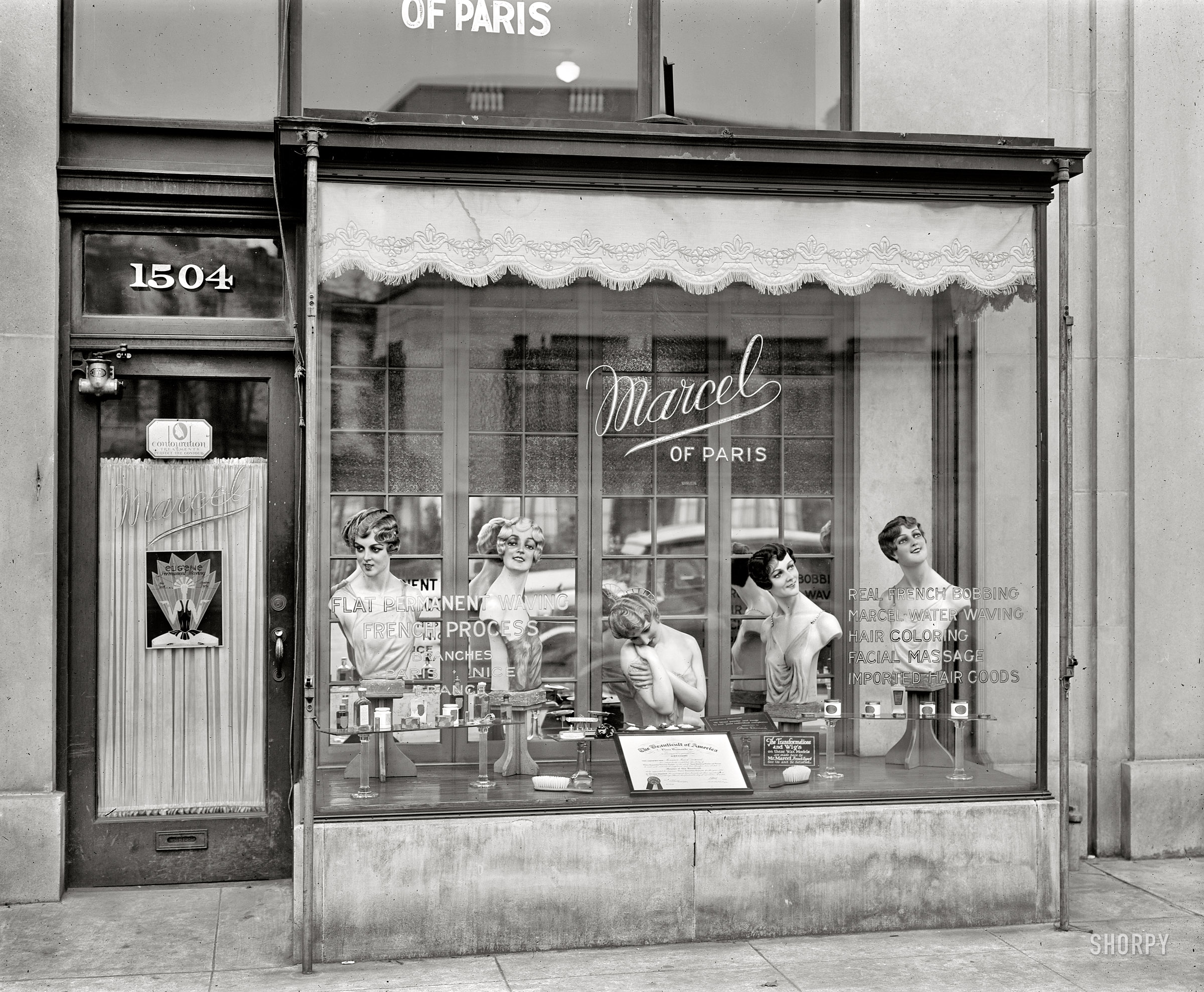
Some more "Tragic Beauties," via Shorpy.com; the caption reads "Washington, D.C., circa 1926. "Marcel Beauty Shop, Connecticut Avenue." Member of the 'Beauticult of America.' H&E glass negative."
Click on image to see MUCH larger and more fantastic version.
I just stumbled upon these lovely and uncanny photographs of early 20th century shop-window mannequins by Barbara Abel. Part of a series she calls "Tragic Beauties," the photos were taken in a a "dimly lit mannequin warehouse in downtown Detroit, [where] they sat, covered in plastic for decades, until a few years ago when they were sold to collectors."
Lovely, wonderful things; can't help but wonder--and not without envy--who are the lucky collectors who ended up with them?
More on the "Tragic Beauties" here. Via, again, the fantastic Wurzeltod, who seemed to have found them on the Marieaunet Blog, from which I sourced the above images. Please click in images to see larger, more-detailed versions.
“I first saw a picture of the anatomical wax model of a woman with pearls in a guidebook on Vienna. She struck a chord in me. I couldn’t stop thinking about her. She seemed to contain all I wanted to say at that moment, about feeling gutted, displayed. Caught as an object of desire and horror at the same time. She also seemed relevant to me in terms of medical history, a gaping example of sexism in medicine. The perversity of those pearls, that long blond hair. I went on with this work even though it is gory and depressing because the images seem to reveal so much.”--Zoe Leonard, Journal of Contemporary Art
You can read the whole article--which investigates the use and meaning of wax anatomical models in the work of contemporary artist Zoe Leonard--by clicking here.
These images are drawn from a large, rather amazing collection of enigmatic vintage photographs found on the Vintage Photo Live Journal page; I urge you to click here to see them all (also, click on images to see larger version). Found via Dream Attack.
One of my favorite contemporary artists, Zoe Beloff, is having an reception for her show "The Somnambulists" at Bellwether Gallery this Saturday night from 6-8 PM. The show itself opens tomorrow, September 2nd, and continues through October 4th. Do not miss this chance to see Beloff's haunting and uncanny work! I had the good fortune to see these works before they went on display, and they were wonderful, in the true sense of the world; her miniature theaters containing what appear to be the ghosts of dead hysterics are some of my absolute favorite pieces of contemporary art ever--they are everything I always wanted art to be and am usually disappointed that it is not.
The Somnambulists is comprised of five hand-painted miniature wooden theaters, into which moving images are projected. The largest of these theaters will house two high-definition 3-D color video projections of vaudevillian musical dramas: A Modern Case of Possession, and History of a Fixed Idea. Shot stereoscopically, the films depict three-dimensional figures, approximately one fifth of human scale, that appear to perform on stage with an effect closer to hallucination than projection. The installation centers on the idea of literally staging the unconscious as a hysterical drama. For these films, Beloff was inspired by several remarkable developments at the end of the 19th century: the discovery of the unconscious by psychotherapists, doctors’ emerging practice of filming their hysterical patients with motion picture cameras, and the public’s fascination with madness which manifested itself in the emotive, hysterical behavior of actors in Parisian cabarets.
Both A Modern Case of Possession and History of a Fixed Idea are based upon 19th century case histories written by the famous French psycho-pathologist Pierre Janet. In each, an actor representing Dr. Janet acts as a kind of narrator, leading us through scenes in which his patients express their delusions through song. Janet realized that his patients’ hysterical attacks provided a window, visual and auditory, into the unconscious working of their minds. Aware that they could neither hear nor speak to him in the throes of their delirium, Janet discovered that he could communicate by entering their imaginary world, as a second actor. It was as if he had walked into their mental theaters and as a master of ceremonies, was able to alleviate the fears that manifested themselves as grotesque, monstrous creatures.
In addition to these films Beloff will present four miniature theaters housing depictions of actual hysterics filmed by doctors in Belgium, Romania, and the United States. Updating a Victorian stage trick called “Pepper’s Ghost”, Beloff has transformed these patients into ghostly figures performing an endless loop of madness within the space of each diorama. Beloff will also display a new print which contains her illustrations of the theaters and various players, and outlines the acts and scenes of History of a Fixed Idea.
Beloff’s book, The Somnambulists: A Compendium of Source Material, which was published by Christine Burgin and includes a DVD, points to the complex interweaving of concepts from psychology, literature, performance, visual art, and moving-image technology at the turn of the last century. The text begins with an introduction to the “players”, with brief biographies of the scholars, artists, and performers who appear within the volume. Acting as a kind of index to Beloff’s artistic pursuits, her book provides an in-depth understanding of the range of ideas that form the basis of this exhibition.
Find out more about the show here. Find out more about Beloff's work here.