Showing posts with label model. Show all posts

Sunday, July 10, 2011

Cabinet Cards / Storydress II, Albumen Print Photographs of Life-size Paper Mache and Plaster Sculpture, Christine Elfman, 2008


Cabinet Cards / Storydress II

albumen prints from wet-plate collodion negatives
4.25 x 6.5 inches, series of 5 mounted on cabinet cards
6.5 x 8.5 inches, series of 10 framed
2008

Storydress II is a series of photographs of a life-size paper mache and plaster sculpture. The dress is made of paper mache stories that I recorded of my great-grandmother’s autobiographical reminiscences. Each photograph contains legible words. The sculpture was photographed with the wet-plate collodion negative process, printed on handmade gold-toned Albumen paper, and burnished onto antique Cabinet Card mounts. For exhibition the cabinet card photographs are displayed using an antique wooden Graphoscope (magnifying device) and shelf.

Finding unknown relatives in my family photograph collection, and noticing old photographs of anonymous people in antique stores, I was taken by how many people were forgotten regardless of photography’s intention to “Secure the shadow, ‘ere the substance fades away.” The older the picture, the more forlorn the subject appeared to me. Holding their image, I was impressed with their absence. Storydress II tries to show this underlying subject of photographic portraiture. The 19th century cabinet card is turned inside out, revealing the presence of absence in a medium characterized by rigid detail and anonymity. The figure of reminiscence, cast in plaster, parallels the poetic immobility of the head clamp, used in early photography to prevent movement during long exposures, aptly defined by Barthes as “the corset of my imaginary existence”. The life size cast figure wears a paper mache dress made of family stories: recorded, torn up, and glued back together again. The tedious processes involved in making both the subject and photograph are offerings to time’s taking.
I really, really love this piece--which uses as its base a life-size paper mache and plaster sculpture!--and encourage you to visit Christine Elfman's website and click on "view close up here" to appreciate it fully. Or click on image to see a pleasing larger version.

Via Foxes in Breeches.

Friday, November 21, 2008

"Making Visible Embryos," University of Cambridge Online Exhibition


Nick Hopwood of the University of Cambridge just sent me a link to a wonderful new online exhibit about the history of visualizing the human embryo, produced by Tatjana Buklijas and himself with support from the Wellcome Trust. The web exhibition is both broad and specific in its approach. As the website explains:

Images of human embryos are everywhere. We see them in newspapers, clinics, classrooms, laboratories, family albums and on the internet. Debates about abortion, assisted conception, cloning and Darwinism have sometimes made these images hugely controversial, but they are also routine. We tend to take them for granted today. Yet 250 years ago human development was still nowhere to be seen.

Developing embryos were first drawn in the eighteenth-century Enlightenment. Modern medicine and biology exploited technical innovations as pictures and models communicated new attitudes to childbirth, evolution and reproduction. In the twentieth century they became the dominant representations of pregnancy and prominent symbols of hope and fear. Wherever we stand in today’s debates, it should enrich and may challenge our understandings to explore how these icons have been made.

The "Making Visible Embryos" web exhibit approaches a complex, wide-spanning subject engagingly and clearly without ever oversimplifying the subject matter. It is well-designed with heavily (and beautifully) illustrated pages (see above; visit the website to find out more about each image.)

The exhibit deftly explores the changes in metaphor, imagery, and understanding of the mysterious and centuries-hidden embryo, from speculative, religiously influenced illustrations of the 1300s to the modern day ultrasound. It also touches on popular debates about embryology, uses of the embryo in the fine arts, the history of (and uses of) illustration and modeling of the embryo, and contemporary controversies surrounding the embryo in the 21st century.

All in all, a fascinating treatment of a complex subject, beautifully designed, thought-provoking, and chock-full of resources and source information; this web exploration takes a subject we take for granted and examines the specific thinkers, physicians, artists, and medical and artistic advances that have quietly influenced our contemporary understanding and visualization. A real pleasure! I highly recommend you visit the website to see for yourself; you can do so by clicking here.

Monday, July 21, 2008

"Lessons in Anatomy Made Easy: Anatomical Models in Scientific and Cultural Context," Conference, 2008


The Museum Boerhaave in Leiden, The Netherlands, is hosting an international conference on anatomical models in historical and cultural context. The conference will be held on November 6th and 7th, and abstracts (if you're interested in presenting a paper) need to be submitted by August 1. The website is interested in submissions from historians of science, art historians and conservators with an interest in anatomical models, whether made from wax, plaster, papier-mâché or glass.

More information here. Via Biomedicine on Display.

Image from Anatomical Theatre exhibition.

Wednesday, April 16, 2008

Florentine Anatomical Venus in Rare American Appearance!


The Getty Villa in Malibu, California has an interesting show up called "The Color of Life: Polychromy in Sculpture from Antiquity to the Present." The exhibition showcases the many ways artists have used color in figural sculpture for centuries, and, to my excitement, includes an actual Anatomical Venus from the famed La Specola collection in Florence!

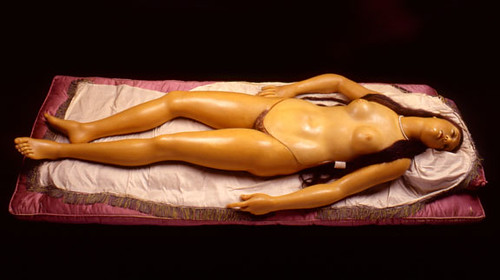
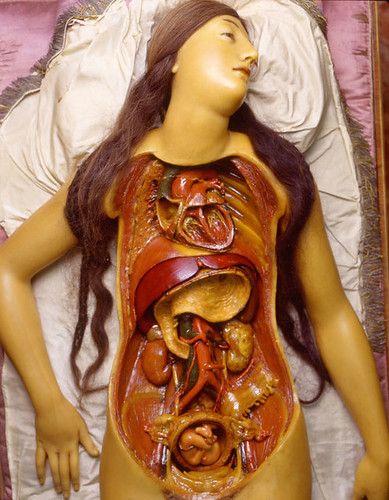
Anatomical Venuses are life-sized wax anatomical models of idealized women, extremely realistic in appearance and often adorned with real hair and ornamental jewelry. These figures consist of removable parts that can be "dissected" to demonstrate anatomy-- a breast plate is lifted to reveal the inner workings of the mysterious female body, often with a fetus to be found nestling in the womb (see before and after above). This was a way to share anatomical discovery with a larger audience without the need for an actual human dissection.

Anatomical Venuses are probably the most historically popular form of anatomical models; in the 19th-Century, they were the centerpiece of museums and itinerant shows of all kinds, and possessed great power to draw crowds. The 18th-Century Florentine Venuses are the best remembered today, in no small part due to Taschen's Encyclopaedia Anatomica,and are considered, by some, to be the finest examples of Anatomical Venuses known to exist.

This Anatomical Venus featured in the Getty show, completed in 1782 by Clemente Susini and his workshop, is truly a masterwork of the genre, and outshines the many copies held by medical museums throughout Europe who, impressed by the veracity and workmanship of the Florentine Venuses, commissioned their own from Susini's workshop. For example, the core of the collection of the Viennese Josephinum Museum consists of 1192 models commissioned by Emperor Joseph from the Susini workshop in 1784 for the training of his military doctors. As a body of work they are interesting, but somehow the models in this collection pale in comparison to the La Specola models. The workmanship is a bit shoddier, the visages a bit less alluring.

The Anatomical Venus exhibited in the Getty exhibition is one of the finest, and almost never leaves her home in Florence--she has only been transported twice in her long history, and even has a specially-built traveling case to protect her delicate wax body. This means that, sadly, you will not see her in her original setting--an elegant rosewood and Venetian glass case-- but the relative accessibility of the piece (i.e. in the United States) should make up for this lack.

It is really great to see anatomical models being seriously approached as artwork in an exhibition of this sort; I consider it a bold move on the part of the curators, and cannot help wondering what strings the curators had to pull in order to acquire one of these rare and fragile Venuses on loan. It is also nice to see that, in reviews of the show, the Venus seems to be a real standout. This supports my belief that, if more people knew of these Venuses and other anatomical models, they would be seen as intriguing artworks and cultural documents, worthy of a greater amount of study as well as inclusion in the medical art canon.

From the UCLA paper The Daily Bruin:
The two most impressive pieces of the whole exhibition, which may please even marble lovers, both shock and fascinate at the same time. One of them is an 18th-century wax model of a nude life-size woman called the “Anatomical Venus,” which shows the multicolored exterior and interior of a female body with an almost uncanny precision.

And from the LA Times review of the show:
The strangest, without a doubt, is an 18th century wax figure known as the "Anatomical Venus": a comely young woman, life-sized and nude, lying prostrate on a pink silk cushion in what looks to be a state of sensual rapture, her torso flayed and all her glistening organs -- including a womb containing a tiny fetus -- revealed. Her long brown hair is real, her eyes are open and unfocused, and the cloth of her pillow is crumpled -- she might as well be writhing. The product of one sculptor's clearly intimate experience with cadavers, she suggests an Enlightenment-era St. Teresa ravished by communion with the invisible forces of science.


To learn more about the show, which runs until June 23 of this year, visit the exhibition website, complete with gallery slideshow. Better yet, visit the show in person if you are able. This might be your only chance EVER to see an Anatomical Venus of this quality without traveling to Florence. To see more images of Anatomical Venuses and other anatomical models, see the Anatomical Theatre Gallery. To learn more about medical models, see Susan Lamb's An Analysis of Anatomy Models and A. W. Bates' abstract for Anatomical Venuses: The Aesthetics of Anatomical Modeling in 18th- and 19th-Century Europe. You can also see the Venus in all states of metaphorical undress in Taschen's Encyclopaedia Anatomica.

Thanks to the Getty for supplying the above images and answering my barrage of questions. Photographs of the Anatomical Venus by Saulo Bambi, Museo di Storia Naturale "La Specola"; Florence, Italy

And if any Morbid Anatomy readers are in the Los Angeles area and could take a photo of the model in context of the show and send me a copy, I'd very much appreciate it.

Saturday, April 5, 2008

Anatomie Modèle Femme (1937)


From the wonderful ephemera collection showcased on the Agence Eureka blog.

Thursday, March 13, 2008

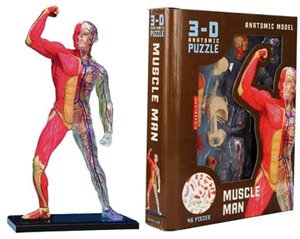
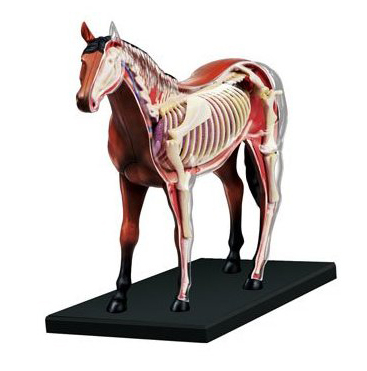
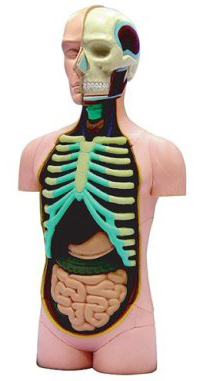
Kikkerland Design Anatomical 3D Puzzles


The enigmatic Kikkerland Design has produced a slew of 3D puzzles of anatomical models (is that the way to word it?), among other odd and intriguing things. I think I want the horse...

Check out the complete Kikkerland collection here. Visit their website here.

Oh! Just heard from the Kikkerland folks themselves, who have informed me about places in NYC where you can purchase these puzzles: MXYPLYZYK, EXIT 9 and what is possibly my favorite place in the world (and where I spend much of my time as a volunteer)--the American Museum of Natural History.