

The delightful Eric Huang (aka dinoboy) recently paid a visit to a theme park which quite simply defies imagination: Tiger Balm (Haw Par) Gardens of Hong Kong. This attraction, built in 1937, is a sort of theme park filled with tableaux illustrating Buddhist and Chinese mythology. The highlight: a depiction of "The Ten Courts of Hell" and the punishments enacted there.
Eric kindly agreed to write a guest post for the readers of Morbid Anatomy about this amazing place, which follows; all photos above are also his own!
Eric kindly agreed to write a guest post for the readers of Morbid Anatomy about this amazing place, which follows; all photos above are also his own!
I heard about the Tiger Balm Gardens whilst visiting a friend in Hong Kong. The park near where she grew up was once one of three gardens built by the heirs to the Tiger Balm fortune, brothers Aw Boon Haw and Aw Boon Par. Only the Singapore garden, called Haw Par Villa after the brothers - exists today. The park in the Fujian province of China was never completed, and is now a museum. The Hong Kong gardens closed in 2004, though the mansion where Aw Boon Haw lived has been preserved.
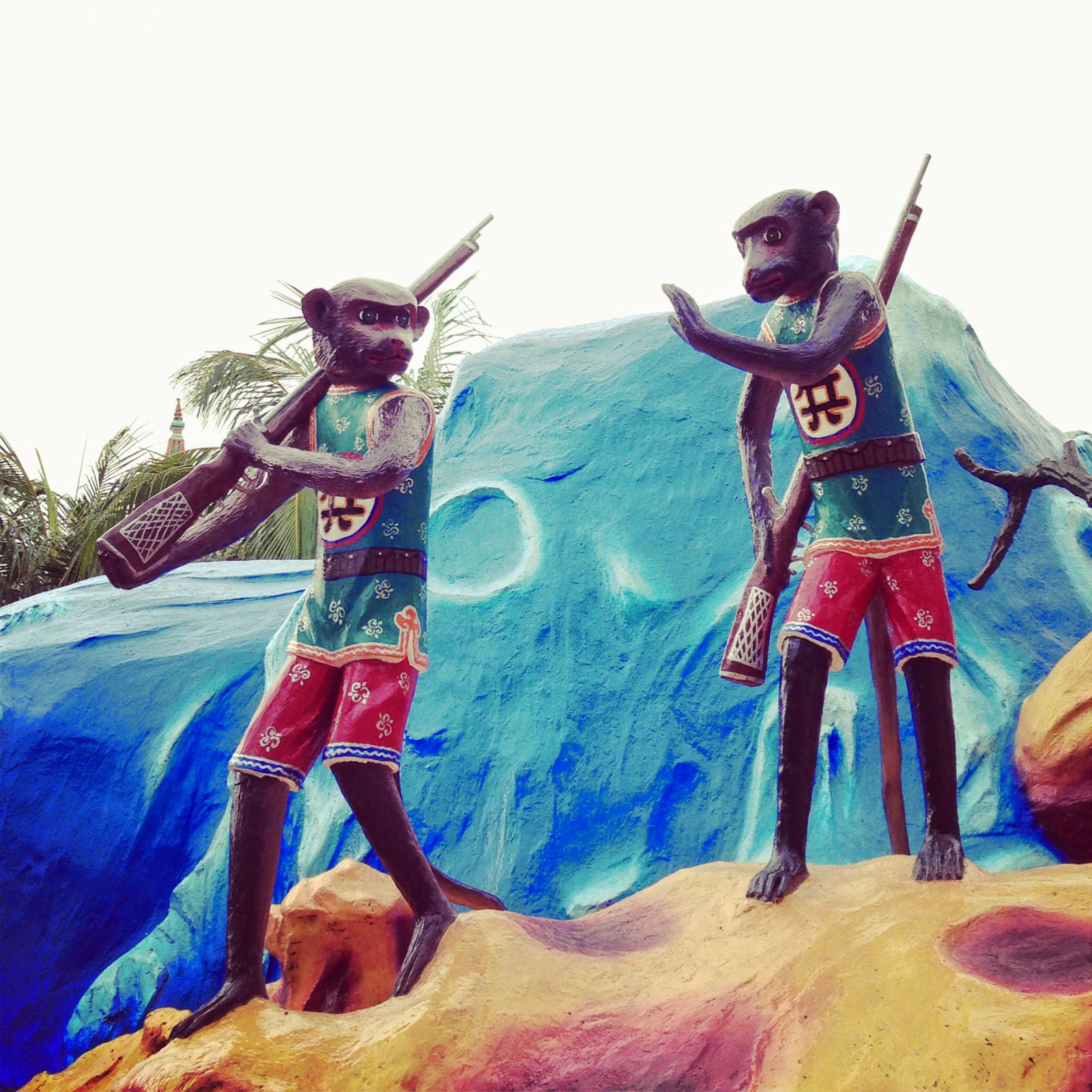
What a garden Haw Par is! Roughly the size of Fantasyland at the Disney theme parks, the attraction built in 1937 is a maze of grottoes, monuments, and tableaux of Buddhist morality and Chinese mythology. Many will likely recognize Monkey from the Buddhist legend, Journey to the West, that spawned numerous TV series and films as well as the Damon Albarn musical/opera, but the familiar bits are the least interesting.
Human-beast hybrid monsters abound, mainly aquatic: yes there are mermaids, but also scallop shell ladies, crab women, manta ray men, fish dudes – and all are angry, in mid-battle wielding feudal and magical weapons, seducing silly humans, and cavorting with any thing – living or otherwise - nearby. Most are players in epic legends involving the gods and their loves, jealousies, and savage revenge on each other and on helpless (but hot) humans.
There’s also a giant wall depicting the sins of urban life: dancing to gambling to liquor and loose women. Scenes of good deeds and piety mirror the sinful acts. The park opposite the wall is an odd assemblage of anthropomorphic animals, a giant gorilla family, frogs riding ostriches, and a load of Australian animals: kangaroos, koalas, and emus.
The very, very best attraction at Haw Par Gardens is undoubtedly the Ten Courts of Hell. The entrance is a park-like path lined with decapitated heads. It’s clear you’re about to enter something nasty – very Temple of Doom. The tableau nearby depicts a brutal war between rats and squirrels!
The Courts themselves are set inside a dark and appropriately hot – tropical, humid, Singapore hot – cave guarded by Ox-Head and Horse-Face, escorts of Hell. Don’t let their names fool you into thinking they’re funny circus animals. Ox-Head and Horse-Face chase newly arrived souls into Hell with a steel spear and an ivory stick.
Once inside the cave, the exhibit leads visitors through the process of judgement, sorting, punishment, and finally redemption through reincarnation. Each Court in Hell punishes those guilty of particular crimes. Many crimes have the same punishment. For example, in the Third Court of Hell, the following crimes are judged and punished:
Ungratefulness, Disrespect to elders, Escaping from prison = Heart cut out.
Drug addiction and trafficking, Grave robbing, Seducing people into a life of crime, Creating social unrest = Tied to a red-hot copper pillar and grilled.
To the modern visitor and unbeliever, the crimes and punishments are unlikely to make any logical sense. Money lenders with exorbitant interest rates face being thrown onto a hill of knives – quite right! The misuse of books and wasting food are both punishable by having your body sawn in two – not at the waist, but down your body in a lateral cut.
But fear not, even the most heinous of crimes – disobeying your siblings, for example – are eventually forgiven. Once souls have been punished for the prescribed length of time, they are led through the Pavilion of Forgetfulness where a draught of magic tea administered by an elderly woman named Men Po causes all to forget their past life. Then it’s off to Samsara and the Wheel of Incarnation. Depending on the crimes committed in the past life and the punishment meted out, the soul will be reincarnated either as an invertebrate, a sea creature, a land animal (mammal), a flying creature, someone poor or foreign, or Han Chinese nobility – in that order.
The Courts are beautifully gruesome and very camp at the same time. It’s worth it to go to Singapore just to see the Courts of Hell themselves. Sadly the gift shop was closed when I visited. I can only imagine the souvenirs I might have purchased. Maybe this is the just one of the punishments I deserve for my crimes …