Showing posts with label music. Show all posts

Wednesday, November 12, 2014

The Rise of--and Hysteria Related to--The 1960s "Death Disc": Guest Post by Eric Huang, Morbid Anatomy Foreign Corespondent

 
In the following guest post, Morbid Anatomy foreign corespondent Eric Huang reports on the little-remembered phenomenon--and hysteria related to--the 1960s "death disc," or songs in which the love interest dies "due to a lovers’ spat, jealousy, a cruel twist of fate, or suicide."

Just a few well known examples of "death discs"--which spanned such genres as rock, Motown and country and western--are "Leader of the Pack" by The Shangri-Las (1965); "Ode to Billie Joe" by Bobby Gentry (1967); "Tell Laura I Love Her" by Ray Petersen (1960); and "Teen Angel" by Mark Dinning (1960).

Following is the full and fascinating story, along with videos of ten of the best remembered "death discs." Thanks, Eric, for this excellent report!

THE RISE OF THE DEATH DISC

In the 1960s, there was a trend in popular music dubbed, ‘death discs’ or ‘splatter platters.’ All were songs about love-lost in which the protagonist – often male and almost always named Johnny or Tommy – dies due to a lovers’ spat, jealousy, a cruel twist of fate, or suicide. The girl in the song is usually the one at fault. It’s her honor that he protects to the death, her infidelity/ambivalence that leads to his demise.

On a recent BBC documentary about songs banned in the UK, historians described how death discs were new outlets for women, finally able to sing about their tormented modern lives. The songs reflected a rejection of 1950s morality by a new generation, but it wasn’t a pretty picture: those who didn’t obey the rules always met with death. Jim Stark, James Dean’s character in ‘Rebel without a Cause’ (1955), is a prime example - as are Romeo and Juliet, who were resurrected in Franco Zeffirelli’s award-winning box office smash in 1968. This sexed-up adaptation of the Shakespearean tale had all the ingredients of an archetypal death disc tragedy: youth, rebellion, passion, death.

The plane and car crashes that ended many teen celebrities’ lives from the 50s onwards were a massive influence on this morbid music trend. Sports cars, motorcycles and high-flying airplanes represented another new way of life, one that was too fast for many. Death discs were about losing lovers in exactly this way: tragically in crashes just before a wedding day or right after a warning to be careful. The death disc hit, ‘Three Stars’, by Tommy Dee was about the very plane crash that killed Ritchie Valens, The Big Bopper and Buddy Holly in 1959.

Death discs spanned genres: from rock and roll to Motown to country and western. But the most popular death disc of all was ‘Leader of the Pack’ by the Shangri-Las. Singer Mary Weiss laments the tragic story of her hot-blooded biker boyfriend. They were deeply in love, but she bowed to societal pressure to ‘find someone new.’ Moments after breaking up, a fatal crash ends his life. So popular was this song about teenage death, that it toppled the Beatles from the US charts!

The popularity of death discs shocked the establishment. Journalist Alexandra Apolloni describes Seventeen magazine’s condemnation of these morbid songs:
A 1965 editorial made it clear that good Seventeen readers shouldn’t be listening to death discs: “I expect the Johnny Mathis version of ‘Wonderful Wonderful’ to live considerably longer than the Shangri-Las’ gory ditties about motorcycling or hot-rodding death scenes."
Nevertheless, ‘Leader of the Pack’ and numerous songs like it flourished in the 1960s. The music industry cashed in on a never-ending obsession with untimely death, turning young idols like James Dean and Marilyn Monroe – later Jimmy Hendrix, Ian Curtis, Kurt Cobain, Amy Winehouse - into immortals.

Here is a playlist of ten 1960s death disc faves:

"Leader of the Pack" by The Shangri-Las (1965)


"Condition Red" by The Goodees (1968)


"Teen Angel" by Mark Dinning (1960)


"Tell Laura I Love Her" by Ray Petersen (1960)


"Patches" by Dickie Lee (1962)


"Johnny Remember Me" by Johnny Leyton (1961)


"Ode to Billie Joe" by Bobby Gentry (1967)


"The Hero" by Bernadette Carroll (1965)


"Ebony Eyes" by The Everly Brothers (1961)


"Car Crash" by The Cadets (1960)


Friday, May 11, 2012

Mermaid Polka, Sheet Music,1850

I love these delectable creatures of the nautical sublime, especially their seaweed bracelets and headdresses. As described on the Beauty, Virtue and Vice online exhibit of the American Antiquarian Society website (from which the images is also sourced):
Mermaid Polka. Lith. of Napoleon Sarony, 1850. [H. D. Hewitt]

In the nineteenth century, informal musical entertainments were a very common American pastime, and the piano was a common presence in American parlors. The piano’s rise in popularity coincided with advances in printing technology, and a booming sheet music industry was one result of these simultaneous developments.

American consumers purchased particular pieces of music for various reasons. Certainly, popular songs of the American musical stage became bestselling sheet music, but it is clear that sheet music publishers recognized that American consumers would buy even unfamiliar music if the cover art was appealing enough. Pictorial sheet music covers did double duty within the household: displayed above a keyboard even when a piano wasn’t in use, they functioned as decorative art.

Nineteenth-century pictorial sheet music covers capitalized on an endless array of already popular subjects, ideas, and themes in order to capture buyers’ attention. Over the course of the nineteenth century, sheet music images of beautiful women remained the most consistently popular type of illustration. In Mermaid Polka, these nude and loosely robed young women are graceful, demure, and carefree. They embody various ideas about women’s nature, with a titillating erotic accent. This lavish visual fantasy of beautiful young sea nymphs frolicking in the moonlight was meant to appeal to a wide variety of potential buyers. While women and men alike might have enjoyed this image for its pictorial beauty and expression of innocent romantic pleasure, men might also have associated it with antebellum dancing-girl performances (which were enjoyed by overwhelmingly male audiences) and European paintings like Botticelli’s celebrated fifteenth-century work, The Birth of Venus.
More here. Click on image to see much finer, larger version.

Friday, January 13, 2012

Gabba Gabba Hey! Ramones Night at Observatory TONIGHT, Friday January 13 at 8:00


Tonight at Observatory! Hope to see you there.

Gabba Gabba Hey! Ramones Night at Observatory
A screening of End of the Century: The Story of the Ramones
out-takes and Q&A with filmmakers Jim Fields, Michael Gramaglia and John Gramaglia
Date: Friday, January 13th
Time: 8:00 PM
Admission: $8
Presented by Morbid Anatomy

In 2003, the documentary End of the Century: The Story of the Ramones was released to great critical and popular acclaim after much legal finagling with The Ramones and their managers. On Friday the 13th of January, join the team behind the film--directors Jim Field and Michael Gramaglia and editor John Gramaglia--for an evening that takes up where the film left off. The night will feature screenings of numerous out-takes from the film, as well as anecdotes about the trials and tribulations of getting the film made. Following that, the team will take questions from the audience.

Jim Fields is a doc filmmaker and co-director of "EOTC" with Michael Gramaglia. He's currently a staff video journalist for Time.com.

Michael Gramaglia is a filmmaker living in Queens. His current project is a feature film about Graham Parker.

John Gramaglia is a freelance editor for documentaries and TV commercials.

More on Observatory can be found here. To sign up for events on Facebook, join our group by clicking here. To sign up for our weekly mailer, click here.

Wednesday, March 30, 2011

The Lennon Sisters singing Dry Bones, The Lawrence Welk Show, 1965


Thanks so much to Salvador Olguin for drawing this wonderful video to my attention! I simply cannot stop watching it.

Monday, February 21, 2011

"Carmina Burana" and Carl Orff's "Theatrum Mundi," 1936


I have always loved the music of Carl Orff's scenic cantata Carmina Burana, but until I saw the above video clip on the Cosmodromium Blog, I had no idea that the music was only a small part of Orff's overall theatrical conception, or the fascinating story of the source material which inspired the piece.

Carl Orff's Carmina Burana was completed in 1936 and premiered to great acclaim in Nazi-era Frankfurt in 1937; it was based on a manuscript of 254 medieval poems and dramatic texts written by students and clergy--many with a decidedly satirical tone towards the Catholic Church--that was uncovered at a Benedictine monastery in Bavaria in 1803.

The poems are mainly songs of morals and mockery, love songs, and drinking and gaming songs with additional songs of mourning, as well as "a satire, and two educational stories about the names of animals..." Within the collection are also descriptions of a raucous medieval paradise in which "the rules of priesthood include sleeping in, eating heavy food and drinking rich wine, and regularly playing dice games."

Carl Orff 's original conception of the staged Carmina Burana (as so provocatively shown above) included elements of dance, masks and costume, set design, and dramatic acting in a kind of theatrical gestalt he termed "Theatrum Mundi," a theatrical conception in which music, movement, and speech were all equal and essential pieces of a whole.

The movement you see above--drawn from a 1975 version Carmina Burana directed by Jean-Pierre Ponnelle--is entitled "O Fortuna" ("Fortuna Imperatrix Mundi"); it is the best known segment of Carmina Burana and it both begins and ends the piece. Lyrics follow, in English translation from Wikepedia:
O Fortune,
like the moon
you are changeable,
always waxing
or waning;
detestable life
now difficult
and then easy
deceive a sharp mind;
poverty
power
it melts them like ice.

Fate—monstrous
and empty,
you whirling wheel,
stand malevolent,
vain health
always dissolves,
shadowed
and veiled
you plague me too;
now through trickery,
my bare back
I bring to your villainy.

Fate, in health
and in virtue,
is now against me,
affection
and defeat
always enslaved.
So at this hour
without delay
pluck the vibrating string;
since Fate
strikes down the strong,
everyone weep with me!
You can find out more about this amazing performance--directed by Jean-Pierre Ponnelle for Munchner Rundfunkorchester Chor des Bayerischen Rundfunks and conducted by Kurt Eichhorn in West Germany--here and can purchase a copy by clicking here. You can watch much of the production--albeit in pixelated form--by clicking here.

Information via Wikipedia, 1 and 2; clip via Cosmodromium.

Tuesday, March 30, 2010

Observatory's First Birthday and Lecture, this Thursday, April Fools Day!


This Thursday, April 1st (April Fools Day! Yes, we know, and no, this is not a trick!) we at Observatory will be celebrating our 1st birthday with a party and a lecture. Come early--the evening will begin at 7:00--to enjoy DJ Davin Kuntze spinning 78s on his Victrola and your first glass(es) of wine. At 8, we will file into Observatory for David Suisman's lecture "The Birth of the Music Industry: Phonographs, Song Factories, and the Selling of Sound" (see below for details). Stick around for the free after-party, and enjoy DJ Platterhead (aka music journalist John Swenson) spinning from his incredible collection of 45s. And, of course, there will be drinks. Many of them.

Hope to see you there!
The Birth of the Music Industry: Phonographs, Song Factories, and the Selling of Sound
A reading and illustrated lecture by David Suisman, followed by Observatory's 1st birthday party celebration!
Date: Thursday, April 1 (April Fools Day. Yes, we know!)
Time: 8:00 PM (Music and drinks begin at 7:00 PM)
Admission: $5


***Happy First Birthday, Observatory! To celebrate, come early (7:00 PM) and enjoy antique melodies played at 78 rpm on DJ Davin Kuntze's old Victrola, accompanied by drinks. Following the lecture, please join us for a party featuring drinks, snacks, and the sound stylings of DJ Platterhead (aka music journalist John Swenson), spinning vintage 45s from his own collection. Admission to party is free. Please Note: This is NOT an April Fools prank. There will really, truly be a party! And a lecture. Hope to see you there.

We are immersed in music. We hear it virtually everywhere, from cars to restaurants to airports, not to mention the mobile sounds that reach our ears via iPods and ringtones. This is not a “natural” state of affairs, a simple by-product of people’s love for melody. Rather, this musical culture was created a century ago, David Suisman will show, when the modern music industry took shape. From Tin Pan Alley to grand opera, player-pianos to phonographs, the rise of the music business lay the foundations of today’s aural world and produced many of the ideas and assumptions we hold about music today.

In his acclaimed new book Selling Sounds: The Commercial Revolution in American Music, Suisman explores the formation in the early twentieth century of a radically new musical culture, driven by new products, technologies, and commercial strategies to incorporate music into the daily rhythm of modern life. Popular songs filled the air with a new kind of musical pleasure, phonographs brought opera into the parlor, and celebrity performers like Enrico Caruso captivated the imagination of consumers nationwide. In tonight’s lecture and reading, Suisman will uncover the origins of this new kind of culture industry and chronicle how music ignited an auditory explosion that still reverberates today.

***

David Suisman’s first book Selling Sounds: The Commercial Revolution in American Music was published in 2009 by Harvard University Press. It appeared on numerous year-end Top Ten lists and was named a Choice Outstanding Academic Title of 2009. He is also co-editor (with Susan Strasser) of Sound in the Age of Mechanical Reproduction (University of Pennsylvania Press, 2009). His articles have appeared in The Believer, Social Text, the Journal of American History and other publications. He is also an occasional disc jockey at WFMU and an assistant professor of history at the University of Delaware. He lives in Philadelphia.
You can get directions to Observatory--which is next door to the Morbid Anatomy Library--by clicking here. You can find out more about Observatory here, join our mailing list by clicking here, and join us on Facebook by clicking here.

Image: "Edison Phonograph magazine ad from around October of 1904, depicting a two-minute cylinder record-playing phonograph." Via Carolina History Project.

Wednesday, March 5, 2008

"Music From the Body," Roger Waters and Ron Geesin, 1970


The album "Music from the Body" is the soundtrack to a 1970s documentary called "The Body" which is described on Internet Movie Database thusly: The body is birth and love. The body is life and sex. The body is dreams and beauty. The body is joy and fear. The body is you and everybody you know." The soundtrack is the product of a collaboration between Pink Floyd's Roger Waters and British composer and musician Ron Geesin; here are just a few of the songs you will find there: "Red Stuff Writhe," "Dance of The Red Corpuscles," "Embryonic Womb-Walk," and "March Past Of the Embryos."

Despite the general un-listenability of the record (well, there are a few decent songs, but most are a bit high-concept for my taste) I am still quite curious to see the film itself. Sadly, I have been unable to locate any rentable or purchasable copy of it. Might anyone out there know of a way to acquire or access a copy? To get a taste of it, you can check out the film's opening sequence here.

Thanks, by the way, to my good friend Amy Slonaker for sending the LP my way.

Tuesday, March 4, 2008

"Danse Macabre," Saint-Saëns, 19th Century


The Danse Macabre, also known as the Dance of Death, Danza Mababra, danza della morte, or Totentanz (depending on you nationality), originated during the years of the bubonic plague (a.k.a. the black death) in the 14th century, and was intended to remind one that death would soon be coming for us, be we king, pope or commoner. The theme was explored in forms as diverse as poetry, visual arts (see above) and music. One of my favorite examples of the genre is a musical composition by Camille Saint-Saëns, entitled Danse Macabre, first performed in 1875.

Wikipedia has a wonderful entry on the piece; following are some of the highlights:

The composition is based upon a poem by Henri Cazalis, which itself is based upon an old French superstition:

Zig, zig, zig, Death in a cadence,
Striking with his heel a tomb,
Death at midnight plays a dance-tune,
Zig, zig, zig, on his violin.
The winter wind blows and the night is dark;
Moans are heard in the linden trees.
Through the gloom, white skeletons pass,
Running and leaping in their shrouds.
Zig, zig, zig, each one is frisking,
The bones of the dancers are heard to crack—
But hist! of a sudden they quit the round,
They push forward, they fly; their cocks have crowed.

According to the ancient superstition, "Death" appears at midnight every year on Halloween. Death has the power to call forth the dead from their graves to dance for him while he plays his fiddle (represented by a solo violin with its E-string tuned to an E-flat in an example of scordatura tuning). His skeletons dance for him until the first break of dawn, when they must return to their graves until the next year.

The piece opens with a harp playing a single note,and soft chords from the string section. This then leads to the eerie E flat and A chords (also known as a tritone or the "Devil's chord") played by a solo violin, representing death on his fiddle... The final section, a pianissimo, represents the dawn breaking and the skeletons returning to their graves.


Listen to (or download) a wonderful version from 1925, conducted by Leopold Stokowski here. The lavishly illustrated and lovingly compiled website Danza Macabre might make a nice companion piece.

Thursday, December 27, 2007

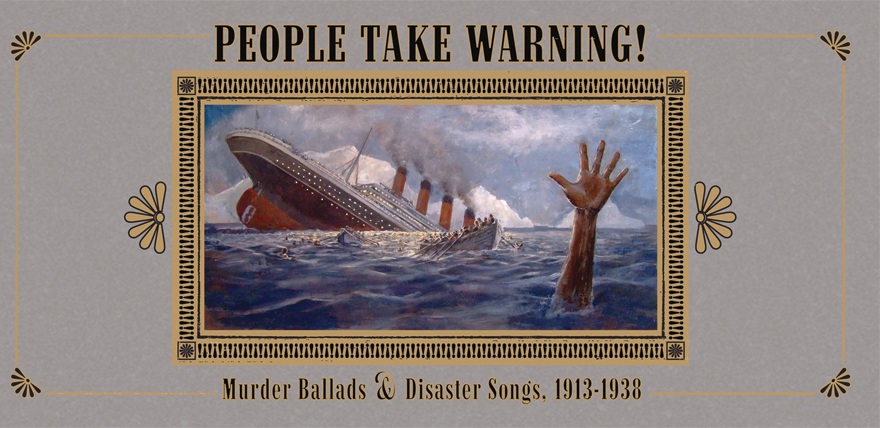
People Take Warning! Murder Ballads & Disaster Songs 1913-1938


As I type this entry, I am enjoying the wonderful CD set People Take Warning! Murder Ballads & Disaster Songs 1913-1938.

It is a 3 CD set, packed into an illustrated book full of historical information about each song. There are three themed CDs--"Man versus Machine," "Man versus Nature," and "Man versus Man (and Woman too.)" Here is a sample of some of the songs you'll find here: "Titanic Blues (1932)" (one of about 5 other songs on this theme), "Memphis Flu (1930)," "Burning of the Cleveland School (1933), "Fatal Wreck of the Bus (1936)," "The Santa Barbara Earthquake (1928) , and "Murder of the Lawson Family" (1930).

Thanks, Herbert, for alerting me to this collection. And special thanks to Gerry Newland for buying it for me. You can download an MP3 from the collection and find out more here.

Monday, August 20, 2007

Hush, Hush, Hush, Here Comes The Bogey Man!


"Children have You ever met The Bogeyman before?" A "children's classic" from by Henry Hall and his Orchestra.