Friday, May 7, 2010

Tonight!!! "The Saddest Object in the World," An Illustrated Meditation, Observatory


Tonight! Evan Michelson on "The Saddest Object in the World," as experienced at this years Congress for Curious People.

Full details follow; hope to see you there!
The Saddest Object in the World
An Illustrated Meditation by Evan Michelson, Obscura Antiques and Oddities, Morbid Anatomy Library Scholar in residence
Date: TONIGHT! Friday, May 7th
Time: 8:00 PM
Admission: $5
Location: Observatory

“The Saddest Object in the World” is a meditation on one particular artifact; an exercise in Proustian involuntary memory, aesthetic critique, and philosophical bargaining.

Sometimes objects have consequences.

Evan Michelson is an antiques dealer, lecturer, accumulator and aesthete; she tirelessly indulges a lifelong pursuit of all things obscure and melancholy. She currently lives in another place and time.
You can find out more about this presentation here. You can get directions to Observatory--which is next door to the Morbid Anatomy Library (more on that here)--by clicking here. You can find out more about Observatory here, join our mailing list by clicking here, and join us on Facebook by clicking here.

Thursday, May 6, 2010

Original Fritz Kahn Posters and Key Booklet, Sotheby's Vintage Posters Auction, May 13


Morbid Anatomy reader Gotthold is a long time collector of Fritz Kahn books and posters. He is currently selling two of his original posters (as pictured above) along with a "key booklet" as part of Sotheby's May 13 Vintage Posters Auction.

I asked Gotthold to tell me and the Morbid Anatomy readership a bit about this special collection he is actioning off in the hopes of helping it find a proper and loving home; here is his response:
Dear Morbid Anatomy readers:

I have been a keen reader of this blog since I discovered it about a year ago when searching for information on anatomical posters I bought for use in an art project.

My personal artistic fascination with death, pornography, science and religion has taken me on a strange and fascinating journey over the past year through the cavernous bookshop cellars of Vienna, the seedy sex shops of London’s Soho, and the wonderful Morbid Anatomy blog in search of new materials and ideas. In my search for materials to use for my work, I spend a seemingly senseless amount of time and money looking for rare, obscure, and interesting materials to use and take inspiration from. It was on one of these escapades when visiting Vienna that I first stumbled upon the wonderful works of Fritz Kahn whose unique mechanical anatomy illustrations have earned much attention on this very blog (recent posts here, here, and here).

Since this initial discovery, I have managed to amass an extensive collection of Fritz Kahn's books, all featuring his wonderful illustrations, and have also had the luck to acquire a few original posters, including the famed ‘Der Mensch als Industriepalast’ or 'Man as Industrial Palace' of 1926 as seen above, top; you can found out more about that piece here.

Conducting more commercially oriented research around these works, I stumbled upon Morbid Anatomy for the first time to read a post on a Christies ‘Anatomy as Art’ auction in New York where this poster sold for some $3,500. The financially conscious side of myself forced me to reluctantly get in touch with Christies in London regarding a sale. I was informed by their experts there was no specialist auction coming up anytime soon but that I could still consign the poster to a ‘Vintage Posters’ auction in May. I chose to sell the two posters and a ‘key’ booklet together as a lot; I still believe this is extremely unique, given that the key booklet acts as an index to the numerical and alphabetical indicators on the poster without which it is difficult to fully comprehend the intended meaning of the illustrations.

The marketing around this auction has been weak, and there isn’t much explanation of the uniqueness of the key booklet or even an image of the second poster in the lot (as seen above, bottom). When I looked at the other posters for sale at this the auction I realized that my item is out of place and I doubt that it will strike the right chord with the bidders.

I have still however decided to proceed with the auction, not in the least because I need the proceeds of this sale to help further my artistic pursuits. I therefore implore anyone who knows relevant collectors to spread the word about the auction, and encourage anyone who’s interested to bid on these items as they are impeccable (the nice thing about Christies auctions is that anyone can place bids from anywhere in the world online). You can see the lot on the auction website by clicking here.
So please, any and all of you medical art aficionados out there, check out (and bid on!) Gotthold's Sotheby's lot on May 13th; you can find out more about the lot by clicking here and more about the auction by clicking here. And yes, online/remote bidding is very much a possibility! Also, please feel free to forward this post to any interested parties!

If you are interested in learning more about Fritz Kahn and seeing more of his incredible work, I highly recommend the beautiful, lavishly illustrated book Fritz Kahn: Man Machine / Maschine Mensch, which comes complete with a frame-worthy poster-sized reproduction of ‘Der Mensch als Industriepalast’ ('Man as Industrial Palace'). Good stuff!

Tonight!!! "Experimenting with Death: An Introduction to Terror Management Theory," Lecture, Observatory


Tonight! Michael Johns on all things Terror Management Theory! 8:00! Observatory!

Full details follow. Hope to see you there!
Experimenting with Death: An Introduction to Terror Management Theory
An Illustrated Lecture by Michael Johns, Former Assistant Professor of Psychology at the University of Wyoming
Date: Thursday, May 6
Time: 8:00 PM
Admission: $5
Presented by Morbid Anatomy

In his Pulitzer Prize-winning book, Denial of Death, cultural anthropologist Ernest Becker attempted to develop a unified theory of human behavior. He argued that it was the human capacity to grasp and contemplate our own mortality–and our need to suppress this knowledge–that was at the root of human culture and behavior, from genocide to altruism, religion to philosophy. Terror Management Theory (TMT) is a psychological theory directly based on Becker’s work, developed by a group of social psychologists interested in testing Becker’s assertions about death as a core motivator of human behavior. Over the last 25 years, psychologists in the North America, Europe and the Middle East have conducted hundreds of studies to test hypothesis derived from Becker’s work and the Terror Management Theory it inspired. This body of research compellingly supports Becker’s thesis and reveals the ways in which mortality salience influences behaviors ranging from aggression and stereotyping to creativity and sexuality. Using segments from the documentary “Flight from Death: The Quest for Immortality,” this lecture will introduce Terror Management Theory and discuss the often clever experiments that have been conducted to test its tenets.

Michael Johns is a social psychologist and works as a research scientist in the NYC Department of Health. He has published numerous research articles and book chapters on a variety of topics, including Terror Management Theory. Before moving to Brooklyn, Mike was an Assistant Professor of Psychology at the University of Wyoming.
You can find out more about this presentation here. For more on Ernest Becker's wonderful book Denial of Death, click here; for more on the film "Flight From Death - The Quest for Immortality," click here. You can get directions to Observatory--which is next door to the Morbid Anatomy Library--by clicking here. You can find out more about Observatory here, join our mailing list by clicking here, and join us on Facebook by clicking here.

Wednesday, May 5, 2010

The Taxidermy of Mr. Walter Potter and his Museum of Curiosities, Melissa Milgrom


Melissa Milgrom--author of Still Life: Adventures in Taxidermy and panelist at the recent Congress for Curious People--has just published a nice article about that undisputed king of Victorian anthropomorhic taxidermy, animal artist and museologoist Walter Potter; following is a brief excerpt:
Athletic toads? Rats gambling in a dollhouse of decadence? How about bespectacled gentlemen lobsters?

No, this isn’t Wes Anderson’s sequel to Fantastic Mr. Fox, but the work of English Victorian taxidermist Mr. Walter Potter. Potter was famous for his over-the-top anthropomorphic scenes—kittens at the tea table; guinea pigs playing cricket—which were displayed in his Museum of Curiosities from 1861 until 2003 when his wondrous collection was sold in a contentious auction, which I attended in Cornwall.

One of England’s oldest private museums, Potter’s belonged to the era of the amateur nature lover when museums were spirited jumbles, not the sober typologies they would become post-Darwin. Potter’s verged on the freakish: random, cluttered, crammed to the rafters with curios and oddities, weird accumulations and creatures that were stuffed, pickled, dissected, and deformed. And I was lucky, though it filled me with sadness, to wander through Potter’s crooked corridors on its very last day...

Had Potter attended the Great Expo (very likely) he would have seen among the taxidermy displays a comic depiction of Goethe’s fable Reinecke the Fox reenacted with semi-human foxes. Sounds childlike—and it was in the best, most passionate way—but in the days before irony anthropomorphism was a form of endearment (imagine Beatrix Potter, no relation). More so, the facial expressions were expertly manipulated, raising the taxidermic bar and inspiring followers.

Known as the Grotesque School, “mirth-provoking” characters were the equivalent of a blockbuster movie. Queen Victoria herself stopped to linger and laugh at a frog shaving another frog. And taxidermists began transforming all sorts of animals into tiny humans: crows playing violin, frogs doing the cancan, squirrels as Romeo. None were as ambitious as Mr. Walker Potter...
You can read the full article on the Wonders and Marvels blog by clicking here. You can find out more about Milgrom's Still Life--which contains a nice discussion of Potter and his work--by clicking here. If the life and work of Walter Potter is of interest, I also highly highly recommend that you check out the wonderful, lavishly-illustrated Walter Potter and his Museum of Curious Taxidermy, written by Congress for Curious People lecturer Pat Morris; you can do so by clicking here or by visiting Observatory (more on that here).

All images are of Walter Potter's work and are drawn from the wonderful Ravishing Beasts blog; you can see them in context by clicking here.

"An Atlas of Topographical Anatomy after Plane Sections of Frozen Bodies," Christian Wilhelm Braune, 1877


Christian Wilhelm Braune (July 17, 1831 Leipzig – April 29, 1892) was a German anatomist and professor of topographical anatomy at the University of Leipzig. He is known for his excellent lithographs regarding cross-sections of the human body, and his pioneer work in biomechanics. Braune was son-in-law to German physician Ernst Heinrich Weber (1795–1878).

Braune was inspired by the photographic work of French scientist Étienne-Jules Marey (1830–1904) regarding anatomical movement. Marey believed that movement was the most important of all human functions, which he described graphically for biological research in Du Mouvement Dans Les Functiorls Da La Vie (1892) and Le Mouvement (1894). This led the way for Braune's experimental, anatomical studies of the human gait, being published in the book Der Gang des Menschen. This study of the biomechanics of gait covered two transits of free walking and one transit of walking with a load. The methodology of gait analysis used by Braune is essentially the same used today.

Braune and his student, Otto Fischer (1861–1917) did research involving the position of the center of gravity in the human body and its various segments. By first determining the planes of the centers of gravity of the longitudinal, sagittal and frontal axes of a frozen human cadaver in a given position, and then dissecting the cadaver with a saw, they were able to establish the center of gravity of the body and its component parts. Braune and Fischer also did extensive work regarding the fundamentals of resistive forces that the muscles need to overcome during movement.

In unrelated investigative work, Braune had a decisive role in the publication of the musical pieces composed by Frederick the Great of Prussia.
Text via Wikipedia; image via Ars Anatomica.

"The Saddest Object in the World," An Illustrated Meditation, Observatory, Friday, May 7th


This Friday, Observatory and Morbid Anatomy will host Morbid Anatomy Library Scholar in residence and Obscura co-proprietor Evan Michelson as she leads us on an illustrated meditation on what she has termed "The Saddest Object in the World." This event is a reprise of Michelson’s popular Congress for Curious People presentation which took place at the Coney Island Museum earlier this month; if you missed Michelson's beloved presentation the first time around, I cannot encourage you enough to come out tonight and find out all about The Saddest Object in the World.

Full details follow; hope to see you there!
The Saddest Object in the World
An Illustrated Meditation by Evan Michelson, Obscura Antiques and Oddities, Morbid Anatomy Library Scholar in residence
Date: Friday, May 7th
Time: 8:00 PM
Admission: $5
Location: Observatory

“The Saddest Object in the World” is a meditation on one particular artifact; an exercise in Proustian involuntary memory, aesthetic critique, and philosophical bargaining.

Sometimes objects have consequences.

Evan Michelson is an antiques dealer, lecturer, accumulator and aesthete; she tirelessly indulges a lifelong pursuit of all things obscure and melancholy. She currently lives in another place and time.
You can find out more about this presentation here. You can get directions to Observatory--which is next door to the Morbid Anatomy Library (more on that here)--by clicking here. You can find out more about Observatory here, join our mailing list by clicking here, and join us on Facebook by clicking here.

Tuesday, May 4, 2010

Kabinett des Grotesken ("Cabinet of the Grotesque"), Berliner Medizinhistorisches Museum der Charité, Spiegel Online


My friend, German journalist Michael Kneissler, just sent me a link to an article and an amazing short film celebrating the world famous Berliner Medizinhistorisches Museum der Charité on its 300th birthday, prompted by a new exhibition at the museum entitled "Charité--300 years of medicine in Berlin."

Following is an excerpt from the article--found on Spiegel Online and entitled "Kabinett des Grotesken" ("Cabinet of the Grotesque")--via a sloppy Google Translation:
Human malformations, surgical instruments, the Dildo-box of a sex researcher: The Collection of the Berlin Charité shows the dazzling variety of medical research. To mark its 300th anniversary Clinic presents highlights from the world famous now its archive.

Hands upset, steal: impossible. In the showcases the treasures of the Lord Virchow are safe. Very safe. And yet the guards sneak past every now and again. Ready to intervene immediately. They know that the temptation is to press for the issue "Charité - 300 Years of Medicine in Berlin" on the trigger...

Brains, livers, lungs, testes, ovaries removed - from the different and peaceful perished miserably, preserved in jars for viewing, Educate and quenching. An exhibition of the Interior, without taboos. Even human fetuses are also included. One with legs fused together, one with eyes grown together in the middle of the forehead. A Cyclops. Unreal and yet real.

Virchow himself called this collection - eagerly gathered for medical students and the public in order to warn of an unhealthy lifestyle - his "favorite child", for some visitors to the house if these preparations now the favorite image design: "Krass," it escapes some...
This dazzling looking exhibition is on view at the Berlin-based Medizinhistorisches Museum der Charité until February 2011; very much hope to see it before it comes down!

You can read the whole article and watch the wonderful video walk-through on the same page (just click the play button!) by clicking here. You can find out more about the museum in English by clicking here. Image above is drawn from the video.

Thanks so much to Michael Kneissler for sending this along!

Monday, May 3, 2010

"Experimenting with Death: An Introduction to Terror Management Theory," Lecture, Observatory, Thursday May 6


This Thursday, May 6, join Morbid Anatomy and Michael Johns at Observatory for a night of all things Terror Management Theory! Full details follow; This will be a very good night and I hope very much to see you there!
Experimenting with Death: An Introduction to Terror Management Theory
An Illustrated Lecture by Michael Johns, Former Assistant Professor of Psychology at the University of Wyoming
Date: Thursday, May 6
Time: 8:00 PM
Admission: $5
Presented by Morbid Anatomy

In his Pulitzer Prize-winning book, Denial of Death, cultural anthropologist Ernest Becker attempted to develop a unified theory of human behavior. He argued that it was the human capacity to grasp and contemplate our own mortality–and our need to suppress this knowledge–that was at the root of human culture and behavior, from genocide to altruism, religion to philosophy. Terror Management Theory (TMT) is a psychological theory directly based on Becker’s work, developed by a group of social psychologists interested in testing Becker’s assertions about death as a core motivator of human behavior. Over the last 25 years, psychologists in the North America, Europe and the Middle East have conducted hundreds of studies to test hypothesis derived from Becker’s work and the Terror Management Theory it inspired. This body of research compellingly supports Becker’s thesis and reveals the ways in which mortality salience influences behaviors ranging from aggression and stereotyping to creativity and sexuality. Using segments from the documentary “Flight from Death: The Quest for Immortality,” this lecture will introduce Terror Management Theory and discuss the often clever experiments that have been conducted to test its tenets.

Michael Johns is a social psychologist and works as a research scientist in the NYC Department of Health. He has published numerous research articles and book chapters on a variety of topics, including Terror Management Theory. Before moving to Brooklyn, Mike was an Assistant Professor of Psychology at the University of Wyoming.
You can find out more about this presentation here. For more on Ernest Becker's wonderful book Denial of Death, click here; for more on the film "Flight From Death - The Quest for Immortality," click here. You can get directions to Observatory--which is next door to the Morbid Anatomy Library--by clicking here. You can find out more about Observatory here, join our mailing list by clicking here, and join us on Facebook by clicking here.

Sunday, May 2, 2010

Head of Discovery and Engagement, Wellcome Library, Employment Opportunity


To quote the new call for applications for "Head of Discovery and Engagement at the Wellcome Library," "The Wellcome Library is the one of the world's great cultural treasures: a unique and irreplaceable collection, which documents medicine and its role in society, past and present." The Wellcome Library also happens to be one of my favorite places in the world, and the newly created position of "Head of Discovery and Engagement" seems like a potentially pretty darn great job.

The closing date for applications is May 10th; full job description and details follow:
Head of Discovery and Engagement
Wellcome Library
Closing Date: 5/10/2010
Salary: £50 000 - £60 000

Job Details
The Wellcome Trust is a global charity dedicated to achieving extraordinary improvements in human and animal health. We support the brightest minds in biomedical research and the medical humanities.

The Wellcome Library is the one of the world's great cultural treasures: a unique and irreplaceable collection, which documents medicine and its role in society, past and present. As Head of Discovery and Engagement, you will play a pivotal role in making these outstanding collections accessible, a key part of an ambitious strategy to transform the Wellcome Library. This will include revolutionising our web presence and reading-room services to meet the needs of existing and new audiences and developing the Library's role as not only a world-class research resource, but also as part of Wellcome Collection, one of London's most exciting cultural destinations.

A passionate advocate for our collections, you will lead the Library's outreach, communication and marketing activities and, by developing our understanding of users and their needs, ensure we have a robust framework for evaluating our success. As a key member of the senior management team, reporting to the Head of Library, you will need to demonstrate: significant experience in a public/user focused role in a cultural environment; a commitment to audience development and engagement programmes; a proven understanding of commissioning audience research and evaluation; a good knowledge of social media and web technologies and experience of creating/commissioning web content; previous staff management experience and an ability to manage budgets/resources; excellent written and verbal communication skills across a broad range of stakeholders; a demonstrable ability to contribute creatively and enthusiastically at a strategic level. In addition a strong interest in the history of health, medicine or science would be advantageous.

For more information on the Wellcome Library and the transformation strategy, please visit: http://library.wellcome.ac.uk For more information on this role or a job description and to apply online visit: www.wellcome.ac.uk/jobs Alternatively write to: HR, Wellcome Trust, 215 Euston Road, London, NW1 2BE. Please send a CV (including salary details) and covering letter explaining how you meet the criteria and what you feel you can bring to this role.
You can find out more by clicking here. To find out more about the astounding Wellcome Library, click here.

Image: The Wellcome Library via Himetop and drawn from chrisjohnbeckett's Flickr photostream.

Friday, April 30, 2010

Tomorrow Night at Observatory! "Three Unique Medical Museums in Northern Italy," Lecture by Marie Dauenheimer


Just a quick reminder: tomorrow night at Observatory! Marie Dauenheimer--the curator of the "Anatomical Art: Dissection to Illustration" exhibition discussed in this recent post--will be on hand at Observatory to deliver an illustrated lecture that "will survey the collections of three unique and often over-looked anatomical museums in Northern Italy." You can read a full description here. Full event details follow; hope very much to see you there!
Three Unique Medical Museums in Northern Italy
An illustrated presentation by Marie Dauenheimer of the Vesalius Trust
Date: May 1, 2010
Time: 8:00 P.M.
Admission: $5
Presented by Morbid Anatomy

Tonight’s visual presentation by Marie Dauenheimer will survey the collections of three unique and often over-looked anatomical museums in Northern Italy which Dauenheimer toured as part of last years Vesalius Trust “Art and Anatomy Tour.” First, the University of Florence Museum of Pathological Anatomy, famous for its collection of wax pathological models created in the 19th century, including an amazing life size leper; then The Museum of Human Anatomy in Bologna featuring the work of famed wax modeling team of Anna Morandi Manzolini and her husband Giovanni Manzolini, whose life size wax models inspired Clement Susini and the wax-modeling workshop in Florence (see image above); and lastly the fascinating University of Pavia Museum of Anatomy, which houses the beautiful 18th century frescoed dissection theater, where anatomist Antonio Scarpa. So join us tonight for wine, fellowship, and a virtual and very visual tour of some of the finest and most fascinating medical museums of Italy!

Marie Dauenheimer is a Board Certified Medical Illustrator working in the Washington, DC Metropolitan area. She specializes in creating medical illustrations and animations for educational materials, including posters, brochures, books, websites and interactive media. Since 1997 Marie has organized and led numerous “Art and Anatomy Tours” throughout Europe for the Vesalius Trust. Past tours have explored anatomical museums, rare book collections and dissection theatres in Italy, The Netherlands, Belgium, France, Scotland and England. In addition to illustrating Marie teaches drawing, life drawing and human and animal anatomy at the Art Institute of Washington. Part of Marie’s anatomy class involves study and drawing from cadavers in the Anatomy Lab at Howard University College of Medicine in Washington, DC (for more on that, see this recent post).
You can find out more about this presentation here. You can get directions to Observatory--which is next door to the Morbid Anatomy Library--by clicking here. You can find out more about Observatory here, join our mailing list by clicking here, and join us on Facebook by clicking here. To learn more about Marie's "Anatomical Art: Dissection to Illustration" exhibition, click here. For more on the Vesalius Trust, click here.

Image: Self-portrait of wax modeller Anna Morandi Manzolini dissecting a human brain, Bologna, c. 1760; Via Scienza a Due Voci

Thursday, April 29, 2010

"Imaging / Imagining the Skeleton," Symposium, Tomorrow, Friday, April 30, 1:00-4pm, CUNY Graduate Center


I just found out about a pretty intriguing looking event taking place in New York City tomorrow afternoon: "Imaging / Imagining the Skeleton," a free Symposium at CUNY Graduate Center. Participants include friend-of-Morbid-Anatomy and future Observatory lecturer (click here for details) Mark Dery.

Full details below; hope to see you there!
Imaging / Imagining the Skeleton
Friday, April 30, 1:00-4pm
CUNY Graduate Center, 365 Fifth Ave. (at 34th St.), NYC
Rooms 9206 / 9207
No reservations. First come, first seated
Caroline Jones KEYNOTE, MIT, History, Theory, Art History
Vincent Stefan, Lehman College CUNY, Anthropology
Lisa E. Farrington, John Jay College CUNY, Art History and Race
Mark Dery, Independent Scholar
Tatiana Garmendia, Artist
Dr. Joseph Lane, Hospital for Special Surgery, Orthopedic Surgery
Co-Sponsored by the Ph.D. Program in Art History and Science & the Arts CUNY Graduate Center; Funded by the John Rewald Endowment of the Ph.D. Program in Art History

Imaging/Imagining the Skeleton is a symposium organized to explore how social conceptions of the human form have evolved alongside the increasing ability of science/medicine to represent the body. The speakers will present a constellation of inter-disciplinary discussions about the relationship between representing/exhibiting the body, evolving conceptualizations of the body and bones, and artistic and professional responses to new medical imaging technologies. The underlying proposition is that the ability to investigate and represent the body—at the levels of both anatomy and function—has exerted a profound impact on how the relationship between the physical body and human experience is conceived. Those changing conceptions, in turn, have had far-reaching consequences for the humanities, social sciences, public policy, and artistic practice.

Symposium attendees will receive a catalogue from the exhibition Visionary Anatomies, originally presented at the National Academy of Sciences.

Introductory remarks by Kevin Murphy, Professor of Art History. Panel discussion moderated by Adrienne Klein, co-Director, Science & the Arts.

Speaker Bios and Paper Topics
Professor Caroline Jones will speak on “Senses, mediation, and selves beyond the skin.” Jones explores selected art works that use the trope of the skeleton to indicate “penetrating” views of the self, but contrasts these with a recent sensory turn that suggests a broader critique of modern ocularity. Caroline Jones studies modern and contemporary art, with a particular focus on its technological modes of production, distribution, and reception. Previous to completing her art history degree, she worked in museum administration and exhibition curation, holding positions at The Museum of Modern Art in New York (1977-83) and the Harvard University Art Museums (1983-85), and completed two documentary films. In addition to these institutions, her exhibitions and/or films have been shown at the San Francisco Museum of Modern Art, the Hirshhorn Museum and Sculpture Garden in Washington DC, the Hara Museum Tokyo, and the Boston University Art Gallery, among other venues. She is the recipient of fellowships from the National Endowment for the Humanities and the John Simon Guggenheim Foundation (among others), and has been honored by fellowships at the Wissenschaftskolleg zu Berlin and the Max Planck Institüt (2001-02), the Institute for Advanced Studies in Princeton (1994-95), and the Stanford Humanities Center (1986-87). Her books include Machine in the Studio: Constructing the Postwar American Artist, (1996/98, winner of the Charles Eldredge Prize from the Smithsonian Institution); Bay Area Figurative Art, 1950-1965, (1990, awarded the silver medal from San Francisco's Commonwealth Club); and Modern Art at Harvard (1985).

Professor Vincent H. Stefan, Lehman College CUNY, will speak on “Human Skeletal Variations” as it relates to analysis of skeletal structures both prehistoric and contemporary. Dr. Stefan's field of general interest is physical anthropology with specialization in human skeletal biology. His fields of study include human osteology and skeletal biology; forensic anthropology; paleoanthropology; quantitative methods; Rapa Nui (Easter Island) skeletal biology; Polynesian skeletal biology. Current research interests include the documentation and analysis of contemporary and prehistoric human skeletal variation. Future research will focus on the use of these same procedures to assess metric cranial/skeletal variation for understanding the peopling of all of Polynesia and Oceania. Currently Professor Stefan regularly consults with the Nassau County Medical Examiner, East Meadow, NY, the Suffolk County Medical Examiner, Hauppauge, NY, and the Westchester County, Department of Laboratories & Research, Office of the Medical Examiner, Valhalla, NY in cases involving human skeletal remains. He is expert in the recovery of decomposed/ skeletonized human remains, and in the identification of victims from skeletal remains.

Professor Lisa E. Farrington will speak on “de Bouffon's 1805 published autopsy findings on the body of Sartjie Baartman” Professor Lisa E. Farrington is the founding Chair of John Jay’s Art & Music Department, as well as an accomplished curator, author, and art historian. In 2007-2008 she was awarded the prestigious William and Camille Cosby Endowed Scholars chair at Atlanta University’s historically black women’s college, Spelman. She has earned numerous academic degrees, including PhD and Master of Philosophy degrees from the CUNY Graduate Center in New York, an MA in art history from American University, a BFA (magna cum laude) from Howard University, and an Honors Degree in painting and illustration from New York's School of Art & Design. Dr. Farrington worked for many years at the Museum of Modern Art and, from 1994 to 2007, was senior art historian at Parsons School of Design (the fine arts division of The New School). She specializes in Western and Non-Western Art, Haitian Art and Vodou Culture, African-American Art, Women’s Art, and Race and Gender studies. She has also taught the on-site museum art history course at Parsons Atelier in Paris, France. Dr. Farrington is a Mellon, Magnet, U.S. State Department, and Ford Foundation Fellow, and was a consultant for The College Board’s Advanced Placement (AP) Art History program. She has published ten books and a dozen scholarly essays in the past decade, including two monographs on artist Faith Ringgold, and a 2005 textbook for Oxford University Press entitled Creating Their Own Image: The History of African-American Women Artists, which recently won three major academic literary awards, including the American Library Association Award for Outstanding Contribution to Publishing, the American Association of Black Women Historians Annual Book Award, and the Richard Wright/Zora Neale Hurston Foundation nomination for non-fiction. She recently won the Andy Warhol Foundation / Creative Capital Arts Writers prize for 2010.

Mark Dery will speak on "The Anatomical Unconscious: X-Ray Specs, Visible Women, and the Eros of the Unseen," a cultural critique of the eroticizing of the scientific gaze. Mark Dery is a cultural critic. His byline has appeared in publications ranging from The New York Times Magazine to Rolling Stone to Salon to Cabinet, and his lectures have taken him to Australia to Austria, Belgium to Brazil, Macedonia to Mexico. He has been a professor in the Department of Journalism at New York University, a Chancellor’s Distinguished Fellow at UC Irvine, and a Visiting Scholar at the American Academy in Rome. Dery is best known for his writings on the politics of popular culture in books such as The Pyrotechnic Insanitarium: American Culture on the Brink and Escape Velocity: Cyberculture at the End of the Century. He is widely associated with the concept of “culture jamming,” the guerrilla media criticism movement he popularized through his 1993 essay “Culture Jamming: Hacking, Slashing, and Sniping in the Empire of the Signs,” and “Afrofuturism,” a term he coined and theorized in his 1994 essay “Black to the Future” (included in the anthology Flame Wars: The Discourse of Cyberculture, which he edited). More at www.markdery.com.

Tatiana Garmendia, MFA, will speak by remote uplink on her “X-ray Painting and Graphite Series”and explore some of the dichotomies between actual and conceptual representations of body and bones. Tatiana Garmendia is a figurative artist with a conceptual twist. Her work synthesizes formal concerns and a humanist engagement with history and culture. Born in Cuba, she was raised a devotee of Santeria - the syncretic mix of Yoruba mysticism and Spanish Catholicism. She also hails from a family of doctors and medical researchers. “I grew up in a household where the human body, in various guises of dejection and exaltation, was a primary theme in devotional and medical imagery. In my earliest recollections, the body is both flesh and mythological certainty." Repatriation from the Spanish government took the artist’s family first to Madrid, and later to the U.S.A. She studied at the School of the Museum of Fine Arts in Boston, and has degrees from Florida International University, and Pratt Institute of Art, Brooklyn.

Dr. Joseph Lane, MD, Professor Orthopedic Surgery and Assistant Dean, Weill Cornell Medical College and Chief Metabolic Bone Disease Hospital for Special Surgery, will speak on “Reconstructing the Skeleton.” He presents the skeleton including radiographs, bone scans, PET scans, CT scans and MRI, and will suggest some of the implications of changing methods for “reading” skeletons and bones. Joseph M. Lane, MD has published extensively on bone biology, tissue injury and repair, trauma, bone and soft tissue sarcomas (including osteogenic sarcoma and Ewing’s sarcoma), limb preservation, functional amputations, limb regeneration, and metabolic bone diseases (osteoporosis, Paget’s disease, rickets, osteomalacia, fibrous dysplasia). He has served on numerous committees for the AAOS, including the Board of Directors and Chairman of COMSS, the Chairman Oversight Panel on Women’s Health Issues. He was President of the Orthopaedic Research Society, Musculoskeletal Tumor Society, Chairman of NIH Orthopaedic Study Section, OREF grants review board, ABOS Question Writing Task Force. He is a member of the AAOS, AOA, ABJS, ASBMR, ORS, MSTS, and OTA. He has earned NIH career and R01 grants, OREF grants, and foundation awards. He has been a visiting professor at educational institutes and is on the editorial board of several peer journals.
Thanks so much to friend, artist, and book-club partner Laura Splan for tipping me off to this!

Image (click on image to see much larger version): from Mike Sappol and the National Library of Medicine's incomparable Dream Anatomy Exhibition; Caption reads: Elementi di anatomia fisiologica applicata alle belle arti figurative, Turin, 1837-39. Lithograph. National Library of Medicine; Francesco Bertinatti (fl. mid-1800s) [anatomist]; Mecco Leone [artist]. The anatomical studies for real, imaginary and prospective sculptures and paintings became a genre in its own right in the early and middle decades of the 19th century.

Wednesday, April 28, 2010

"Excellent Old-School Science Models," Life Magazine Photo Gallery


The images you see above--and the captions below--are drawn from a really fantastic Life Magazine online photo gallery entitled "Excellent Old-School Science Models." You can see the entire gallery of 29 images--well worth your perusal!--by clicking here.

Captions top to bottom, as supplied by the gallery:
  1. Isn't She Lovely: Trainee nurses examine a model of a human body to learn anatomy, Gerry Cranham, Oct. 7, 1938
  2. Behind It All: A technician works on life-like models for use in science and health lectures at the Cologne Health Museum in Germany, Ralph Crane, Feb 01, 1955
  3. Going Deep: A technician at the Cologne Health Museum gets into his work, Ralph Crane, Feb 01, 1955
  4. The Egg Factory: An exhibit illustrates the biology of the chicken at the World Poultry Exhibition at the Crystal Palace exhibition hall in London, Fox Photos, Jul 28, 1930
  5. Universal: A girl scout leans in to take a closer look at an enclosed model of the solar system, circa 1920s, George Eastman House, Jan 01, 1920
Found via Morbid Anatomy Library intern Amber Duntley's Facebook feed. Thanks, Amber!

Tuesday, April 27, 2010

"Three Unique Medical Museums in Northern Italy," Lecture by Marie Dauenheimer, Observatory, Saturday May 1


This Saturday night, Marie Dauenheimer--the curator of the "Anatomical Art: Dissection to Illustration" exhibition discussed in yesterday's post--will be on hand at Observatory to deliver an illustrated lecture that "will survey the collections of three unique and often over-looked anatomical museums in Northern Italy." One of the museums discussed will be The Museum of Human Anatomy in Bologna, which houses--among other works--an incredible wax self-portrait of Anna Morandi Manzolini dissecting a brain (c. 1760 ; see above). The other two musems she will discuss will be the fantastic and difficult-to-access University of Florence Museum of Pathological Anatomy and the University of Pavia Museum of Anatomy.

Marie--who also leads tours of medical museums for the Vesalius Trust (as discussed in this recent post)--is an excellent speaker; her lecture on Italian Wax Anatomical Models in European Collections, which she gave about a year ago, was beloved by all, and we are exceptionally pleased to be hosting her again!

Full details follow; hope very much to see you there!
Three Unique Medical Museums in Northern Italy
An illustrated presentation by Marie Dauenheimer of the Vesalius Trust
Date: May 1, 2010
Time: 8:00 P.M.
Admission: $5
Presented by Morbid Anatomy

Tonight’s visual presentation by Marie Dauenheimer will survey the collections of three unique and often over-looked anatomical museums in Northern Italy which Dauenheimer toured as part of last years Vesalius Trust “Art and Anatomy Tour.” First, the University of Florence Museum of Pathological Anatomy, famous for its collection of wax pathological models created in the 19th century, including an amazing life size leper; then The Museum of Human Anatomy in Bologna featuring the work of famed wax modeling team of Anna Morandi Manzolini and her husband Giovanni Manzolini, whose life size wax models inspired Clement Susini and the wax-modeling workshop in Florence (see image above); and lastly the fascinating University of Pavia Museum of Anatomy, which houses the beautiful 18th century frescoed dissection theater, where anatomist Antonio Scarpa. So join us tonight for wine, fellowship, and a virtual and very visual tour of some of the finest and most fascinating medical museums of Italy!

Marie Dauenheimer is a Board Certified Medical Illustrator working in the Washington, DC Metropolitan area. She specializes in creating medical illustrations and animations for educational materials, including posters, brochures, books, websites and interactive media. Since 1997 Marie has organized and led numerous “Art and Anatomy Tours” throughout Europe for the Vesalius Trust. Past tours have explored anatomical museums, rare book collections and dissection theatres in Italy, The Netherlands, Belgium, France, Scotland and England. In addition to illustrating Marie teaches drawing, life drawing and human and animal anatomy at the Art Institute of Washington. Part of Marie’s anatomy class involves study and drawing from cadavers in the Anatomy Lab at Howard University College of Medicine in Washington, DC (for more on that, see this recent post).
You can find out more about this presentation here. You can get directions to Observatory--which is next door to the Morbid Anatomy Library--by clicking here. You can find out more about Observatory here, join our mailing list by clicking here, and join us on Facebook by clicking here. To learn more about Marie's "Anatomical Art: Dissection to Illustration" exhibition, click here. For more on the Vesalius Trust, click here.

Image: Self-portrait of wax modeller Anna Morandi Manzolini dissecting a human brain, Bologna, c. 1760; Via Scienza a Due Voci

Monday, April 26, 2010

"Anatomical Art: Dissection to Illustration," Exhibition Curated by Marie Dauenheimer, Arlington, Virginia


"We have the gift of language, the gift of making memories in words and pictures," Aziz says. "The bodies are gone, but by making these memories, we, to an extent, resurrect them. This is the antidote to death."--David Montgomery, "In gross anatomy, Howard U.'s Ashraf Aziz sees nothing but grace," Washington Post, Wednesday, April 21, 2010
Marie Dauenheimer, friend, friend of Morbid Anatomy, and Observatory lecturer past and future (more on that future lecture--which is entitled "Three Unique Medical Museums in Northern Italy" and will take place on Saturday May 1--soon!) has curated an exhibition of artworks inspired by the cadaver as part of a year-long collaboration between Howard's College of Medicine and the Art Institute of Washington. The Washington Post just ran a really lovely and in-depth story about the exhibition and the collaboration; it was such an interesting article that I have posted it here in its entirety:
In gross anatomy, Howard U.'s Ashraf Aziz sees nothing but grace
By David Montgomery
Washington Post Staff Writer
Wednesday, April 21, 2010

At 71, Ashraf Aziz has spent half his life cutting open cadavers and initiating medical students at Howard University into the pungent mysteries of human anatomy. He likes the heads. Extracting the muscles of chewing is one of his specialties. There is little about the body that can faze him anymore.

And yet, here in a little art gallery across the street from the Rosslyn Metro station, this most eloquent and loquacious man of science has been rendered almost speechless.

"I, I'm really a little bit -- " he stammers.

He sounds like a first-year medical student about to be overcome in the embalming room.

"I'm sorry," he says.

Tears well in his eyes.

Surrounded by red-wine-sipping artists and art students on a recent evening, the anatomist is contemplating their renderings of the human body. The nudes not only have no clothes, they also have no skin. The subjects are cadavers -- cadavers from the lab where Aziz teaches gross anatomy.

"I'm so deeply moved," he says. He never thought he would find such kindred spirits.

This exhibit, "Anatomical Art: Dissection to Illustration," is just one outcome of an unusual year-old collaboration between Howard's College of Medicine and the Art Institute of Washington. The cross-disciplinary ping-pong continues strong in both directions:

There is talk of enlisting animators from the art school to enhance lessons on locomotion at the medical school. An Art Institute sculptor presented Aziz with some fancy modeling clay, which he used to take an impression from the inside of a chimpanzee skull as part of his comparative chew-muscle research.

Meanwhile, at the art school, to such curriculum standards as "life drawing" -- portraits of live, nude models -- has been added the informal option of, well, dead drawing, in the cadaver lab. Some artists have taken to exploring -- and memorizing the Latin names of -- complex muscle groups that invisibly influence the supple motions of the living torso.

Perhaps most striking has been seeing the life and career of one of Washington's singularly passionate scientists come full circle.

The son of amateur artists in the Indian diaspora, growing up in Tanzania, Aziz, too, once wanted to become an artist. But his poet-carpenter father and his henna-painter mother feared there wasn't a secure future in art. So Aziz became a zoologist and a human anatomist, an associate professor at Howard.

The choice was apt, for the study of anatomy has embraced art -- and vice versa -- at least since Leonardo da Vinci performed dissections and drew the results. From "Gray's Anatomy," the seminal 19th-century illustrated text, to latter-day sensational exhibitions of plasticized cadavers such as "Bodies" and "Body Worlds," the dissected corpse continues to fascinate, repulse, instruct and inspire.

Aziz believes that when science and art diverge, both lose. He draws his own illustrations. To conclude his regular medical lecture on the hand and forearm, he has had traditional Indian tabla drummers demonstrate the dexterity of the muscles and tendons that his students will tweeze in the cadaver lab. In 1999 he co-wrote a 19-page academic journal article in which he cited Virginia Woolf, Gertrude Stein, James Joyce and Marshall McLuhan, along with medical authorities. The ostensible subject was to defend the relevance of the "real" cadaver in medical education despite the rise of digital "cyber cadavers" -- but really the piece was a stirring meditation on authenticity. Away from the lab he reads poetry and writes essays on popular Indian cinema.

Aziz's dream has been to see what a new generation of artists would bring to a new generation of cadavers. Even if the results were nothing revolutionary, he thought, the process itself would be illuminating for all involved: Where life has ended, insight might begin.

Anatomy for art students
As Aziz was casting his thoughts from the realm of science to art, an artist named Marie Dauenheimer was thinking in the other direction.

In 1979, five years after Aziz began teaching at Howard, Dauenheimer was sitting in a class, Gross Anatomy for Artists, at the State University of New York at Stony Brook. What a concept, she thought: The students would spend a couple of hours in a studio life drawing, then cross the hall to the anatomy lab. They would shuttle back and forth from living to dead, surface to structure, skin-deep to skinless.

"That was a turning point for me," she says.

She got a master's in medical illustration at Johns Hopkins University School of Medicine, where she took gross anatomy and dissected a cadaver. "I loved every minute of it," she says. "To explore the human body and then being able to draw it."

She built a career as a freelance illustrator -- drawing surgical procedures, molecular structures, physiological processes. Four years ago she joined the faculty of the Art Institute, teaching classes in life drawing and human and animal anatomy.

Last year she conceived a summer sabbatical to realize one of her own dreams. She wanted to conjure those epiphanic student days in the anatomy lab. She proposed to develop a more powerful way to teach principles of anatomy to art students.

One of the best friends and collaborators of her husband, anthropologist Samuel Strong Dunlap, was none other than Aziz. Dauenheimer paid a visit to Howard. She expected just to have coffee with Aziz, and brainstorm how they might work together. Aziz surprised her.

"Your cadaver is waiting for you," he said.

He encouraged Dauenheimer to do the dissection herself, with help from Dunlap. All summer she cut and drew, inviting art students and colleagues to make their own sketches and sculptures. That work is in the exhibit.

The anatomist imposed one condition on the artist.

"He had dibs on the head," Dauenheimer says.

The source
Dissection puts Aziz in a philosophical mood. In the lab one recent afternoon, he grasps the left hand of a cadaver and holds it up for inspection. The flexible assemblage of bones, muscles and tendons rests in his rubber-gloved palm.

"Look at this here," he says, manipulating the sinewy thumb. "What Aristotle called the organ of organs, the opposing thumb."

His rubber fingers glide down the flayed forearm, and he lightly presses and pulls stringy cords that cause the thumb and fingers to move, puppetlike.

"The body is organized in layers of muscles," he says. "Look at the silvery tone of the tendons! Beauty is not skin-deep, it is deep-deep. . . . The cadaver opens itself up to reflection. This is where data and information lead to knowledge and insight."

Aziz is standing in the center of a vast space filled with 46 stainless steel platforms, each supporting a cadaver in a blue or white body bag and connected to black ventilation tubes.

The atmosphere is not morbid, but reverent. The bodies have been donated by the families of the dead. For six months, students work with the cadavers. Then the remains are cremated and returned to the families, or interred in a plot in Beltsville. No personal details about the cadavers are revealed to the students. The cadaver that Dauenheimer dissected and that most of the artists drew belonged to a 94-year-old woman.

Before dissection, the bodies are embalmed in a room next to the lab. The blood is drained out and preservative chemicals are pumped in. During dissection, the skin is peeled back and fat and other tissue is cleared away to reveal the purple-brown muscles and iridescent tendons.

In Aziz's view, the anatomy lab is not the end of anything, it is the beginning of something.

"The cadaver is a medical student's first patient," he says.

It is like a message from the physician who signed the death certificate to a new generation of doctors. "The novice begins training where the trained physician leaves off," he wrote in his manifesto celebrating the cadaver.

A cadaver is unwieldy. It will not fit in your laptop for later reference. Hence the need to depict and describe it -- the artist's role.

Yet Aziz stakes his worldview on this point: Just as the medical student must begin his initiation with the original flesh and guts, not with a pristine digitized reflection, so the artist -- engaged in creating yet another reflection -- must begin at the source.

Moment of insight
Pen and sketchbook in hand, Geoffrey Moore was paying close attention to the skinned and stripped lower leg and foot of the cadaver. He noticed that one of the toenails was still tinted with polish. Fuchsia. A sudden powerful consciousness of this departed life flooded his imagination.

"I had to stop drawing for a minute," recalls Moore, 21, a third-year animation student.

Then he went back to work. He was trying to solve an artistic problem. In his animation exercises at the institute, he had been having trouble with the "toe-roll" or "foot-roll" motion, when an animated character is taking strides. Now in the lab he was drawing -- and mentally absorbing -- those muscles and tendons that make that roll possible.

"We're all kind of differently shaped, but motion is universal," Moore says. He was accustomed to rendering the surfaces of things, where appearances vary so much. The cadaver lab reveals the universal in the particular. "Instead of seeing the differences, you see the similarities in our bodies," he says. "The more you learn about what's under the skin, the more you can apply that when you see someone walking down the street."

Moore's sketches of the leg and foot hang in the exhibit organized by Dauenheimer, along with the work of eight other students and professional artists.

At the exhibit opening, having recovered his composure, Aziz walks from picture to picture, pausing delightedly at each. Courtly and cheerful, he wears a sports coat and a striped tie with little skulls on it. He is joined by his wife, Barbara Dunn, an oncologist with the National Cancer Institute. They live in Mount Pleasant.

"This is fantastic," Aziz says to Charl Ann Brew, who has made an eight-inch sculpture of a gesturing cadaver whose bones and muscles are revealed to different degrees on different limbs. Aziz lingers over the head.

"You have the forehead muscle . . . the smile muscle . . . then the kissing muscle right there . . . and in order to give a French kiss, the muscle there to get deep suction. Exquisite detail!"

Brew, an art instructor, says the project has inspired her to look deeper. "I'm memorizing a different sent of muscles every quarter."

As he walks through the exhibit, Aziz cites a few lines by the Urdu poet Ghalib, about how the awareness of death adds intensity to life: "If the candle did not immolate itself in all its brilliant colors, the night would not be illuminated."

These are his most important anatomy lessons.

"We have the gift of language, the gift of making memories in words and pictures," Aziz says. "The bodies are gone, but by making these memories, we, to an extent, resurrect them. This is the antidote to death."
The exhibition--which looks not-to-be-missed--will be on view until May 8th at the Art Institute of Washington Gallery (“Gallery 1820”), 1820 N. Fort Myer Drive, Street Level, Arlington, Virginia. You can read the entire article in context on the Washington Post website by clicking here. You can see the photo gallery--from which the above image was drawn--by clicking here. You can find out more about the show by clicking here.

Image: Nikki Kahn-The Washington Post; Caption reads: "The son of amateur artists in the Indian Diaspora and growing up in Tanzania, Aziz, too, once wanted to become an artist. But his poet-carpenter father and his henna-painter mother feared there wasn't a secure future in art. So he became a zoologist and a human anatomist, and is now an associate professor at Howard. Here, Aziz spritzes a solution on a cadaver to keep it moist at the gross anatomy lab in Northwest Washington." You can see the full photo essay by clicking here.

Thursday, April 22, 2010

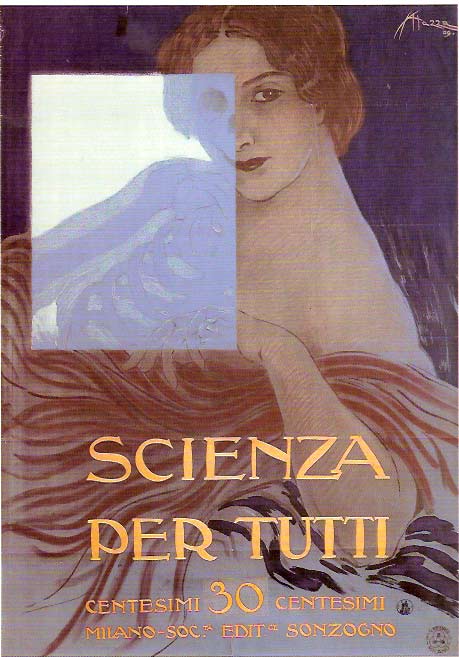
Scienza Per Tutti (Science for All), Aldo Mazza, 1909


Scienza Per Tutti (Science for all), 1909, Cover, by graphic designer Aldo Mazza (1880-1964).

From Arte Liberty in Italia, via Elettrogenica.

"Museums, Monsters and the Moral Imagination" Lecture by Stephen Asma, Tonight!, Observatory


As discussed in this recent post, tonight professor Stephen Asma of Chicago's Columbia College will be at Observatory to deliver a much-anticipated lecture "Museums, Monsters and the Moral Imagination." This heavily-illustrated lecture will draw on the scholarship explored in two of his books--the very influential Stuffed Animals and Pickled Heads and his new On Monsters--and will examine how science museums and monsters both illustrate the essential yet problematic human "urge to classify, set boundaries, and draw lines between the natural and the unnatural the human" and to "try to excavate some of the moral uses and abuses of this impulse."

Asma's written work--which has influenced my own projects immeasurably--is scholarly yet conversational, fun yet of the utmost earnestness; I am sure his lecture will strike the same balance, making this lecture truly not-to-be-missed. Both of Dr. Asma's books will be available for sale and signing at the event. Full details follow; hope very much to see you there!
Museums, Monsters and the Moral Imagination
An Illustrated lecture with Professor Stephen Asma, author of Stuffed Animals and Pickled Heads: the Culture and History of Natural History Museums and On Monsters.
Date: Tonight, Thursday, April 22
Time: 8:00 PM
Admission: $5
Presented by Morbid Anatomy

In this illustrated lecture, professor Stephen Asma–author of the the definitive study of the natural history museum Stuffed Animals and Pickled Heads: the Culture and History of Natural History Museums–will draw upon his studies of science museums and monsters to reflect on their often hidden moral aspects. Museums are saying more about values than many people notice, and the same can be said about our cultural fascinations with monsters. The urge to classify, set boundaries, and draw lines between the natural and the unnatural are age-old impulses. In this lecture, Dr. Asma will try to excavate some of the moral uses and abuses of this impulse.

Stephen T. Asma is the author of Stuffed Animals and Pickled Heads: the Culture and History of Natural History Museums (Oxford) and more recently On Monsters: an Unnatural History of Our Worst Fears (Oxford). He is Professor of Philosophy at Columbia College Chicago and Fellow of the LAS Research Group in Mind, Science and Culture at Columbia. You can find out more about him at his website, www.stephenasma.com.
You can find out more about this presentation here. You can get directions to Observatory--which is next door to the Morbid Anatomy Library--by clicking here. You can find out more about Observatory here, join our mailing list by clicking here, and join us on Facebook by clicking here. To find out more about Asma's fantastic books, click here and here.

Image: From The Secret Museum; Pathological Cabinet, the Museum of the Faculty of Medicine at the Jagiellonian University, Krakow. © Joanna Ebenstein

Wednesday, April 21, 2010

"The Rogue Taxidermy Kunstkammer," The Minnesota Association of Rogue Taxidermists, La Luz de Jesus, Los Angeles


This just in from Congress for Curious People participant and Friend-of-Morbid-Anatomy Robert Marbury; if I was in the greater Los Angeles area, I'd surely be there:
The Minnesota Association of Rogue Taxidermists proudly presents The Rogue Taxidermy Kunstkammer
Our contemporary culture has seen a growing interest in taxidermy fueled by the internet, ambivalence about the food industry, and concerns over animal extinction. The representation of animal form is wide-ranging, and this exhibition presents the first major group show of Rogue Taxidermy. Rogue Taxidermy, a mixed-media art utilizing taxidermy materials, is more closely related to Surrealism than to mainstream taxidermy. Ranging from the macabre to the sublime, this exhibition explores the Borgesian imaginary made real.

Featuring:
SCOTT A. A. BIBUS
SARINA BREWER
MELISSA DIXON
ENRIQUE GOMEZ DE MOLINA
JESSICA JOSLIN
JEANIE M
ROBERT MARBURY
ELIZABETH MCGRATH
ALAN WADZINSKI
BROOKE WESTON
MIRMY WINN

The Show runs May 7th - May 30th

OPENING RECEPTION
Friday May 7th, 8pm-11pm

SQUIRREL MASTERCLASS/GAMEFEED
This event will include a taxidermy demo, followed by Squirrel Chili. A vegan "Mock-Squirrel" Chili will also be available. Sponsored by Schmaltz Brewing Company.
Saturday May 8th 6pm-10pm

LA LUZ DE JESUS
4633 Hollywood Blvd
Los Angeles CA 90027
Phone: 323-666_7667
www.laluzdejesus.com

* All members adhere to a strict ethics charter. Only animals procured in an ethical and environmentally responsible manner were used, and none of the animals were killed for the purpose of this artwork.
* A portion of the proceeds of this show will be given to a local wildlife rehabilitation center.
For more information, check out the La Luz de Jesus website by clicking here. You can find out more about The Minnesota Association of Rogue Taxidermists by clicking here. Click on image to see larger version.

Tuesday, April 20, 2010

The Dance of Death, 1919, Attributed to Josef Fenneker


THE DANCE OF DEATH. 1919.
ATTRIBUTED TO JOSEF FENNEKER (1895-1956)
54 1/2x41 inches, 138 1/2x104 cm.
Condition B+: restoration along vertical and horizontal folds; minor restoration in margins.
Fenneker designed over three hundred movie posters. His recognizable style drew largely on German Expressionism combined with a flair of aesthetic decadence. Written by Fritz Lang, Totentanz is considered by The Internet Movie Database to be a "lost film [in which] a beautiful dancer's sexual allure is used by an evil cripple to entice men to their deaths. Falling in love with one of the potential victims, she is told by the cripple that he will set her free if her lover, actually a murderer himself, survives and escapes a bizarre labyrinthe which runs beneath the cripple's house" (www.imdb.com). Even without a signature, this poster is clearly the work of Fenneker. Although another image by Fenneker for this film exists, this particular version is previously unrecorded.
Estimate $2,000-3,000
"The Dance of Death" is one of many beautiful posters you will find in the upcoming modernist poster sale at Swann Galleries Auction House. You can find out more about the sale--which begins at 1:30 PM on May 3--and view the other lots by clicking here. Another favorite modernist poster recently blogged about here will also be available at the auction.

Via Random Index. Click on image to see larger version.

Monday, April 19, 2010

"The Silken Web: The Erotic World of Paris, 1920-1946," Mel Gordon Lecture at Observatory, Tomorrow April 20th


Tomorrow night! At Observatory!
The Silken Web: The Erotic World of Paris, 1920-1946
An illustrated lecture by Professor Mel Gordon, author of Voluptuous Panic: The Erotic World of Wiemar Berlin

Date: Tuesday, April 20

Time: 8:00 PM

Admission: $5

Presented by Morbid Anatomy

In tonight’s illustrated lecture, Professor Mel Gordon–author of Voluptious Panic: The Erotic World of Weimar Berlin and Grand Guiginol: Theatre of Fear and Terror–will present a graphic look at the brothel worlds of interwar Paris. Each of the 221 registered maisons closes–French for “closed house”–had its own unique attractions for its specialized clientele: theatricalized sex, live music, pornographic entertainments, aphrodisiac restaurants, even American-style playrooms and wife-friendly lounges for the customers’ families and bored mistresses. Tonight, have some wine and partake in authentic French culture and their Greatest Generation, complements of Mel Gordon and Observatory.

Mel Gordon is the author of Voluptious Panic: The Erotic World of Weimar Berlin, Grand Guiginol: Theatre of Fear and Terror, and many other books. Voluptuous Panic was the first in-depth and illustrated book on the topic of erotic Weimar; The lavish tome was praised by academics and inspired the establishment of eight neo-Weimar nightclubs as well as the Dresden Dolls and a Marilyn Manson album. Now, Mel Gordon is completing a companion volume for Feral House Press, entitled The Silken Web: The Erotic World of Paris, 1920-1946. He also teaches directing, acting, and history of theater at University of California at Berkeley.
You can find out more about this presentation here. You can get directions to Observatory--which is next door to the Morbid Anatomy Library--by clicking here. You can find out more about Observatory here, join our mailing list by clicking here, and join us on Facebook by clicking here. To find out more about Gordon's books, click here and here.

"Stuffed Animals and Pickled Heads" Book and Lecture by Stephen Asma, Thursday April 22, Observatory


People often ask me how I first became interested in the topics that would lead me to launch the Morbid Anatomy blog and related projects, such as The Secret Museum and Anatomical Theatre exhibitions. When I am asked this question, I usually rattle off a few of my major serendipitous inspirations: my first trip to Europe and the death-symbolism-packed churches and osteo-architecture I was surprised to find there; The gift of a Mütter Museum Calendar for my birthday one year from a well-meaning friend; And, last but never least, the discovery of Stephen Asma's wonderful, incredible, perfect book Stuffed Animals and Pickled Heads: the Culture and History of Natural History Museums.

Asma's book has had such a profound impact on my work that it is difficult to exaggerate its importance. The book is a conversationally toned yet extremely scholarly "natural history of natural history museums," covering, with wit and intelligence, the history of specimens preparation and the artists and pioneers of the medium, the evolution of the museum from Cabinet to comparative anatomy collection to today's science museum, the history and follies of taxonomy, and what the drive to order the world reveals about human nature. Over the course of the book, Asma introduces us to a number of incredible museums I have now--inspired largely by this book!--visited and photographed many times, such as London's Hunterian Museum and Paris' Hall of Comparative Anatomy, and all this in an accessible, enthralling, humorous, and fascinating way.

This is why I am so extremely delighted that Stephen Asma will be visiting Observatory this Thursday, April 22, to deliver his much-anticipated lecture "Museums, Monsters and the Moral Imagination." This heavily-illustrated lecture will draw on the scholarship of both Stuffed Animals and Pickled Heads and new book, On Monsters, to examine how science museums and monsters both illustrate the essential yet problematic human "urge to classify, set boundaries, and draw lines between the natural and the unnatural the human" and to "try to excavate some of the moral uses and abuses of this impulse."

Both of Dr. Asma's books will be available for sale and signing at the event. Full details follow; hope very much to see you there!
Museums, Monsters and the Moral Imagination
An Illustrated lecture with Professor Stephen Asma, author of Stuffed Animals and Pickled Heads: the Culture and History of Natural History Museums and On Monsters.
Date: Thursday, April 22
Time: 8:00 PM
Admission: $5
Presented by Morbid Anatomy

In this illustrated lecture, professor Stephen Asma–author of the the definitive study of the natural history museum Stuffed Animals and Pickled Heads: the Culture and History of Natural History Museums–will draw upon his studies of science museums and monsters to reflect on their often hidden moral aspects. Museums are saying more about values than many people notice, and the same can be said about our cultural fascinations with monsters. The urge to classify, set boundaries, and draw lines between the natural and the unnatural are age-old impulses. In this lecture, Dr. Asma will try to excavate some of the moral uses and abuses of this impulse.

Stephen T. Asma is the author of Stuffed Animals and Pickled Heads: the Culture and History of Natural History Museums (Oxford) and more recently On Monsters: an Unnatural History of Our Worst Fears (Oxford). He is Professor of Philosophy at Columbia College Chicago and Fellow of the LAS Research Group in Mind, Science and Culture at Columbia. You can find out more about him at his website, www.stephenasma.com.
You can find out more about this presentation here. You can get directions to Observatory--which is next door to the Morbid Anatomy Library--by clicking here. You can find out more about Observatory here, join our mailing list by clicking here, and join us on Facebook by clicking here. To find out more about Asma's fantastic books, click here and here.

Image: From The Secret Museum; Pathological Cabinet, the Museum of the Faculty of Medicine at the Jagiellonian University, Krakow. © Joanna Ebenstein